How it got its name
- Named by
- Post, 1892Published in Pl. Post. 4: 6
A small pink sainfoin from the Kurd Mountain
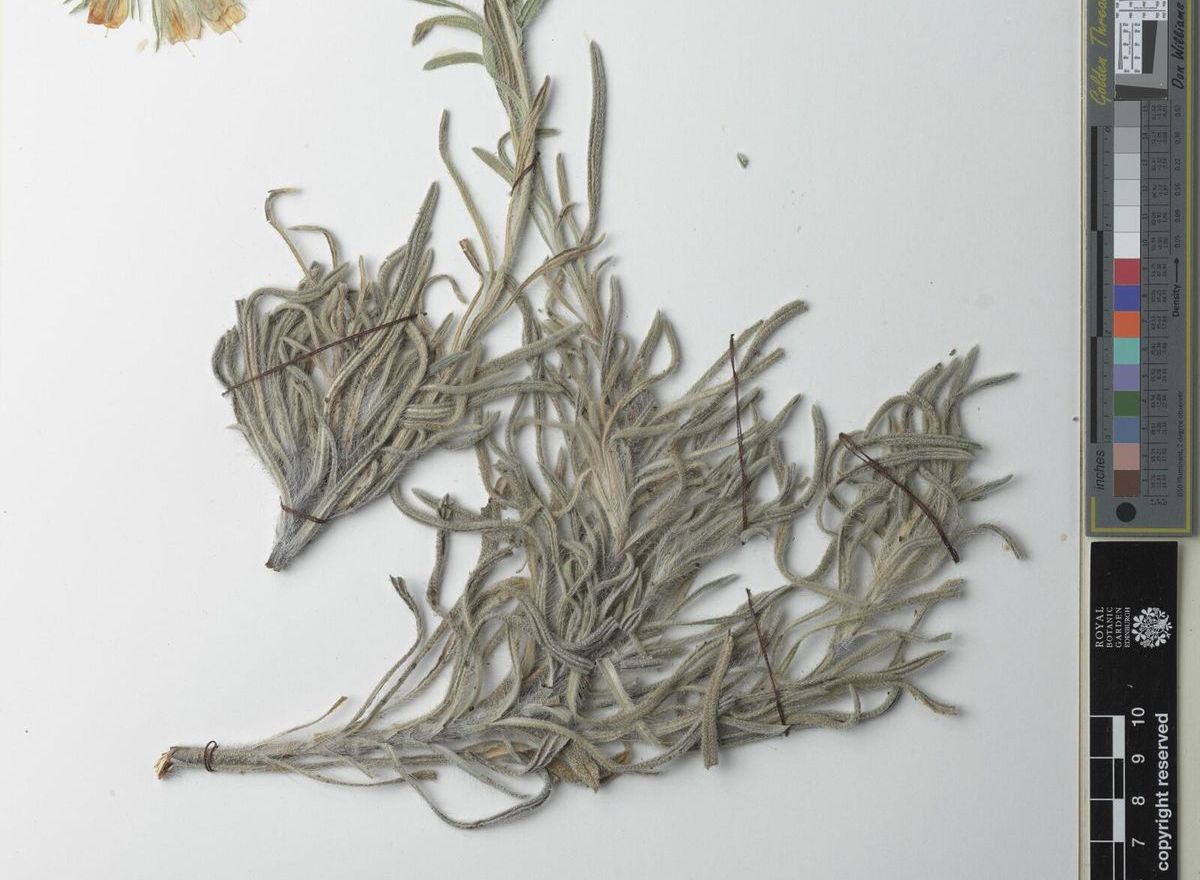
Onobrychis kurdica is a low, silvery perennial of the pea family, one of the sainfoins: a plant about 15 to 20 cm tall, pressed all over with silky grey hairs, with small pink flowers in June[1][2]. It is known from a single plant, gathered somewhere on the Kurd Mountain, in Kurdish Çiyayê Kurmênc, the highland range around Efrîn (Afrin) in Rojava that runs on across today's Turkish border; Post does not say where on the mountain[1]. Its name, kurdica, "Kurdish", comes from that mountain[1].
Very little else is known about it. The global biodiversity database GBIF holds not a single specimen or observation of it, there is none on iNaturalist, and we know of no photograph of the living plant[3]. It has never been assessed for the IUCN Red List[3].
"So small a collection, so many new forms"
The sainfoin was named by George Edward Post (1838–1909)[4], of the Syrian Protestant College in Beirut, who later wrote the Flora of Syria, Palestine and Sinai (1896)[2]. In 1891 plants were collected on the Kurd Mountain, in June and again in September, and in May 1892 Post published them as the fourth part of his Plantae Postianae, printed in Lausanne[1][4].
He opened it with a portrait of the mountain:
Le Kurd Dagh est une chaîne de montagnes situées entre le mont Amanus et le plateau d'Aintab en Asie Mineure ; sa hauteur moyenne est d'un millier de mètres au-dessus du niveau de la mer.
The Kurd Dagh is a chain of mountains lying between Mount Amanus and the plateau of Aintab in Asia Minor; its average height is about a thousand metres above sea level.[1] (our translation)
In Kurdish terms, that is the mountain country of Efrîn, between the Amanus or Nur mountains and the plateau of Dîlok (Aintab, now Gaziantep). Its flora, Post wrote, had "a fairly large number of species of its own", and "we were astonished that so small a collection should yield so many new forms"[1] (our translation).
The sainfoin is the first new species in the fascicle. On the pages that follow come a scabious, Scabiosa kurdica[1], a plant of the thistle tribe, Serratula kurdica (today Klasea kurdica)[1], and a skullcap, Scutellaria kurdica[1]. Together with a buckthorn from the same slopes that Boissier and Hohenacker had already named Rhamnus kurdica[1], that makes five plants called "Kurdish" in a few pages of one small booklet.
One plant in Beirut
Post's Latin description of the sainfoin fills half a page. Where it grew, and how much of it he had, takes three lines:
Habitat in monte Kurd Dagh Syriæ borealis : floret Junio. … Specimen unicum in Herbario Postiano apud Berythum Syriæ conservatum.
It grows on the mountain Kurd Dagh in northern Syria; it flowers in June. … A single specimen, kept in Post's herbarium at Beirut, Syria.[1] (our translation)
Unlike its neighbours on the page, which carry a month, a year and a collection number, the entry gives no date and no number[1]. Everything we know about the plant goes back to that one sheet, and GBIF lists no record of it today[3].
What it looks like
Post's description, and the shorter English version he added to his Flora four years later, give a clear picture[1][2]:
- a perennial about 15 to 20 cm tall, with nearly upright stems, the whole plant greyish with silky hairs that lie flat against it;
- papery stipules at the base of each leaf, joined together beyond their middle;
- leaves 8 to 12 cm long, with 4 to 9 pairs of leaflets; the leaflets are egg-shaped with the broad end outwards, about 7 mm long, silky on both sides, and end in a tiny point, or none, or a small notch;
- a hairy calyx whose teeth are as fine as awls and twice as long as its tube;
- a pink flower about 8 mm long, scarcely twice as long as the calyx, its wings longer than the calyx tube and without the small ear-like lobes at their base;
- a young pod pressed with silky hairs and set with long prickles.
The pod is what makes it a sainfoin. In this genus, Post explains, the pod does not break up into joints: it is flattened, leathery and roughly half-round, pitted on its face, with a crest along its margin that is often spiny[2]. The best-known member of the genus is the fodder plant Onobrychis viciifolia, which Post lists as O. sativa, the "Sainfoin", with pink, striped flowers, "cultivated and escaped from cultivation"[2].
A cousin from the desert
Post set his plant next to Onobrychis ptolemaica, and spelled out how the two differ: the Kurdish plant has a different coat of hairs, egg-shaped leaflets that are silky on both sides, and tiny pink flowers without stripes[1]. O. ptolemaica is in many ways its opposite. In Post's Flora it has yellow flowers almost twice the size, lined with rust-coloured veins, and it grows far to the south, from Gaza and the southern end of the Dead Sea to Sinai and Egypt, where it has an Arabic name, Khansar-el-'Arus[2]. In the Flora, Post placed the Kurdish sainfoin directly after it[2].
Where it grows
Kew's checklist records it only from Hatay, on the Turkish side of the border[5]. Post's own words point only to the Kurd Mountain, which he places in "northern Syria"[1] and, in his introduction, between the Amanus and the plateau of Aintab "in Asia Minor"[1]; his Flora lists no other place[2]. Because the mountain itself crosses the border, Kew's Turkish record need not contradict Post, but why Kew names Hatay is not known. The Flora of Turkey volume that might explain Kew's entry could not be read for this page, and we found no later record of the plant anywhere: no specimen, no field observation, no photograph[3].
What the sources do say about its home is short. Post gives the mountain an average height of about a thousand metres and calls its vegetation "more desert-like" than that of the Amanus nearer the sea[1]. The plant flowered in June[1][2]. Nothing is recorded about its soil, slope or companions.
The other "Kurdish" sainfoin
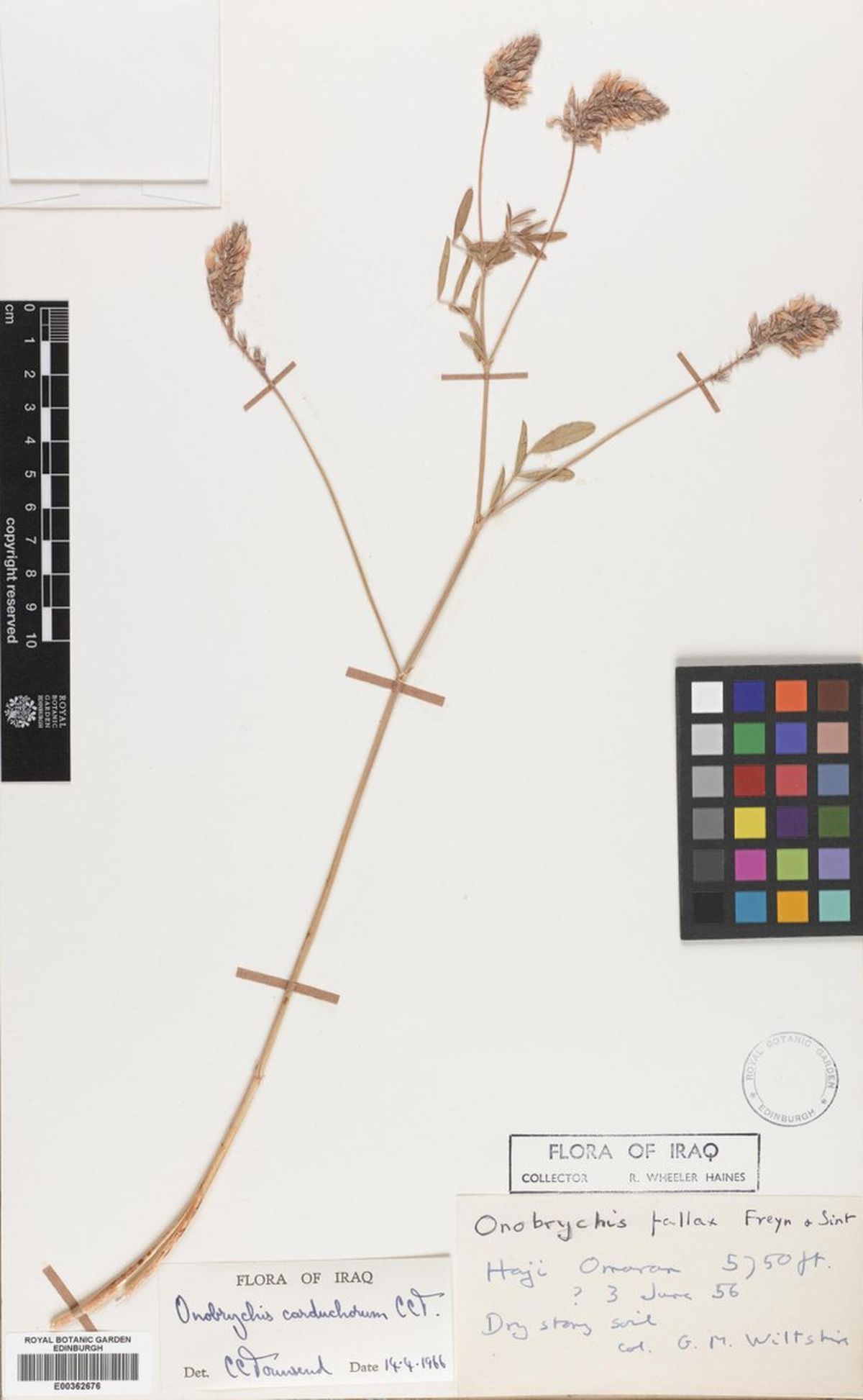
There is a second sainfoin named after the Kurds, and it is far better known. In 1968 the botanist Clifford Charles Townsend (1926–2018) described Onobrychis carduchorum[4]. Its epithet means "of the Carduchi", the mountain people of Xenophon's Anabasis.
Unlike Post's plant, O. carduchorum has been collected again and again across Kurdistan. Herbarium sheets filed under its name come from Colemêrg, between Bajirge and Gever (Yüksekova), from above Şirnex (Şırnak), from the slopes of Çiyayê Sîpan (Süphan Dağı) and from near Erxenî (Ergani) in Bakur; from Hacî Omeran, from the road to Zawîta near Duhok and from between Amêdî and Hashitha in Başûr; and from the road between Sine (Sanandaj) and Merîwan (Marivan) in Rojhilat[3].
Kurdish names
We found no Kurdish name for Onobrychis kurdica recorded in the field. Ehmedê Dirihî's dictionary of Kurdish plant names, Ferhenga Navên Nebatan a Kurdî (2013, Mardin Artuklu University), gives it qoringana kurde, without a source code: a dictionary name whose wording seems to mirror the Latin. On the same page it gives qoringeya kurdan for O. carduchorum[6].
Those names are built on the Kurdish word for sainfoins in general, which the dictionary records in several forms[6]:
- qorîngan for the cultivated sainfoin, O. viciifolia and O. sativa, from D. Izoli's Kurdish–Turkish dictionary; for O. viciifolia the dictionary also gives qoringe, with goringan, koringe, kevlok and kivlok listed alongside[6];
- qerîngan for a sainfoin, from the Kurdish Institute in Istanbul[6];
- qurînge for the genus, from Sadulla Husen Bamernî[6].
In Başûr, plant collectors for the Rustam Herbarium noted Kurdish names for other sainfoins in 1932: qara najuk at Ain Sifni, where it was noted as a fodder plant, and si dadan at Duhok, both for O. crista-galli; halawuk at Duhok for O. lanata; and haishtaruk at Akrê for a plant close to O. squarrosa[7].
Sources
- 1.Post, G.E. (1892). Plantae Postianae, fasc. 4. Lausanne.
- 2.Post, G.E. (1896). Flora of Syria, Palestine and Sinai. Beirut: Syrian Protestant College. biodiversitylibrary.orghttps://www.biodiversitylibrary.org/page/18086455
- 3.GBIF.org GBIF Backbone Taxonomy and occurrence records. gbif.orghttps://www.gbif.org/
- 4.International Plant Names Index. Royal Botanic Gardens, Kew, Harvard University Herbaria and Australian National Herbarium.
- abcOnobrychis kurdica Post; Onobrychis carduchorum C.C.Towns.; author records for Post and Townsend.
- urn:lsid:ipni.org:names:509995-1. ipni.orghttps://www.ipni.org/n/509995-1accessed 14 November 2026
- 5.Plants of the World Online. Royal Botanic Gardens, Kew.
- ↩Onobrychis kurdica Post.
- plant_name_id 2388834. powo.science.kew.orghttps://powo.science.kew.org/taxon/urn:lsid:ipni.org:names:509995-1accessed 14 November 2026
- 6.Ahmet Kasımoğlu (Ehmedê Dirihî) (2013). Ferhenga Navên Nebatan a Kurdî (Dictionary of Kurdish Plant Names). Mardin Artuklu University, Institute of Living Languages in Turkey (ISBN 978-605-4202-12-6).
- 7.↩Blakelock, R. A. (1948). The Rustam Herbarium, 'Iraq. Systematic List. Part I. Kew Bulletin 3(3): 404–405, p. 418.
Last updated 20 November 2026