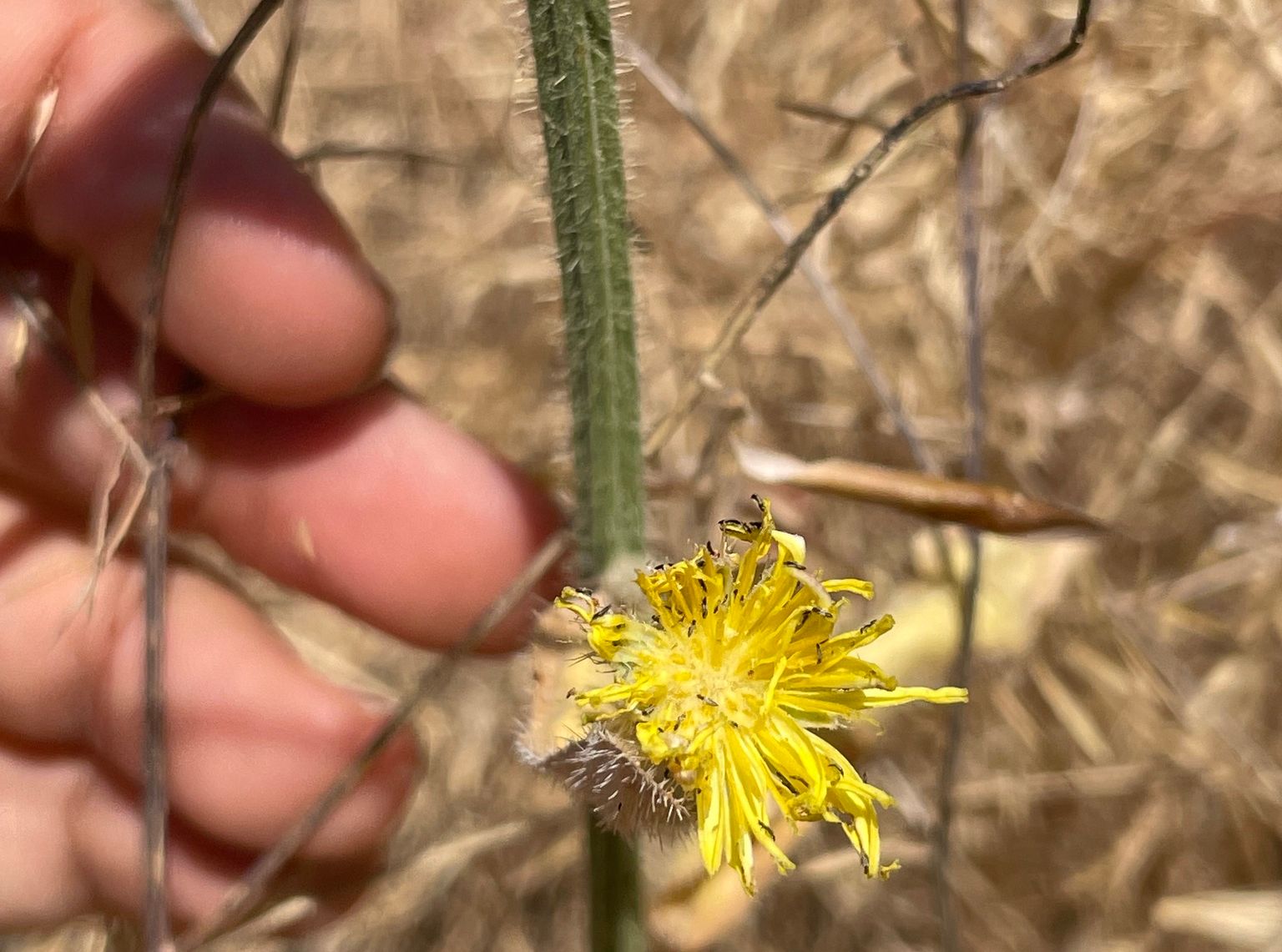
Picris strigosa is a wiry, much-branched member of the daisy family (Asteraceae), with small, dandelion-like yellow flower heads on long, thin stalks and stems rough with stiff, hooked bristles[1][2][3]. The species reaches from the Caucasus and the eastern Mediterranean to Iran and Turkmenistan[4]. Plants from the oak country of South Kurdistan (Başûr) were described as a subspecies, subsp. kurdica, "the Kurdish one", in 1977, from a plant collected in the valley between Rayat and Hecî Omeran[5][6].
How it got its name
- Named by
- M.Bieb., 1808Published in Fl. Taur.-Caucas. 2: 250
A plant from the Caspian shore
The species was first described in 1808 by Friedrich August Marschall von Bieberstein (1768–1826)[6], in his flora of the Crimea and the Caucasus. He found it on grassy hills at the eastern end of the Caucasus, towards the Caspian Sea, around a rock called Beshbarmak[1]:
Planta pedalis ramosissima divaricata strigosissima: pilis albidis furcatis.
A plant a foot tall, very much branched, spreading, very bristly, with whitish forked hairs.[1] (our translation)
Boissier later called it remarkable for its stiffly branched, sharply angled stems and "strigositate", its bristliness[2]. Its flowers, Bieberstein added, were half the size of those of the plant before it in his book, with pale florets[1].
Three collectors in Kurdistan
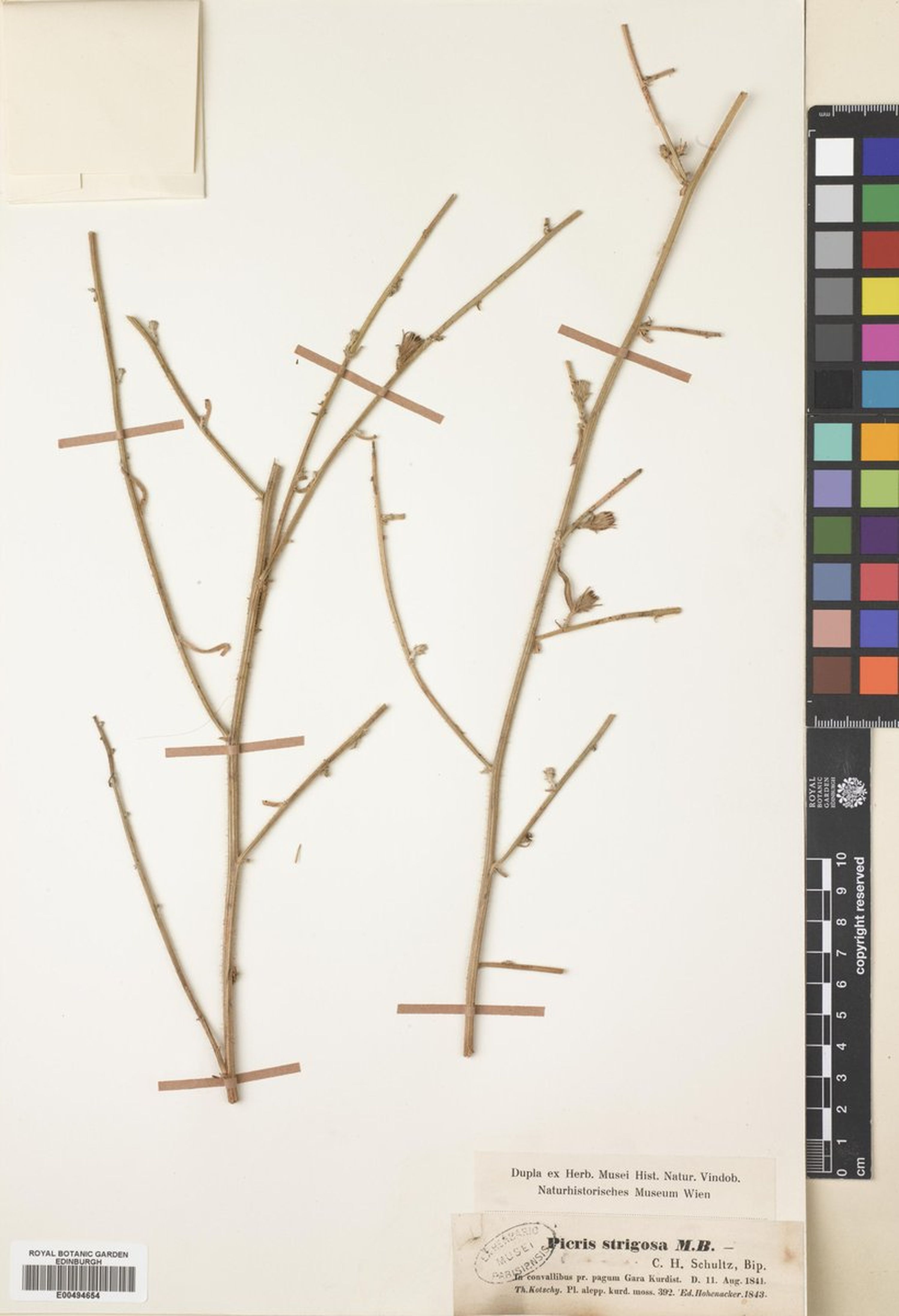
The plant soon turned up much further south. On 11 August 1841 the botanist Theodor Kotschy (1813–1866)[6] collected it "in the valleys near the village of Gara, Kurdistan"[7]. Eight days earlier, on 3 August, he had collected the Kurdish hollyhock, Alcea kurdica, in the high rocky parts of Mount Gara[8]. His plants were issued in numbered sets, "plants of Aleppo, Kurdistan and Mosul", edited by Hohenacker in 1843, and this one, number 392, is still kept in Edinburgh, Kew and Stockholm[7].
In July 1867 Heinrich Haussknecht (1838–1903)[6] found it on the rocks of Hewraman (Avroman) in East Kurdistan (Rojhilat), at about 5,000 feet[2][9]. Edmond Boissier listed both finds in his Flora Orientalis of 1875: "mons Gara Kurdistaniæ" and "mons Avroman Kurdistaniæ Persicæ"[2].
In 1888 Paul Sintenis (1847–1907)[6] collected it at Mêrdîn (Mardin) in North Kurdistan (Bakur), "in vineis", among the vineyards of a place his label spells Caballa. The printed label puts the place in "Kurdistania"[10].
The Kurdish subspecies
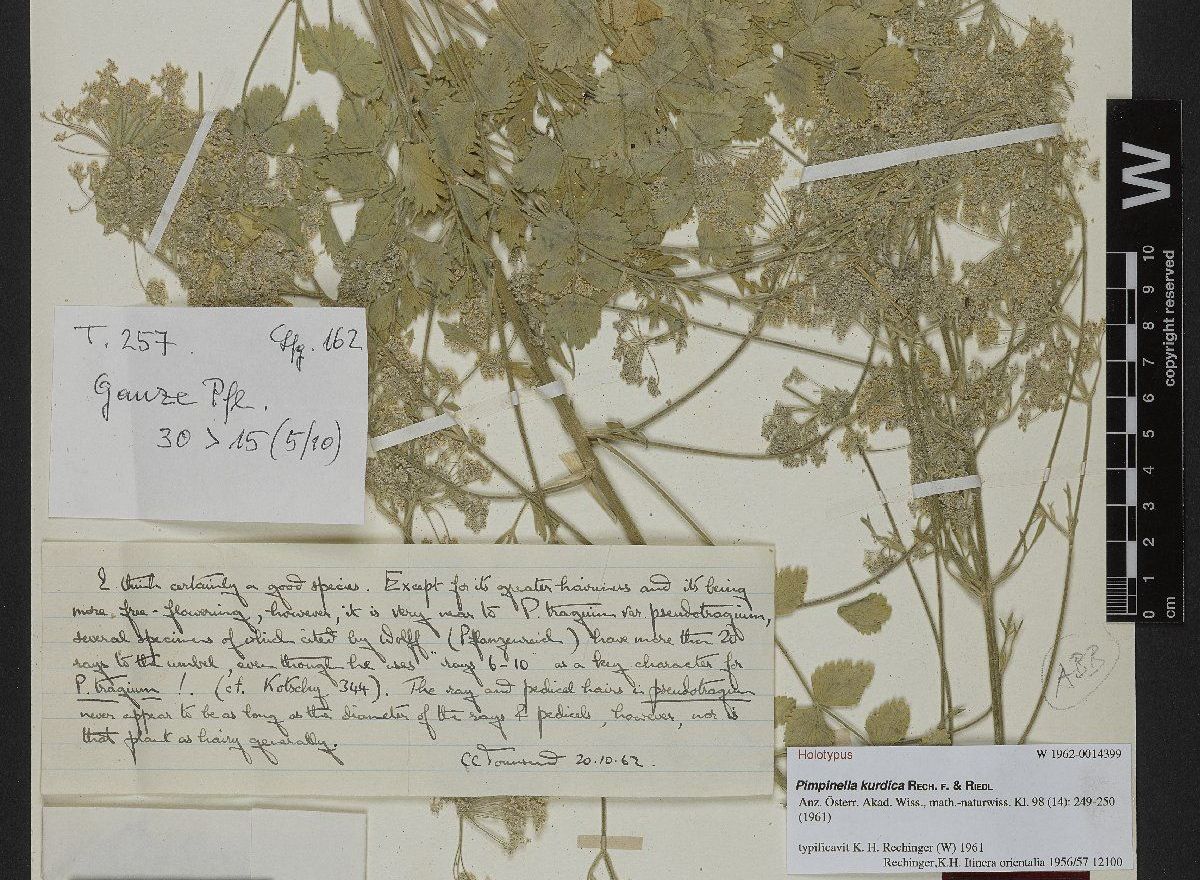
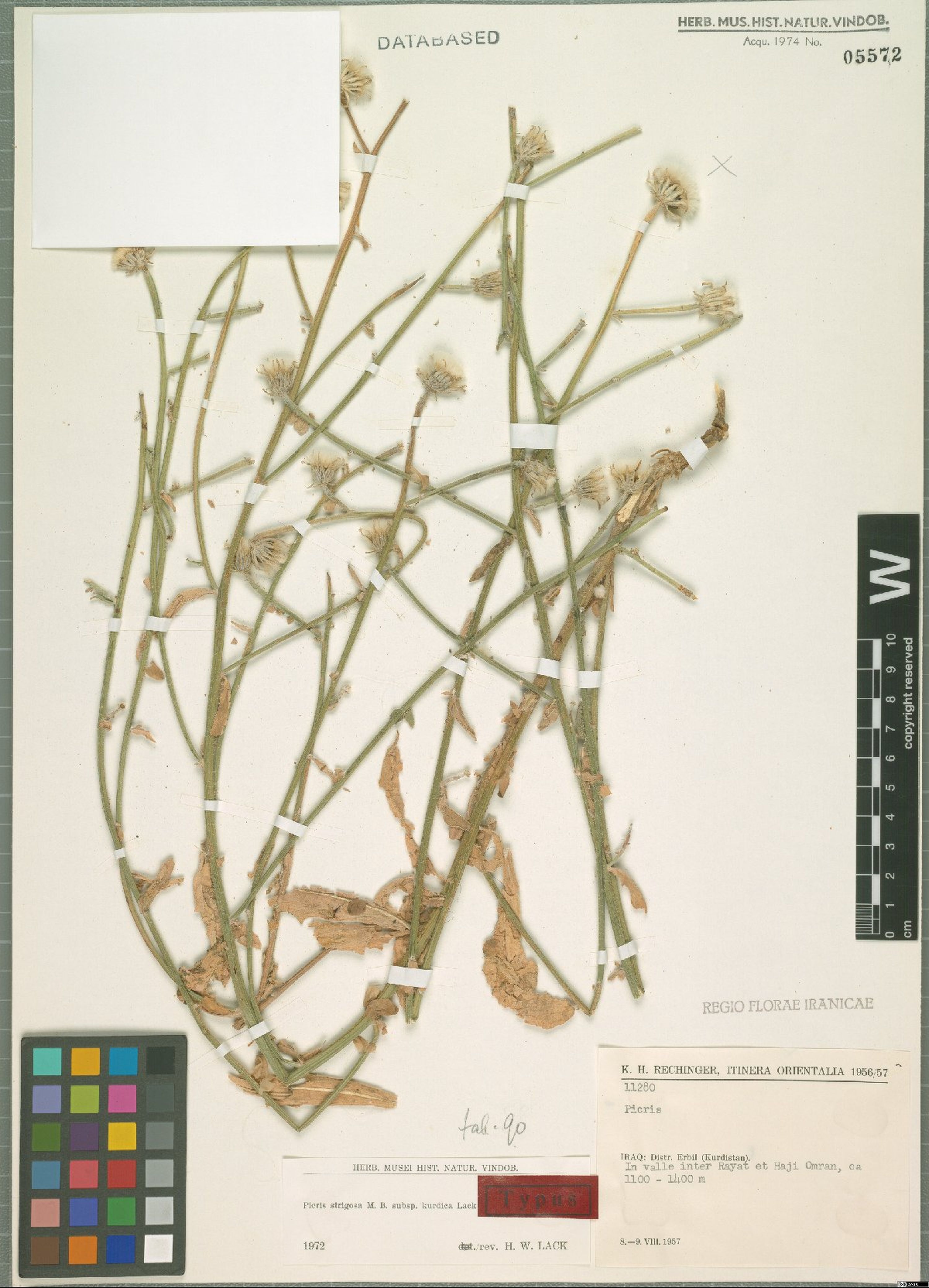
The botanist Karl Heinz Rechinger (1906–1998)[6] worked for a time at Baghdad University, where he laid the foundations of the university herbarium[11], and his labels from that stay read "Itinera Orientalia 1956/57"[5]. On 8–9 August 1957 he collected this Picris "in the valley between Rayat and Haji Omran", in the Hewlêr (Erbil) district, at about 1,100 to 1,400 m[5]. Hecî Omeran (Haji Omaran) is the Kurdish form of the second name.
Rechinger was the editor of Flora Iranica, a flora of Iran and its neighbours that also covers northern Iraq[11]. One of his few doctoral students, H. Walter Lack (born 1949)[6][11], took on the genus Picris for it. In 1972 he annotated sheets of this plant now kept in Vienna, Kew and Meise[5][10][12][12]. On Sintenis's Mardin sheet he first called the plant a variety, "var. kurdica Lack" (23 August 1972)[10]. When the Flora Iranica account came out in 1977, it was a subspecies, Picris strigosa subsp. kurdica Lack, with Rechinger's plant from the Rayat valley as its type[5][6]. In the same account Lack also named a second subspecies, subsp. macrotricha[6].
What to look for
Boissier's description still fits the plants in the field[2]:
- one to two feet tall, the stems rod-like, sharply angled and grooved, stiffly and densely branched from the base, and rough with bristles;
- the lower leaves oblong to lance-shaped, cut back into teeth, and soon withering; the upper leaves narrow, stalkless and bent downwards;
- small flower heads at the ends of long, slender stalks that do not thicken under the head;
- the bracts around the head grey with pressed-down hairs, with a single row of bristles along the back, the outer ones three times shorter than the inner and loose;
- fruits elliptic and strongly wrinkled across, each with a feathery parachute (pappus) that falls off.
A 2026 revision by Nawroz Salam Aman and Rubar Hussein Muhammed-Salih of Koya University and the University of Sulaimani measured plants from Başûr[3]: stems 37 to 67 cm long, flower heads about 1 cm across with bright yellow florets that stand out beyond the bracts, and hairs that end in two to four tiny hooks. All the fruits on a head are of one kind[3].
The best field mark is at the foot of the plant. In 1957 the botanist R. Wheeler Haines (1906–1994)[6] collected it at Sersing (Sersang), and on his label he corrected the books: "Perennial, not 'biennial'. Last year's flowering stems can still be recognised"[12]. The 2026 revision makes the same point: the collar of old stem bases from the year before, still there at flowering time, tells P. strigosa apart from the annual P. kotschyi, the other Picris of the region[3].
Where it grows
These are records of the species as a whole: most herbarium sheets from Başûr are named only to species, and so is the 2026 revision. In Başûr, sheets record it from Mount Gara and Sersing in the north, through Hecî Omeran, Rayat, Rewandiz and the foot of the Qendîl range near Ranya, down to Qeredax, Tawêle and Hewraman in the south-east[7][12][12][3]. In 2022 Nawroz Salam found it on Helgurd at 1,871 m, a new record for the mountain[3].
It is a plant of the oak belt. Collectors' labels describe "dry oak forest" at 4,500 feet at Sersing[12], "open rocky hillside with remains of oak" at Qeredax[12], oak forest on a south-facing slope near Pishtashan, below Qendîl[12], and the "upper edge of oaks" between Hecî Omeran and Rayat[12]. The recorded heights run from about 980 to 1,871 m in Başûr[3], and from 1,100 to 1,400 m for the type[5]. Boissier's general word for its places was "dry and rocky"[2].
Only a few sheets are named to subspecies. In Başûr, three are filed under subsp. kurdica: the type from the Rayat valley[5], Sersing[12] and a hillside in the Silêmanî district[12], while one from Qeredax is filed under subsp. macrotricha[12]. Outside Başûr, sheets filed under subsp. kurdica come from Mêrdîn and Birecik in Bakur[10][13], and from Luristan, Isfahan and Azerbaijan in Iran[13]. The Flora Iranica text that sets out the exact range of each subspecies is in print only, and we could not read it[6].
When it flowers
Bieberstein gave June and July for the Caucasus[1]. In Başûr it flowers from mid-June, and fruits in August and into September[3]; the herbarium sheets were collected between June and late September[5][12][12].
Is it rare?
The 2026 revision found it only twice in its own fieldwork, at Hecî Omeran and on Helgurd, and assessed it as Critically Endangered in Iraq, citing farming, pesticides, building, climate change and overgrazing[3]. The same paper also calls it "a common species in the region"[3], and the older herbarium sheets record it from many places in the oak country of Başûr[12]. It has not been assessed for the global IUCN Red List[14].
Kurdish names
Ehmedê Dirihî's dictionary of Kurdish plant names gives şîro for the genus Picris[15]. On the same page şîro is also given for dandelions (Taraxacum), for Lactuca scarioloides, Senecio racemosus, Calendula arvensis and several other plants, so it is a name for a whole group rather than for one species[15].
For this plant the dictionary lists şîroyê kurdan, "the Kurds' şîro" (our translation), with no region or informant[15]: a dictionary name that mirrors the scientific name, not one recorded from speakers. The 2026 revision gives the same name, spelled Şîroye Kurdan, as the plant's Kurdish name[3].
Sources
- 1.abcdeMarschall von Bieberstein, F. A. (1808). Flora Taurico-Caucasica. 1: 34.
- 2.Boissier, E. (1875). Flora Orientalis, vol. 3. Geneva & Basel.
- 3.Aman, N. S. & Muhammed-Salih, R. H. (2026). Systematic revision of Picris L. (Asteraceae-Cichorieae) distributed in the Rawanduz (MRO) district of Kurdistan Region-Iraq. Iraqi Journal of Agricultural Sciences 57(1): 19–34. doi:10.36103/zqvv1y66https://doi.org/10.36103/zqvv1y66
- 4.Plants of the World Online. Royal Botanic Gardens, Kew.
- ↩Picris strigosa.
- plant_name_id 3072400. powo.science.kew.orghttps://powo.science.kew.org/taxon/urn:lsid:ipni.org:names:237938-1accessed 14 November 2026
- 5.abcdefghNatural History Museum Vienna (W) – Herbarium. via GBIF, herbarium specimen W 1974-0005572 (Rechinger 11280, type of subsp. kurdica), via GBIF.
- 6.International Plant Names Index. Royal Botanic Gardens, Kew, Harvard University Herbaria and Australian National Herbarium.
- ahikPicris strigosa M.Bieb.; subsp. kurdica Lack and subsp. macrotricha Lack, Flora Iranica 122: 131–132 (1977).
- bcdefgjauthor records for Lack, Rechinger, R. W. Haines, Sintenis, Marschall von Bieberstein, Schultz Bipontinus, Stapf, Kotschy and Haussknecht.
- urn:lsid:ipni.org:names:237938-1. ipni.orghttps://www.ipni.org/n/237938-1accessed 14 November 2026
- 7.abcRoyal Botanic Garden Edinburgh Herbarium (E), specimen catalogue (via data.rbge.org.uk and GBIF). herbarium specimen E00494654 (Kotschy 392), and duplicates at Kew and Stockholm, via GBIF. data.rbge.org.ukhttps://data.rbge.org.uk/herb/
- 8.↩Alefeld, F. (1862). Ueber die Malveen. Oesterreichische Botanische Zeitschrift 12: 246–261.
- 9.↩Herbarium Haussknecht, Jena (JE), specimen records (JACQ) via GBIF. Jena, herbarium specimen JE00028622 (Haussknecht 604), via GBIF. api.gbif.orghttps://api.gbif.org/v1/occurrence/3028980654
- 10.abcdMeise Botanic Garden, herbarium specimen BR0000022861689 (Sintenis 1248), via GBIF.
- 11.Lack, H. W. (1987). Karl Heinz Rechinger: a grand old man in botany. Plant Systematics and Evolution 155: 7–14.
- 12.Royal Botanic Gardens, Kew – Herbarium Specimens. via GBIF. gbif.orghttps://www.gbif.org/dataset/cd6e21c8-9e8a-493a-8a76-fbf7862069e5
- 13.abHerbarium specimens filed as Picris strigosa subsp. kurdica from Iran (W, K, MICH), via GBIF.
- 14.↩IUCN Red List status via GBIF: Picris strigosa, not evaluated.
- 15.Ahmet Kasımoğlu (Ehmedê Dirihî) (2013). Ferhenga Navên Nebatan a Kurdî (Dictionary of Kurdish Plant Names). Mardin Artuklu University, Institute of Living Languages in Turkey (ISBN 978-605-4202-12-6).
Last updated 20 November 2026