How it got its name
- Named by
- Rech.f. & Riedl, 1961Published in Anz. Österr. Akad. Wiss., Math.-Naturwiss. Kl. 98: 249
A grey umbellifer from the rocks above Zaxo
Pimpinella kurdica is a greyish, hairy plant of the carrot family (Apiaceae), with many small umbrellas of tiny white flowers. It belongs to Pimpinella, a genus of some 150 species[1], whose best-known member is anise, P. anisum. It grows in the cracks of limestone cliffs, and it is known from only two places, one on each side of the border between South Kurdistan (Başûr) and North Kurdistan (Bakur)[1][2].
Found on Jabal Khantur
In early July 1957 the botanist Karl Heinz Rechinger (1906–1998)[3], on the expedition his labels call Itinera orientalia 1956/57, was collecting in the limestone mountains north of Zaxo (Zakho) in Behdînan. On Jabal Khantur, near the village of Sharanish, he pressed an umbellifer growing in rock crevices at 1,200 m and gave it the number 12100[4]. His printed label reads:
IRAQ: Distr. Mosul (Kurdistan). Ad confines Turciae prov. Hakari, in ditione pagi Sharanish, in montibus calc. a Zakho septentrionem versus. … Jabal Khantur, in rupium fissuris, 1200 m.
Iraq: Mosul district (Kurdistan). On the border of the Turkish province of Hakkari, in the area of the village of Sharanish, in the limestone mountains north of Zakho. Jabal Khantur, in rock crevices, 1,200 m.[4] (our translation)
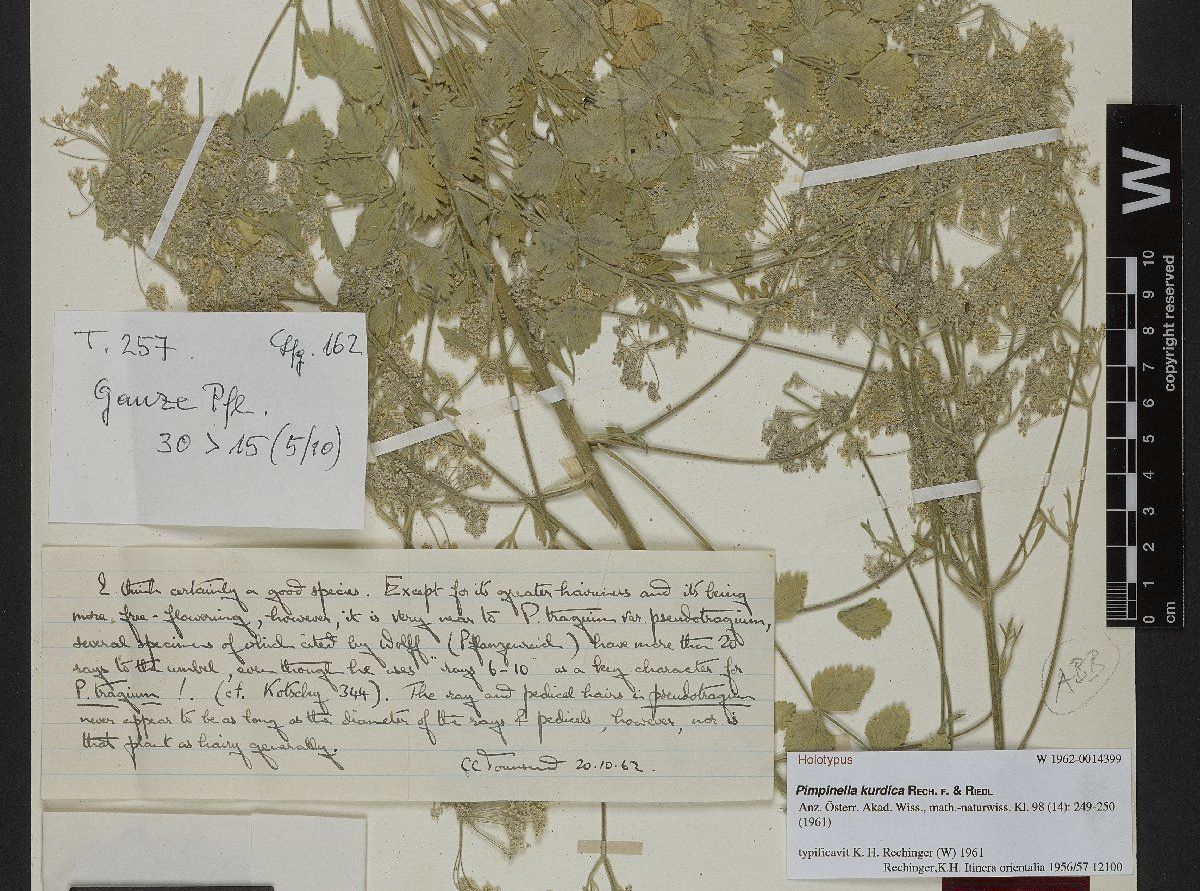
The province the label means is Colemêrg (Hakkâri), just across the border in Bakur. Rechinger and Harald Riedl (born 1936)[3] described it as a new species in 1961, in a short paper on "new and noteworthy umbellifers from Iraq and Iran" (our translation) in the Anzeiger of the Austrian Academy of Sciences, and named it Pimpinella kurdica, "the Kurdish Pimpinella"[4][3][5]. Their type citation begins "Iraq: Kurdistan" and dates the gathering to 4–9 July 1957[5]. The same few pages named three more new umbellifers from that summer's travels, among them Cachrys nematoloba from the Hewraman mountains on the border and Ferulago phialocarpa from west of Seqiz (Saqqez) in Rojhilat[5]. The sheet is still kept at the Natural History Museum in Vienna as the holotype, the specimen the name is tied to[4].
Jabal Khantur was a rich mountain for Rechinger. It also gave him a second new Pimpinella, the yellow-flowered P. nephrophylla, published in the same volume[1], and the area around Sharanish appears again on the pages for Carthamus curdicus and Carlina kurdica.
A second opinion from Kew
In October 1962 the sheet was looked at by botanists of the Royal Botanic Gardens, Kew: a stamp records a Kew photograph of it ("Kew Negative No. 5792"), and Clifford Charles Townsend (1926–2018)[3], who later wrote the account of the carrot family for the Flora of Iraq[1], added a handwritten note, dated 20 October 1962[4]:
I think certainly a good species. Except for its greater hairiness and its being more free-flowering, however, it is very near to P. tragium var. pseudotragium … The ray and pedicel hairs in pseudotragium never appear to be as long as the diameter of the rays & pedicels, however, nor is that plant as hairy generally.[4]
That one detail, hairs longer than the stalks they grow on are thick, is still how the Flora of Iraq tells P. kurdica apart from its relatives[1].
Townsend's comparison was not the one the authors had made. Rechinger and Riedl had set their plant beside P. aromatica, from which it differs in its much more robust build, its upper branches in whorls, its soft leaflets and its more numerous umbel rays, and beside P. ramulosa, from which it differs in its whorled upper branches, the very short side shoots on some branches, its longer, thinner and more numerous umbel rays and its missing involucels[5].
What to look for
From the first description of 1961[5], the Flora of Iraq[1] and Mehmet Fırat's fuller description of 2019[2]:
- a biennial or perennial with a woody rootstock, 30–65 cm tall, branched from near the base, the upper branches opposite or in whorls[1][2]. Rechinger and Riedl thought it a rock plant that probably flowers only once and then dies (verosimiliter monocarpica, "probably monocarpic")[5];
- the whole plant ash-grey with short, spreading white hairs, thickest in the flowering part;
- many long-stalked basal leaves in a rosette, 12–29 cm long, the stalk broadened at the base and about as long as the blade, simply pinnate with usually four pairs of stalkless, egg-shaped, round-toothed leaflets, the end leaflet sometimes deeply cut into three; the stem leaves get small quickly, and those under the flowering branches are cut into three or five narrow lobes[1][2][5];
- many umbels, each with 12–21 rays, 1–3 cm long; no bracts, or at most a single narrow one[1][2];
- the rays and flower stalks densely covered in spreading hairs longer than the stalks are thick;
- about 15 tiny white flowers in each small umbel, about 2 mm across, the petals hairy along the midrib on the back;
- fruit oblong to broadly elliptic, 1.6–2 mm long, dark brown and downy, with fine pale-brown ribs[2].
Half a century without a fruit
Rechinger's plant was in flower. The first description said Fructus ignotus, "fruit unknown"[5], and the Flora of Iraq, published in 2013, still had to say "Fruit not seen"[1]. It also called the species "very rare; only found once"[1].
The fruit came from the other side of the border. In the Zap valley in Colemêrg (Hakkâri), the upper course of the Great Zab, the botanist Mehmet Fırat of Van Yüzüncü Yıl University found it on rocky cliffs at 1,215 m. He collected it on 15 July 2014 and again, in fruit, on 20 August 2015[2]. In 2019 he published it as new to the flora of Turkey, gave it a fuller description, and measured its fruit "for the first time"[2]. His map shows the two known places: the Zap valley in Bakur, and Jabal Khantur in what he calls the "Kurdistan region of Iraq"[2].
On the cliffs of the Zap it grows with other rock plants of the region, among them two bellflowers (Campanula radula and C. acutiloba), Gypsophila baytopiorum, Clinopodium hakkaricum and a saxifrage[2].
Where it grows
Kew's checklist still gives its native range as northern Iraq only[6]; the record from Colemêrg came later[2]. So far it is known from:
- Başûr: Jabal Khantur near Sharanish, north of Zaxo, in rock crevices on limestone at 1,200 m, the type locality[1][4];
- Bakur: the Zap valley in Colemêrg, on rocky cliffs at 1,215 m[2].
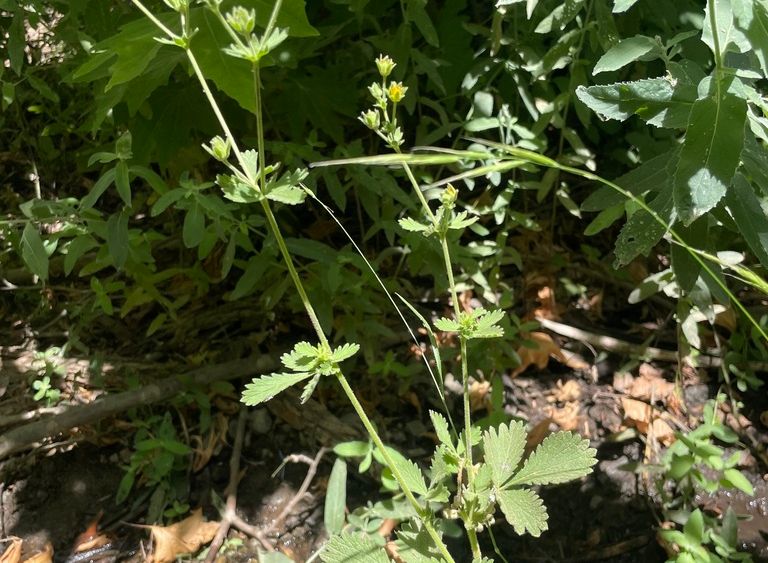
Both are cliff sites in the mountains along the border. It flowers in July[2][4] and was carrying fruit by late August[2]. No photograph of a living plant has been published that we could find; if you see it on the rocks of Behdînan or Colemêrg, it is waiting to be photographed.
Kurdish names
Mehmet Fırat writes that in Colemêrg (Hakkâri) local people call the plant Meyane[2]. It is the only name for this species we have found.
For the genus Pimpinella as a whole, Ehmedê Dirihî's dictionary of Kurdish plant names gives catirî kêfî and enîson (also anîson)[7]. These are names for the genus, still to be checked, not names for this species. Its famous relative anise is Razyane to herbalists in the Silêmanî (Sulaymaniyah) region[8], printed RAZYANA in the Flora of Iraq[1].
Sources
- 1.Townsend, C. C. (2013). Apiaceae (Umbelliferae), updated by J. R. Edmondson. In: Ghazanfar, S. A. & Edmondson, J. R. (eds), Flora of Iraq 5(2): 108–283. Ministry of Agriculture, Baghdad & Royal Botanic Gardens, Kew.
- 2.Fırat, M. (2019). Pimpinella kurdica (Apiaceae), a new record for the flora of Turkey. Iranian Journal of Botany 25(2): 123–126. doi:10.22092/ijb.2019.127386.1252https://doi.org/10.22092/ijb.2019.127386.1252
- acdehiklmn
- bpp. 123–124.
- fgjop. 124.
- Iran. J. Bot. 25(2): 124. ijb.areeo.ac.irhttps://ijb.areeo.ac.ir/article_120691_5db5d1d03bdc2f4b0207c09d313aaf78.pdf?lang=faaccessed 14 November 2026
- p. 124. ijb.areeo.ac.irhttps://ijb.areeo.ac.ir/article_120691_5db5d1d03bdc2f4b0207c09d313aaf78.pdf?lang=faaccessed 14 November 2026
- 3.International Plant Names Index. Royal Botanic Gardens, Kew, Harvard University Herbaria and Australian National Herbarium.
- abcdPimpinella kurdica Rech.f. & Riedl, Anz. Österr. Akad. Wiss., Math.-Naturwiss. Kl. 98: 249 (1961), and author records for Rechinger, Riedl and Townsend.
- urn:lsid:ipni.org:names:846870-1. ipni.orghttps://www.ipni.org/n/846870-1accessed 14 November 2026
- 4.abcdefghNatural History Museum Vienna (W) – Herbarium. via GBIF, herbarium specimen W 1962-0014399, holotype of Pimpinella kurdica (K. H. Rechinger 12100), via GBIF.
- 5.Rechinger, K. H. & Riedl, H. (1961). Notizen zur Orient-Flora, 25.–28. Neue und bemerkenswerte Umbelliferen aus Iraq und Iran, II. Anzeiger der Österreichischen Akademie der Wissenschaften, Mathematisch-naturwissenschaftliche Klasse 98: 248–251.
- 6.Plants of the World Online. Royal Botanic Gardens, Kew.
- ↩Pimpinella kurdica.
- plant_name_id 2403030. powo.science.kew.orghttps://powo.science.kew.org/taxon/urn:lsid:ipni.org:names:846870-1accessed 14 November 2026
- 7.↩Ahmet Kasımoğlu (Ehmedê Dirihî) (2013). Ferhenga Navên Nebatan a Kurdî (Dictionary of Kurdish Plant Names). Mardin Artuklu University, Institute of Living Languages in Turkey (ISBN 978-605-4202-12-6), pp. 142, 224.
- 8.↩Hiwa M. Ahmed (2016). Ethnopharmacobotanical study on the medicinal plants used by herbalists in Sulaymaniyah Province, Kurdistan, Iraq. doi:10.1186/s13002-016-0081-3https://doi.org/10.1186/s13002-016-0081-3
- GBIF.org GBIF Backbone Taxonomy and occurrence records.
- occurrence 1231054430 (W 1962-0014399, Holotype). api.gbif.orghttps://api.gbif.org/v1/occurrence/1231054430accessed 14 November 2026
- occurrence 1231054430. api.gbif.orghttps://api.gbif.org/v1/occurrence/1231054430accessed 14 November 2026
Last updated 20 November 2026