How it got its name
- Named by
- Vatke, 1874Published in Linnaea 38: 734
A pink scabious of the Kurdish limestone
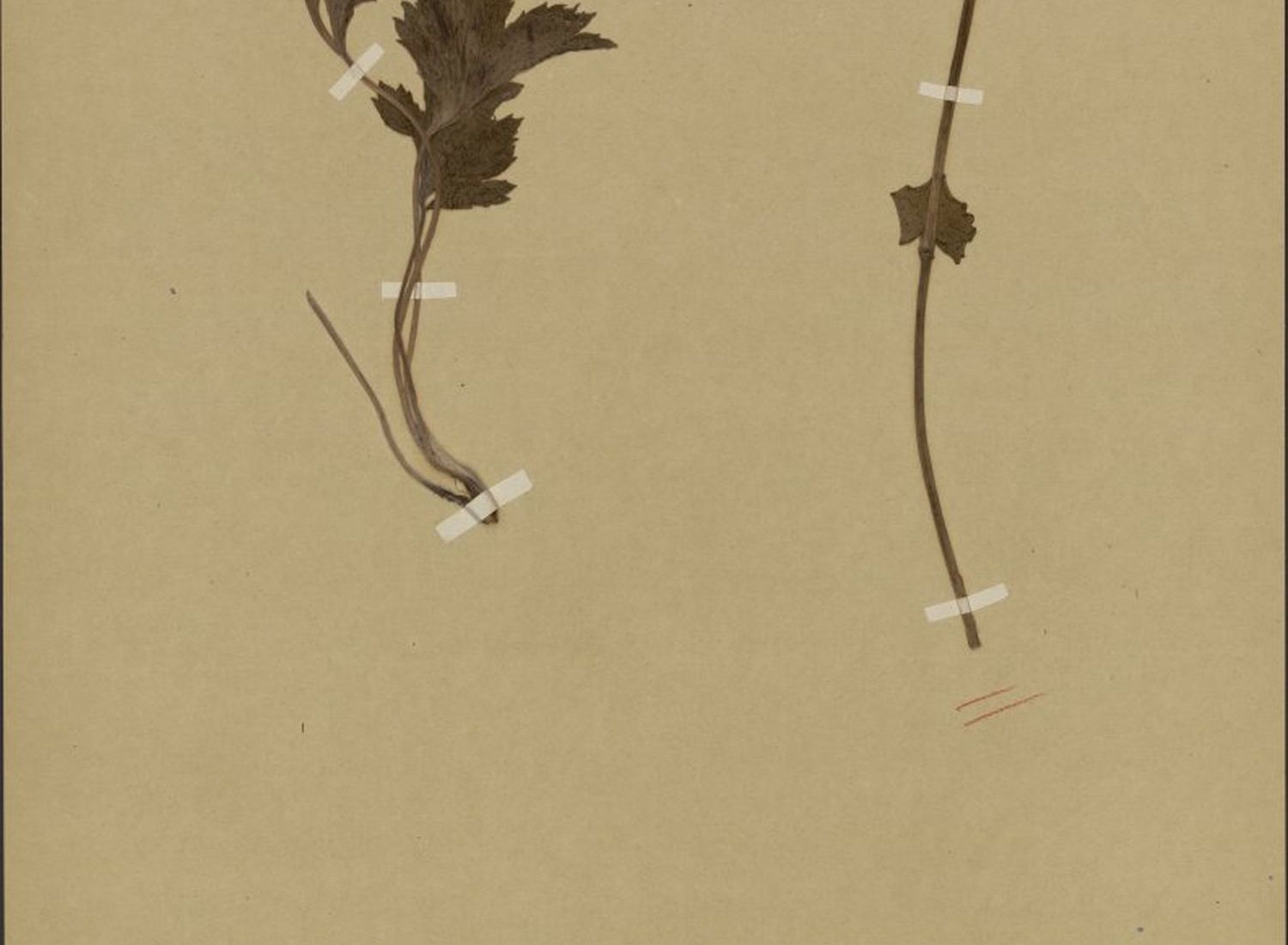
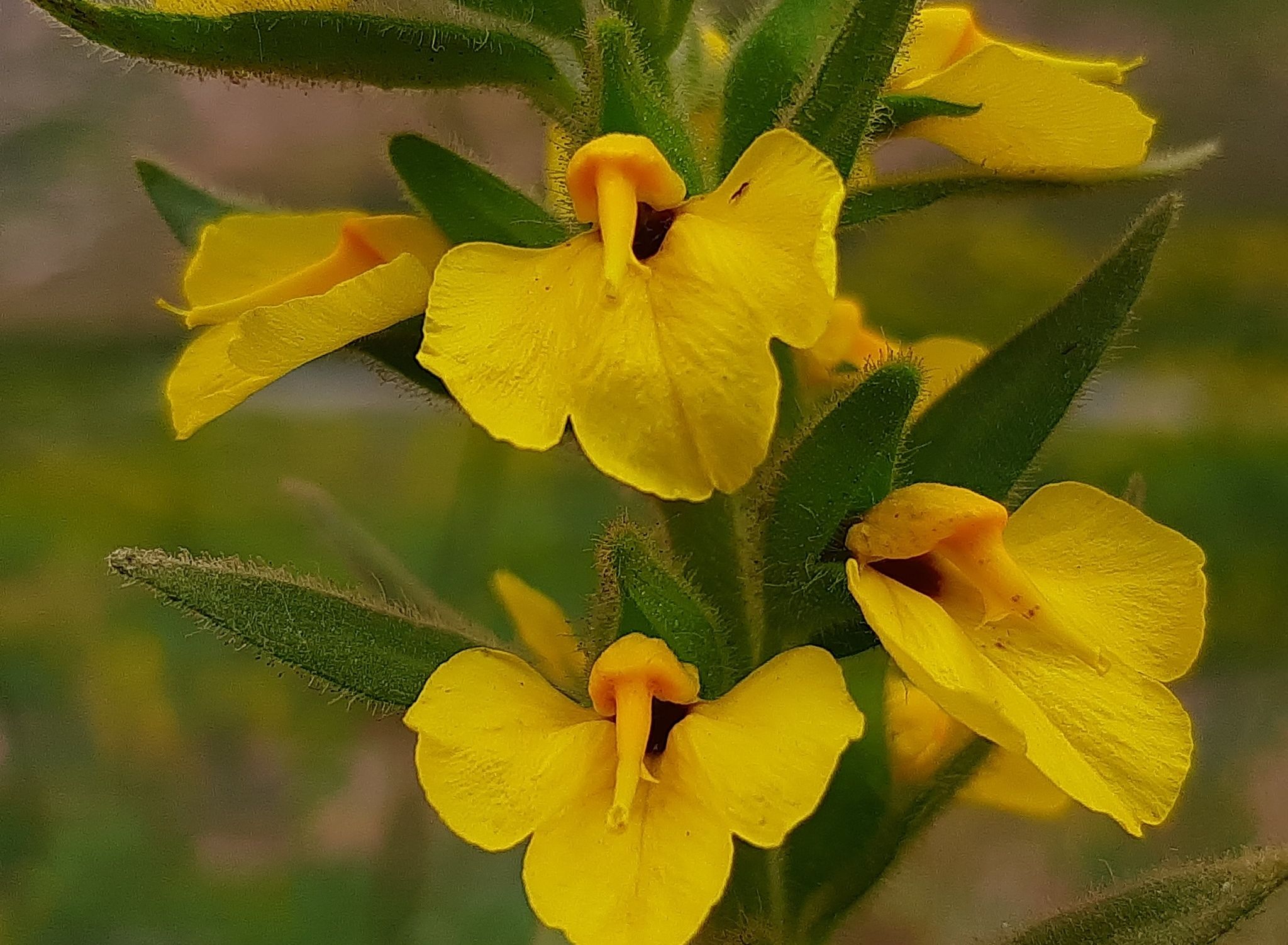
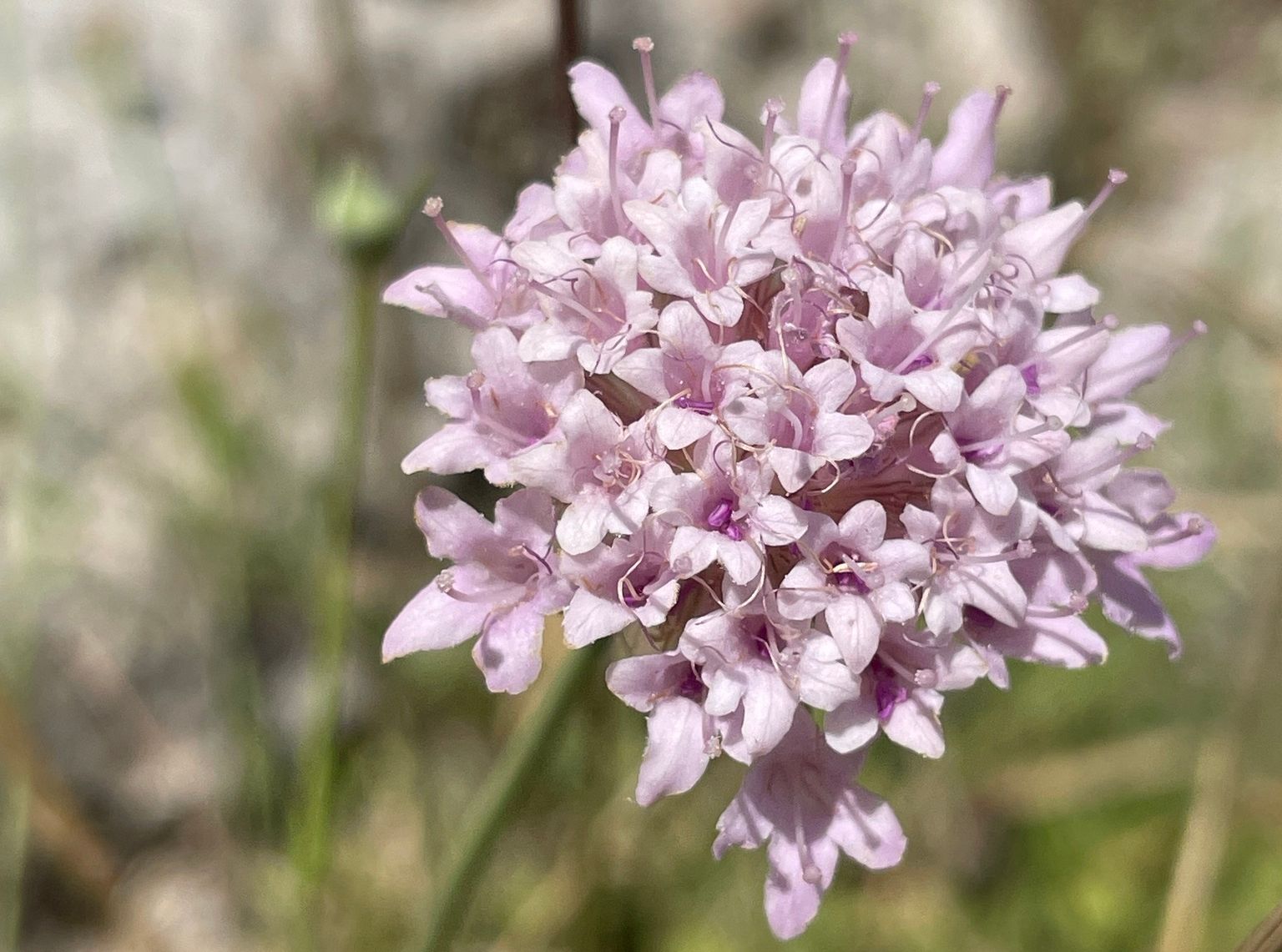
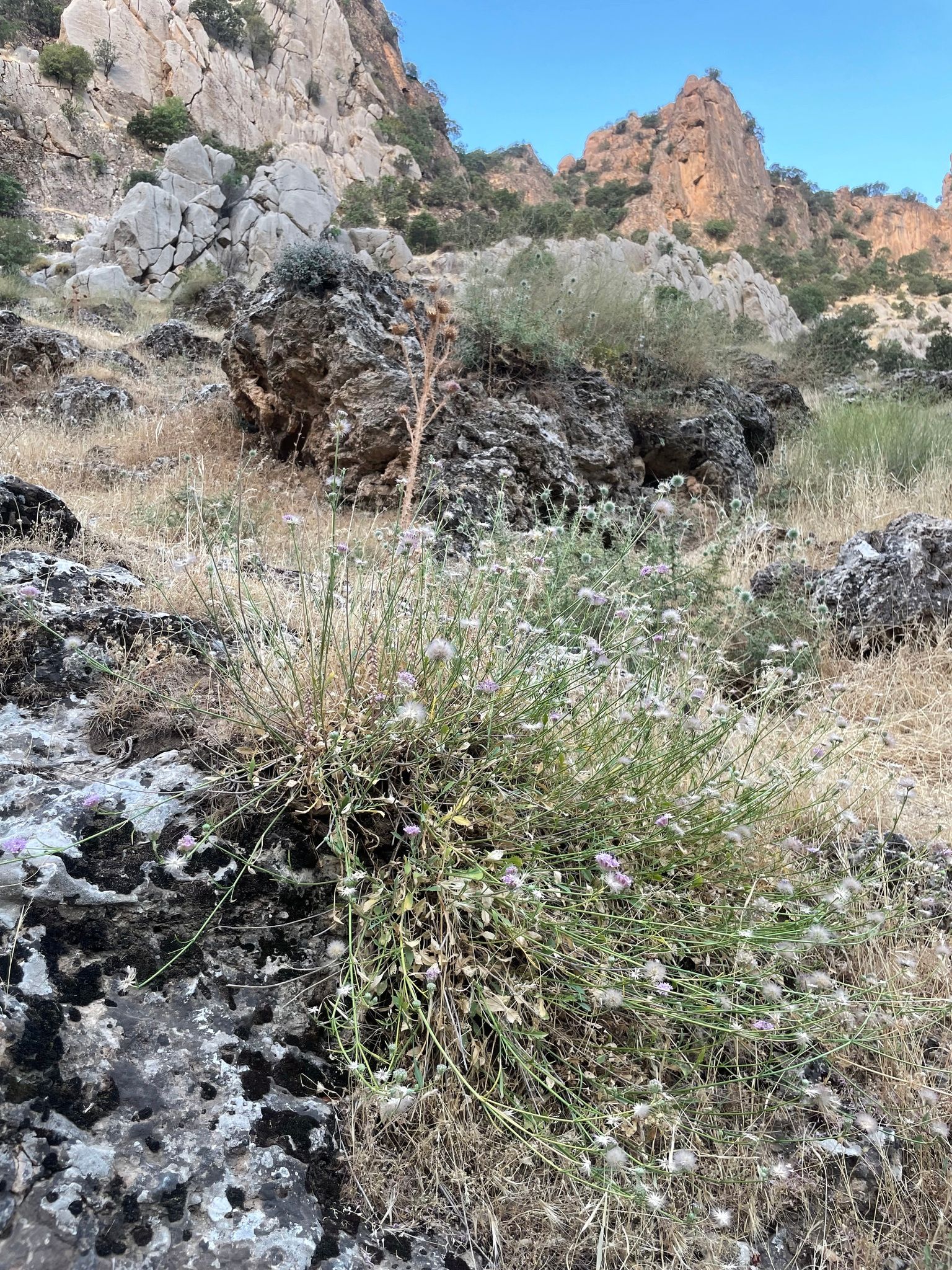
Pterocephalus kurdicus is a small, woody-based perennial of rocks and cliffs, a relative of the scabiouses. From a gnarled base it sends up long, thin, stiff stems, each ending in a rounded head of pink or lilac flowers[1][2][3]. When the flowers are over, every head turns into a ball of feathery bristles: Pterocephalus means "feather-head", from the Greek for feather and head[3].
Its name means "Kurdish", and it has earned it. All three of the botanists who first gathered it did so in Kurdistan, and the man who named it opened his list of where it grows with the words In Kurdistania, "in Kurdistan"[1][4]. Kew's checklist gives its native range as south-eastern Turkey to western Iran[5]. In Kurdish terms that is a plant of Bakur, Başûr and Rojhilat, whose range runs on south down the Zagros[5][6].
Three collectors in the mountains
The first of them was a collector named Brandt, who brought a specimen from Kurdistan in 1839; the record gives nothing more[1].
The second was the traveller and botanist Theodor Kotschy. On 24 September 1859, on a journey he called his Iter cilicico-kurdicum, he gathered it at 7,000 feet (over 2,100 m), at an alpine inn called Chana Putkie in the district of Müküs, the area of today's Bahçesaray south of Lake Wan in Bakur[7]. The printed labels of that journey describe the whole collection as Plantae ex montibus calcariis Karduchiae, "plants from the limestone mountains of Karduchia", an old learned name for the Kurdish mountains, after the Carduchi of ancient writers[7]. Kotschy called the plant Pterocephalus Putkianus, after the inn, and sent it out under that name as number 477[7].
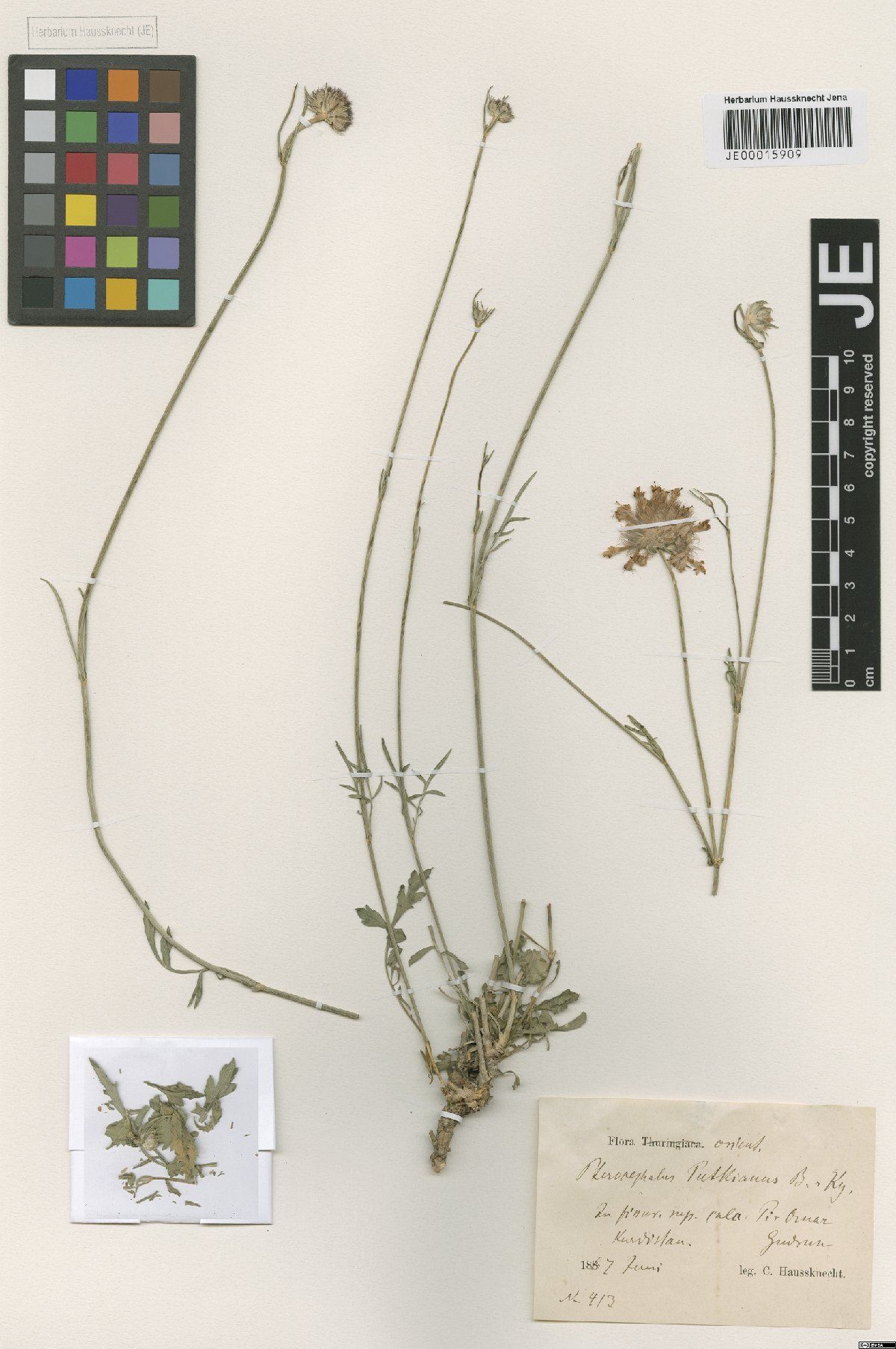
The third was Carl Haussknecht, the plant collector from Thuringia. In June 1867 he found it in the clefts of limestone rocks on Pîremegrûn (Pira Magrun), the mountain north-west of Silêmanî (Sulaymaniyah), and in July on the limestone rocks of the Hewraman and Şaho (Shahu) mountains, on both sides of today's border between Başûr and Rojhilat[1][8][8]. He wrote his labels on slips printed for the flora of his home region, crossed out Thuringiaca and added orient.[8].
Named for the Kurds, a year ahead of Boissier
In December 1874 a young botanist in Berlin, Wilhelm Vatke (1849–1889)[4], published a paper of notes on the bellflowers in the royal herbarium in Berlin, in the journal Linnaea. At the very end he added a few "notes on the genus Pterocephalus", and among them a new species, Pt. kurdicus[1]. He described it as woody at the base, with many smooth, erect, wand-like branches carrying few heads; lance-shaped leaves, deeply cut near the base into blunt, toothed lobes, the highest ones narrow and untoothed; and 14 to 18 feathery calyx bristles[1]. He thought it closest to Pterocephalus canus, which has untoothed leaves and grey-haired branches, bare above the middle[1]. Then came a confession:
Stirpem kotschyanam nomine inedito insignitam non differre sero intellexi.
I realised late that Kotschy's plant, which bears an unpublished name, does not differ.[1] (our translation)
The next year, in 1875, the Geneva botanist Edmond Boissier published Kotschy's name with a full description in the third volume of his Flora Orientalis, citing Kotschy's gathering from Müküs and Haussknecht's from the rock clefts of Hewraman and Şaho, at 6,000 to 7,000 feet, flowering in July[2][4]. In his Latin he placed Müküs Armeniae Kurdicae, "of Kurdish Armenia", and Hewraman and Şaho Persiae Kurdicae, "of Kurdish Persia"[2].
So for a time the same plant had two names, and the question was settled in favour of the Kurdish name. As R. A. Blakelock of Kew put it in 1948, following Joseph Bornmüller in 1938: since Kotschy's type specimen "has no description printed on the label", Vatke's P. kurdicus of 1874 "is an earlier name" than Boissier's P. putkianus of 1875[9]. Pterocephalus putkianus is now a synonym, and the inn's name lives on in the herbarium labels[4][5][7].
What to look for
The Flora of Iraq describes it like this[3]:
- an erect perennial up to 50 cm tall, smooth or hairy, more or less glandular;
- freely branched stems, woody below and herbaceous above;
- leaves 3 to 6.5 cm long: the lowest wedge-shaped, with rounded teeth, narrowing into a short stalk; those in the middle lance-shaped, untoothed or weakly lobed, with a lance-shaped end lobe and narrow side lobes; the highest narrow and linear;
- a flower head shaped like a half-ball, 1.4 to 2.5 cm across, set in a ring of oblong, pointed bracts;
- pink or lilac flowers, 10 to 14 mm long;
- a calyx with 14 to 24 bristles, 7 to 9 mm long, which make the feathery heads of the fruit.
Among the perennial Pterocephalus species of Başûr it is told apart by its pink or lilac flowers (some relatives are yellow), toothed or lobed leaves, and shorter flowers and calyx bristles than its close relative P. strictus[3].
Rocks, gorges and a very variable plant
Wherever it has been gathered, it grows on rock: in the clefts of limestone cliffs, on rocky mountain slopes and in gorges[1][2][3][8][10][11]. The Flora of Iraq gives 700 to 1,550 m and flowering from June to August in Başûr[3]; Kotschy's inn lay at 7,000 feet, above 2,100 m[7].
The Flora of Iraq calls it "a very variable species" and recognises two varieties[3]. The ordinary form, var. kurdicus, is smooth or only sparsely hairy and is rare in the mountains of north-eastern Başûr, known there from Hewraman[3]. A form covered in sticky glandular hairs, var. viscosissimus, grows mainly in the far north: near Atrûş (Atrush), in the Mazurka gorge near Amêdî (Amadiya) and on Şengal (Sinjar)[9][3]. But, the author adds, the glands vary a great deal from plant to plant[3].
Herbarium labels fill in the map:
- Şengal, 8 June 1910: on rocks in a gorge above the town, on limestone, at 700–1,000 m, gathered by Heinrich von Handel-Mazzetti[10]. Henry Field and Y. Lazar found it again near Şengal in 1934[3][6].
- The old Hakkari district, 27 July 1910: on rocks at about 1,650 m on a mountain near the village of Hoz, which the label places in the district of Hakkiari between Amêdî and Šattak, gathered by František Nábělek, whose label reads Kurdistan bor.-orient., "north-eastern Kurdistan"[11]. The old district reached further than today's Colemêrg province, so the exact spot is uncertain.
- Zawîte (Zawita), 6 July 1973: on limestone at 950 m, in a forest of Calabrian pine and Brant's oak[12].
- Bahçesaray, 1990: on a steep slope at 2,350 m, back in the district where Kotschy found it in 1859[7][13].
- Between Qesra Şîrîn (Qasr-e Shirin) and Kirmaşan (Kermanshah) in Rojhilat, 28 August 1957, gathered by Karl Heinz Rechinger[14].
Specimens filed under the name go on south down the Zagros, into Luristan, the Bakhtiari country and Fars[6]. The plant has not been assessed for the IUCN Red List[6].
Back near Pîremegrûn
For more than 150 years the plant was known almost only from pressed specimens. That changed with photographs taken by Arya Aras and shared on iNaturalist: in June 2024 in the Silêmanî area, near Pîremegrûn, the mountain where Haussknecht collected it in June 1867, and in July 2026 near Dûkan[15][16]. Both records were confirmed by a second observer[15]. The July photographs show flowers and feathery fruit heads on the same plant[15].
Names in Kurdish
Ehmedê Dirihî's dictionary of Kurdish plant names, published in 2013 by Mardin Artuklu University, lists Pterocephalus kurdicus in its Latin index with the Kurdish name sirge[17]. We could not find a matching main entry in the dictionary, so we cannot say where the name was recorded or by whom[17].
Kurdish names have also been written down for three of its relatives in Başûr:
- gia bizhink, marked "(K.)", recorded in Duhok on 8 May 1932 by Makki Beg for the Rustam Herbarium, whose plants Blakelock listed in the Kew Bulletin under the name Pterocephalus involucratus[9]; the Flora of Iraq treats that name under the annual P. brevis[3].
- "?NISAK (Kurd.)", printed in capitals and with a question mark, for P. strictus at Sawara Tuka[3].
- "?SARKHIRRA (Kurd.?)", printed with two question marks, for the yellow-flowered P. canus near Pêncwên (Penjwin)[3]. That is the species Vatke thought closest to P. kurdicus[1].
Sources
- 1.Vatke, W. (1874). Notulae in Campanulaceas herbarii regii berolinensis. Linnaea 38: 734–735 ("Adnotationes in Pterocephali genus").
- 2.Boissier, E. (1875). Flora Orientalis, vol. 3. Geneva & Basel.
- abcd3: 150. Geneva & Basel.
- vol. 3, p. 150 (as Pt. Putkianus). archive.orghttps://archive.org/details/floraorientaliss03bois/page/n157/mode/1upaccessed 14 November 2026
- 3.Ferguson, I. K. (2013). Dipsacaceae. In: Ghazanfar, S. A. & Edmondson, J. R. (eds), Flora of Iraq 5(2): 296–312. Kew: Royal Botanic Gardens, Kew.
- 4.International Plant Names Index. Royal Botanic Gardens, Kew, Harvard University Herbaria and Australian National Herbarium.
- abcdPterocephalus kurdicus Vatke; Pterocephalus putkianus Boiss. & Kotschy ex Boiss.; P. kurdicus var. viscosissimus Bornm.; author record for W. Vatke.
- urn:lsid:ipni.org:names:319614-1. ipni.orghttps://www.ipni.org/n/319614-1accessed 14 November 2026
- 5.Plants of the World Online. Royal Botanic Gardens, Kew.
- abcPterocephalus kurdicus.
- plant_name_id 2411324. powo.science.kew.orghttps://powo.science.kew.org/taxon/urn:lsid:ipni.org:names:319614-1accessed 14 November 2026
- 6.abcdGBIF.org GBIF Backbone Taxonomy and occurrence records. occurrence records and IUCN status for Pterocephalus kurdicus (taxon 7496601). gbif.orghttps://www.gbif.org/
- 7.abcdefKotschy 477 (1859), herbarium specimens JE 00015908 (Jena), W 0050931 (Vienna), G00330415 (Geneva), P02284209 and P02284210 (Paris).
- 8.Herbarium Haussknecht, Jena (JE), specimen records (JACQ) via GBIF. api.gbif.orghttps://api.gbif.org/v1/occurrence/3028980654
- 9.abcBlakelock, R. A. (1948). The Rustam Herbarium, 'Iraq. Systematic List. Part I. Kew Bulletin 3(3): 404–405.
- 10.abNatural History Museum Vienna (W) – Herbarium. via GBIF, herbarium specimen W 1913-0016760 (Handel-Mazzetti 1395, Şengal, 1910).
- 11.abSlovak Academy of Sciences, Bratislava, herbarium specimen SAV0004180 (Nábělek, Hakkari, 1910).
- 12.↩Missouri Botanical Garden, herbarium specimen 103649108 (Weinert, Zawîte, 1973).
- 13.↩Nezahat Gökyiğit Botanic Garden herbarium, specimen NGBB-002746 (Güner & Karaca 7830, Bahçesaray, 1990).
- 14.↩Rechinger 14620 (1957), herbarium specimens B 10 1072157 (Berlin) and W 1992-0010948 (Vienna).
- 15.abciNaturalist. observations 224201081 (2024) and 386794495 (2026), Arya Aras. inaturalist.orghttps://www.inaturalist.org/
- 16.↩Flora of the World (2013). Pterocephalus, records from Shakh-i Pira Magrun.
- 17.Ahmet Kasımoğlu (Ehmedê Dirihî) (2013). Ferhenga Navên Nebatan a Kurdî (Dictionary of Kurdish Plant Names). Mardin Artuklu University, Institute of Living Languages in Turkey (ISBN 978-605-4202-12-6).
- Vatke, W. (1874). [Adnotationes in Pterocephali genus.]. Linnaea 38: 734–735.
- vol. 38, pp. 734–735. archive.orghttps://archive.org/details/mobot31753002428669/page/n736/mode/1upaccessed 14 November 2026
- vol. 38, p. 735. archive.orghttps://archive.org/details/mobot31753002428669/page/n736/mode/1upaccessed 14 November 2026
Last updated 20 November 2026