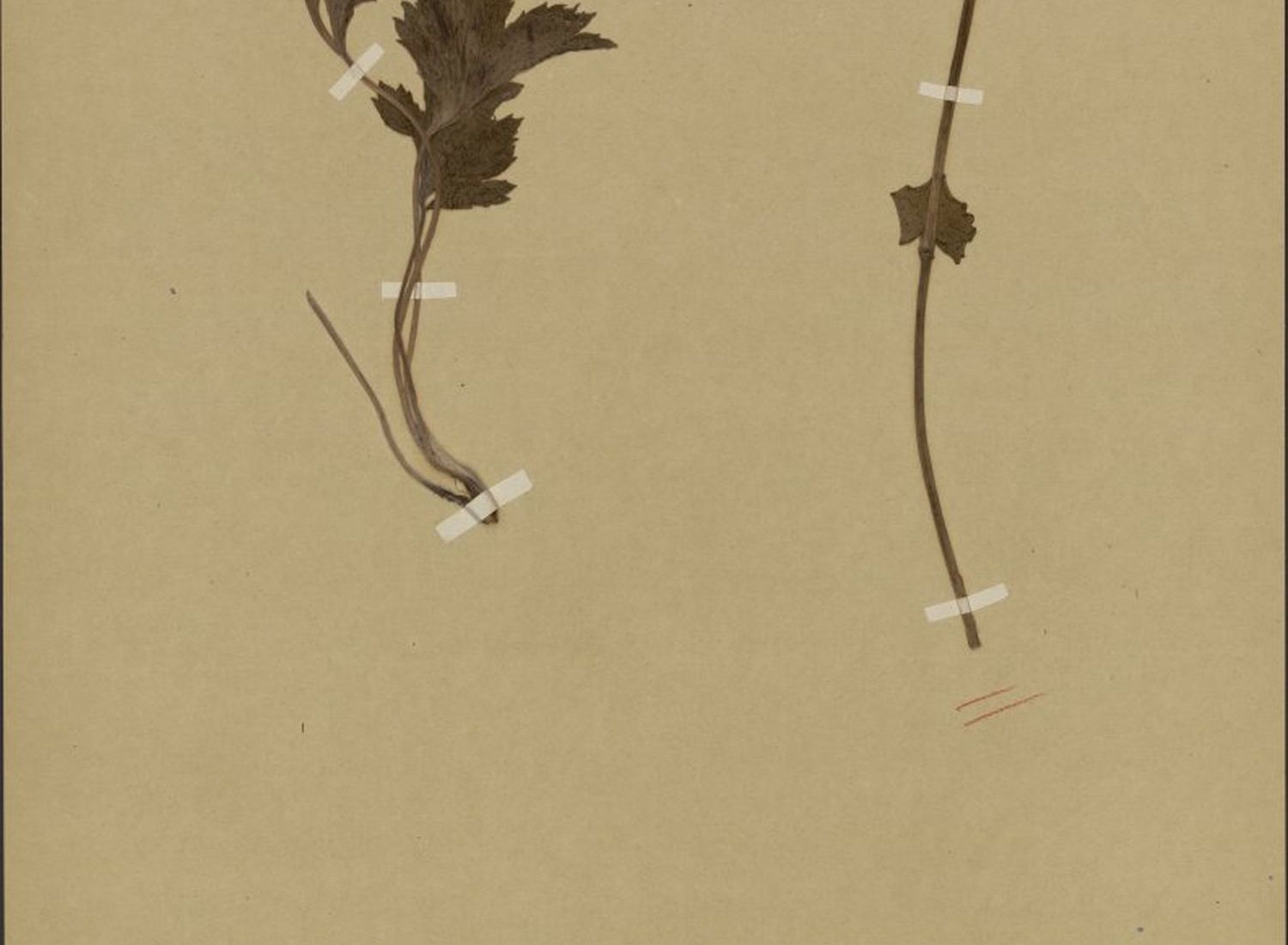
Puschkinia kurdistanica is a small spring bulb with pale, lilac-washed flowers, known from a single gully on the southern shore of Lake Van (Gola Wanê) in North Kurdistan (Bakur)[1][2]. Its name says where it comes from: the botanist who described it in 2019 named it, in his own words, "after Kurdistan, where it was found"[1].
How it got its name
- Named by
- Rukšāns, 2019Published in Int. Rock Gard. 116: 16
- Type collected by
- Rukšāns, Seisums & Zetterlund5 April 2019
Found in 2004, named in 2019
In May 2004 a joint Swedish and Latvian expedition was in the Lake Van region. The trip, which its members called BATMAN, had been "organized by Henrik Zetterlund from the Gothenburg Botanic Garden"[1], and with him were Jānis Rukšāns and Arnis Seisums (Seisums from the National Botanic Garden of Latvia)[1][2]. On 26 May, about 19 km out of Tetwan (Tatvan) on the road along the lake towards Wan (Van), at around 1,670 m, they stopped by a short, very steep gully. In wet clay under juniper and oak bushes they found a puschkinia already in seed, and labelled it on the spot as P. scilloides[1][2], at that time the only recognised species of the genus[1]. It went into Rukšāns's collection under the number BATMAN-060[1].
For years nobody knew quite what it was. In 2009 its label was changed to "P. peshmenii whitish form"[1], after Puschkinia peshmenii, a puschkinia described two years earlier from a gorge near Gever (Yüksekova) in Colemêrg (Hakkâri)[2]. That species had reportedly first been seen in 1974 by Hasan Peşmen (the herbarium sheets give other dates, Rukšāns notes) on the eastern flank of a mountain between Tetwan and Wan, on the south side of the lake, and the BATMAN-060 plants came from somewhere near there[1]. But grown on in the garden, BATMAN-060 kept to its own ways. Its seedlings "perfectly reproduce the bluish-coloured form" of the wild plants[1], even though in Rukšāns's greenhouse they grow side by side with other puschkinias, free to cross with them[1]. In the end Rukšāns decided that the plants his team had collected "were so different that they undoubtedly needed a name of their own"[1].
He published it in August 2019 in the Scottish Rock Garden Club's online journal International Rock Gardener as Puschkinia kurdistanica[1][2]. The type specimen, the dried plant that fixes the name, was taken on 5 April 2019 from the BATMAN-060 plants growing in Rukšāns's garden, and is kept at the herbarium in Gothenburg[1][2].
Two names for the Kurds
P. kurdistanica was Rukšāns's second attempt to name a puschkinia after the Kurds.
In 2009 and again in 2011 he had led trips into the mountains south of Lake Van, over the high Karabet Pass, where another puschkinia grows in alpine meadows at almost 2,900 m[1][2][3]. At home he crossed these plants with P. scilloides and got no seed, which encouraged him to describe them as a new species[1], "which I decided to name as P. kurdica conveying my great respect to the Kurdish people brutally suppressed by the regime governing now in Turkey"[1]. His manuscript was accepted in November 2013, but Puschkinia kurdica appeared in the journal The Alpine Gardener only on 13 March 2014[1][2].
He had been beaten to it. On 4 March 2014 the botanist Hasan Yıldırım had published the same plant from the same pass as Puschkinia bilgineri, named in honour of Ali Rıza Bilginer, the amateur plant-watcher who had first collected it[3][2]. As Rukšāns put it, "Only nine days earlier the same species was published under the name P. bilgineri"[1]. Yıldırım's manuscript, Rukšāns wrote, had been sent in about two months after his own, but under the botanical code the earlier publication has priority[1], so P. kurdica went "into synonymy, for being published later" under P. bilgineri[1][4][5].
Five years later the BATMAN-060 plants from the lakeshore gave him a second chance. This time he chose kurdistanica: named, he wrote, "after the part of Turkey inhabited by the Kurds, where it was discovered"[1].
How to tell it apart
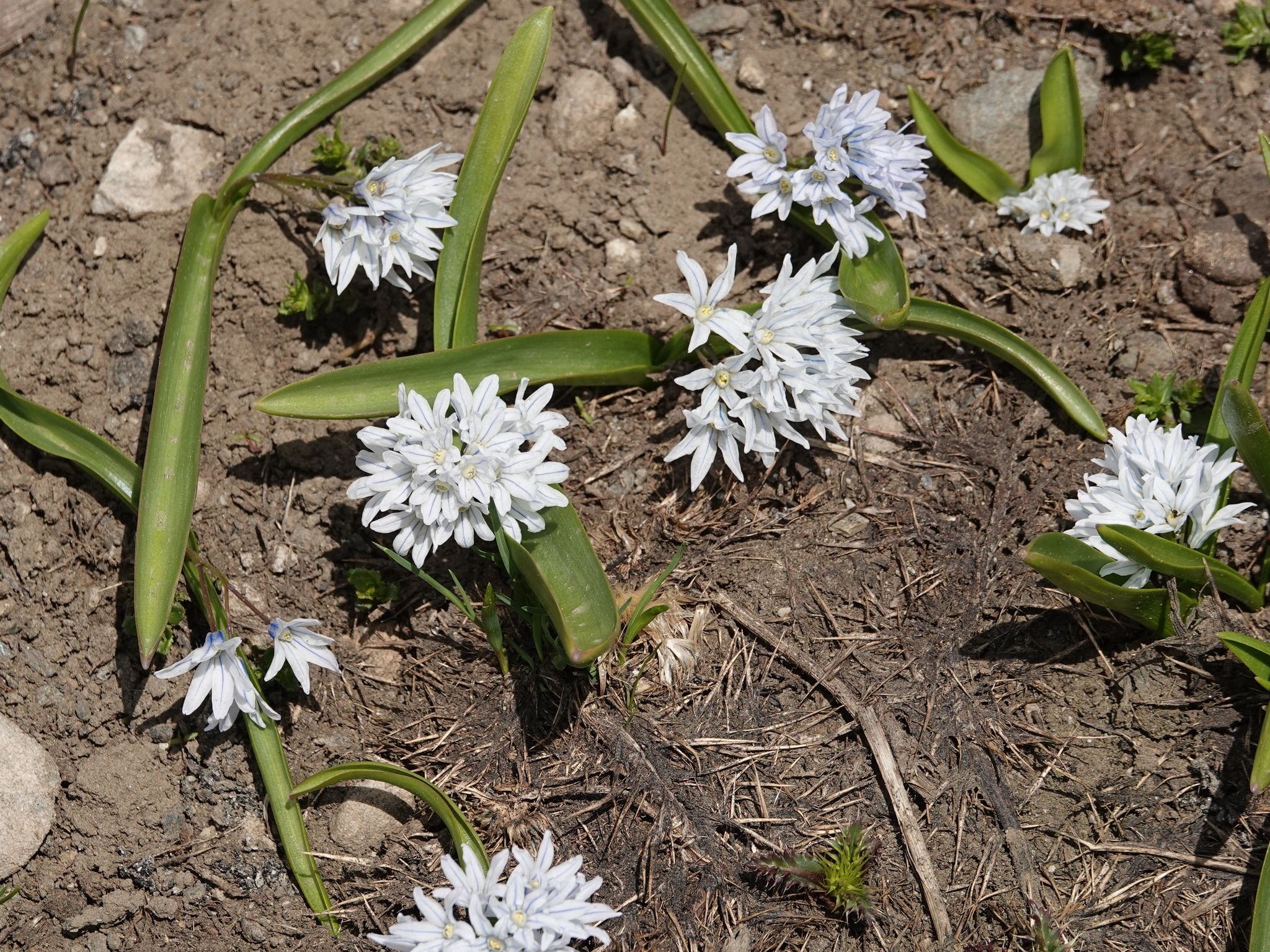
Puschkinias are small spring bulbs. Inside each flower the stalks of the stamens widen and join into a little cup, the corona, and the species differ in small things like this cup, the style and the seeds. Rukšāns's description of P. kurdistanica picks out these features[1]:
- a rounded bulb about 25 mm across and up to 29 mm high, with blackish-brown outer scales;
- two dark green leaves, channelled near the base and flat higher up, the lower one 19–40 mm wide;
- a single flower stalk up to 15 cm long, ending below the leaf tips and bent sideways and down at the top, so that its highest point is only about 11 cm above the ground[1][5];
- 3 to 11, rarely up to 18 flowers, "dirty lilac with a greenish midrib or whitish", sometimes with a dirty bluish tube, bell-shaped and opening only a little at the mouth;
- unusually long flower stalks at the bottom of the cluster, 30–40 mm and sometimes over 50 mm, shrinking to 7–10 mm at the top;
- a whitish corona with six lobes;
- almost no style: less than 1 mm long, or practically absent;
- a round capsule 8–10 mm across with yellowish seeds up to 2 mm.
The style is the clearest difference from P. peshmenii, the plant it was once mistaken for, whose style is about 3 mm long[1]. From P. bilgineri of the Karabet Pass it differs in its six-lobed corona and its yellowish seeds: P. bilgineri has a corona with an entire edge and black seeds[1][3]. Rukšāns and Dimitri Zubov's 2022 key to the genus sums it up as "Flower scape distinctly arcuate; flowers bluish lilac; style obsolete"[5].
One gully by the lake
As far as anyone knows, P. kurdistanica grows in one place: the gully on the southern shore of Lake Van where it was first collected, at about 1,670 m[1][2]. There it grows in wet clay soil[1], "at the bottom of a steep gully under shrubs of Juniperus sp. and Quercus sp.", in the shade of juniper and oak, together with autumn crocuses (Colchicum), lesser celandine (Ficaria), fritillaries, navelwort (Umbilicus) and larkspurs (Delphinium)[1]. "It blooms there soon after snowmelt"[1].
No other wild record has been published. GBIF, the global database of specimens and observations, holds none[4], and none has been posted to iNaturalist[6]. Kew's checklist gives its range simply as Turkey[7], and Rukšāns and Zubov call it "quite restricted"[5].
A family of puschkinias across Kurdistan
The genus Puschkinia is older than any of these discoveries. It was described in 1805 by the botanist J. M. F. Adams, who "named this beautiful early spring bloomer after his travel partner A. Musin-Pushkin"[1][2]. Rukšāns gave its home as the Caucasus[1]. Rukšāns and Zubov later gave more detail: Count Apollos Musin-Pushkin was a chemist and mineralogist who took part in a mining expedition to Georgia in 1800–1803, and Adams described the first species, P. scilloides, from the subalpine meadows on the southern side of Çiyayê Agirî (Mount Ararat). Adams's own specimen cannot be traced, and the specimen chosen in 2003 to stand for the name comes from Georgia[5]. For a long time botanists recognised very few species. In the Flora of Turkey of 1984, the botanist Edmondson merged P. libanotica and P. hyacinthoides into P. scilloides[1], and that one name covered the puschkinias of the region.
Since 2007 that picture has broken up. Eight new species have been described, and all but one, P. latifolia from the Alborz[2], come from Kurdistan:
- P. peshmenii (2007), from a gorge near Gever (Yüksekova) in Colemêrg (Hakkâri), in Bakur[2];
- P. bilgineri (2014), from the Karabet Pass south of Lake Van, and also found near Oramar (Dağlıca) in Colemêrg[3][2];
- P. kurdistanica (2019), from the southern shore of Lake Van[1];
- P. avromanica (2022), from rocky outcrops on the road from Kirmaşan (Kermanshah) to Merîwan (Marivan) via Pawe (Paveh) in East Kurdistan (Rojhilat), named after Hewraman (Avroman), a region "populated with the Hawrami Kurdish people"[2];
- P. parvula (2022), from west of Şino (Oshnavieh) in Rojhilat[2];
- P. advayana (2023), from near the road from Seqiz (Saqqez) to Merîwan in Rojhilat, named after the botanist Mahfouz Advay, "who found this species independently"[2]. Rukšāns had botanised by this road in 2017, when his team had to stop to change cars; the puschkinias he found there he counted in 2019 as P. peshmenii[1], and in April 2022 he went back to the 2017 site to collect specimens. Whether those plants are P. peshmenii or a species of their own was, in 2022, still to be settled[5];
- P. seisumsiana (2026), from near Çewlîk (Bingöl) in Bakur, named after Arnis Seisums, who had been on the BATMAN trip in 2004[2]. On that trip, some 12 km east of Çewlîk, Seisums took off his boots to cross a small river and came back with puschkinia seeds, BATMAN-250, which Rukšāns in 2019 could not yet place: he called them P. peshmenii aff. and wrote that whether they deserve a name of their own is difficult to say without a DNA check[1]. Neither paper says whether they belong to P. seisumsiana, whose type was collected in 2024 on the other side of the town, 12–13 km west-north-west of Çewlîk[2].
Rukšāns and Zubov count P. kurdistanica, P. peshmenii, P. bilgineri, P. parvula and P. avromanica, with part of P. scilloides, in what they call "The Armenian Plateau–Taurus–Zagros speciation and biodiversity center" of the genus[5]. As the list above shows, the mountains where these species grow lie almost entirely in Kurdistan. They are careful to add that their species rest on the plants' form and geography, because "we have no access to molecular & genetic analysis tools"[5]. How these puschkinias are related, and whether all of them will stand as species, is still for a DNA study to show. The 2024 volume of the Illustrated Flora of Turkey (Resimli Türkiye Florası), for one, treats P. peshmenii as a subspecies of P. scilloides[2].
Kurdish names
No Kurdish name has been recorded for P. kurdistanica itself, and none for its neighbour on the Karabet Pass: Yıldırım wrote that no local name could be found for P. bilgineri[3].
For the genus as a whole there are dictionary records. Ehmedê Dirihî's dictionary of Kurdish plant names lists serhêşîn, from Colemêrg, and serhîşîng for Puschkinia scilloides[8], the species name under which the puschkinias of the region were long filed. Whether these names were also used for the lakeshore plant is not known.
Sources
- 1.Rukšāns, J. (2019). Puschkinia kurdistanica (Asparagaceae) – a new species from the shores of Lake Van in Turkey. International Rock Gardener 116: 3-18.
- abcdefghijklmnopqrstuvwxyzaaabacadaeafagahaiaj
- p. 16 (page per IPNI; article pp. 3–18; no page marker in the extracted text). srgc.nethttps://www.srgc.net/documents/irg/2019Aug291567110323IRG116.pdfaccessed 14 November 2026
- p. 16. srgc.nethttps://www.srgc.net/documents/irg/2019Aug291567110323IRG116.pdfaccessed 14 November 2026
- 2.International Plant Names Index. Royal Botanic Gardens, Kew, Harvard University Herbaria and Australian National Herbarium.
- acefjPuschkinia kurdistanica Rukšāns, Int. Rock Gard. 116: 16 (2019).
- brsPuschkinia seisumsiana Rukšāns & Zubov, Int. Rock Gard. 194: 45 (2026).
- dmtPuschkinia peshmenii Rix & B.Mathew, Bot. Mag. 24(1): 56 (2007); P. scilloides subsp. peshmenii (Rix & B.Mathew) Yıldırım & Gemici, Res. Türkiye Fl. 4a: 273 (2024).
- ghPuschkinia kurdica Rukšāns, Alpine Gardener 82(1): 61 (2014).
- inPuschkinia bilgineri Yıldırım, Bağbahçe Bilim Derg. 1(1): 2 (2014).
- kPuschkinia Adams, Nova Acta Acad. Sci. Imp. Petrop. Hist. Acad. 14: 164 (1805).
- lPuschkinia latifolia Rukšāns & Zubov, Int. Rock Gard. 150: 29 (2022).
- oPuschkinia avromanica Rukšāns & Zubov, Int. Rock Gard. 150: 13 (2022).
- pPuschkinia parvula Rukšāns & Zubov, Int. Rock Gard. 150: 37 (2022).
- qPuschkinia advayana Rukšāns & Zubov, Int. Rock Gard. 160: 15 (2023).
- urn:lsid:ipni.org:names:77209171-1. ipni.orghttps://www.ipni.org/n/77209171-1accessed 14 November 2026
- 3.abcdeYıldırım, H. (2014). Puschkinia bilgineri (Asparagaceae subfamily Scilloideae): a new Puschkinia Adams species from Eastern Anatolia, Turkey. Bağbahçe Bilim Dergisi 1(1): 1–10.
- 4.abGBIF.org GBIF Backbone Taxonomy and occurrence records. Backbone Taxonomy and occurrence search: Puschkinia kurdistanica, Puschkinia kurdica. gbif.orghttps://www.gbif.org/
- 5.abcdefghRukšāns, J. & Zubov, D. (2022). Three new and noteworthy Puschkinia species (Asparagaceae: Scilloideae) concealed in the Iranian Alborz and Zagros Mountains. International Rock Gardener 150.
- 6.↩iNaturalist. Puschkinia kurdistanica (taxon 1268037). inaturalist.orghttps://www.inaturalist.org/
- 7.Plants of the World Online. Royal Botanic Gardens, Kew.
- ↩Puschkinia kurdistanica.
- plant_name_id 538685. powo.science.kew.orghttps://powo.science.kew.org/taxon/urn:lsid:ipni.org:names:77209171-1accessed 14 November 2026
- 8.↩Ahmet Kasımoğlu (Ehmedê Dirihî) (2013). Ferhenga Navên Nebatan a Kurdî (Dictionary of Kurdish Plant Names). Mardin Artuklu University, Institute of Living Languages in Turkey (ISBN 978-605-4202-12-6).
Last updated 20 November 2026