Crataegus kurdistanica is a hawthorn, a thorny shrub or small tree of the rose family[1][2], and its name means "of Kurdistan". It was named in 1980 by two botanists from Prague, from a flowering shrub one of them had collected in 1961 high in the mountains of the Rewandiz district in Başûr[2]. Yet branches now counted as this species were gathered almost 140 years earlier, on a mountain in the central Zagros, and went by other names for more than a century.
How it got its name
- Named by
- Hadač & Chrtek, 1980Published in Candollea 35: 317
Two botanists from Prague
The ecologist and botanist Emil Hadač (1914–2003)[3] spent 1959 to 1961 in Iraq, where he described new plant species and plant communities and brought around 6,000 specimens back to the collections in Prague[4]. Several of his excursions went into the mountains of Başûr: his labels name places around Silêmanî (Sulaymaniyah) and Pêncwên (Penjwin)[5]. Back in Prague, much of this material was worked through by Jindřich Chrtek (1930–2008)[3], whose obituary says he identified collections from other botanists, "especially those from Iraq collected by E. Hadač"[6].
Together the pair named a small run of new plants from Iraqi Kurdistan, among them the grass Poa bulbillifera, "a new species from the Iraqi Kurdistan" (1969), and, named after Kurdistan, the grass Poa kurdistanica (1970) and Tragopogon kurdistanicus (1974)[7]. In 1980 they turned to the rose family. In the Geneva journal Candollea they listed 29 species and subspecies of Rosaceae from Hadač's Iraqi collections of 1959 to 1961, and described four of them as new: this hawthorn, Crataegus kurdistanica, a second hawthorn, C. sakranensis, the shrub or tree Sorbus shirinensis, and a large-fruited variety of the almond Amygdalus carduchorum[2].
A flowering shrub at Hassar-i-Sakran
On 7 June 1961 Hadač and his companion, printed in the paper as Faisal abd-el-Kader, were at a place they called Hassar-i-Sakran, at 2,400 to 2,800 m, in the Rewandiz district of the Flora of Iraq[2][8]. There they gathered a hawthorn in flower. It became the type of the new species, Hadač number 5620, kept in the herbarium of the National Museum in Prague[2]. A day earlier, by a stream at the village of Sakri Sakran, at 1,900 m, they had collected the type of the second new hawthorn, C. sakranensis[2].
The pair thought their plant "stands probably nearest to C. meyeri", a hawthorn treated in the Flora of Iraq. It differed in three styles instead of two, denser hair on the leaves, red-brown rather than grey-brown twigs, much shorter leaf stalks (5–8 mm against 1–2.5 cm), broader petals and longer stamens[2].
They also took up a puzzle from the Flora of Iraq. In its account of the rose family, published in 1966, R. D. Meikle had noted a single hawthorn collected by Guest at Rayat, at 1,800 m in the same district, on 25 August 1953. It looked like C. meyeri in its leaves and the size of its fruit, but seemed to have four styles and four stones in each fruit, and Meikle wondered whether it was an aberrant C. meyeri, a hybrid or an undescribed species: "Additional material, especially flowering material, is required to establish its identity"[2]. Hadač's shrub was in flower, and had three styles. The higher number of styles and stones, the two authors concluded, "seems not to be accidental, but a constant, specific character". Their plant was collected "not far from the above locality", and they thought the two "possibly conspecific"[2].
A hawthorn collected in 1842
On 6 July 1842 the botanist Theodor Kotschy set out from the village of Dozdkurd to climb Kuh-e Dena, a 4,409 m massif in the central Zagros, then "a loosely administered area mainly inhabited by nomadic tribespeople"[9]. He camped on the high pastures, the "alps where the nomads pitch their tents", collected on the summit itself and came down with more than 240 collections, many of them new to science[9].
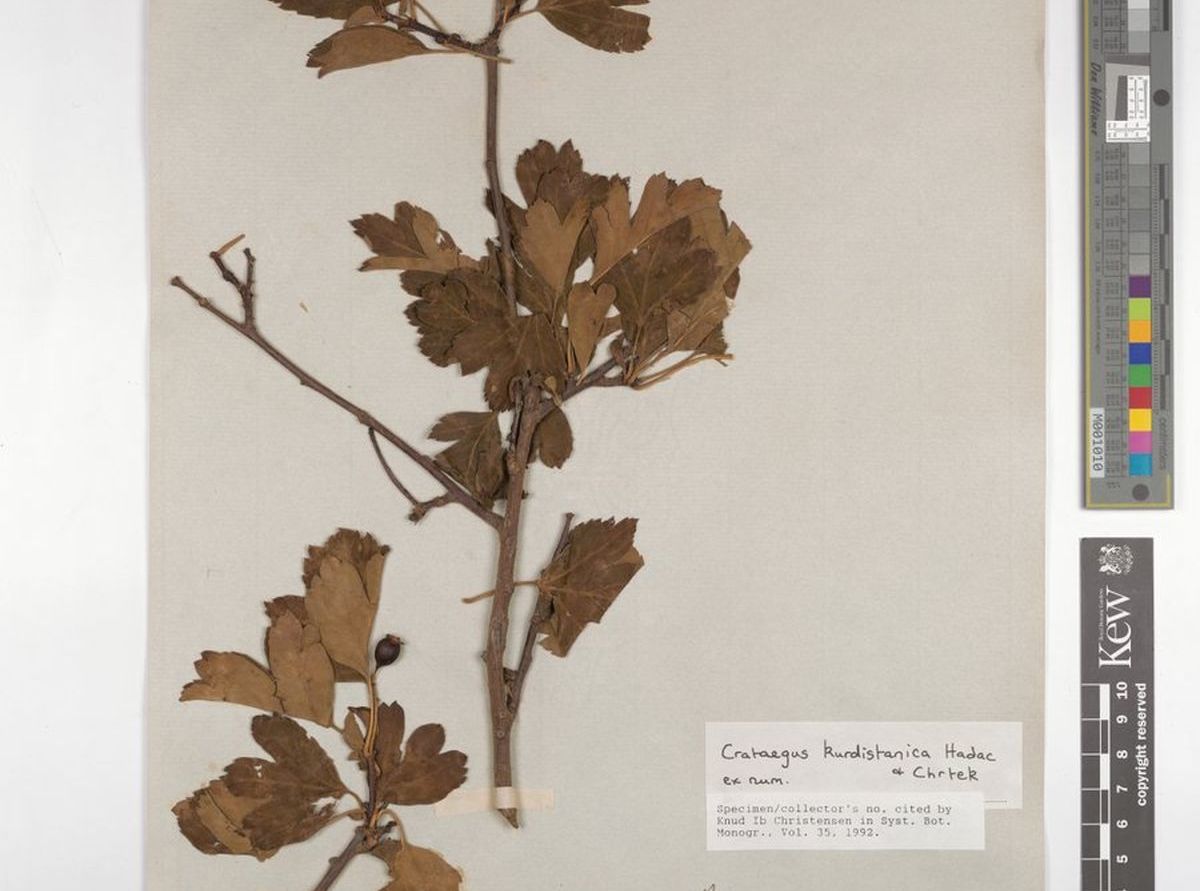
One of them, gathered on 14 July, was a hawthorn branch, number 648[10]. R. F. Hohenacker arranged Kotschy's Persian plants and distributed them to herbaria[9], and when this set went out in 1845, its printed label carried a guess with a question mark: Crataegus heterophylla Flügge?[10]. Later hands wrote C. sinaica on the sheets[10][11]. Today two of those duplicates, in London and Paris, carry slips naming them Crataegus kurdistanica[10][11].
A variety from the Elburz
A year later Kotschy was in the mountains north of Tehran, and climbed Damavand[9]. In the Elburz (Alborz) he again collected hawthorns, and in 1856 the botanist Edmond Boissier gave them a name of their own, as a variety of the black-fruited Crataegus melanocarpa[12]. His note is three lines long:
Cratægus melanocarpa MB. var. Kotschyana Boiss. Indumentum petiolorum pedunculorum ramorumque juniorum longius magis patulum. Flores paulò majores. Styli 3-4. Hab. in monte Elbrus Persiæ borealis Kotschy N° 670 et 268.
Crataegus melanocarpa, variety Kotschyana. The hairs on the leaf stalks, flower stalks and young shoots longer and more spreading. Flowers a little larger. Styles 3–4. Grows on Mount Elburz in northern Persia, Kotschy nos 670 and 268.[12] (our translation)
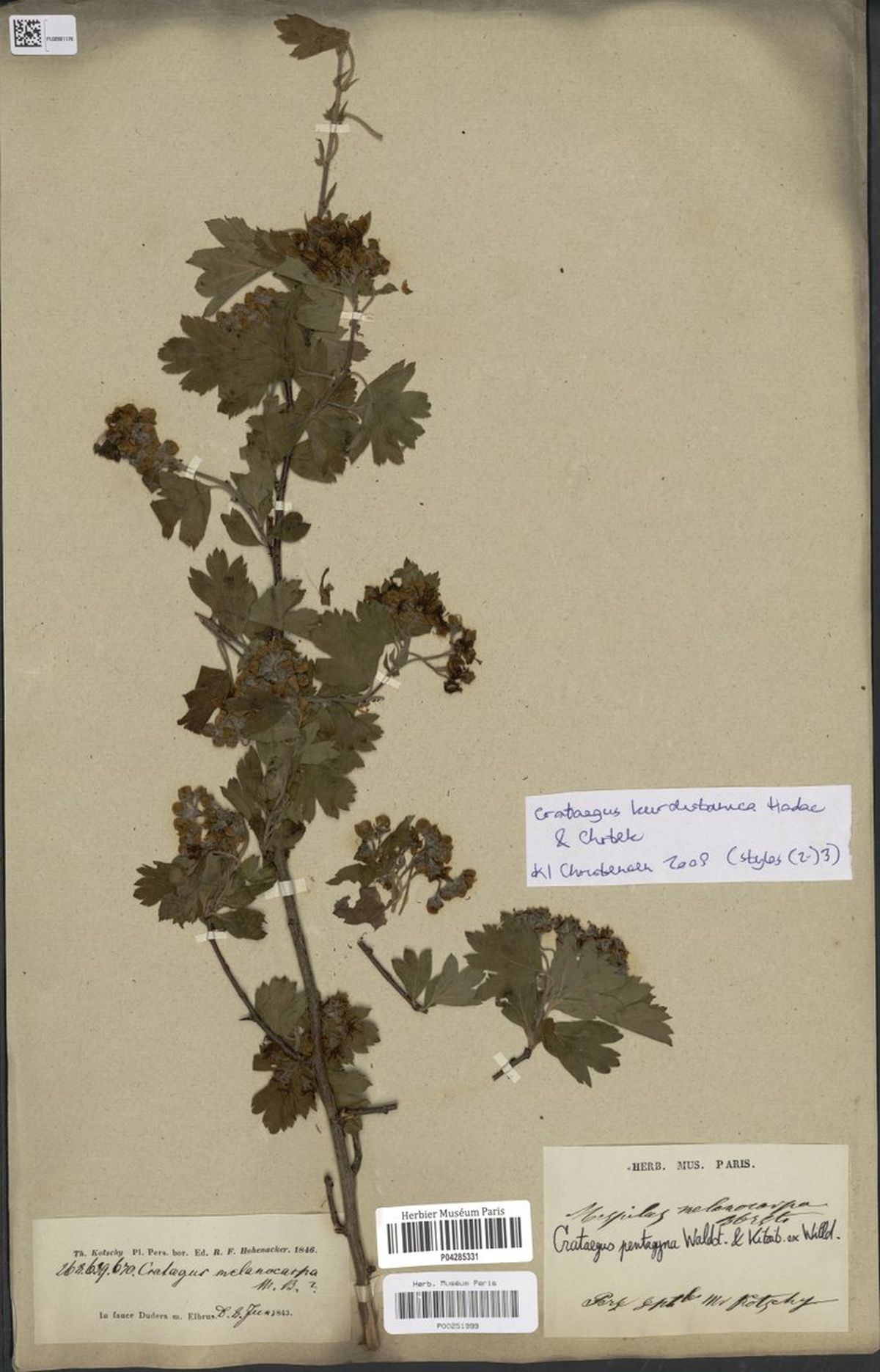
A sheet in Paris carries those same numbers, "268. 639. 670.", with Kotschy's own query, "Crataegus melanocarpa M.B.?", and the date 8 June 1843[13]. Kotschy's numbers from 1843 run parallel to those of his 1842 journey in the south, so these are not the 1842 gatherings with the same numbers, from Persepolis (268) and Kuh-e Dena (639, 670)[9]. The Paris sheet too has a slip that renames it Crataegus kurdistanica[13]. Kew's checklist now lists Boissier's var. kotschyana as a synonym of C. kurdistanica[1].
Who renamed them
The two Paris slips are signed by Knud Ib Christensen and dated 2008[11][13]. Christensen wrote a comprehensive monograph of the hawthorns of Europe and Asia[14], and a printed slip on the Kew sheet records that its "Specimen/collector's no." was cited in that monograph in 1992[10]: this specimen, or at least Kotschy's number 648.
So in Christensen's view, a shrub named for Kurdistan from the mountains of Rewandiz also takes in branches gathered more than a century earlier, far to the south-east in the Zagros and to the east in the Elburz[10][11][13]. Kew gives its native range as "N. Iraq to Afghanistan", recorded from Iraq, Iran and Afghanistan[1].
A genus of many names
Its many labels are typical of hawthorns. "Polymorphism and hybridisation", wrote the botanist Ali Dönmez, "are the main reason for abundance of the synonyms of the Crataegus species"[14]: the plants vary a great deal, and different species cross. A 2025 doctoral study at the University of Silêmanî calls the Kurdistan Region "a diversity center for Crataegus spp."[15]. The same study names four hawthorn species from Iraq and the Kurdistan Region, C. azarolus, C. monogyna, C. pentagyna and C. meyeri, and does not mention C. kurdistanica at all[15].
What it looks like
Hadač and Chrtek's Latin description gives the first full picture of the plant[2] (our translation):
- a shrub about 2 m tall, the young branches softly hairy, the older ones becoming bare and red-brown, with spines about 1 cm long;
- leaves on short stalks of 5–8 mm (rarely 12 mm), the blade about 4 cm long and 3 cm wide, ovate to diamond-shaped with a wedge-shaped base, cut a third of the way in or a little more into three pointed lobes with a few coarse teeth;
- the leaves rather densely hairy on both sides, dull green above and grey-green beneath;
- clusters of 10 to 14 flowers on hairy stalks 2–3 cm long, with small, reflexed sepals about 2 mm long;
- white petals 6–7 mm long and about 6 mm wide, 16 hairless anthers, given as about 6 mm long (in their English discussion the authors give about 6 mm for the stamens), and three styles, a little shorter than the stamens;
- the fruit: unknown. The type was gathered in flower, and the paper says simply Fructus ignotus.
"C. kurdistanica is striking especially in flower," they wrote, "as its anthers are conspicuously long"[2].
The old sheets fit this picture in their own way. Boissier set his variety apart by its longer, more spreading hairs, slightly larger flowers and three or four styles[12]; Christensen noted "(2–)3" styles on the Paris sheet[13]. The Kew branch has lobed, toothed leaves and a single dark fruit[10], and the 1843 Paris branch is covered in flowers[13].
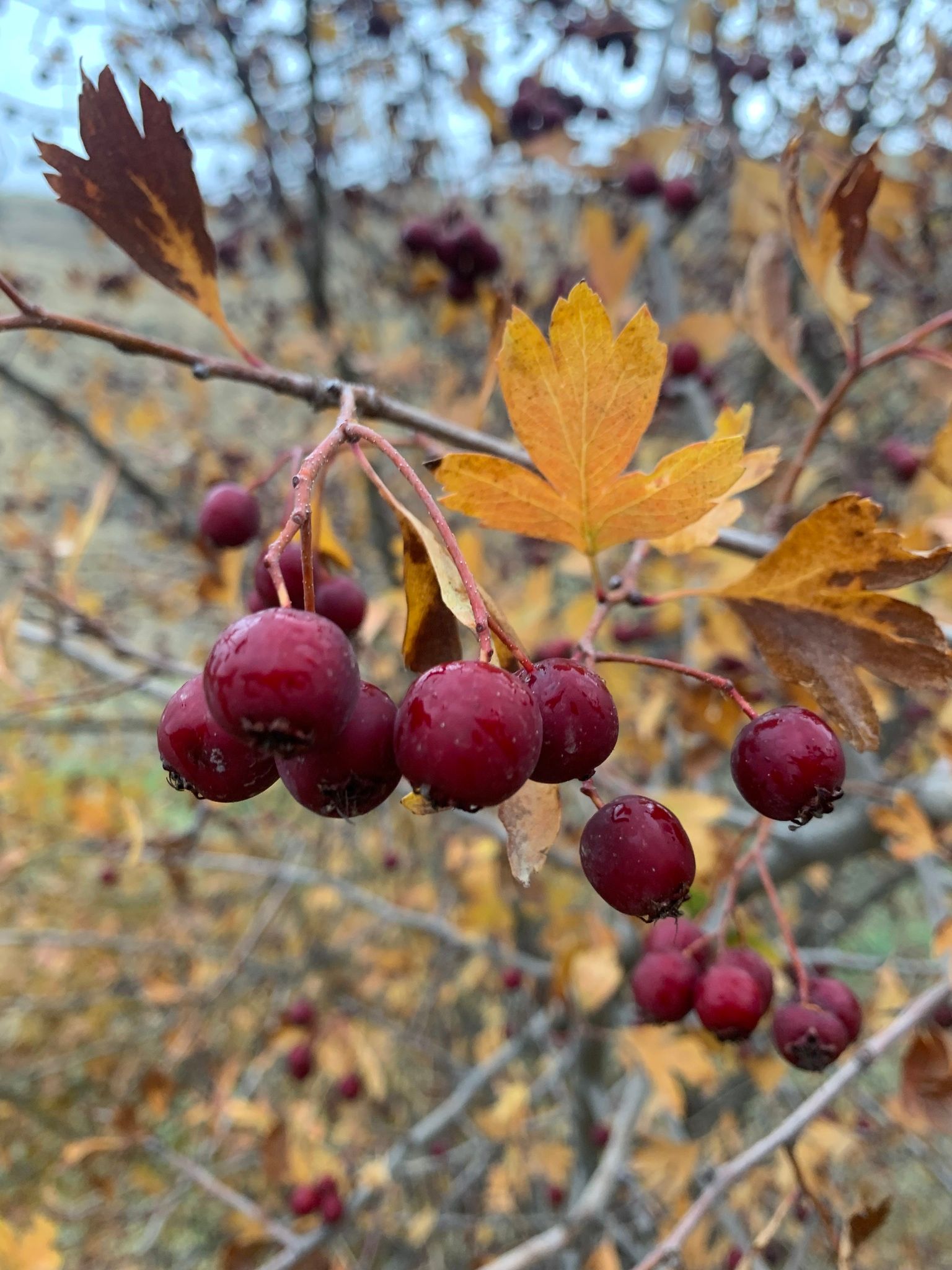
On iNaturalist, the photographer Arya Aras has posted a hawthorn from near Pêncwên, photographed in November 2023, which another user there has identified as C. kurdistanica[16]. Nobody has yet confirmed that identification, and the tree had earlier been taken for C. monogyna and then C. meyeri[16], which shows how hard these trees are to name. The photo shows what a hawthorn of these mountains looks like in autumn.
Hawthorns in Kurdish life
People in Kurdistan have many names for hawthorns, though none we found belongs to this species alone. Ehmedê Dirihî's dictionary of Kurdish plant names lists dozens for the genus, among them gwîj and guvîj[17]. In villages of Başûr along the Great Zab, the Little Zab and the Sirwan, people told researchers in 2019 that they pick hawthorn fruits as a snack, "slightly astringent and sweet", and called them Gwaiş, or Gewask in Kakai villages[18]. Those names were recorded for hawthorns in general, not for C. kurdistanica[18][17].
The trees are under pressure. The Silêmanî study warns that "Crataegus species in the Kurdistan region of Iraq have been declining due to long-term land use"[15]. Crataegus kurdistanica itself has never been assessed for the IUCN Red List[19].
Still to be found
For a plant named after Kurdistan, remarkably little is known. GBIF, the global biodiversity database, holds only four records of it, all old herbarium sheets[19], and none of them from Kurdistan: the type in Prague is not among them. Its fruit was unknown to its authors[2], and none of the sources we found says what colour its ripe fruit is or what kind of ground it grows on. The best way to fill the gap may be on the hillsides of Başûr and Rojhilat themselves: a confirmed photograph of Crataegus kurdistanica in flower and in fruit, with the place it grows, would add a great deal to what is publicly known.
Sources
- 1.Plants of the World Online. Royal Botanic Gardens, Kew.
- abcCrataegus kurdistanica.
- plant_name_id 2945893. powo.science.kew.orghttps://powo.science.kew.org/taxon/urn:lsid:ipni.org:names:723633-1accessed 14 November 2026
- 2.Hadač, E. & Chrtek, J. (1980). A contribution to the Iraqi Rosaceae. Candollea 35: 311–328. doi:10.5169/seals-880094https://doi.org/10.5169/seals-880094
- 3.International Plant Names Index. Royal Botanic Gardens, Kew, Harvard University Herbaria and Australian National Herbarium.
- abCrataegus kurdistanica E.Hadač & Chrtek, Candollea 35(1): 317 (1980); Sorbus shirinensis E.Hadač & Chrtek, Candollea 35(1): 325 (1980); author records for E. Hadač and J. Chrtek.
- urn:lsid:ipni.org:names:723633-1. ipni.orghttps://www.ipni.org/n/723633-1accessed 14 November 2026
- 4.↩Kovář, P., Möllerová, J. & Rambousková, H. (2015). Emil Hadač – a founder of Czech landscape ecology. Journal of Landscape Ecology 8(2).
- 5.↩Chrtek, J. & Hadač, E. (2002). A contribution to the Ranunculaceae of Iraq. Journal of the National Museum (Prague), Natural History Series 171: 125–130.
- 6.↩Pouzar, Z. (2008). Jindřich Chrtek (1930–2008). Acta Musei Nationalis Pragae, Ser. B, Hist. Nat. 64(1): 3–4.
- 7.↩Chrtek, J. & Hadač, E. (1969). Poa bulbillifera. a new species from the Iraqi Kurdistan. Österr. Bot. Z. 117: 146–148; Chrtek, J. & Hadač, E. (1974). A new species of Tragopogon from the Iraqi Kurdistan. Folia Geobot. Phytotax. 9: 95–97; IPNI: Poa kurdistanica Chrtek & Hadač, Candollea 25: 260 (1970).
- 8.↩Dirmenci, T., Haloob, A., Celep, F. & Ghazanfar, S. A. (2023). Revision of the genus Nepeta L. (Lamiaceae) in Iraq. Turkish Journal of Botany 47(2): 169–189, p. 170. doi:10.55730/1300-008X.2754https://doi.org/10.55730/1300-008X.2754
- 9.Edmondson, J. R. & Lack, H. W. (2006). Karl Georg Theodor Kotschy's itinerary in southern Iran, 1841–42. Willdenowia 36: 579–588. doi:10.3372/wi.36.36154https://doi.org/10.3372/wi.36.36154
- 10.abcdefgRoyal Botanic Gardens, Kew – Herbarium Specimens. via GBIF, herbarium specimen K004281281 (Kotschy 648, 1842), via GBIF. gbif.orghttps://www.gbif.org/dataset/cd6e21c8-9e8a-493a-8a76-fbf7862069e5
- 11.abcdMuséum national d'Histoire naturelle, Paris, herbarium specimen P04285332 (Kotschy 648, 1842), via GBIF.
- 12.Boissier, E. (1856). Diagnoses Plantarum Orientalium Novarum. ser. 2, 2: 123.
- 13.abcdefMuséum national d'Histoire naturelle, Paris, herbarium specimen P04285331 (Kotschy, Elburz, 1843), via GBIF.
- 14.Dönmez, A. A. (2004). The genus Crataegus L. (Rosaceae) with special reference to hybridisation and biodiversity in Turkey. Turkish Journal of Botany 28: 29–37.
- 15.Mohammed, K. E. (2025). Morpho-physiological and genetic diversity of Crataegus taxa (Rosaceae) in selected locations of Iraqi Kurdistan Region. PhD thesis, University of Sulaimani. arXiv:2605.11028.
- 16.abiNaturalist. observation 191283225 (Arya Aras). inaturalist.orghttps://www.inaturalist.org/
- 17.abAhmet Kasımoğlu (Ehmedê Dirihî) (2013). Ferhenga Navên Nebatan a Kurdî (Dictionary of Kurdish Plant Names). Mardin Artuklu University, Institute of Living Languages in Turkey (ISBN 978-605-4202-12-6).
- 18.abAndrea Pieroni, Hawre Zahir, Hiwa M. Ahmed, Renata Sõukand (2019). Where tulips and crocuses are popular food snacks: Kurdish traditional foraging reveals traces of mobile pastoralism in Southern Iraqi Kurdistan. doi:10.1186/s13002-019-0341-0https://doi.org/10.1186/s13002-019-0341-0
- 19.abGBIF.org GBIF Backbone Taxonomy and occurrence records. Crataegus kurdistanica (species 3015640), occurrence records and IUCN category. gbif.orghttps://www.gbif.org/
- 20.F. Hooshidari (2009). Medicinal plants of Kurdistan province (گیاهان دارویی استان کردستان). ijmapr.areeo.ac.irhttps://ijmapr.areeo.ac.ir/article_7319.html
- 21.Catalogue of Life, vernacular names via the GBIF Backbone Taxonomy. api.gbif.orghttps://api.gbif.org/v1/species/3015640/vernacularNamesaccessed 14 November 2026
Last updated 20 November 2026