High above Lake Van (Gola Wanê), inside the crater of the volcano Nemrûd (Nemrut), a small white-flowered plant creeps over loose scree[1][2]. It is a form of Sabulina umbellulifera, a mountain sandwort of the pink family (Caryophyllaceae) that grows on high mountains across Anatolia[1][3]. The form that lives here is called var. kurdica, "the Kurdish variety", and as far as anyone knows it grows nowhere but in Bakur (North Kurdistan), between 2,400 and 3,200 metres[1].
There is a small irony in it. The species was named for the way it holds its flowers, in little umbels, and the Kurdish variety is the one that does not.
How it got its name
- Named by
- (Boiss. & Balansa) Dillenb. & Kadereit, 2014Published in Taxon 63: 88
A flower picked out by its umbels
The story starts in the west. On 18 July 1855 the plant collector Benedict Balansa (1825–1891)[4] was in the alpine zone of the Taurus above Bulgarmaden, in Cilicia, when he gathered a tufted little plant with white flowers[1][5]. On the same day, in rock crevices above the same place, he also made the type gathering of another small sandwort, Minuartia rimarum, and the two species were later at times confused[1]. The botanist Pierre Edmond Boissier (1810–1885)[4], with Balansa, described it in 1856 as Alsine umbellulifera, "the Alsine that bears little umbels" (our reading of the name)[5][4]. Its upright flowering stems, he wrote, ended "umbellatim 2–5 floris", in an umbel of two to five flowers, ringed at the base by four or five tiny leaves[5]. And that was what set it apart:
Species inflorescentiâ distinctissima.
A species most distinct in its inflorescence.[5] (our translation)
An umbel is a cluster in which all the flower stalks spring from one point, like the ribs of an umbrella. Remember that, because a century later the Kurdish plants turned out to do something else.
A scree inside a volcano
On 12 August 1956 the young botanist John McNeill (born 1933)[4] was high on Nemrûd, near Tetwan (Tatvan) in the province of Bidlîs (Bitlis). On the north slope of the crater, at 2,600 m, he found the plant on scree. His label is short and exact:
Scree on north slope of crater on Nemrut Dagh, 2600 m. Open community – scree rather mobile. Perennial. Fls. white.[2]
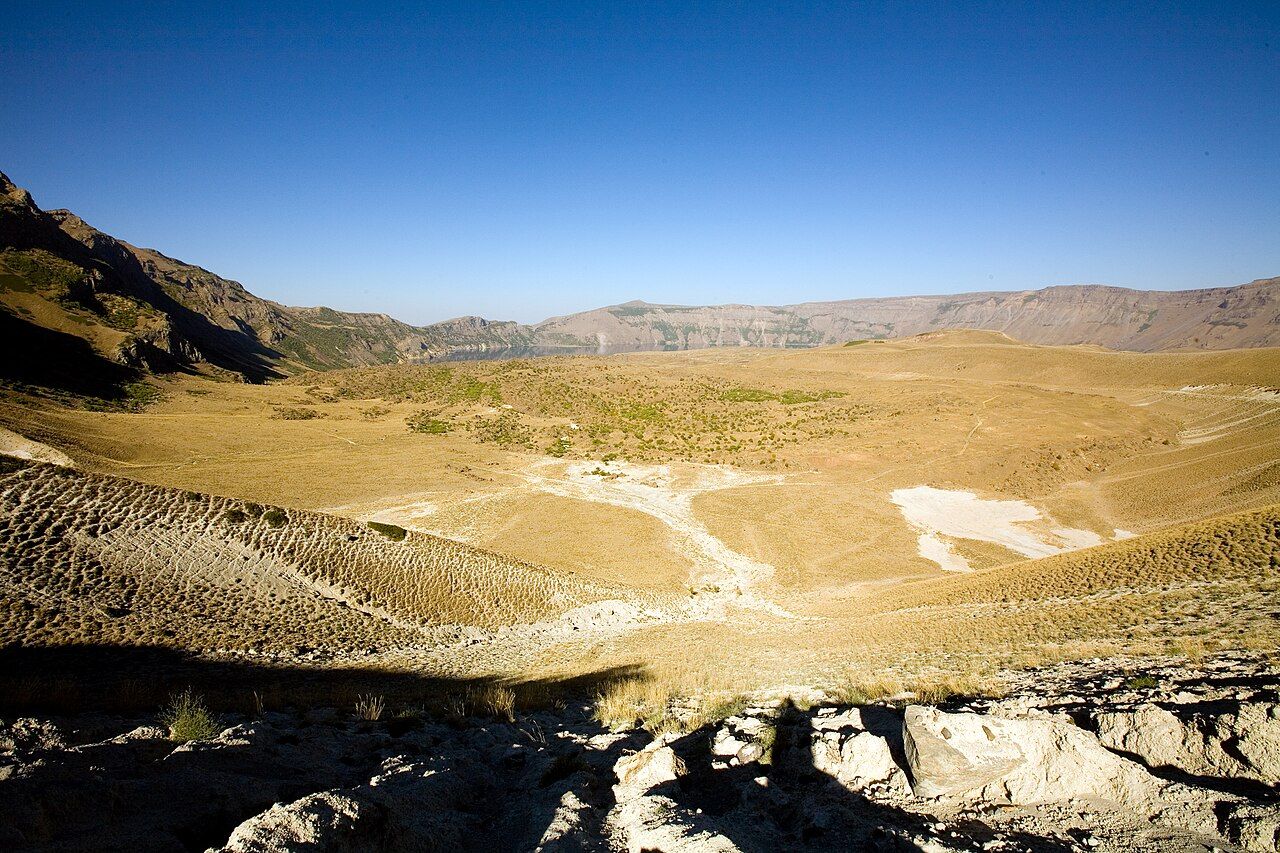
It is a remarkable place for a plant. Nemrûd is the westernmost of the volcanoes that ring Lake Van, about 10 km from Tetwan. Its summit reaches 2,948 m, and its crater, a caldera of about 9 by 5 km, is partly filled by a lake[6]. With 27 recorded eruptions since the end of the last ice age, it is the most active volcano in Turkey[6]; its last confirmed eruption was in 1650[7]. (It is a different mountain from the better-known Mount Nemrut near Semsûr (Adıyaman), with its giant stone heads.)
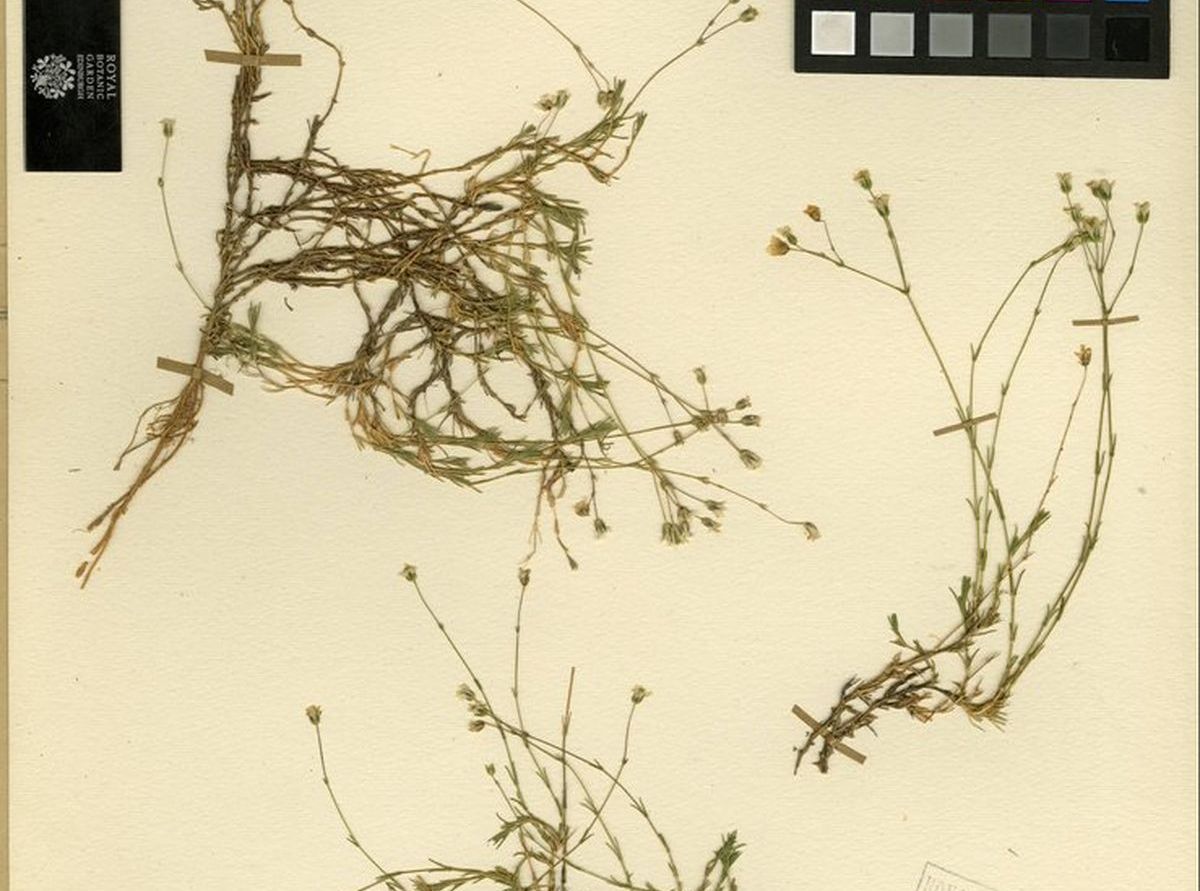
McNeill pressed several plants on one sheet. That sheet, now in the Royal Botanic Garden Edinburgh, became the holotype of the Kurdish variety, the specimen to which its name is tied for good; a duplicate went to Kew[1][2].
The variety without umbels
McNeill was then working through all the sandworts and their relatives of the Near East, a study he first wrote up as a thesis in 1960 and published from the University of Liverpool in 1963[1]. When he came to umbellulifera, he found a species that would not sit still. It was, he wrote, "a rather polymorphic species and one in which it is difficult to assess the correct rank for the recognisably distinct forms"[1]. He split it into four subspecies, from the mountains of Amasya in the north to two single peaks in Caria in the south-west[1].
The plants from Kurdistan were a puzzle of their own. They had all the flower characters of the typical plant of the Taurus, but they did not hold their flowers in an umbel. Instead their flowers came in a monochasium: a stalk ends in a flower, a single side branch grows on below it and ends in a flower too, and so on, so that the flowers open one after another on long, separate stalks[1]. As McNeill put it, "plants from Kurdistan have the monochasial inflorescence of pontica along with all the floral characters of umbellulifera sensu stricto"[1].
That mixture mattered for the whole species. Bornmüller had described pontica, from the mountains of Galatia in the north, as a species of its own, and had the typical plant and pontica been the only forms known, McNeill wrote, "one would not question their specific distinction". But the Kurdish plants, and two gatherings from Caria, combined their characters in new ways. So McNeill kept a single species and made the main forms subspecies of it[1].
So in 1963 he gave them a name of their own, but kept it modest: var. kurdica, a variety of the typical subspecies, because "the Kurdistan plants seem closer to the typical form (itself rather variable) than are the others"[1]. In his formal record he filed its home simply as "Turkey: Kurdistan", and added: "Endemic"[1].
How to recognise it
McNeill's key and Latin description give the Kurdish variety these marks[1]:
- a perennial, loosely tufted or creeping, spreading a little over the rocks;
- flowers in a loose, branching cluster in which they open one after another, one to six of them, usually two to four;
- long flower stalks, 8–15 mm (in the typical variety 2–8 mm, rarely 10);
- broad white petals, only 1.5 to 2 times as long as wide (in the typical variety usually about 2.5 times);
- sepals always egg-shaped, never narrowing into a lance shape.
One thing nobody could describe in 1963: its seeds. The key notes that those of var. kurdica were "unknown"[1].
Three mountains and two botanists
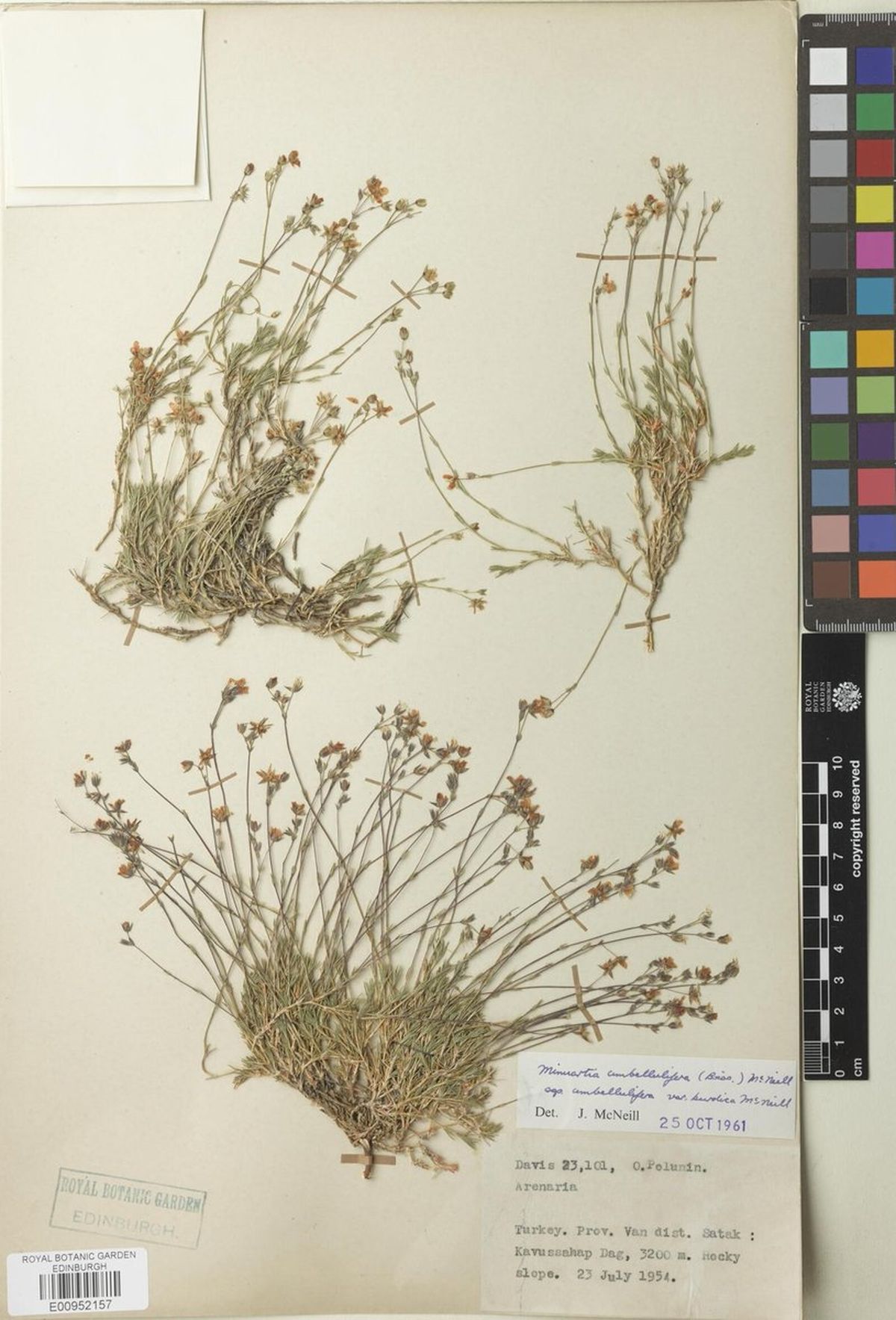
McNeill had not been the first to collect it. Two years earlier, in July 1954, the botanist Peter Hadland Davis (1918–1992)[4] and Oleg Polunin had brought back the same plant from two mountains around Lake Van. Their typed labels call it only "Arenaria", a sandwort[2][2]:
- on 7 July 1954, on Pelli Dag above Pelli in the province of Bidlîs, at 10,000 feet (about 3,050 m), on rocky ground, with white flowers[2];
- on 23 July 1954, on Kavussahap Dag in the Satak district of the province of Wan (Van), at 3,200 m, on a rocky slope[2].
In October 1961 McNeill wrote his determination on both sheets: Minuartia umbellulifera subsp. umbellulifera var. kurdica[2][2]. With his own gathering from Nemrûd, they fall within the heights McNeill gave for the variety, 2,400 to 3,200 m; he gives its flowering time as July and August[1]. No other form of the species that McNeill recognised reaches as high: he recorded the others between 1,600 and 2,500 m[1].
Are there more? Two gatherings Davis made in June 1966 show that the species itself reaches further into Kurdistan: one on the north side of Erek Dag above Değirmenköy near Wan, at 2,400 m, on rocky igneous slopes, and one on a shaley north slope at 2,500 m on the pass between Colemêrg (Hakkâri) and Kaval, both with white flowers[8]. In 2018 both sheets at Kew were named Minuartia umbellulifera subsp. umbellulifera for the Resimli Türkiye Florası (Illustrated Flora of Turkey) project, without saying which variety[8]. Whether they belong to the Kurdish variety is still to be checked.
Kew's world checklist gives the species' range as Turkey alone[3]. In Kurdish terms, its Kurdish variety is a plant of the high mountains of Bakur around Lake Van, from Bidlîs to Wan.
A plant that may have crossed with its neighbour
A third sheet from McNeill's 1956 journey hints at a more tangled life. On 31 August, on Halanduran Dag about 25 km from Elbak (Başkale), at 3,000 m, he collected a sandwort he later put under another species, Minuartia juniperina. In 1961 he added a note: the plant was "male sterile" (it made no working pollen) and "approaches (? hybrid with) M. umbellulifera var. kurdica"[2].
Elsewhere in his revision McNeill wrote that, in one group of these sandworts, frequent male sterility suggested "extensive hybridisation"[1], and that another neighbour, Minuartia glandulosa, "shows an approach to M. umbellulifera … (particularly to var. kurdica)"[1]. On the mountains around Lake Van, it seems, the Kurdish variety may not keep entirely to itself. That has never been tested.
From Alsine to Sabulina
The plant has had three genera. Boissier and Balansa put it in Alsine[5][4]. McNeill moved it in the early 1960s to Minuartia[1][4], and that is the name on all the sheets above. Then DNA studies showed that Minuartia in the old sense was not one natural group: its species came from several separate branches of the family tree[9]. In 2014 Markus Dillenberger and Joachim Kadereit split it into smaller genera and placed this species in Sabulina[4][9]. Its full name is now Sabulina umbellulifera var. kurdica (McNeill) Dillenb. & Kadereit; the "(McNeill)" records who described the variety first[4]. The variety is still accepted today[3].
A name in Kurdish?
We know of no Kurdish name for this plant. Ehmedê Dirihî's dictionary of Kurdish plant names lists Minuartia umbellulifera var. kurdica in both its Turkish and its Latin index, but the column for the Kurdish name is empty[10]. No photograph of the living Kurdish variety is known to us either. If you know the small white flowers of the Nemrûd screes, or a name for them, Flora Kurdica would like to hear from you.
Sources
- 1.McNeill, J. (1963). Taxonomic studies in the Alsinoideae: II. A revision of the species in the Orient. Notes from the Royal Botanic Garden Edinburgh 24(3): 241-404.
- acfhkmnqrp. 353.
- blpp. 352–353.
- dp. 352.
- eup. 350.
- gpp. 241–242.
- ipp. 351–353.
- jopp. 351, 353.
- pp. 351.
- sp. 242.
- tp. 349.
- p. 352. archive.orghttps://archive.org/details/notes-from-royal-botanic-garden-edinburgh-24-003-241-404/page/n111/mode/1upaccessed 14 November 2026
- p. 353. archive.orghttps://archive.org/details/notes-from-royal-botanic-garden-edinburgh-24-003-241-404/page/n112/mode/1upaccessed 14 November 2026
- 2.Royal Botanic Garden Edinburgh Herbarium (E), specimen catalogue (via data.rbge.org.uk and GBIF). data.rbge.org.ukhttps://data.rbge.org.uk/herb/
- 3.Plants of the World Online. Royal Botanic Gardens, Kew.
- abcSabulina umbellulifera; GBIF Backbone Taxonomy: Sabulina umbellulifera var. kurdica.
- plant_name_id 2998480. powo.science.kew.orghttps://powo.science.kew.org/taxon/urn:lsid:ipni.org:names:77137593-1accessed 14 November 2026
- 4.International Plant Names Index. Royal Botanic Gardens, Kew, Harvard University Herbaria and Australian National Herbarium.
- 5.Boissier, E. (1856). Diagnoses Plantarum Orientalium Novarum. ser. 2, 2: 123.
- 6.abGeneral Directorate of Mineral Research and Exploration (MTA), Türkiye: Nemrut Dağı, Turkish volcanoes.
- 7.↩Global Volcanism Program, Smithsonian Institution: Nemrut Dagi (213020).
- 8.abRoyal Botanic Gardens, Kew – Herbarium Specimens. via GBIF, herbarium specimens K006054534 (Davis 44453) and K006054535 (Davis 45401) (via GBIF). gbif.orghttps://www.gbif.org/dataset/cd6e21c8-9e8a-493a-8a76-fbf7862069e5
- 9.abDe Luca, D., Del Guacchio, E., Conti, F., Iamonico, D. & Caputo, P. (2022). Relationships within Mcneillia indicate a complex evolutionary history and reveal a new species of Minuartiella (Caryophyllaceae, Alsinoideae). Plants 11(16): 2118. doi:10.3390/plants11162118https://doi.org/10.3390/plants11162118
- 10.↩Ahmet Kasımoğlu (Ehmedê Dirihî) (2013). Ferhenga Navên Nebatan a Kurdî (Dictionary of Kurdish Plant Names). Mardin Artuklu University, Institute of Living Languages in Turkey (ISBN 978-605-4202-12-6), pp. 999, 1125.
Last updated 20 November 2026