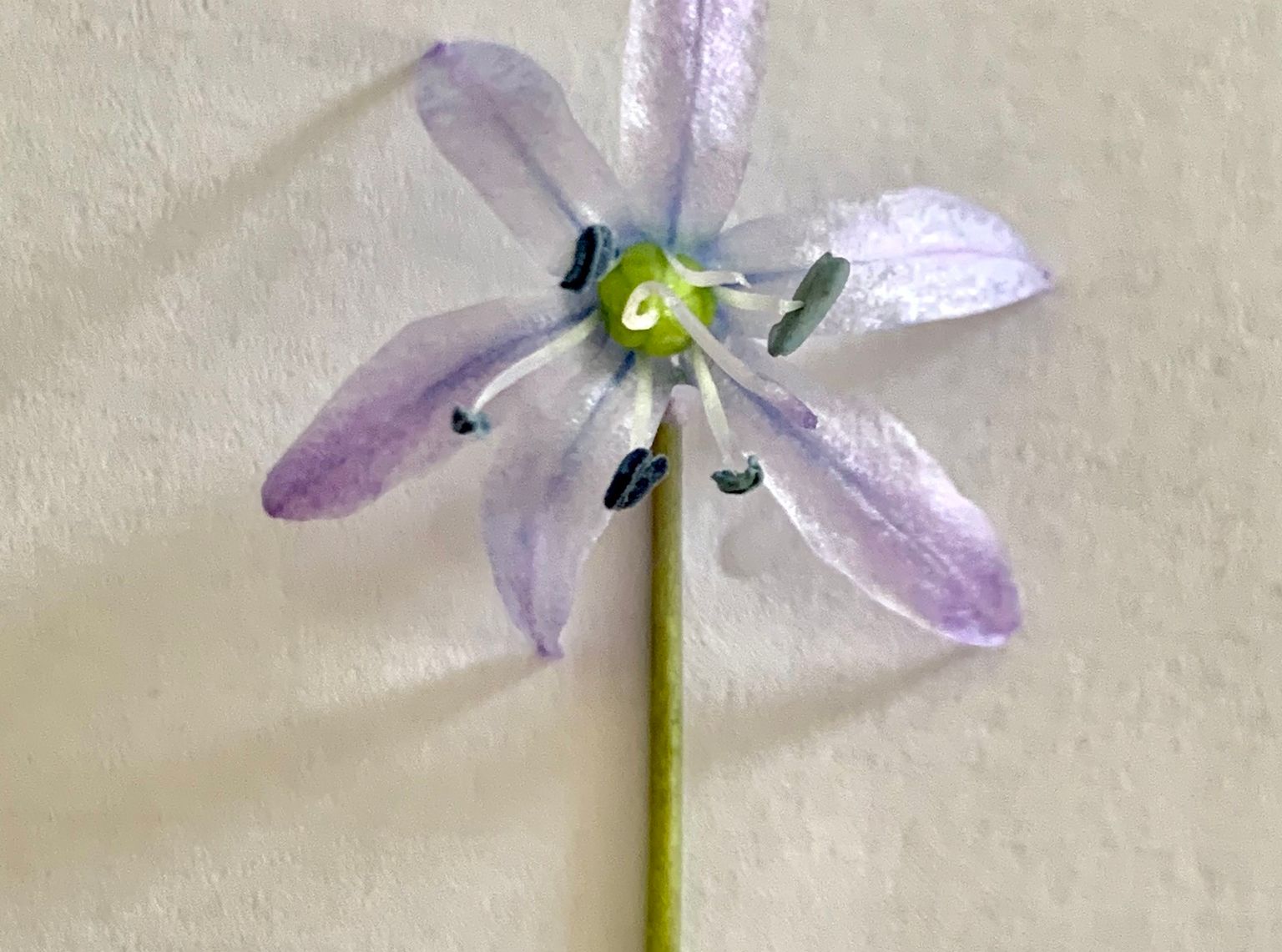
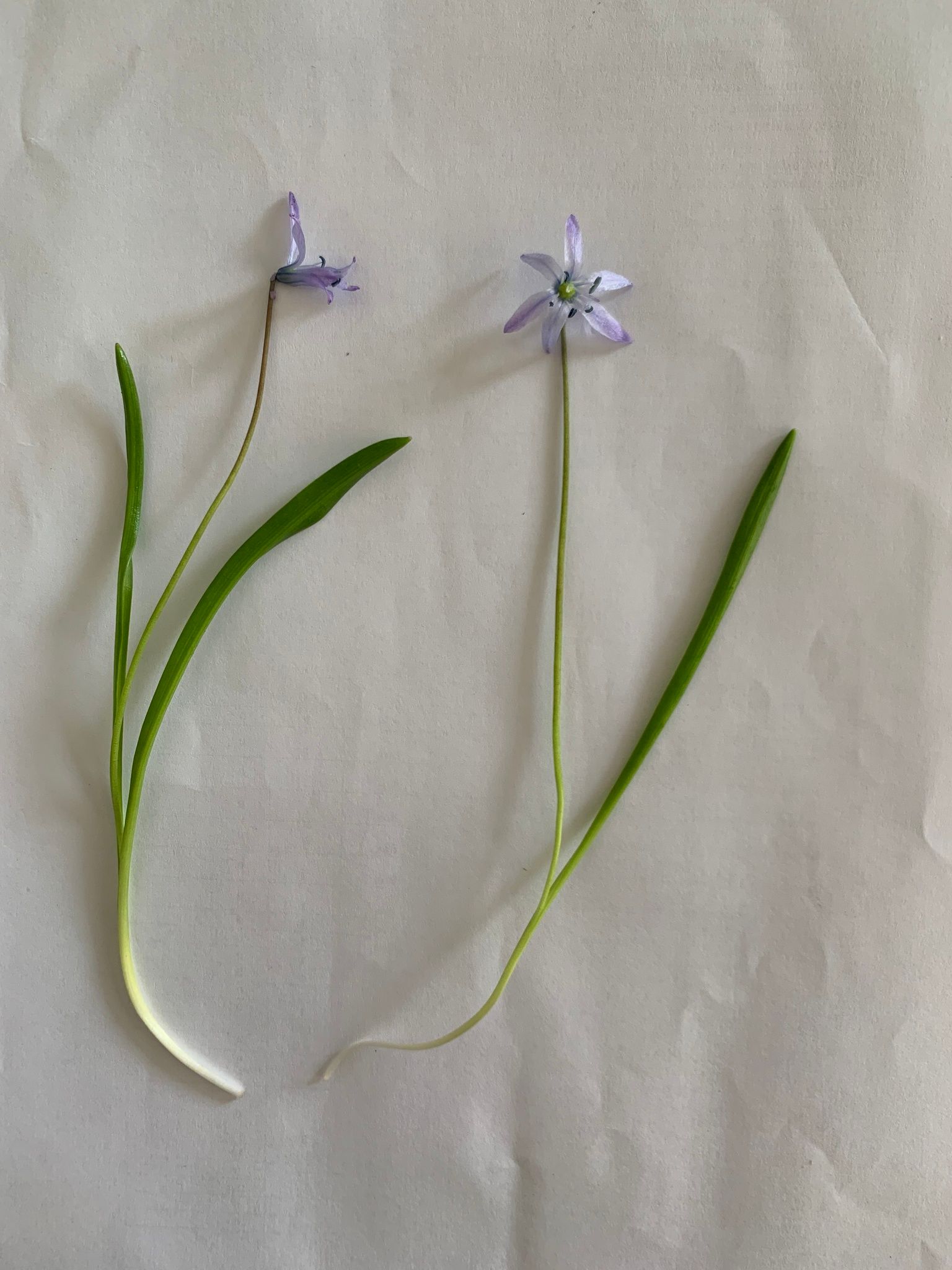
Scilla kurdistanica is a small spring squill, a bulb a few inches tall with a single pale blue star of a flower, each petal marked with a darker central vein[1][2]. It is known only from the mountains of South Kurdistan (Başûr), from Duhok and the gorge of Rewandiz (Rowanduz) to Qeredax (Qara Dagh) near Silêmanî (Sulaymaniyah)[2][3][4], and it flowers in March and April, sometimes right below the melting snow[2][3]. Its name, given in 1976, says simply where it comes from: Kurdistan[1].
How it got its name
- Named by
- Speta, 1976Published in Naturk. Jahrb. Stadt Linz 22: 70
A squill with many names
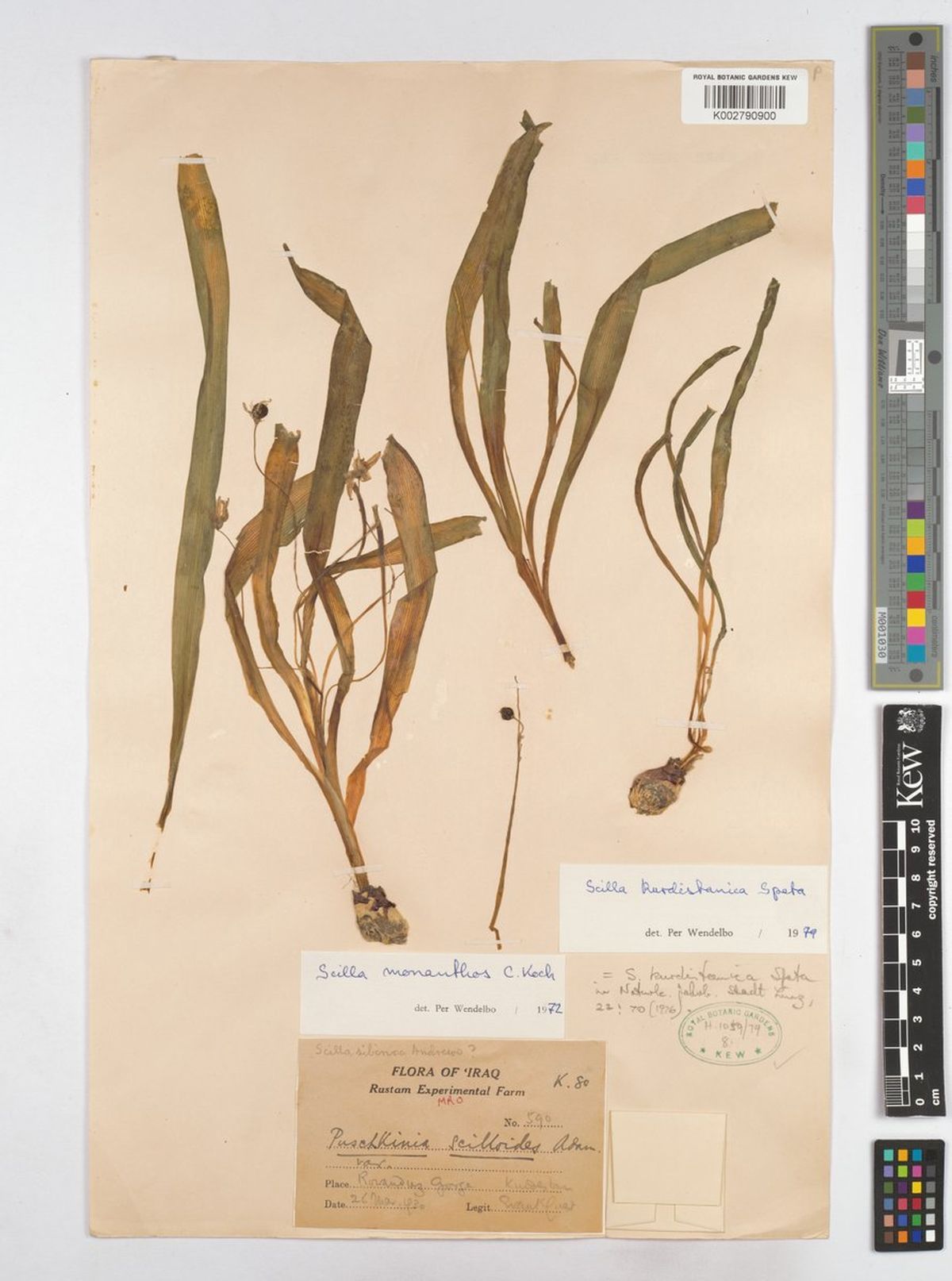
In late March 1930 the botanist Evan Guest (1902–1992)[5] was collecting in the Rewandiz gorge. He pressed several small blue-flowered bulbs and numbered them for the herbarium of the Rustam Experimental Farm[2][6]. His handwritten label is plain about where he was: "Rowanduz Gorge, Kurdistan"[2].
He was less sure what he had found. On the label he wrote Puschkinia scilloides, a related bulb, and someone later pencilled above it "Scilla sibirica Andrews ?"[2]. Over the next half-century the same little plant passed through a whole list of names on the sheets now kept at Kew[2]:
- Puschkinia scilloides, Guest's first guess (1930)[2];
- Scilla cernua, written above a crossed-out Puschkinia scilloides on a sheet from 1932[2];
- Scilla sibirica, the Siberian squill of gardens, on sheets from 1948 and 1958[2];
- "aff. S. hohenackeri", "close to" another squill, on a sheet from 1933[2];
- and in 1972 Scilla monanthos[2], from the botanist Per Wendelbo (1927–1981)[5]. Monanthos means "one-flowered", and fits a plant that carries a single flower on its stem[1]. Kew gives the range of S. monanthos as north-eastern Turkey to north-western Iran[4].
Then in 1976 the botanist Franz Speta (1941–2015)[7] published a short paper on new squills from the eastern Mediterranean region in its widest sense. Most of the squills grown outdoors in gardens come from there, he wrote, and the region's species were far from all known[1]. Among his new species was one from Guest's gorge. He chose one of Guest's 1930 specimens, number 593, kept at the Conservatoire et Jardin botaniques in Geneva, as the type, the specimen that fixes the name[1][6], and called the plant Scilla kurdistanica, the squill of Kurdistan[1].
His Latin description gives the place in a single line:
Typus: Iraq, Rowanduz gorge, 23. III. 1930, Guest 593 (G).[1]
Plate IX of his paper is a photograph of that type sheet, with its Rustam Experimental Farm label[1].
Three years later, in 1979, Wendelbo went back to the Kew sheets and re-labelled them Scilla kurdistanica[2]. On Guest's 1930 sheet someone added a note in ink, pointing to Speta's paper: "= S. kurdistanica Speta in Naturk. Jahrb. Stadt Linz, 22: 70 (1976)"[2]. The volume's pages are dated 31 December 1976[1], but in 1998 Speta dated it 14 June 1977[8]; Kew still cites the name from 1976[4].
What to look for
Speta's description, together with what the collectors noted on their labels, gives a clear picture[1][2]:
- an egg-shaped bulb, white inside, wrapped in a black tunic that is dark purple on the inner side, with simple white roots that are renewed every year;
- two to four sword-shaped leaves, already out when the plant flowers;
- a single flowering stem, half-round in section, carrying one flower on a stalk about 6 mm long, above tiny violet-tinged bracts about 1 mm long that are split in two;
- six petals 14–15 mm long and 2.5–4 mm wide, a whitish lapis blue with a darker midrib[1]; "pale blue with central darker vein" in the words of Oleg Polunin's 1958 label[2]; they fall once flowering is over[1];
- white, thread-like stamens 8–9 mm long, widened at the base and violet at the tip, with grey-violet anthers, and a style about 7 mm long;
- round seeds with a warty coat and a white fleshy appendage, an elaiosome[1].
The whole plant is small. Polunin found it "in leafmould under boulders and in scrub thickets", and gave its height as 3 inches, about 7.5 cm[2].
Where it grows
Kew's checklist gives its native range simply as northern Iraq[4]; in Kurdish terms, that makes it a plant found only in Başûr. The herbarium sheets and one modern photograph give a handful of places, all in the mountains[2][3]:
- Rewandiz: the gorge, where Guest collected the first plants in March 1930[2][6]; a stony mountainside near Rewandiz at 3,000–4,000 ft (about 900–1,200 m), "below melting snow", in April 1932[2]; and a vertical cliff face near Rewandiz at 2,500 ft (about 760 m) in April 1933, where Guest was collecting with the botanists Alexander Eig (1894–1938) and Michael Zohary (1898–1983)[2][5].
- Sefîn (Safin) above Şeqlawe (Shaqlawa): at 1,100 m in March 1948, where Ali Al-Rawi and Jan Gillett noted it as "abundant"[2]; and at 5,000 ft (about 1,500 m) in April 1958, in "sheltered, earthy places under rocks"[2].
- Qeredax (Qara Dagh): at 4,000 ft (about 1,200 m) in April 1958, in wet "flushes" among sedges (Carex and Eleocharis)[2].
- Duhok: a single photographed find, in March 2021[3].
The flowering dates on the sheets run from late March to the third week of April[2], and the 2021 plants were in flower in mid-March[3].
It is not a plant that is often seen. GBIF, the global database of specimens and observations, holds just 13 records, 12 of them herbarium sheets, the most recent from 1958[9], and only one observation has been posted to iNaturalist[3]. A 2018 study of the plant habitats of the Qeredax and Derbendîxan (Darbandikhan) area lists S. kurdistanica among the area's endemic species and calls it "Very rare"[10]. Nature Iraq's profile of Qeredax as a Key Biodiversity Area counts it among the endemics known there only from historical records, not seen on recent surveys[11]. Its conservation status has not been assessed for the IUCN Red List[9].
Its relatives
Speta placed S. kurdistanica among the relatives of Scilla siberica[1], the group of early blue squills that includes the Siberian squill of gardens. Another of the eleven squills in his 1976 paper, Scilla leepii, comes from near Maden on the Tigris in North Kurdistan (Bakur), a plant with one to three nodding flowers on each stem[1].
In 1998 Speta went a step further. In a long analysis of the old, wide genus Scilla, he split it into many smaller genera and gave the S. siberica group a genus of its own, Othocallis: about 20 species, which he recorded from Ukraine and the Caucasus to western Iran, northern Iraq, eastern Turkey and the Levant[8]. In his account these squills have short-lived white roots, blue petals that are barely joined at the base and fall off, and fruits that stay juicy until they are ripe[8]. Our squill became Othocallis kurdistanica[8][5]. Kew's checklist still accepts it as Scilla kurdistanica[4], and that is the name used on this page.
Squills are still being found in the mountains of Kurdistan. In 2020 the botanists Mehmet Fırat and Hasan Yıldırım described Scilla hakkariensis from rocky ground and hawthorn clearings in Şemzînan (Şemdinli) in Colemêrg (Hakkâri), Bakur, not far from Başûr; they thought it "might be discovered on the Iraqi border" too[12]. They also recorded a Kurdish name used for it by local people in Şemzînan[12].
Kurdish names
Edîb Polat's plant list Flora Kurdistanê in the journal Kurmancî (2006) gives gêlik for Scilla kurdistanica[13]. The list came out of the Kurmancî working group's spring 2006 meeting in Duhok, where Kurdish and scientific plant names were the main item of work, with members from both Başûr and Bakur[13].
Ehmedê Dirihî's dictionary of Kurdish plant names (2013) has two more names for this species: gêlika kurdistan, which Dirihî attributes to the Kurmancî journal, although its 2006 list prints only gêlik[13], and gêlka kurdistan, from Şefîq Qazaz's Sorani dictionary[14]. Both mean "the gêlik of Kurdistan" (our translation) and follow the scientific name, so they are dictionary names rather than names recorded in the field.
Gêlik is not only this plant's name. On the same page Dirihî gives gêlik, from Wahby and Edmonds's Sorani dictionary, for the English bluebell, Hyacinthoides non-scripta, and gêlk, from Qazaz, with the note "dibe ku, Hyacinthus orientalis be", "it may be Hyacinthus orientalis", the hyacinth (our translation)[14]. For the squills as a genus he lists gezîze[14], a name he also gives for the bellflowers (Campanula) and for Ixiolirion tataricum[14]. So gêlik is used for more than one small blue spring bulb, and Scilla kurdistanica is the one that carries Kurdistan in its scientific name.
Sources
- 1.Speta, F. (1976). Neue Scilla-Arten aus dem östlichen Mittelmeerraum. Naturkundliches Jahrbuch der Stadt Linz 22: 65–72.
- 2.Royal Botanic Gardens, Kew – Herbarium Specimens. via GBIF. gbif.orghttps://www.gbif.org/dataset/cd6e21c8-9e8a-493a-8a76-fbf7862069e5
- apqwherbarium specimens K002790900, K002790901, K002790902, K002790903, K002790915 and K002790916 (via GBIF); K002790915.
- bcglmoryherbarium specimens K002790900, K002790901, K002790902, K002790903, K002790915 and K002790916 (via GBIF).
- defhnsherbarium specimens K002790900, K002790901, K002790902, K002790903, K002790915 and K002790916 (via GBIF); K002790900.
- itherbarium specimens K002790900, K002790901, K002790902, K002790903, K002790915 and K002790916 (via GBIF); K002790901.
- jherbarium specimens K002790900, K002790901, K002790902, K002790903, K002790915 and K002790916 (via GBIF); K002790903, K002790915, K002790916.
- kuherbarium specimens K002790900, K002790901, K002790902, K002790903, K002790915 and K002790916 (via GBIF); K002790902.
- vherbarium specimens K002790900, K002790901, K002790902, K002790903, K002790915 and K002790916 (via GBIF); K002790903.
- xherbarium specimens K002790900, K002790901, K002790902, K002790903, K002790915 and K002790916 (via GBIF); K002790916.
- 3.abcdefiNaturalist. observation 144555690 (Ibrahim Hirory, 2021). inaturalist.orghttps://www.inaturalist.org/
- 4.Plants of the World Online. Royal Botanic Gardens, Kew.
- 5.International Plant Names Index. Royal Botanic Gardens, Kew, Harvard University Herbaria and Australian National Herbarium.
- abcauthor records for Speta, Guest, Wendelbo, Eig and Zohary.
- dOthocallis kurdistanica (Speta) Speta, urn:lsid:ipni.org:names:1003477-1. ipni.orghttps://www.ipni.org/n/1003477-1
- urn:lsid:ipni.org:names:540862-1. ipni.orghttps://www.ipni.org/n/540862-1accessed 14 November 2026
- 6.abcConservatoire et Jardin botaniques de Genève (G) – Herbarium. via GBIF, herbarium specimen G00176243 (via GBIF).
- 7.↩Greilhuber, J. & Speta, E. (2016). Franz Speta (1941–2015) zum Gedenken. Neilreichia 8: 245–262.
- 8.Speta, F. (1998). Systematische Analyse der Gattung Scilla L. s.l. (Hyacinthaceae). Phyton (Horn) 38(1): 1–141.
- 9.abGBIF.org GBIF Backbone Taxonomy and occurrence records. org, occurrence records of Scilla kurdistanica (accessed 15 November 2026). gbif.orghttps://www.gbif.org/
- 10.↩Ahmad, S. A., Ahmad, N. S., Salih, S., Raza, H. A. & Ararat, K. (2018). Plant habitat study of QaraDagh-Darbandikhan area. Journal of Zankoy Sulaimani Part A, special issue: 621–635.
- 11.↩Nature Iraq. Key Biodiversity Areas of Iraq: Qara Dagh (IQ039).
- 12.Fırat, M. & Yıldırım, H. (2020). Scilla hakkariensis. sp. nov. (Asparagaceae: Scilloideae): a new species of Scilla L. from Hakkari (eastern Anatolia). Adansonia 42(2): 89–94. doi:10.5252/adansonia2020v42a2https://doi.org/10.5252/adansonia2020v42a2
- 13.Edîb Polat (2006). Flora Kurdistanê (I). institutkurde.orghttps://www.institutkurde.org/publications/kurmanci/
- 14.Ahmet Kasımoğlu (Ehmedê Dirihî) (2013). Ferhenga Navên Nebatan a Kurdî (Dictionary of Kurdish Plant Names). Mardin Artuklu University, Institute of Living Languages in Turkey (ISBN 978-605-4202-12-6).
Last updated 20 November 2026