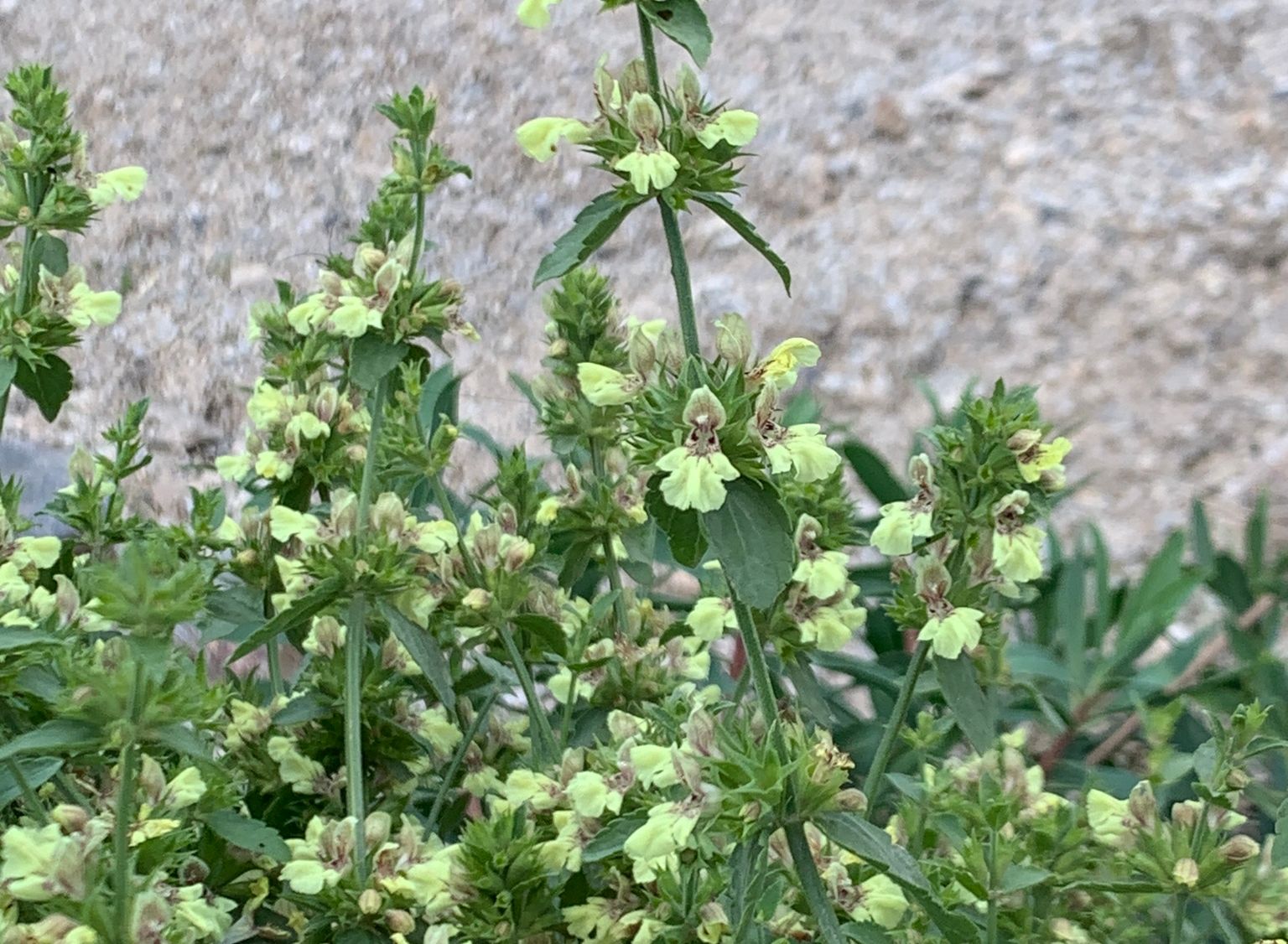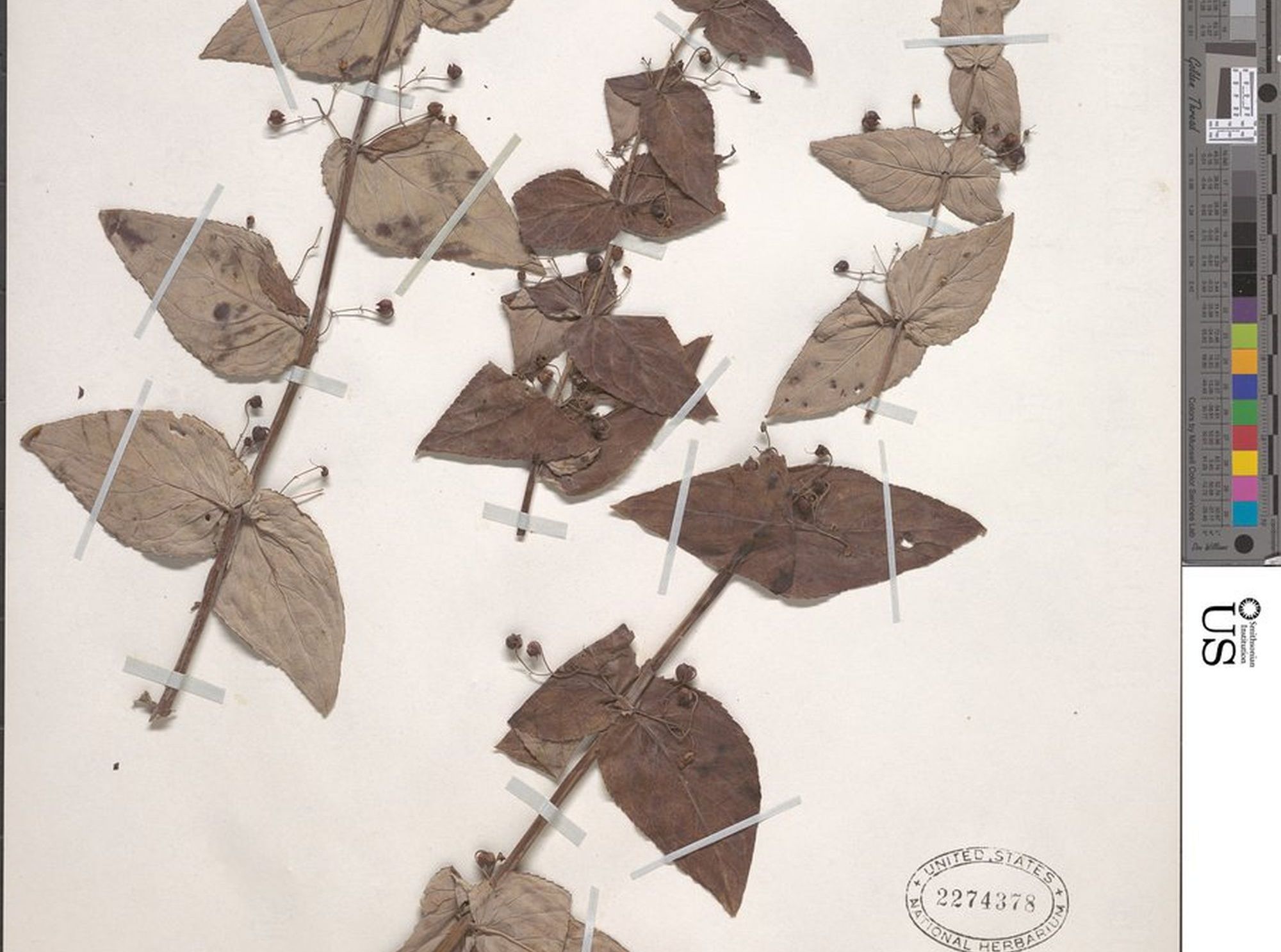
Scrophularia kurdica is a figwort of the high rocks of Kurdistan: a leafy, sticky-haired plant with small, dusky green flowers that grows in the shade of cliffs and in rock crevices, from about 1,200 m up to the edge of the snow[1][2]. It was found in Başûr in 1933, named for Kurdistan by a botanist who did not live to see the name in print, and is known today from a handful of mountains in Başûr, Bakur and Rojhilat[2][3][4][4][4][5].
How it got its name
- Named by
- Eig, 1944Published in Palestine J. Bot., Jerusalem Ser. 3: 81
Rocks near the snow
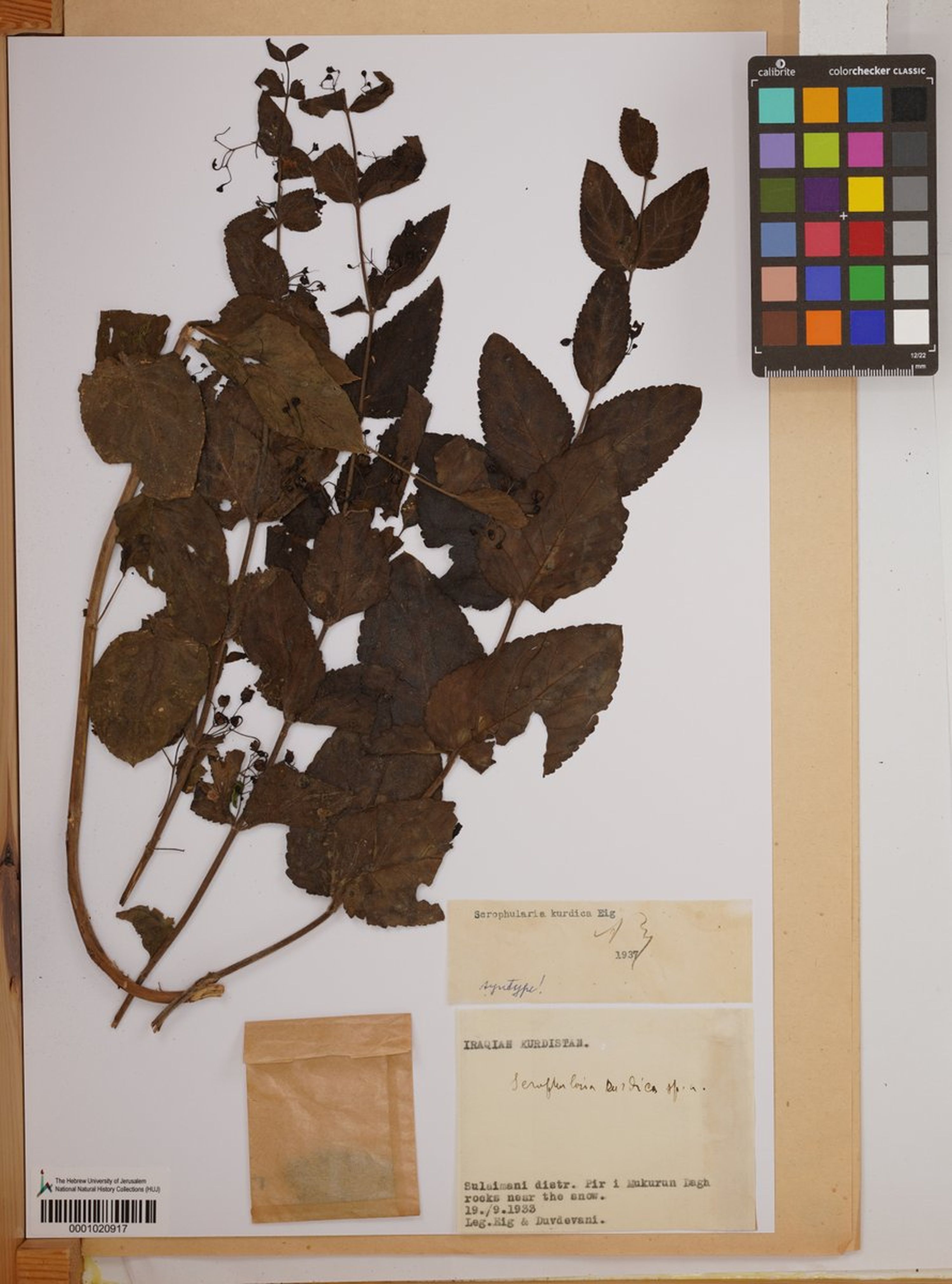
On 19 September 1933 two pairs of botanists were at work in the mountains of the Silêmanî (Sulaimani) district in Başûr. Alexander Eig (1894–1938)[6] and Duvdevani climbed Pîremegrûn (Pira Magrun), which their label calls "Pir i Mukurun Dagh", and on the rocks near the snow they pressed a figwort that Eig would later describe as new to science[1][7]. The same day Michael Zohary (1898–1983)[6] and Amdursky collected the same plant on rocks at a place called Mergapan, at 1,200–1,300 m[1].
They were part of a longer journey through Başûr that September: the same revision records Eig, Zohary and Naomi Feinbrun in an oak wood at Kanitacht in the Qeredax (Qara Dagh) on 10 September, and Feinbrun near the village of Sersing (Sarsink) on 26 September[1]. On Pîremegrûn, Eig and Duvdevani also gathered a second figwort, S. libanotica[1]. The plants went to the herbarium of the Hebrew University in Jerusalem, where Eig was revising its figworts, a collection made "chiefly by the author and his collaborators"[1].
The sheet from Pîremegrûn is still there. Its field label is typed "IRAQIAN KURDISTAN", with Scrophularia kurdica sp. n. written in by hand, and a second slip carries the typed name, Eig's signature and the year 1937[7]. Pîremegrûn is the high mountain north-west of the city of Silêmanî that some writers identify with Mount Nisir, where the boat comes to rest in the flood story of the Epic of Gilgamesh.
A name published after its author's death
Eig died in 1938[6]. His Revision of the Oriental Scrophularia Species of the Herbarium of the Hebrew University came out in the Palestine Journal of Botany in November 1944, and the first footnote on its first page says only: "Posthumous."[1].
On page 81 is the new species, Scrophularia kurdica Eig, with a Latin description, the two gatherings of 19 September 1933 and a photograph on Plate II[1]. Both gatherings are its original material, the syntypes[1][2]. Eig told it apart from S. divaricata by its short-stalked, unlobed leaves and round capsule, and from S. crenophila, a figwort of Rojhilat, by its flower clusters that rise from the leaf axils[1].
The same paper named a second new figwort from Başûr, S. guestii, collected in July 1932 by E. R. Guest by a stream at 8,500 feet on a mountain the paper spells "Arl-Gird-Dagh". Eig wrote that its flower clusters and capsules set it apart at once from S. kurdica[1].
What to look for
Eig's description, with a few later notes[1][8][4]:
- a plant 40–50 cm tall, covered all over in short, slightly sticky hairs and partly glandular;
- leafy stems, usually unbranched, almost round or bluntly angled rather than sharply square;
- large leaves on very short stalks or none, oval to oblong, round-toothed to saw-toothed, often slightly heart-shaped at the base. In Başûr, the key to Iraq's figworts singles it out by its dark green stems and leaves and its almost stalkless leaves[8];
- loose, spreading clusters of five to many flowers rising from nearly every leaf axil, on stalks 2–2.5 cm long, all of it glandular;
- small flowers, 7 mm long and 4 mm wide, which Eig called fusco-virens, a dusky green. A collector on the mountains of Hewlêr in 1947 noted them as "dull reddish brown + greenish"[4];
- a round capsule about 4 mm long with a short point.
Lall's thesis, written from more sheets, widens some of these figures: plants 35–50 cm, "completely glabrous to densely glandular-puberulent", that is from quite hairless to thickly covered in sticky hairs, leaf blades 4.3–9.2 cm long, clusters of 4 to 20 flowers, and corollas "greenish-red to brown". He gives June to August for flowering[9].
Biennial or perennial?
Eig described the plant as biennis, living for two years[1]. When Peter Davis and Oleg Polunin found it in Bakur in 1954, Davis wrote "Peren." on his label: perennial[3]. Samuel S. Lall, revising the figworts of Turkey for his Edinburgh doctoral thesis of November 1969, left both doors open: "biennial or perennial"[9]. His identification slips, dated 1969, are on one of the Cîlo sheets and on the Pîremegrûn and Tarshin sheets[3][4][4]. Kew's checklist today lists it as a perennial[10]. Living plants are rarely seen: the authors of a 2018 synopsis of the figworts of Turkey did not find it during their fieldwork in Colemêrg (Hakkâri) and worked from herbarium sheets[2].
From Pîremegrûn to Cîlo
Every record of S. kurdica is a mountain one, and almost every one is a rock[2][3][4][4][4][5]:
- Başûr: Pîremegrûn again in June 1948, at 2,000 m, collected by Dr Rawi of the National Herbarium of Iraq[4]; "among igneous rocks usually by streams" at 2,250 m at Tarshin near Sev Kurawa, in the mountains of Hewlêr (Erbil), in August 1947, where it was noted as "occasional"[4]; and on the rocky slopes of Hewraman in June 1961[4].
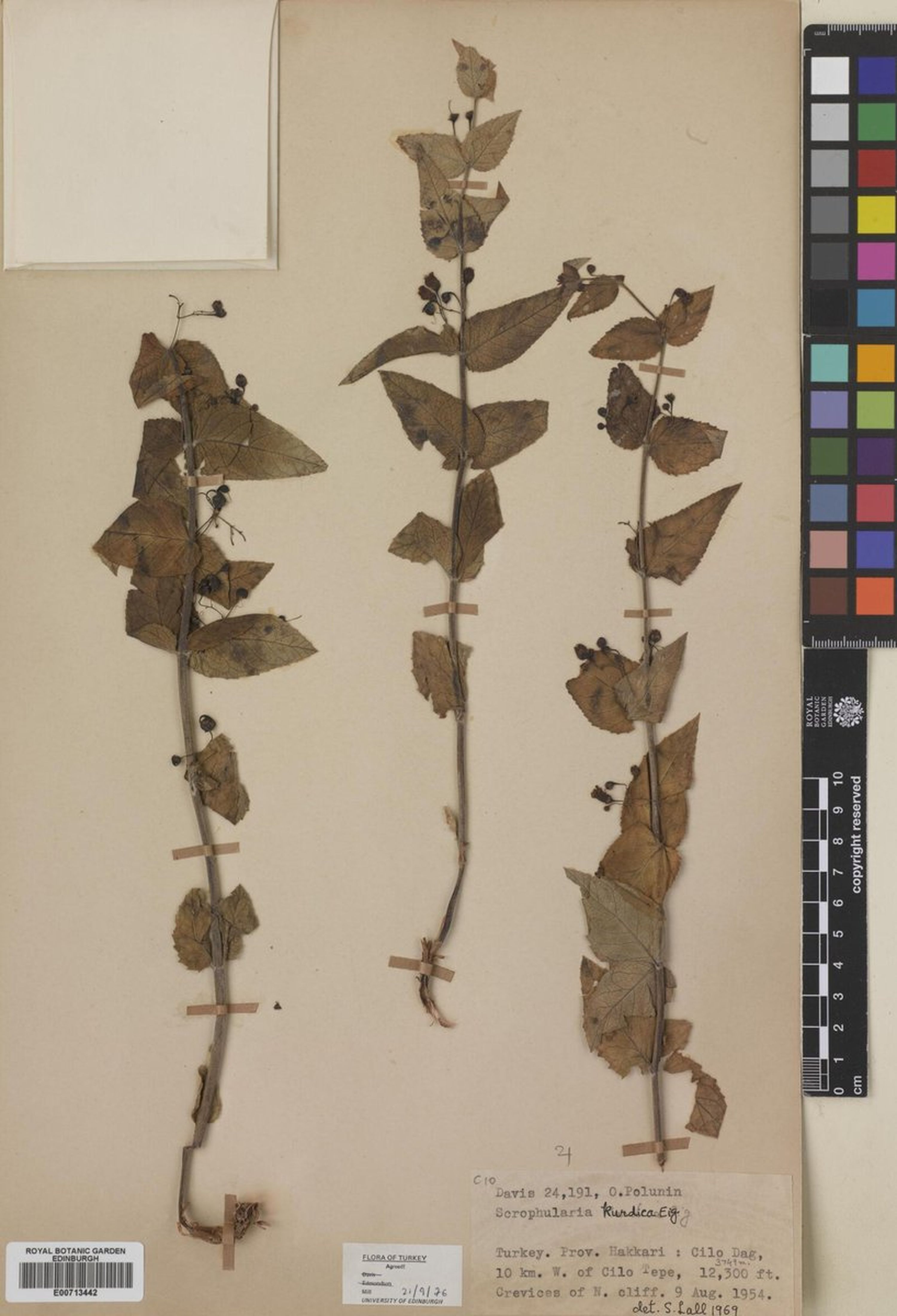
- Bakur: on Mount Cîlo in Colemêrg (Hakkâri), where Davis and Polunin found it in August 1954 "among shady rocks" in the Diz valley (Diz Deresi) at 5,800 ft, about 1,770 m, and in the crevices of a north-facing cliff at 12,300 ft, about 3,750 m[3].
- Rojhilat: on Chalil Kuh, in the mountains west of Urmia, where Karl Heinz Rechinger collected it in rock crevices at 1,750–2,000 m in July 1974: on 2 July in the gorges north of Razhan, and on 4 July north-west of Silîvana (Silvaneh)[5].
Lall summed up its home in 1969 as "wet, shady rocks and crevices, 1200-3749 m"[9], and the 2018 synopsis repeats those words[2]. It was Lall who added S. kurdica to the list of Turkey's figworts, from Davis and Polunin's two gatherings on Cîlo in Bakur[9]. The herbarium sheets were gathered between early June and late September[7][3][4][4][4][5].
A smooth subspecies and a garden in Munich
In 1981 the Munich botanist Jürke Grau (1937–2022)[6] described Rechinger's plants from Chalil Kuh in Flora Iranica as a subspecies of their own, S. kurdica subsp. glabra: glabra is Latin for smooth, hairless[6]. Its type is Rechinger's gathering of 2 July 1974 from the rock crevices in the gorges north of Razhan, 1,800–2,000 m[5].
Grau also went through the older sheets at Kew. In 1978 he named Dr Rawi's 1961 plants from Hewraman as the typical subspecies, S. kurdica subsp. kurdica[4], and the 1947 plants from Tarshin as subsp. glabra[4]. The Washington duplicate of that Tarshin gathering is marked "PARATYPE", one of the further specimens cited with the new subspecies[4]. So both forms grow in Başûr.
The smooth form also travelled. A plant grown from Rechinger's gathering was cultivated in the Munich Botanical Garden, and in July 1996 specimens from it were pressed and shared among herbaria through a European plant-exchange society. Their label adds a detail found nowhere else in the record: Grau counted its chromosomes, 2n = 42[11].
Kurdish names
No Kurdish name recorded in the field is known for this plant. Ehmedê Dirihî's dictionary of Kurdish plant names (2013) gives two dictionary names, both without a place or informant code: gezikê kurdan (p. 255) and giyaberazê kurdan (p. 274), each listed with the other[12]. Like the Latin kurdica, both say "… of the Kurds".
They are built on two names Dirihî gives for other figworts: gezik, for the genus Scrophularia and for S. orientalis, and giyaberaz, also for S. orientalis, where it carries the code PS[12]. In Amêdî, a 2017 study recorded brouk for S. macrophylla and bruk for S. rubricaulis, both used in ointments for redness, spots and freckles[13].
Sources
- 1.Eig, A. (1944). Revision of the Oriental Scrophularia species of the Herbarium of the Hebrew University. Palestine Journal of Botany, Jerusalem Series 3(2): 79–93, pl. II.
- 2.abcdefUzunhisarcıklı, M. E., Doğan Güner, E. & Ekici, M. (2018). Synopsis of the genus Scrophularia (Scrophulariaceae) in Turkey. Phytotaxa 333(2): 151–187. doi:10.11646/phytotaxa.333.2.1https://doi.org/10.11646/phytotaxa.333.2.1
- 3.abcdefRoyal Botanic Garden Edinburgh Herbarium (E), specimen catalogue (via data.rbge.org.uk and GBIF). herbarium specimens E00713442, E00713443 and E00713444 (Davis & Polunin, 1954; via GBIF). data.rbge.org.ukhttps://data.rbge.org.uk/herb/
- 4.Royal Botanic Gardens, Kew – Herbarium Specimens. via GBIF. gbif.orghttps://www.gbif.org/dataset/cd6e21c8-9e8a-493a-8a76-fbf7862069e5
- 5.abcdeNatural History Museum Vienna (W) – Herbarium. via GBIF, W 1984-0002336, and Royal Botanic Garden Edinburgh, E01096951 (Rechinger 48719 and 48908, 1974; via GBIF).
- 6.International Plant Names Index. Royal Botanic Gardens, Kew, Harvard University Herbaria and Australian National Herbarium.
- 7.abcHebrew University of Jerusalem herbarium (HUJ), specimen 0001020917, syntype of Scrophularia kurdica (via GBIF).
- 8.abGhazanfar, S. A. & Haloob, A. (2017). Scrophularia amadiyana (Scrophulariaceae), a new species from Iraq and a key to Scrophularia in Iraq. Kew Bulletin 72: 17. doi:10.1007/s12225-017-9683-8https://doi.org/10.1007/s12225-017-9683-8
- 9.Lall, S. S. (1969). Taxonomic studies in the genus Scrophularia. PhD thesis, University of Edinburgh.
- 10.Plants of the World Online. Royal Botanic Gardens, Kew.
- ↩Scrophularia kurdica.
- plant_name_id 2586599. powo.science.kew.orghttps://powo.science.kew.org/taxon/urn:lsid:ipni.org:names:809281-1accessed 14 November 2026
- 11.↩Muséum national d'Histoire naturelle, Paris, herbarium specimen P04571031 (Société pour l'Échange des Plantes vasculaires de l'Europe et du Bassin méditerranéen, fasc. 27, no. 18439; via GBIF).
- 12.abAhmet Kasımoğlu (Ehmedê Dirihî) (2013). Ferhenga Navên Nebatan a Kurdî (Dictionary of Kurdish Plant Names). Mardin Artuklu University, Institute of Living Languages in Turkey (ISBN 978-605-4202-12-6).
- 13.↩Shimal Ahmed Tahir (2017). Plant biodiversity and ethnobotanical properties of various plants in Amedi (Duhok, N. Iraq). tez.yok.gov.trhttps://tez.yok.gov.tr/UlusalTezMerkezi/
Last updated 20 November 2026