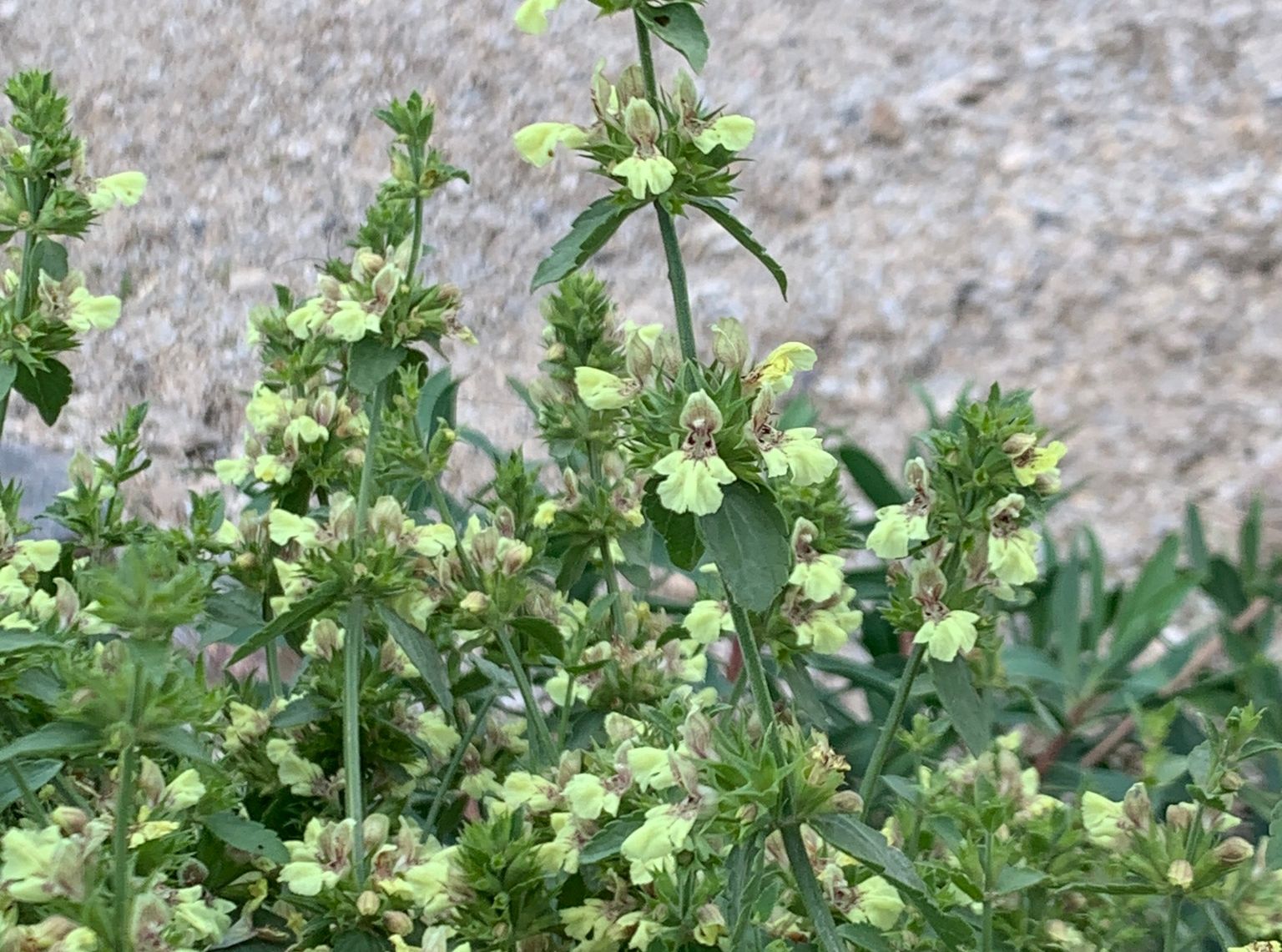
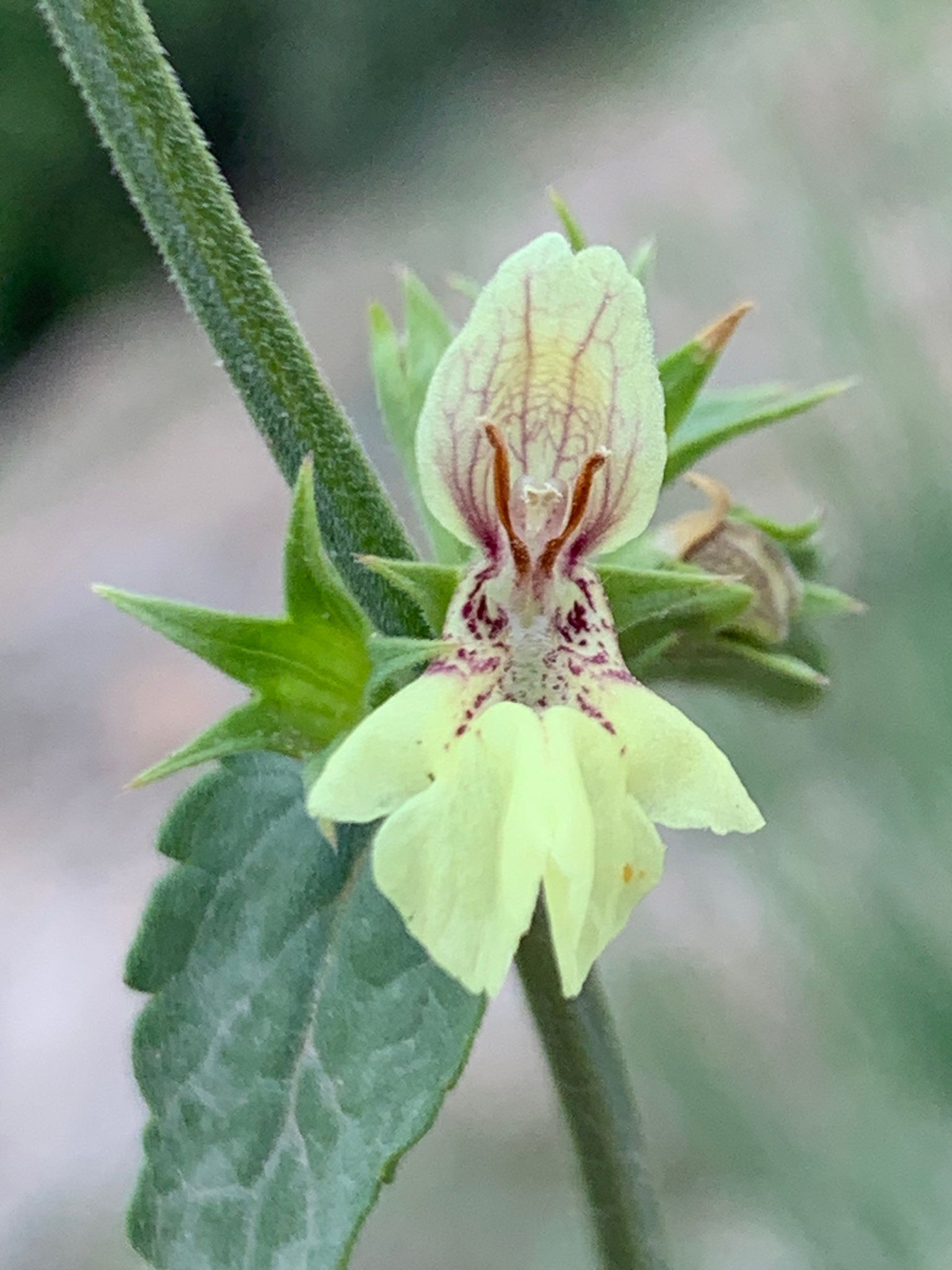
Stachys kurdica is a yellow-flowered woundwort of the rocks of the Kurdish mountains: a slender, aromatic perennial with thin, four-angled, wiry stems, a few toothed leaves and short heads of lemon- to sulphur-yellow two-lipped flowers[1][2][2][2]. It was first gathered on Mount Gara in South Kurdistan (Başûr) in August 1841, and nearly every record since comes from the mountains of Başûr, North Kurdistan (Bakur) and East Kurdistan (Rojhilat), from Cûdî and Colemêrg to Hewraman and Merîwan[1][3][2][2][2][2][4][2][5]. Its epithet, kurdica, means simply "Kurdish".
How it got its name
- Named by
- Boiss. & Hohen., 1844Published in Diagn. Pl. Orient. 5: 31
A deep-yellow woundwort from Mount Gara
On 10 August 1841, the plant collector Theodor Kotschy (1813–1866)[6] was working the rocks of Mount Gara, where a week earlier, on 3 August, he had gathered the Kurdish hollyhock (Alcea kurdica, in Kurdish hêro)[7][8]. Among the rocks he pressed a thin, almost leafless woundwort. Its printed label, issued two years later, says where: "In rupestribus totius m. Gara Kurdist.", "in rocky places all over Mount Gara, Kurdistan"[7].
Like the rest of his Kurdish plants, it was arranged and sent out to herbaria by the missionary Rudolph Friedrich Hohenacker (1798–1874)[6] as number 390 of his series "Pl. alepp. kurd. moss.", plants of Aleppo, Kurdistan and Mosul, "Ed. Hohenacker. 1843"[7] (our expansion of the abbreviations). The label already carried a name and a diagnosis in miniature: Stachys kurdica Boiss. et Hohenack. n. sp., close to Stachys subnuda "but distinct in its elongated, toothed leaves and shorter, broader calyx teeth"[7] (our translation). Duplicates of that one gathering now lie in at least eleven herbaria, from Kew, London, Paris and Vienna to Munich, Jena, Halle, Zürich, St. Louis, Washington and Harvard[9].
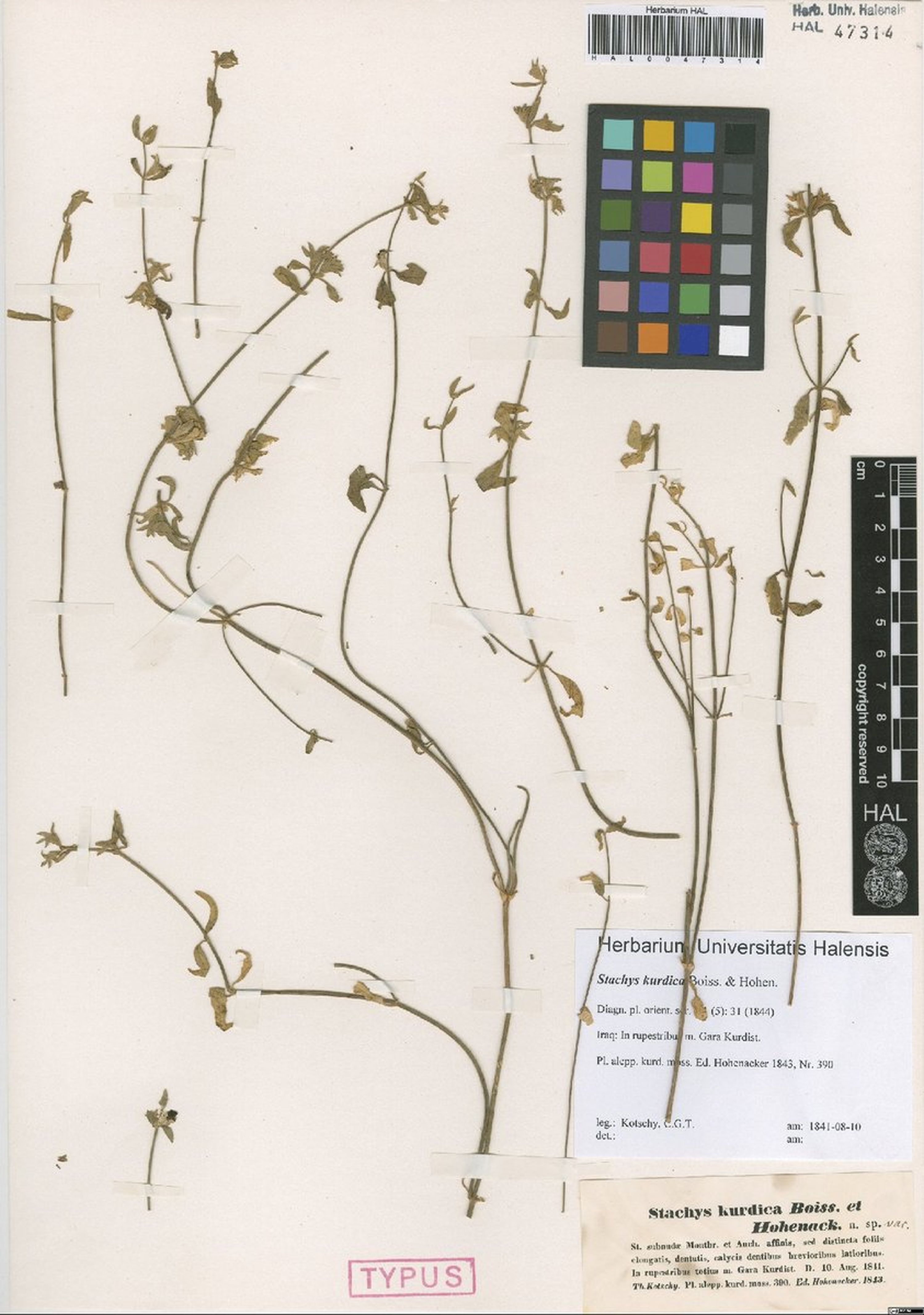
In 1844 the botanist Edmond Boissier (1810–1885) published the species properly in his Diagnoses of new Eastern plants, under his and Hohenacker's names[1][6]. His Latin portrait is of an unusual plant:
… corollæ intensè flavæ brevissimè hirtulæ tubo calyce incluso, labiis abbreviatis. Hab. in rupibus montis Gara Kurdistaniæ Kotschy.
… the corolla deep yellow, very shortly hairy, its tube hidden in the calyx, the lips shortened. It grows on the rocks of Mount Gara in Kurdistan, Kotschy.[1] (our translation)
The colour is the first thing he gives for the flower: "intensè flava", deep yellow. Boissier described slender, wand-like, four-angled stems about a foot and a half long (roughly 45 cm), branching widely and almost bare, with distant, narrowly lance-shaped, toothed leaves up to an inch or an inch and a half long, and whorls of four to eight flowers crowded into small heads at the tips of the branches[1]. He compared it with Stachys subnuda, a pale-flowered species collected on the Euphrates, and kept the two apart: S. subnuda has smaller, almost untoothed leaves, whorls set far apart along the stem, narrower calyx teeth and a corolla tube that just shows[1].
On the same page Boissier described a second woundwort from the same rocks of Gara, the grey-felted Stachys kotschyi[1]. Kotschy's days on Mount Gara gave science two new woundworts at once.
Sunk, and raised again
Thirty-five years later, in the fourth volume of his Flora Orientalis (1879), Boissier changed his mind. He now treated the Kurdish plant as only a variety of S. subnuda, "β. Kurdica", with leaves becoming hairless, larger and toothed, and the lower floral leaves sometimes longer than the flowers[3]. He added a second place for it, the mountains "Avroman et Schahu", Hewraman and Şaho, at 5,000–7,000 feet (about 1,500–2,100 m), where Heinrich Haussknecht (1838–1903) had collected it[3]. And he gave the stems a good word: "tetragoni juncei", four-angled and rush-like[3].
Collectors went on writing the species name on their labels: "Stachys kurdica Boiss" on the sheet Peter Hadland Davis (1918–1992) and Oleg Polunin collected in 1954, "Stachys kurdica Boiss. et Hohen." on the one Karl Heinz Rechinger (1906–1998) collected in 1957[6][2][4]. In 1974 the botanist Reba Bhattacharjee, in a study of Stachys from Turkey in the Notes from the Royal Botanic Garden Edinburgh, treated it as a species again, with Boissier's variety name listed as a synonym[10][6]. S. kurdica, she wrote, "is closely allied to S. subnuda", but differs in its oblong-lanceolate middle stem leaves and in its broad calyx teeth with soft, blunt, non-rigid tips[10]. Kew's world checklist accepts it as a species today[11].
A plant that looked like black horehound
Meanwhile the Kurdish woundwort had been given other names. In June 1867 Haussknecht had collected two woundworts in the mountains he called Pir Omar Gudrun, at 4,000 and 5,000 feet[12][13]. In 1875 the botanist Wilhelm Vatke (1849–1889)[6] described both as new species in the Botanische Zeitung, placing the mountains in "Kurdistaniae persicae", Persian Kurdistan[12]. This is the mountain known in Kurdish as Pîremegrûn, near Silêmanî in Başûr, where GBIF files the sheets[13]; Christopher Davidson photographed the plant there again in 2010 (see below). Vatke's two species were:
- Stachys ballotiformis, softly hairy, with stems clothed in down-turned hairs and a corolla up to 1.2 cm long. Its name means "shaped like Ballota", because, he wrote, "habitu quodammodo Ballotam nigram refert": "in habit it somewhat recalls black horehound"[12] (our translation).
- Stachys plebeia, from the same region, which "at first sight seems very different" from the first, "but perhaps it is nothing but an abnormal state of it". Its fruiting calyx teeth were very unequal and very blunt, and Vatke ended with a question: "an monstrositate?", "or by some malformation?"[12] (our translation).
Neither name has lasted: in the GBIF Backbone Taxonomy both are now synonyms of S. kurdica subsp. kurdica, Boissier's plant[14]. It was not always so. The slips pinned to Davis's sheets from Cûdî and from the Sat mountains record that Bhattacharjee herself, in volume 7 of the Flora of Turkey, filed them as "Stachys ballotiformis Vatke": "fide Bhattacharjee in Davis, Fl. Turkey 7"[2][2].
Lemon, sulphur, pale yellow
Kotschy's printed label says nothing about colour, but every later field label that notes one says yellow[2][2][2][2]. In the Bakur mountains, Davis typed:
- on Cûdî, above Hessana near Silopî, on limestone rocks at 1,200–1,400 m, 11 May 1966: "Flower bud pale yellow"[2];
- in the Zap gorge, 8 km below Colemêrg (Hakkâri), on limestone rocks at 1,250 m, 21 June 1966: "Flowers lemon"[2];
- in the Sat mountains, between Varegöz and the Sat lake, in crevices of igneous rock at 2,400–2,600 m, 29 June 1966: "Flowers sulphur"[2].
Twelve years earlier, on 21 July 1954, Davis and Oleg Polunin had found it in a rocky ravine 8 km north of Satak in the province of Wan (Van), the town now called Çatak (Kurdish Şax), and noted a "very aromatic perennial" with ascending-erect stems and sulphur-yellow flowers[2].
From the Zap to Hewraman
The rocks of Gara were only the first of many. The labels place Stachys kurdica almost always on rock: limestone rocks, rock crevices, rocky ravines and gorges[1][3][2][2][2][2][4]. Where they give an altitude, it lies between about 1,200 and 2,600 m[15][2][2][2][2][4][2].
- Başûr: Mount Gara, the type locality[1][7]; the gorge of Rewandiz (Rawanduz) (Guest, 1932) and Sakri-Sakran above it at 2,200 m (Bornmüller, 1893)[15][5]; the Qorna Qaw valley north of Pushtashan at 1,300 m[5]; between Dihok and Amêdî, and between Kerkûk and Silêmanî[5]; near Silêmanî again in June 2010, on Pîremegrûn, which the photographer Christopher Davidson's record calls "Shakh-i Pira Magun"[16]; and in Hewraman (Hawraman) near the village of Tawêle (Tawilla), in crevices of limestone rocks at 1,400–1,600 m (Rechinger, June 1957)[4].
- Bakur: Cûdî above Silopî; the Zap gorge, the Sat mountains, Cilo and Çukurca around Colemêrg (Hakkâri); the mountain above the pass to Beytüşşebap; Sason; and north of Şax (Çatak)[2][2][2][2][5].
- Rojhilat: Hewraman and Şaho (Haussknecht)[3]; the Chehel Cheshmeh mountains north-east of Merîwan (Marivan) at 2,000 m (Rechinger, 1971)[2]; the road from Nodsheh to Merîwan, and the mountains west of Ûrmiye (Urmia) and Xoy (Khoy)[5]; Bîstûn near Kirmaşan (Kermanshah)[5].
Further south-east along the Zagros, it reaches Lorestan and the Bakhtiari mountains[5]. Kew gives its native range as south-eastern Turkey to western Iran[11], and Bhattacharjee as "SE Anatolia, N Iraq, W Iran"[10]: in Kurdish terms, mostly a plant of Bakur, Başûr and Rojhilat.
The herbarium labels date it in flower from May, when Davis found it in bud on Cûdî, to August, when Kotschy collected it on Gara[7][2]; a photograph from near Silêmanî shows it already flowering on 18 April 2025[17].
Two varieties and a subspecies
Bhattacharjee recognised two varieties[10]:
- var. kurdica, Boissier's plant, with broadly oblong-lanceolate calyx teeth as long as or slightly shorter than the calyx tube;
- var. brevidens, with broadly triangular calyx teeth, a name the collector Joseph Bornmüller (1862–1948)[6] had written but never published. Its type is Bornmüller's gathering from Sakri-Sakran above Rewandiz, at 2,200 m, on 23 June 1893. She found it "mainly in N Iraq", and also cited Davis's lemon-flowered plant from the Zap gorge[10][15][2].
In 2012 a plant from south-western Iran, described in 1941 as a species of its own, Stachys asterocalyx, was made a subspecies of the Kurdish woundwort, S. kurdica subsp. asterocalyx[6][11]. Its type was gathered by Otto Stapf on 9 May 1885 on Kuh Kaeble, in shady ravines south of Kazerun[18]. Kew lists that subspecies only from south-western Iran[11].
In 1980 Bhattacharjee placed S. kurdica in a small group of woundworts of eastern Anatolia, northern Iraq and western Iran, which, she wrote, grows "more often in xerophytic communities particularly on sloping rocks"[19].
Tea and powder around Şax
In English the genus Stachys is called woundwort, and in Kurdistan this one, too, ends up on wounds. A study of villages around Şax (Çatak) in Wan, summarised by Fatih Satıl and Mikail Açar in 2020, records that the aerial parts and flowering branches of S. kurdica are used as a tea and as a powder: for colds and stomach ache, and for livestock. The fresh plant is dried and pounded, and the powder put on the inflamed wounds of animals[20]. It was near Şax, too, that Davis noted how aromatic it was[2].
These are records of traditional use, not medical advice.
Kurdish names
No Kurdish name recorded from people can be given here yet for Stachys kurdica itself: the Çatak study prints one, but its spelling still has to be checked on the page. Ehmedê Dirihî's dictionary of Kurdish plant names lists çaya kurdan, with the variant çeya kurdan, a dictionary name whose wording mirrors the Latin. It carries no place or informant code, and the Turkish name beside it is kara deliçay[21]. Dirihî gives related names for other woundworts: çaya beyanî from Wan for the genus Stachys, and çaya çiya for Stachys lavandulifolia[21]. These are names for the genus and for other species, not for this one.
Sources
- 1.Boissier, E. (1844). Diagnoses Plantarum Orientalium Novarum, ser. 1, 1(4). Genève. archive.orghttps://archive.org/details/e.-boissier-diagnoses-plantarum-orientalium-novarum-series-1-vol.-1-no.-1-7-1843-1846
- 2.Royal Botanic Gardens, Kew – Herbarium Specimens. via GBIF. gbif.orghttps://www.gbif.org/dataset/cd6e21c8-9e8a-493a-8a76-fbf7862069e5
- adlqtxacaispecimen K006249148 (Davis 45361, 1966), via GBIF.
- bfknrvzaespecimen K006249214 (Davis 45635, 1966), via GBIF.
- cgioswaaafajspecimen K006249133 (Davis & Polunin 22977, 1954), via GBIF.
- ejmpuyadahspecimen K006249205 (Davis 42843, 1966), via GBIF.
- habagspecimen K006249150 (Rechinger 43016a, 1971), via GBIF.
- 3.Edmond Boissier (1879). Flora Orientalis, vol. 4. H. Georg, Geneva and Basel (Internet Archive).
- 4.abcdeSmithsonian Institution, US National Herbarium, specimen US 2636860 (Rechinger 10255, 1957), via GBIF.
- 5.abcdefghOther herbarium specimens of Stachys kurdica in K, MO, Z, USCH, L and RBGE, via GBIF.
- 6.International Plant Names Index. Royal Botanic Gardens, Kew, Harvard University Herbaria and Australian National Herbarium.
- 7.abcdefHerbarium of the University of Halle, specimen HAL 0047314 (Kotschy 390, 1841), via GBIF.
- 8.↩Alefeld, F. (1862). Ueber die Malveen. Oesterreichische Botanische Zeitschrift 12: 246–261.
- 9.↩Duplicate specimens of Kotschy 390 (1841) in K, BM, P, W, M, JE, HAL, Z, MO, US and A, via GBIF.
- 10.Bhattacharjee, R. (1974). Taxonomic studies in Stachys I: new species and infraspecific taxa from Turkey. Notes from the Royal Botanic Garden Edinburgh 33(2): 275–292.
- 11.Plants of the World Online. Royal Botanic Gardens, Kew.
- abcdStachys kurdica; subsp. asterocalyx.
- plant_name_id 195232. powo.science.kew.orghttps://powo.science.kew.org/taxon/urn:lsid:ipni.org:names:459666-1accessed 14 November 2026
- 12.Vatke, W. (1875). Botanische Zeitung. 33: cols. 448–449.
- 13.abSpecimens of Haussknecht 805 and 806 (Pir Omar Gudrun, 1867) in W, K, BM, JE and Z, via GBIF.
- 14.↩GBIF.org GBIF Backbone Taxonomy and occurrence records. Backbone Taxonomy: Stachys kurdica subsp. kurdica and synonyms. gbif.orghttps://www.gbif.org/
- 15.abcSpecimens of Bornmüller 1669 and 1670 (Sakri-Sakran, 1893) in JE and K, via GBIF.
- 16.↩Flora of the World (2010). Stachys kurdica subsp. kurdica, photographs by C. Davidson.
- 17.↩iNaturalist. observations of Stachys kurdica (photos and records), 2016–2026. inaturalist.orghttps://www.inaturalist.org/
- 18.↩Universität Wien herbarium, isotypes WU 0070250–0070252 of Stachys asterocalyx (Stapf 696, 1885), via GBIF.
- 19.↩Bhattacharjee, R. (1980). Taxonomic studies in Stachys: II. A new infrageneric classification of Stachys L. Notes from the Royal Botanic Garden Edinburgh 38(1): 65–96, pp. 83–84.
- 20.↩Satıl, F. & Açar, M. (2020). Ethnobotanical use of Stachys L. (Lamiaceae) taxa in Turkey. International Journal of Nature and Life Sciences 4(2): 66–86, pp. 71, 73, 79.
- 21.Ahmet Kasımoğlu (Ehmedê Dirihî) (2013). Ferhenga Navên Nebatan a Kurdî (Dictionary of Kurdish Plant Names). Mardin Artuklu University, Institute of Living Languages in Turkey (ISBN 978-605-4202-12-6).
- Boissier, E. (1844). Diagnoses Plantarum Orientalium Novarum, ser. 1, 1(5). Genève.
- Diagn. Pl. Orient. ser. 1, 5: 31. archive.orghttps://archive.org/details/e.-boissier-diagnoses-plantarum-orientalium-novarum-series-1-vol.-1-no.-1-7-1843-1846/page/n380/mode/1upaccessed 14 November 2026
- p. 31. archive.orghttps://archive.org/details/e.-boissier-diagnoses-plantarum-orientalium-novarum-series-1-vol.-1-no.-1-7-1843-1846/page/n380/mode/1upaccessed 14 November 2026
- GBIF occurrence records of herbarium type specimens (per-record URL in each fact). occurrence 1848917034 (M-0186121). api.gbif.orghttps://api.gbif.org/v1/occurrence/1848917034accessed 14 November 2026
Last updated 20 November 2026