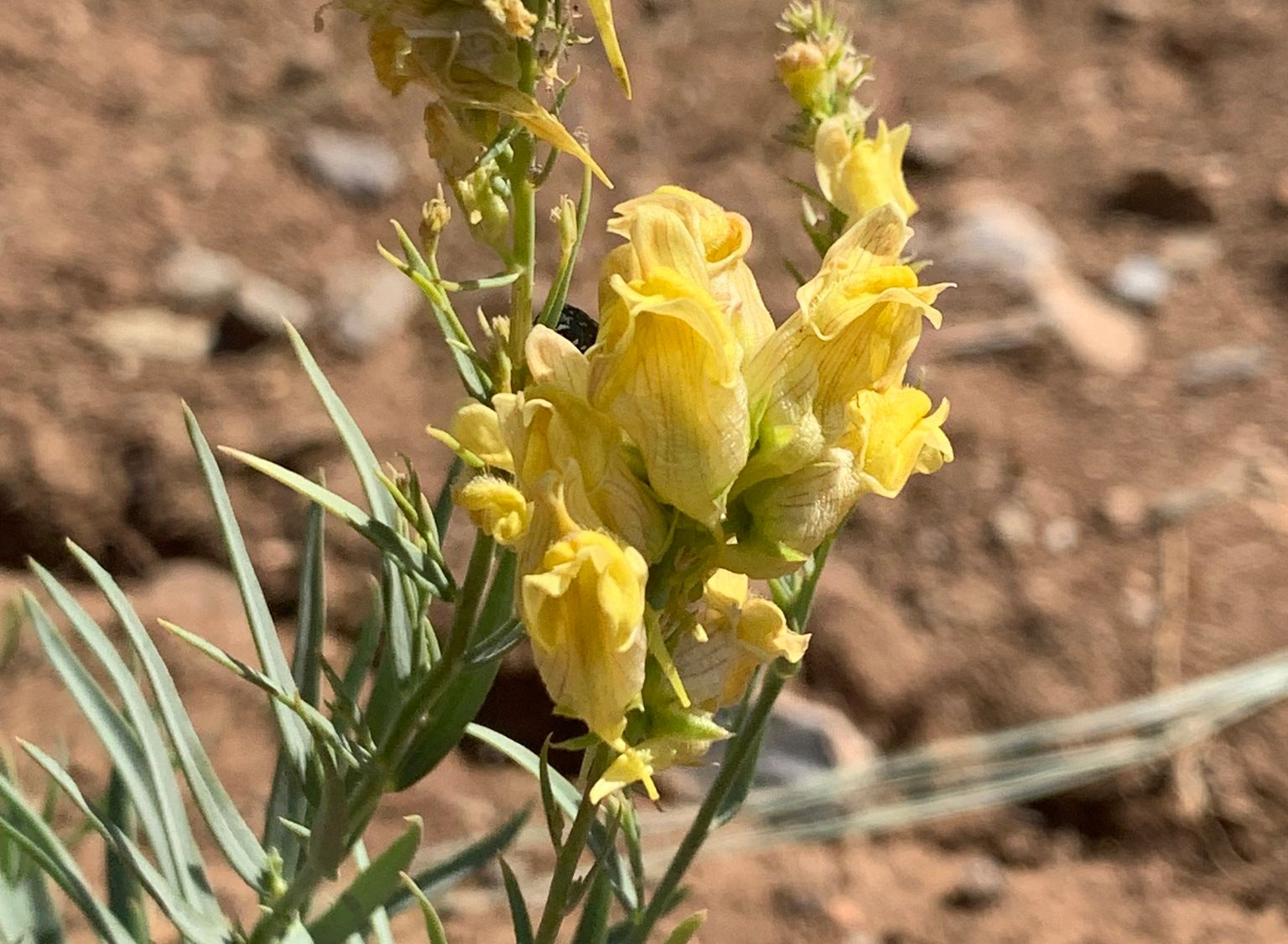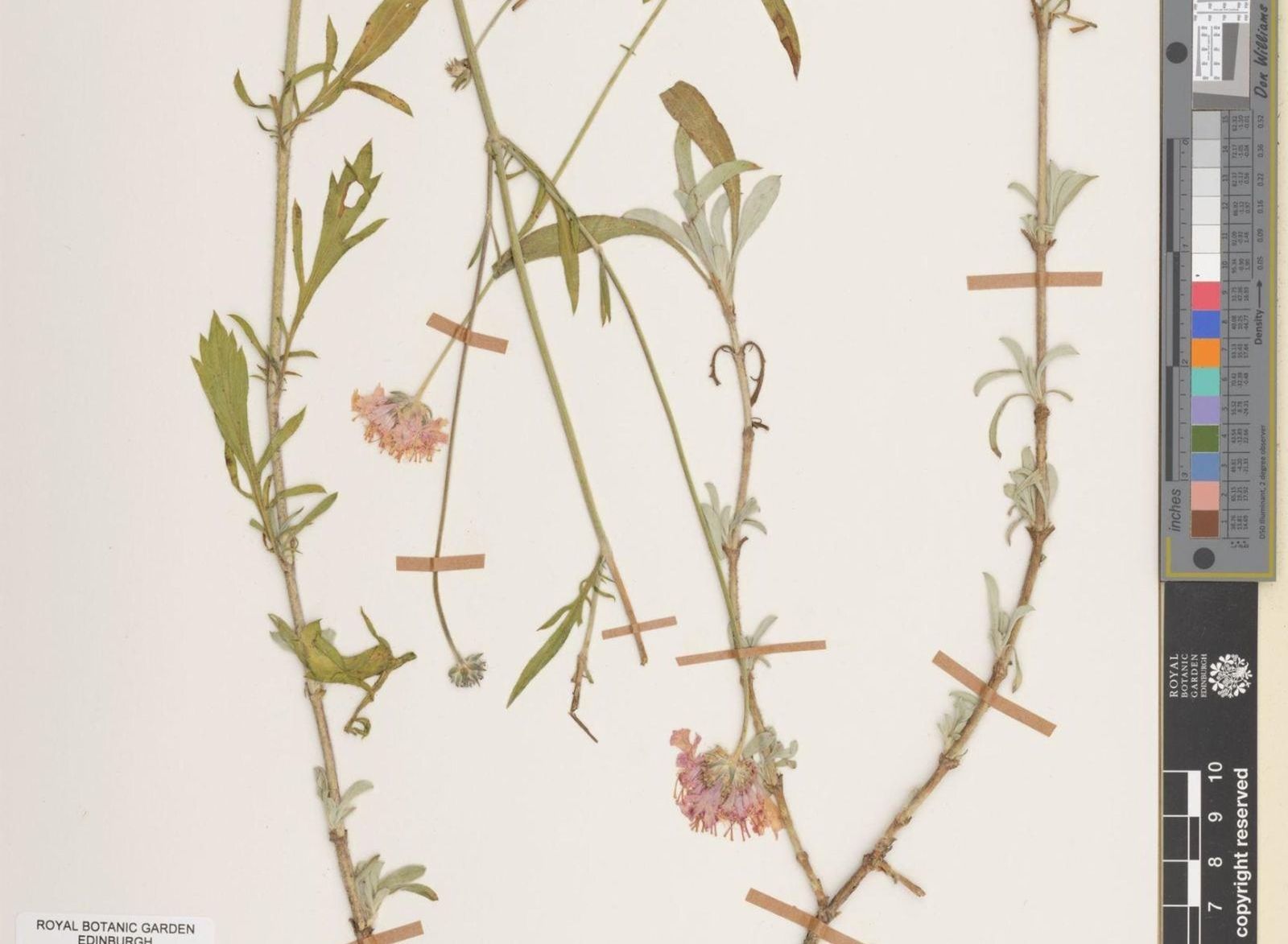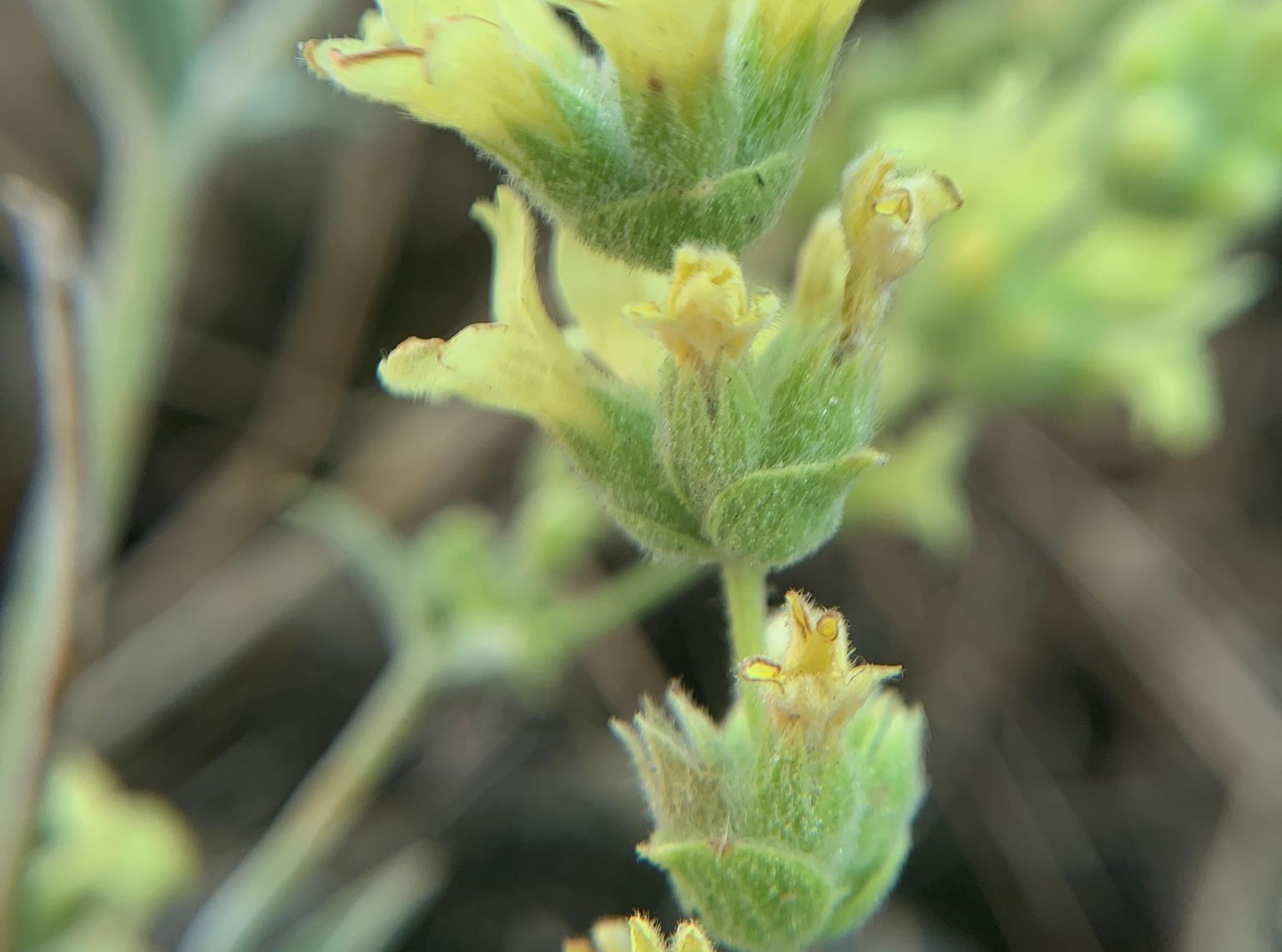
Sideritis libanotica is a yellow-flowered mountain tea of the mint family, a perennial, woody at the base, whose long, bare stems carry small balls of flowers set far apart[1][2][3]. Its home runs from Lebanon through Anatolia to Kurdistan[3], and Kurdistan has a form of its own, subsp. kurdica, which grows on the limestone crags and in the oak woods of Başûr's mountains[4][5]. It took botanists 137 years, and three names, to decide what this Kurdish plant is.
How it got its name
- Named by
- Labill., 1812Published in Icon. Pl. Syr. 4: 13
A yellow ironwort from Mount Lebanon
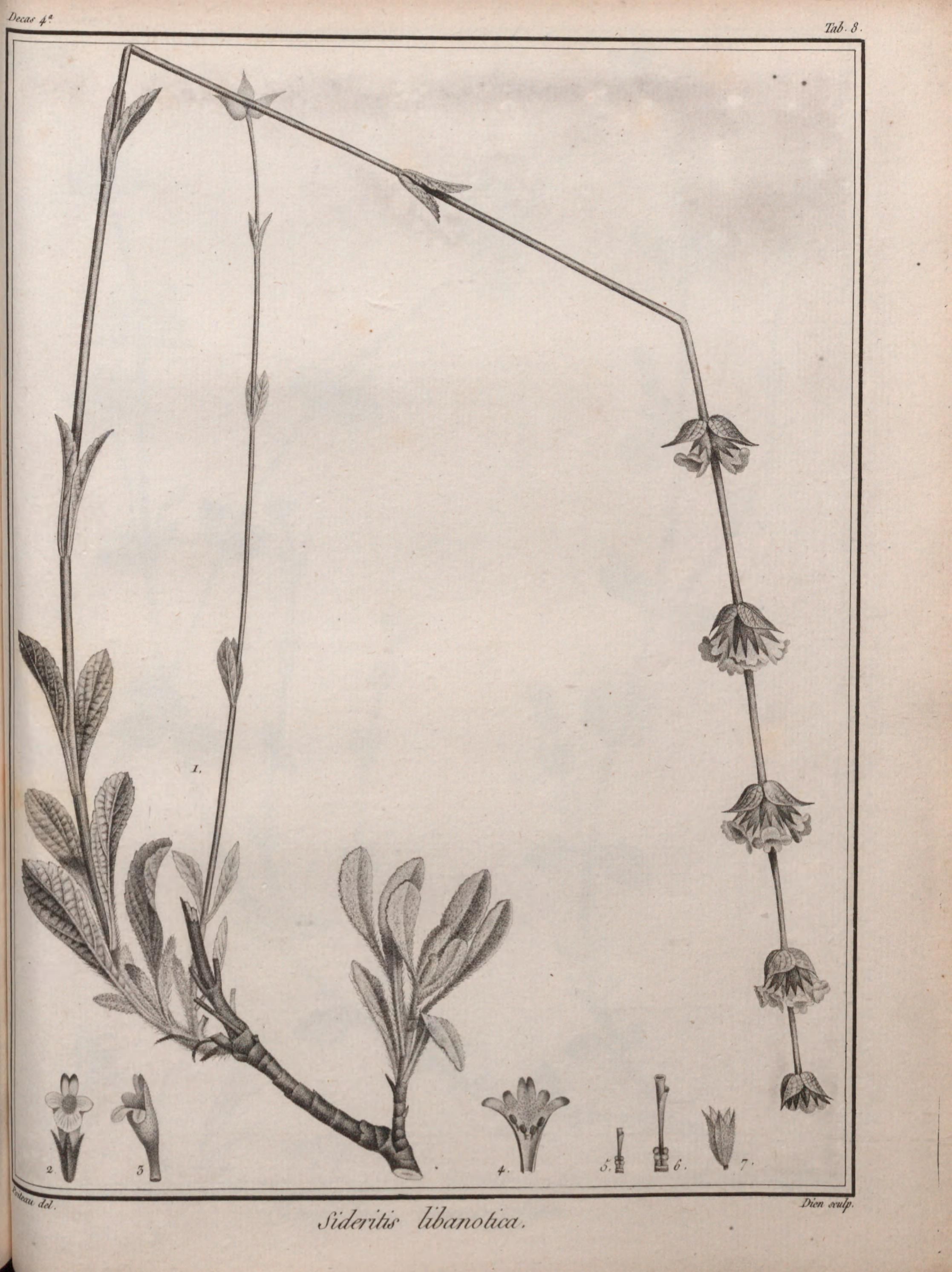
The species was first described by the botanist Jacques Labillardière. In 1812, in the fourth part of his Icones plantarum Syriae rariorum ("Pictures of rare plants of Syria"), he published it as Sideritis libanotica, the ironwort "of Lebanon", with a short note on where it grows: Habitat in Libano, "it grows on Lebanon"[1].
His description is still a good portrait[1]:
- a plant that is woody at the base, sending up straight, unbranched, hairless stems a foot tall or more;
- lower leaves oblong and broadest towards the tip, narrowing into a stalk, toothed and netted with veins, the upper ones narrower and stalkless;
- flowers in whorls of four to eight, the whorls "an inch and a half and more" apart;
- a corolla sulphurea, sulphur-yellow, hairier outside than inside.
The plate that came with it was drawn by Pierre Antoine Poiteau and engraved by Dien[1]:
The English name in the plant databases, Lebanon ironwort, simply translates the Latin[6]. Where these plants are gathered for tea, they are better known as mountain tea[7].
A plant that will not sit still
The Lebanon ironwort is a shape-shifter. When Pierre Edmond Boissier wrote it up for his Flora Orientalis in 1879, he split it into three forms: the green typical plant, a grey-felted var. incana, and a narrow-leaved var. linearis. The species, he wrote, is "very variable in its hair and in its more or less narrow leaves", but it can always be recognised by its small, widely spaced whorls, "the size of a hazelnut or smaller", and by its toothed leaves (our translation)[2].
Among the grey plants of var. incana Boissier listed one from "monte Gara Kurdistaniae", Mount Gara in Kurdistan[2]. It had come from the botanist Theodor Kotschy, who had collected on Gara in the summer of 1841, on the same journey that gave science the Kurdish hollyhock. His specimens were sent out to herbaria under number 375, with a printed label that dates the gathering to 5 August 1841, places it on east-facing slopes near Gara, and already calls the plant Sideritis libanotica[8][9]. Boissier printed the number as 575[2]; Bornmüller later cited it as 375[4].
Bornmüller's Kurdish species
Half a century after Kotschy, the botanist Joseph Bornmüller made a collecting journey through Persia and the Ottoman lands in 1892–93, his Iter Persico-turcicum[10]. On 21 June 1893 he collected the same grey ironwort near Rewandiz (Rawanduz), in wooded mountains at 1,300 m[4][10], and labelled it, following Boissier, Sideritis libanotica var. incana[10]. In his 1932 paper he noted that this gathering had gone out under another name, var. incanescens, a name of Haussknecht's and his own that had never been published with a description[4].
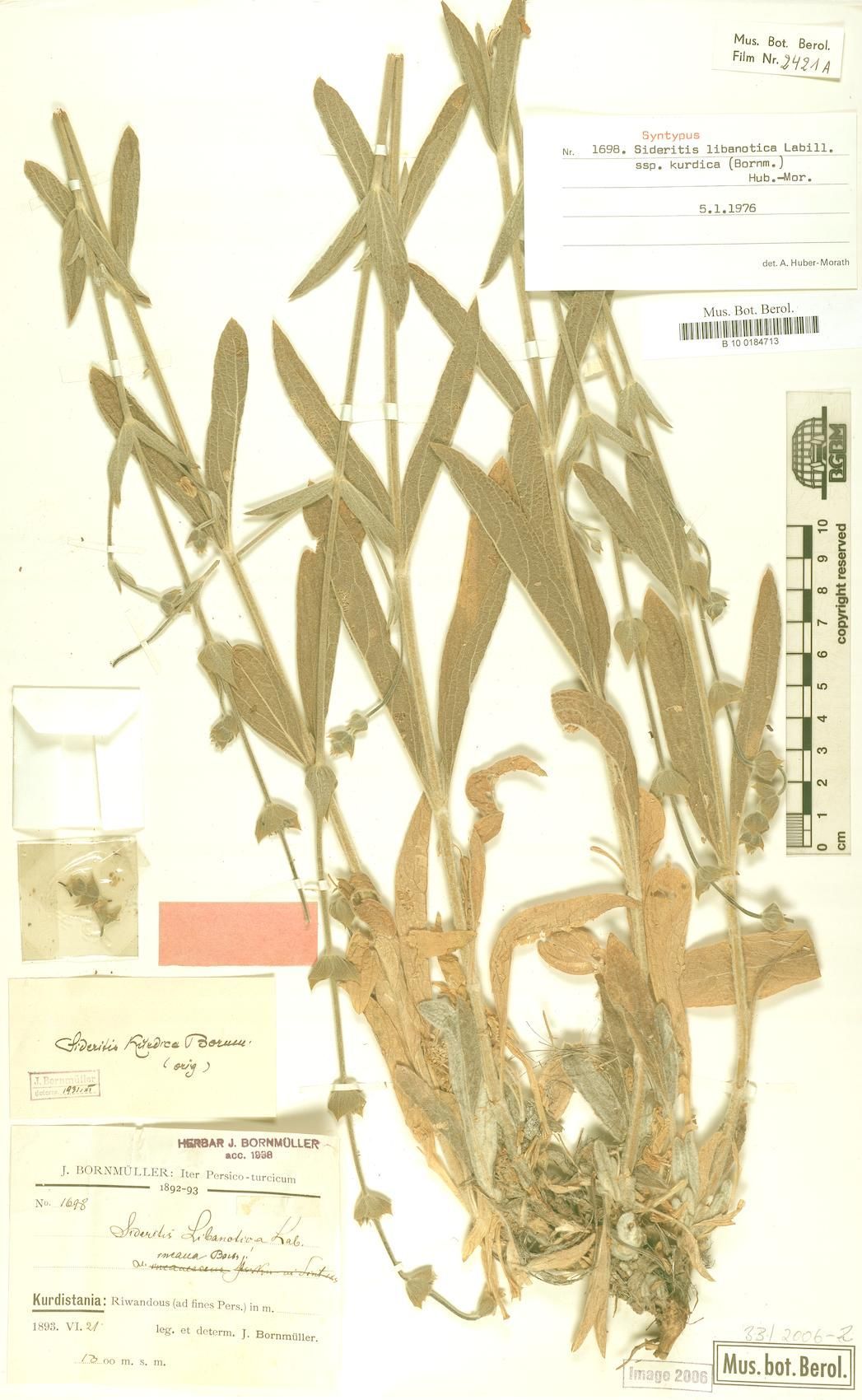
The sheet stayed in his own herbarium. In 1932, in a paper on the ironworts of the Near East, Bornmüller described it as a species of its own, Sideritis kurdica, the Kurdish ironwort[4]. A slip added to his Rewandiz sheet reads "Sideritis kurdica Bornm. (orig)"[10]. He based the name on four gatherings[4]:
- Kotschy's plant from Mount Gara (Bornmüller gives the year as 1843; Kotschy's printed label says 1841);
- his own from the woods near Rewandiz, 1893;
- one from the slopes by the monastery of Deir Zafran near Mêrdîn (Mardin), collected by Paul Sintenis on 19 June 1888;
- and one from rocks on the Kawkirt-dagh between Maraş and Zeytun, collected by Heinrich Haussknecht in July 1865.
What set it apart, Bornmüller wrote, was a tall habit, broad, thin, strongly veined leaves, up to fifteen whorls spaced far apart on the spike, and a calyx tube densely wrapped in wool[4]. He also noted where it lives: unlike its relatives on the dry hills of Mesopotamia, it is a forest plant of the middle mountain zone (eine Waldpflanze der mittleren Bergregion), and it reaches further east than any other ironwort of its group, as far as the Persian border but not beyond[4].
His Latin description gives the measurements[4]:
- several stems from a woody base, 70–100 cm tall, upright and mostly unbranched;
- leaves broadly lance-shaped and pointed, the larger ones up to 9–10 cm long and 2 cm wide, with untoothed edges (only the leaves of the non-flowering shoots are sometimes faintly toothed towards the tip), where the Lebanon ironwort itself has finely toothed leaves[4];
- flower spikes 20–50 cm long, with 5 to 15 whorls set 4–5 cm apart;
- yellow corollas, their tube drying a dull violet.
Species or subspecies?
The Kurdish ironwort kept its rank as a species for 46 years. On 5 January 1976 the botanist Arthur Huber-Morath wrote a new label for Bornmüller's Rewandiz sheet, now in Berlin, marking it as a syntype of Sideritis libanotica ssp. kurdica[10]. In 1978, in the twelfth part of his Novitiae Florae Anatolicae ("Novelties of the flora of Anatolia"), he published the change without comment: the Kurdish plant became a subspecies of the Lebanon ironwort, and so did its dry-hill relative S. microchlamys[11]. Sideritis libanotica subsp. kurdica (Bornm.) Hub.-Mor. is the name it carries today[12]. The "(Bornm.)" in brackets records that Bornmüller described it first.
So the plant has carried three names: libanotica on Kotschy's printed label, Bornmüller's kurdica, and Huber-Morath's compromise, which keeps both[4][11][8].
Where it grows
Kew's checklist gives the species' range as Turkey to Lebanon, recorded from Turkey, Syria and Lebanon, and Iraq[3]. In Kurdish terms, the Kurdish subspecies is a plant of Başûr and of Bakur's southern edge, from Mêrdîn and Colemêrg (Hakkâri) down into the mountains north of Mosul[4][5][13].
- Başûr: Mount Gara, one of the four places Bornmüller based the name on[4][8]; the woods near Rewandiz[4][10]; Jebel Bradost (Baradost) near Rewandiz, in 1934[13]. In July 1933 collectors for the Rustam Herbarium gathered it six times around Zawita, Atrush and Laliş (Lalish, "Shaikh Adi" in the list), between 750 and 1,210 m: "fls. yellow, rocky limestone slope", "on the hill-side in oak forest", "among limestone crags", "in open oak forest"[5]. Kew's database names the botanist E. R. Guest as the collector of five of these sheets[13]. Later collectors found it in oak forest on rocky slopes near Sersing (Sarsang) in 1955, on limestone rocks on the road from Mosul to Zaxo (Zakho) in 1957, and in 1976 near Bamarni, Sandur and on the road from Zawita to Atrush, between 800 and 1,400 m[13].
- Bakur: by the monastery of Deir Zafran near Mêrdîn[4][13], and at Çelê (Çukurca) in Colemêrg, where the botanist Peter Hadland Davis collected it at 1,200 m in June 1966[13].
- Outside Kurdistan, Haussknecht's syntype came from the mountains near Maraş[4], where Davis found the subspecies again in 1952[13].
In short, it is a plant of limestone rocks and open oak woodland in the lower and middle mountains[4][5][13]. It has been gathered from June to early August[5][8][10][13].
A mountain tea
Sideritis species have been used as herbal teas and medicines in the Balkans and the eastern Mediterranean[14], and the Lebanon ironwort is no exception. In Midyat, in the province of Mêrdîn, people brew its narrow-leaved subspecies (subsp. linearis) as a herbal tea to drink in cold weather, and they use the whole plant as a broom[15]. The authors note that it is not easy to gather, because it grows in the mountains among shrubs[15].
The Kurdish subspecies has also reached the laboratory. A 2023 study of plants gathered in Iraq, where the subspecies grows in the Kurdish mountains, found its above-ground parts rich in phenolic compounds and flavonoids, with clear antioxidant activity, and concluded that it could serve as a natural source of antioxidants[7].
These are records of traditional use and laboratory results, not medical advice.
Its Kurdish names
Ehmedê Dirihî's dictionary of Kurdish plant names gives çaya koyî, "mountain tea" (our reading), for the genus Sideritis as a whole[16]. For the Kurdish subspecies, under its old name Sideritis kurdica, it lists çaya çiyayê kurdan and çeya koyî kurdan[16]. Both are dictionary names that follow the Latin name: something like "the Kurds' mountain tea" (our reading). The dictionary gives them with no region or informant, so we do not know whether anyone uses them in the mountains where the plant grows. If you know what the yellow mountain tea of Gara, Bradost or Zawita is called in your village, Flora Kurdica would like to hear from you.
Sources
- 1.Labillardière, J. J. H. de (1812). Icones plantarum Syriae rariorum. decas 4: 13–14, tab. 8. Paris.
- 2.Edmond Boissier (1879). Flora Orientalis, vol. 4. H. Georg, Geneva and Basel (Internet Archive). archive.orghttps://archive.org/details/floraorientaliss04bois
- 3.Plants of the World Online. Royal Botanic Gardens, Kew.
- abcSideritis libanotica.
- plant_name_id 191440. powo.science.kew.orghttps://powo.science.kew.org/taxon/urn:lsid:ipni.org:names:458974-1accessed 14 November 2026
- 4.Bornmüller, J. (1932). Neue und kritische Sideritis-Arten (Sectio Empedoclea) der vorderasiatischen Flora. Ungarische Botanische Blätter (Magyar Botanikai Lapok) 31: 127-143.
- 5.Blakelock, R. A. (1949). The Rustam Herbarium, 'Iraq. Systematic List. Part III. Kew Bulletin 4(4): 528.
- 6.Catalogue of Life, vernacular names via the GBIF Backbone Taxonomy.
- ↩(via GBIF): vernacular names of Sideritis libanotica.
- api.gbif.orghttps://api.gbif.org/v1/species/7307623/vernacularNamesaccessed 14 November 2026
- 7.abUysal, İ., Mohammed, F. S., Koçer, O., Doğan, M. & Sevindik, M. (2023). Antioxidant and oxidant status, DPPH activity, total phenolic and flavonoid contents of mountain tea (Sideritis libanotica subsp. kurdica). International Journal of Chemistry and Technology 7(1): 82–85. doi:10.32571/ijct.1288819https://doi.org/10.32571/ijct.1288819
- 8.abcdSmithsonian National Museum of Natural History, herbarium specimen US 2500812 (via GBIF).
- 9.↩Natural History Museum Vienna (W) – Herbarium. via GBIF, herbarium specimen W 0014929 (via GBIF).
- 10.abcdefgBotanic Garden and Botanical Museum Berlin, herbarium specimen B 10 0184713 (via GBIF).
- 11.Huber-Morath, A. (1978). Novitiae Florae Anatolicae XII. Bauhinia 6(2): 285–292.
- 12.International Plant Names Index. Royal Botanic Gardens, Kew, Harvard University Herbaria and Australian National Herbarium.
- ↩Sideritis libanotica, S. kurdica, S. libanotica subsp. kurdica.
- urn:lsid:ipni.org:names:458974-1. ipni.orghttps://www.ipni.org/n/458974-1accessed 14 November 2026
- 13.abcdefghiHerbarium specimens at Kew (K006137039–43, K006137081–93), Washington (US 2636857) and St. Louis (MO 103488134), via GBIF.
- 14.↩Obón, C., Rivera, D., Fonollá, E., Alcaraz, F. & Attieh, L. (2021). A comparison study on traditional mixtures of herbal teas used in Eastern Mediterranean area. Frontiers in Pharmacology 12: 632692. doi:10.3389/fphar.2021.632692https://doi.org/10.3389/fphar.2021.632692
- 15.Akgül, A., Akgül, A., Şenol, S. G., Yıldırım, H., Seçmen, Ö. & Doğan, Y. (2018). An ethnobotanical study in Midyat (Turkey), a city on the silk road where cultures meet. Journal of Ethnobiology and Ethnomedicine 14: 12. doi:10.1186/s13002-017-0201-8https://doi.org/10.1186/s13002-017-0201-8
- 16.abAhmet Kasımoğlu (Ehmedê Dirihî) (2013). Ferhenga Navên Nebatan a Kurdî (Dictionary of Kurdish Plant Names). Mardin Artuklu University, Institute of Living Languages in Turkey (ISBN 978-605-4202-12-6), p. 159.
Last updated 20 November 2026