Tragopogon kurdistanicus is a goat's beard, a member of the daisy family (Asteraceae), named in 1974 after Kurdistan, the land it came from[1]. Kew's checklist records it only from north-eastern Iraq, that is from South Kurdistan (Başûr)[2]. Beyond that it is one of the most elusive plants on this site: no photograph of it is known, not a single specimen is online, and the Flora of Iraq does not mention it at all[3][4]. This page tells what we do know, and why a plant with the name of Kurdistan can go missing in plain sight.
How it got its name
- Named by
- Chrtek & Hadač, 1974Published in Folia Geobot. Phytotax. 9: 95
A goat's beard
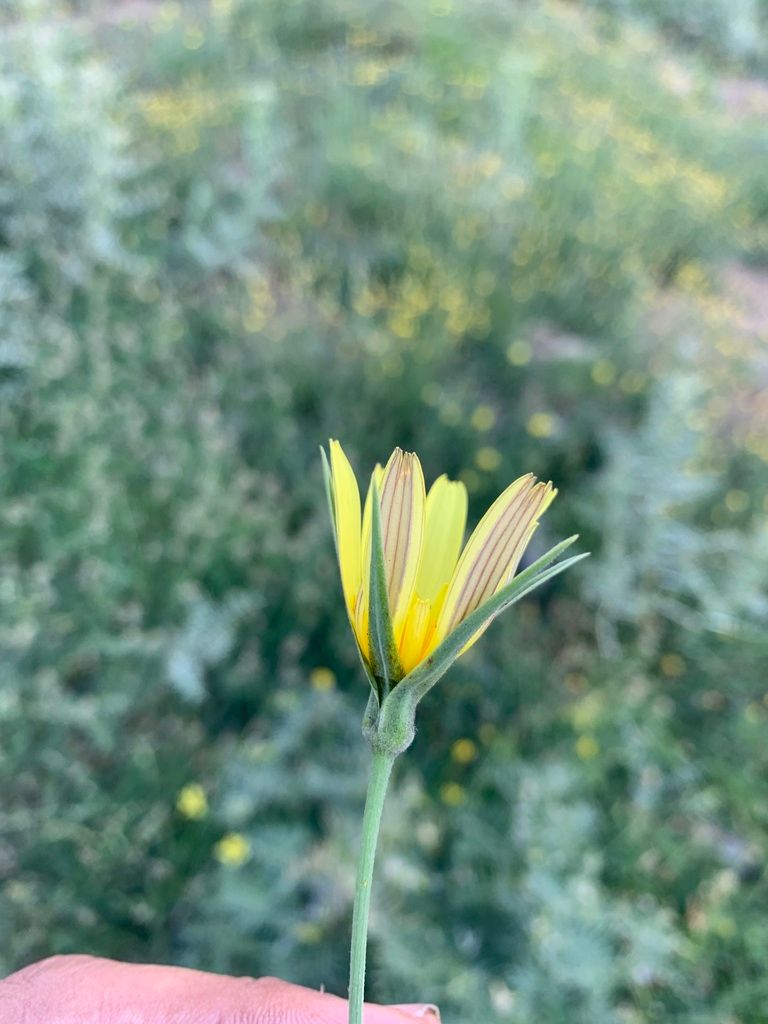
Goat's beards are the genus Tragopogon, about 110 species across Europe, temperate Asia and North Africa[4]. The name is Greek: tragos, a goat, and pogon, a beard, "no doubt referring to the conspicuous pappus", the feathery parachute of the seed[4]. In flower they look like slender dandelions held up on long, grass-leaved stems; in fruit each head becomes a large, airy ball of seeds.
Among the names Ehmedê Dirihî's dictionary of Kurdish plant names lists for the whole genus is rîşê bizinê[5].
The Flora of Iraq counts eight species in Iraq, and its author, C. C. Townsend, does not hide how hard they are[4]:
A taxonomically difficult genus. To be of real use, specimens must include the rootstock, notes on flower colour and mature fruit.[4]
Keep that sentence in mind: it is the whole story of Tragopogon kurdistanicus in two lines.
Found by Emil Hadač, named in Prague
From 1959 to 1961 the botanist Emil Hadač (1914–2003)[6] worked in Iraq[7]. Most of his excursions were made with A. D. Q. Agnew and Richard Wheeler-Haines, much of it in the high mountains of Başûr: around Helgurd and in the district of Rewandiz (Rowanduz)[8]. He brought about 6,000 specimens back to the herbaria of Prague[7].
Back home it fell largely to his colleague Jindřich Chrtek (1930–2008)[6], who taught plant taxonomy at Charles University, to work through them. His obituary says he identified other botanists' collections, "especially those from Iraq collected by E. Hadač"[9]. Out of those boxes came a whole series of new names that carry Kurdistan in them: the dame's violet Hesperis kurdica (1964, with František Dvořák), the meadow-grasses Poa bulbillifera "from the Iraqi Kurdistan" (1969) and Poa kurdistanica (1970), and later the hawthorn Crataegus kurdistanica (1980)[10].
In September 1973 Chrtek and Hadač sent a short paper to the Czech journal Folia Geobotanica et Phytotaxonomica. It appeared in March 1974, three pages long, under the title A new species of Tragopogon from the Iraqi Kurdistan[1]. Its abstract is a single sentence:
A new species of the genus Tragopogon (T. kurdistanicum) has been described from Iraq.[1]
That is as far as we could read. The paper sits behind a paywall, and we have not seen its Latin description, its type specimen or the place where the plant was found[1]. The plant-name index records the type only as coming from "Iraq"[6].
"Kurdistanicum" or "kurdistanicus"?
The abstract spells the name T. kurdistanicum; today it is written T. kurdistanicus[1][6]. The reason is grammar. A Latin adjective in a plant name has to agree with the gender of the genus name[11], and the botanical code counts names ending in -pogon, "beard", as masculine[11]. Older botanists often treated Tragopogon as neuter, so the ending -um turns up again and again in the literature, and the indexes correct it to -us[6][6].
The goat's beard the Flora forgot
Kew's checklist accepts the plant and gives its native range as north-eastern Iraq[2]. Nothing else has turned up:
- GBIF, which pools the world's herbarium catalogues, holds no specimen under the name, and none of its 103 records of Tragopogon from Iraq was collected by Hadač[3];
- iNaturalist has no observation of it[3];
- its conservation status has never been assessed[3];
- and the Flora of Iraq volume for the daisy family (2019), the standard work for Başûr, treats eight species of Tragopogon without a word about T. kurdistanicus[4].
Why it is missing from the Flora we cannot say. Hadač's collections went to Prague[7][8], and Townsend may simply not have seen them; or he may have judged the plant to be one of the variable species he did accept. Without the 1974 paper and the specimen, nobody outside Prague can check. What is clear is how little it would take: one good photograph from the mountains of Başûr, with the flowers, the base of the stem and ripe fruit, could settle it[4].
The other Kurdish goat's beard
Tragopogon kurdistanicus is not the first goat's beard named after the Kurds. On 19 July 1932 E. R. Guest, collecting for the Rustam Herbarium, was on Chia-i-Mandali, a mountain in the Rewandiz area, and on its rocky slopes at 2,400–2,700 m he pressed a slender goat's beard with grass-like leaves[12][13]. In 1949 R. A. Blakelock of Kew described it as a new species, Tragopogon kurdicum, noting its flowers were purple, in sicco, "when dry"[12].
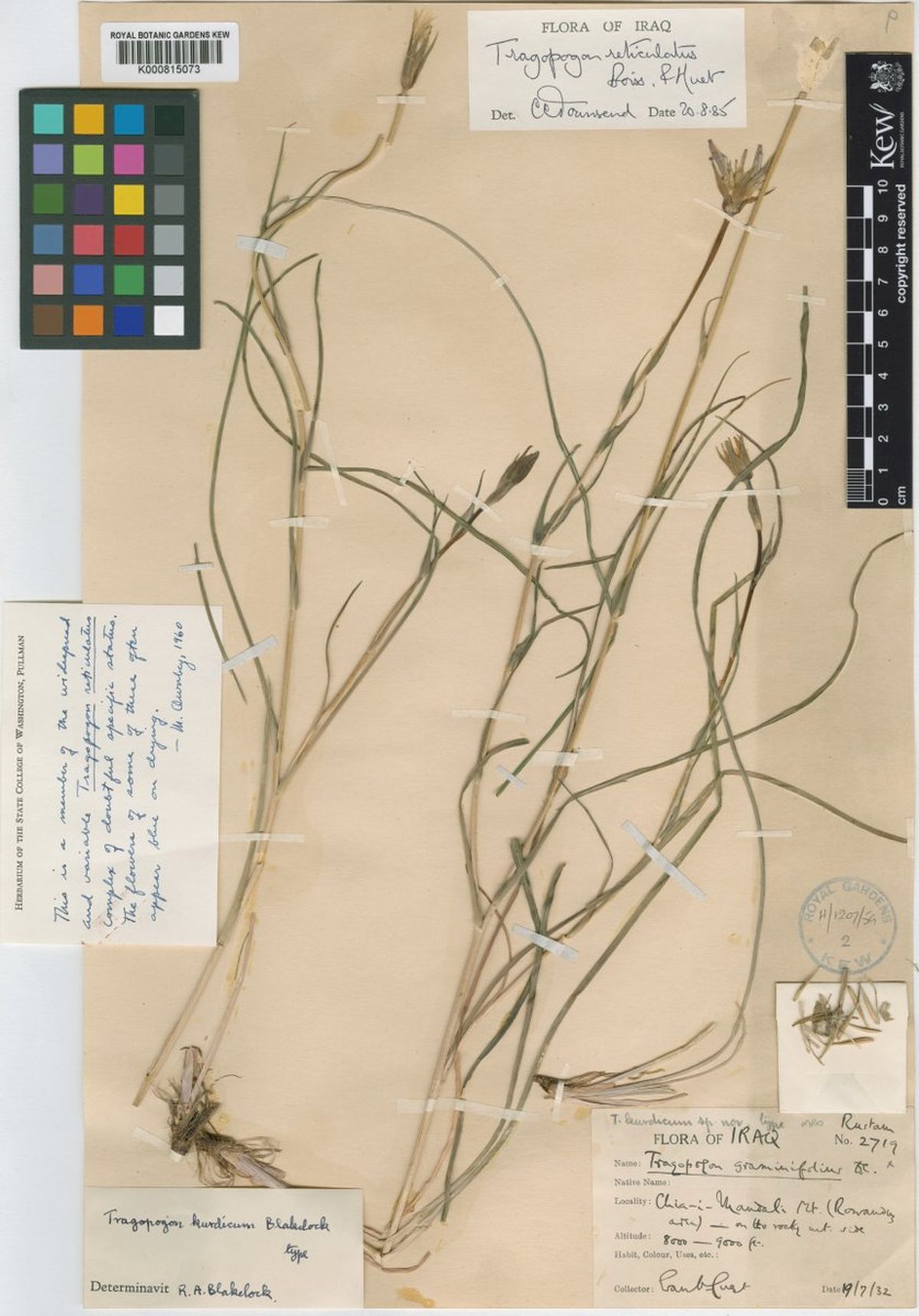
The sheet at Kew shows what happened next[13]. In 1960 the botanist Marion Ownbey, of the State College of Washington at Pullman, added a note: "This is a member of the widespread and variable Tragopogon reticulatus complex of doubtful specific status. The flowers of some of these often appear blue on drying." In 1985 Townsend labelled it T. reticulatus, and in the Flora of Iraq the Kurdish goat's beard of 1949 became a synonym of that species, whose flowers are yellow, purple-streaked on the back and "sometimes turning bluish when dry"[4][13]. So the purple that made Blakelock's plant look new may simply have come from drying.
The name came back once more. In 2014 Reza Safavi and Hossein Maroofi described a Tragopogon kurdicus from Avalan mountain on the road from Sine (Sanandaj) to Kamyaran in East Kurdistan (Rojhilat): a tufted, blue-green plant with stems 60–70 cm tall and golden-yellow flowers[14]. Their paper does not mention Blakelock's plant[14]. Under the rules of botanical naming, a name already used for one plant cannot be reused for another of the same rank; a "later homonym" is illegitimate[11]. The plant-name index marks the 2014 name as exactly that[6], and in 2016 the Rojhilat plant was renamed Tragopogon maroofii, after Hossein Maroofi, who found it[6].
Three goat's beards, then, named after the Kurds and Kurdistan: one sunk into a widespread species, one whose name was already taken and has since been renamed, and one that almost nobody has seen since 1974.
Goat's beards in Kurdish life
None of the sources we read gives a Kurdish name for T. kurdistanicus itself[5]. Its relatives, though, are well known:
- Gillett's labels in the Flora of Iraq record shin at Qeredax (Qara Dagh) and sping at Kursi on Mount Şengal (Jabal Sinjar), for T. coelesyriacus, spelt as printed[4];
- Dirihî's dictionary lists over a dozen names for the genus, among them esping, sping, şinge and rîşê bizinê[5];
- Hawrami and Mukriyani Kurds in Rojhilat call goat's beards Halakok and Asping and eat the leaves raw or fried; the plant was mentioned 21 times in the interviews[15];
- and one goat's beard has a darker reputation: in Şêxan (Shaikhan), Guest heard that T. coelesyriacus could harm sheep, "even causing death in its green state", but was less dangerous once it began to dry[4].
These are genus names and records of other species, not names of Tragopogon kurdistanicus.
How to help
The Flora of Iraq ends its account of these plants with a plea: "new collections of Iraqi Tragopogon with flower colour notes … and both flower and fruit are needed"[4]. Anyone walking the high slopes of Helgurd, Rewandiz or Qendîl in early summer can answer it with a phone: photograph the flower from the front and the back, the base of the stem and, a few weeks later, the ripe seed head, and share it on iNaturalist. Somewhere among those pictures may be the first photograph of the goat's beard named after Kurdistan.
Sources
- 1.abcdeChrtek, J. & Hadač, E. (1974). A new species of Tragopogon from the Iraqi Kurdistan. Folia Geobot. Phytotax. 9(1): 95–97. doi:10.1007/BF02851404https://doi.org/10.1007/BF02851404
- 2.Plants of the World Online. Royal Botanic Gardens, Kew.
- abTragopogon kurdistanicus.
- plant_name_id 3072516. powo.science.kew.orghttps://powo.science.kew.org/taxon/urn:lsid:ipni.org:names:256044-1accessed 14 November 2026
- 3.abcdGBIF.org GBIF Backbone Taxonomy and occurrence records. (species 5693214 and occurrence search) and iNaturalist (taxon 1139391), searched 15 November 2026. gbif.orghttps://www.gbif.org/
- 4.Townsend, C. C. (2019). Tragopogon L. In: Ghazanfar, S. A., Edmondson, J. R. & Hind, D. J. N. (eds), Flora of Iraq 6: Compositae, pp. 255–262. Royal Botanic Gardens, Kew / Ministry of Agriculture, Iraq.
- 5.Ahmet Kasımoğlu (Ehmedê Dirihî) (2013). Ferhenga Navên Nebatan a Kurdî (Dictionary of Kurdish Plant Names). Mardin Artuklu University, Institute of Living Languages in Turkey (ISBN 978-605-4202-12-6).
- 6.International Plant Names Index. Royal Botanic Gardens, Kew, Harvard University Herbaria and Australian National Herbarium.
- abcdeTragopogon kurdistanicus Chrtek & Hadač; author records for Chrtek and Hadač.
- fgTragopogon kurdicus Blakelock (1949); Tragopogon kurdicus S.R.Safavi & Maroofi (2014).
- hTragopogon maroofii Mahmoodi & S.R.Safavi, Annales Botanici Fennici 53: 36 (2016).
- urn:lsid:ipni.org:names:256044-1. ipni.orghttps://www.ipni.org/n/256044-1accessed 14 November 2026
- 7.Kovář, P., Möllerová, J. & Rambousková, H. (2015). Emil Hadač – a founder of Czech landscape ecology. Journal of Landscape Ecology 8(2).
- 8.abHadač, E. & Chrtek, J. (2002). A contribution to the Ranunculaceae of Iraq. Journal of the National Museum (Prague), Natural History Series 171(1–4).
- 9.↩Pouzar, Z. (2008). Jindřich Chrtek (1930–2008). Acta Musei Nationalis Pragae, Ser. B, Hist. Nat. 64(1): 3–4, p. 3.
- 10.↩Dvořák, F. & Hadač, E. (1964). , Preslia 36: 307–308; Chrtek, J. & Hadač, E. (1969), Österreichische Botanische Zeitschrift 117: 146–148; IPNI records for Poa kurdistanica (1970) and Crataegus kurdistanica (1980).
- 11.International Code of Nomenclature for algae, fungi, and plants, Articles 23.5, 53.1 and 62.2.
- 12.abBlakelock, R. A. (1949). The Rustam Herbarium, 'Iraq. Systematic List. Part II. Kew Bulletin 4(1): 41–42, p. 64.
- 13.abcRoyal Botanic Gardens, Kew – Herbarium Specimens. via GBIF, herbarium specimen K000815073 (Guest 2719), via GBIF. gbif.orghttps://www.gbif.org/dataset/cd6e21c8-9e8a-493a-8a76-fbf7862069e5
- 14.abSafavi, S. R. & Maroofi, H. (2014). A new species of the genus Tragopogon L. (Asteraceae) from Iran. Iranian Journal of Botany 20(1): 5–7. doi:10.22092/ijb.2014.6149https://doi.org/10.22092/ijb.2014.6149
- 15.↩Naji Sulaiman, Fereshteh Salehi, Renata Sõukand, Andrea Pieroni, et al. (2024). Cultural vs. State Borders: Plant Foraging by Hawraman and Mukriyan Kurds in Western Iran. doi:10.3390/plants13071048https://doi.org/10.3390/plants13071048
- 16.Ehmedê Dirihî (2007). Flora Kurdistanê (II). institutkurde.orghttps://www.institutkurde.org/publications/kurmanci/
- 17.Roman Hovsepyan, Nina Stepanyan-Gandilyan, Hamlet Melkumyan, Lili Harutyunyan (2016). Food as a marker for economy and part of identity: traditional vegetal food of Yezidis and Kurds in Armenia. doi:10.1016/j.jef.2016.01.003https://doi.org/10.1016/j.jef.2016.01.003
- iNaturalist. observation 282339175 (Arya Aras, 2024). inaturalist.orghttps://www.inaturalist.org/
Last updated 20 November 2026