On a scree slope high above the village of Bendol, in the Hewraman (Avroman) mountains of East Kurdistan (Rojhilat), grows a tall clover with violet flower heads that is known from nowhere else on earth[1][2]. Trifolium kurdistanicum was named for science in 2017. Three years later the botanists who know it best counted a single population, on less than 0.02 km² of mountainside, and judged it Critically Endangered[2].
How it got its name
- Named by
- S.Yousefi, Assadi & Ghaderi, 2017Published in Phytotaxa 297(2): 217
- Type collected by
- Ghaderi3 June 2016
A clover from above Bendol
On 3 June 2016 the botanist Hiva Ghaderi pressed a specimen of the plant at 2,600 m, by Bendol village, about 30 km south to south-east of Merîwan (Marivan)[3]. That sheet, Ghaderi 13441, became the holotype, the specimen the name hangs on, and it is kept in the herbarium of the agricultural and natural-resources research centre of Kurdistan province in Sine (Sanandaj), known as HKS[3][4].
The new species was published on 27 February 2017 in the journal Phytotaxa, in a paper by Somayeh Yousefi and Hojjatollah Saeidi of the University of Isfahan, Hosein Maroofi of the research centre in Sine, Mostafa Assadi of the Research Institute of Forests and Rangelands in Tehran, and Ghaderi[1]. The name itself is credited to three of them: Trifolium kurdistanicum S.Yousefi, Assadi & Ghaderi[3].
Kurdistanicum is Latin for "of Kurdistan". In the authors' words, recorded by the International Plant Names Index, the epithet "refers to the province Kurdestan in the west of Iran, where the type specimen was collected"[3]. That province lies in Rojhilat.
The 2020 paper on the plant's conservation names the mountain: in its Persian text, کوه سپیریز, which we transliterate as Sepiriz, in the Hewraman area of Merîwan county[2].
Two plants from one mountain
Bendol had given botanists a Kurdistan plant once before. On 19 July 2014 Ghaderi had collected a small, yellow-flowered cliff plant at the same place, at the same height of 2,600 m, and in 2016 Maroofi and Ghaderi named it Pentanema kurdistanicum[5]. The coordinates given for the two type localities are the same to the second[3][5]. One mountainside above one village has given two species named after Kurdistan in under two years.
A tall clover with violet heads
Most clovers are low plants of meadows and lawns; the clovers of Weysî Silêman Elî's lesson on nefel stand 10 to 30 cm tall[6]. Trifolium kurdistanicum is much larger. What to look for, from the description in the conservation paper[2] (my translation of the Persian):
- a perennial herb, more or less hairy, 50 to 75 cm tall;
- many stems, branching from the base and mostly upright;
- fairly large leaves on stalks 10 to 30 mm long, the upper leaves often without a stalk, and stipules (the leafy flaps at the base of the stalk) 1.5 to 4.5 cm long;
- three leaflets, untoothed and long-elliptic, 1.5 to 5 cm long and 0.7 to 2 cm wide;
- dense, oval flower heads 2.5 to 5 cm long and 2 to 3.5 cm wide, crowded with many flowers up to 2.5 cm long;
- a cylindrical calyx tube 5 to 6 mm long with 10 prominent veins;
- a pale purple to purple corolla up to 25 mm long, with purplish veins, rarely white;
- usually one seed per pod, brown and kidney-shaped, 2 to 2.5 mm long.
The original description singles out the same features: large, branched stems, flower heads without bracts, the lengths of the calyx teeth and tube, violet (rarely white) flowers and kidney-shaped seeds[1].
It flowers from late May to early July and sets fruit from the second half of July to early August[2] (the paper gives the months of the Iranian calendar: early Khordad to mid-Tir, and late Tir to mid-Amordad).
A cousin from Colemêrg
Among the many clovers, the authors placed the new species in Trifolium section Trifolium, subsection Ochroleuca, closest in its looks to Trifolium longidentatum[1]. That relative has a Kurdish story of its own.
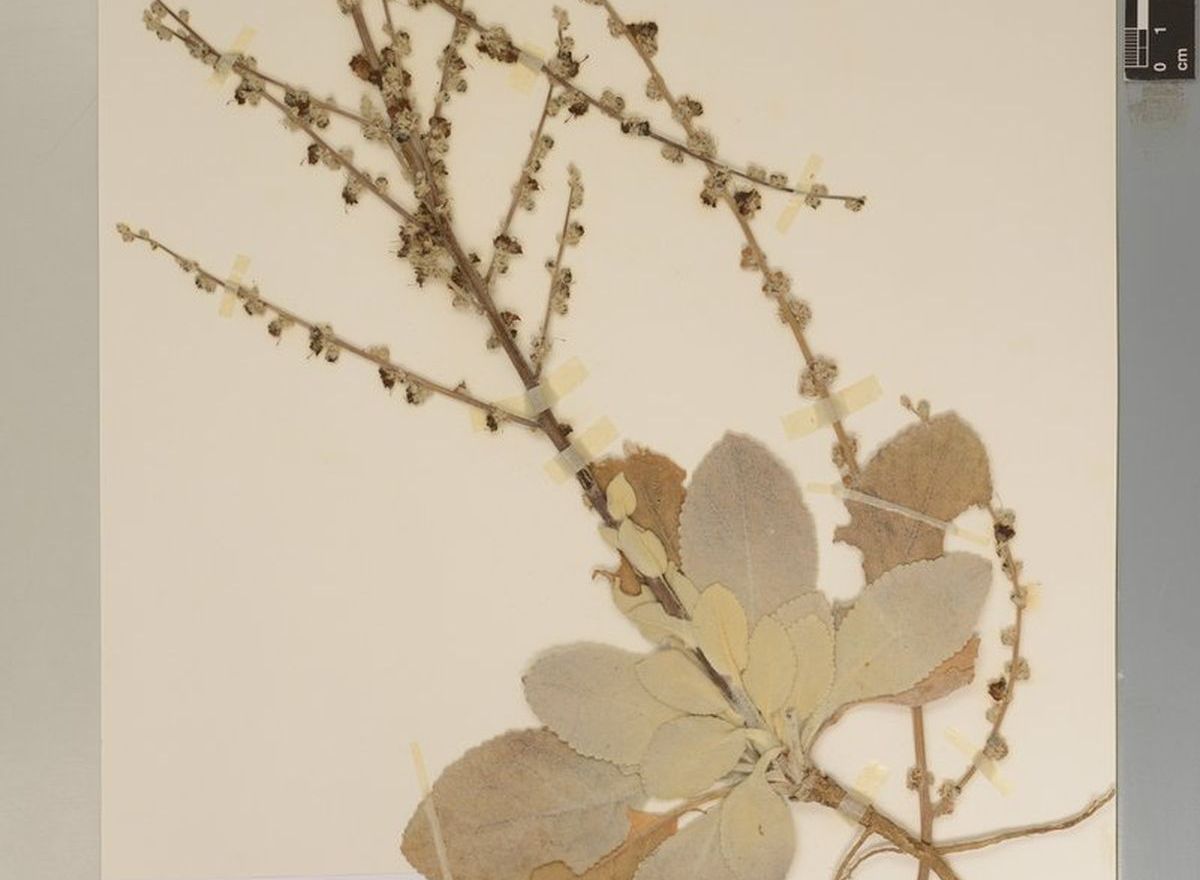
On 20 June 1910 the botanist František Nábělek (1884–1965)[3], travelling on the journey the printed labels call the Iter Turcico-Persicum 1909–10, collected a clover with long, feathery calyx teeth in moist pastures on a mountain written on the label as "Maidanoke", above the village of "Hašitha", at about 1,800 m[7]. The label names the place as "Kurdistan", in the district of "Gulamerik", today's Colemêrg (Hakkâri) in North Kurdistan (Bakur)[7]. Nábělek wrote on the sheet Trifolium longidentatum sp. n., "new species", added a long handwritten Latin description, and published the name in 1923[3][7].
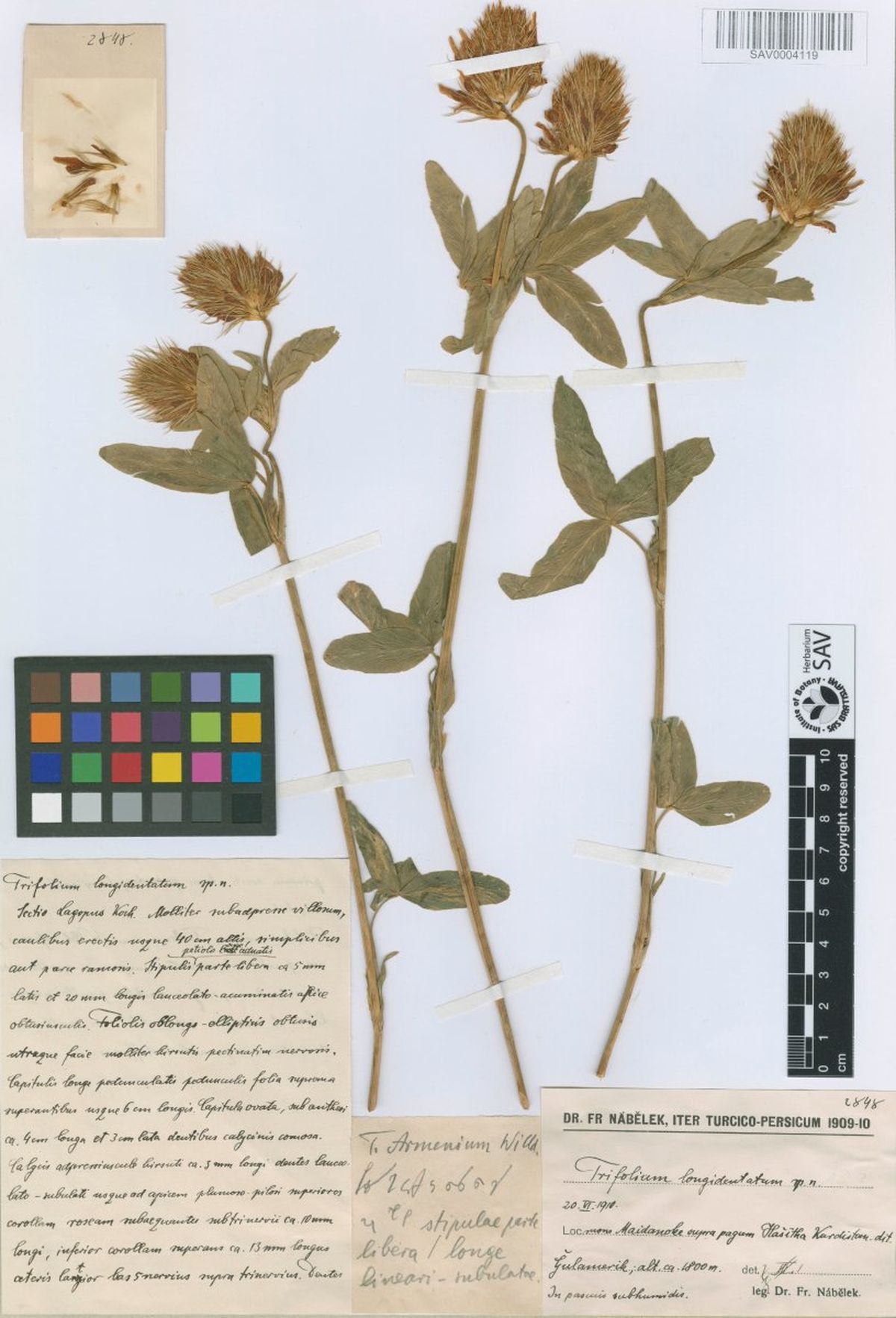
Later sheets filed as T. longidentatum also come from Colemêrg: the botanist Peter Hadland Davis gathered it on rocky slopes of Kara Dağ at 3,292 m in 1954 and in the Sat mountains in 1966[8]. For a long time it was thought to grow only in Bakur[4]. Then, in 2017, Yousefi, Maroofi and Saeidi reported it from Rojhilat as well: from the mountain they spell Nacarouz, by the village of Piromaran on the road from Seqiz (Saqqez) to Bane (Baneh), at 2,400 to 2,500 m, where Maroofi had collected it in June 2005 and 2006[4].
The two cousins are easy to tell apart. In T. longidentatum the stipules are joined to the leaf stalk for four-fifths of their length, the flowers are yellowish to pale pink and the pods end in a bent beak[4]. T. kurdistanicum has violet flowers, flower heads without bracts and kidney-shaped seeds[1].
One slope, one population
Trifolium kurdistanicum lives high up, in subalpine country with steep slopes and shallow soil[1]. The 2020 survey describes the site as karst: mostly scree, with steep slopes and cliffs that are hard to cross[2]. It shares the slope with wild almond (Amygdalus haussknechtii), a wild cherry (Cerasus microcarpa), a buckthorn (Rhamnus cornifolia), the umbellifers Prangos ferulacea and Ferula orientalis, the daisy Tanacetum polycephalum, and two grasses, Bromus tomentellus and Melica persica, which give much of the cover in the growing season[2].
The plants are vigorous and set good seed, but the authors found only one population, occupying less than 0.02 km²[2]. No other population is known from the mountains of Kurdistan province, near or far[2].
Too steep for the flocks
Clover is one of the best fodder plants in the world, as Weysî's lesson on nefel points out[6]. This one has survived partly because nobody feeds it to animals. According to the 2020 survey, livestock cannot reach the site and local people do not cut the plant for fodder[2].
The same isolation is also its weakness. With no natural corridors to similar habitats, few animals and few people to carry its seed, it cannot spread[2]. The greatest dangers come from above: rockfalls from the cliffs over the site and the unstable, stony soil it grows in[2].
On that basis the authors assessed it as Critically Endangered under the criteria of the IUCN Red List, B1B2ab(i,ii,iii)+D[2]. That is their own assessment: the species has not been formally evaluated for the Red List[9]. To save it, they propose collecting its seed and sowing it on similar slopes in the Hewraman mountains, which would need money and trained people, and growing it in botanical gardens and research farms, such as Iran's National Botanical Garden[2].
Nefel, wênce, şewer
No Kurdish name has been recorded for Trifolium kurdistanicum in any source we checked. That is no surprise for a plant that science first described in 2017 and that grows where flocks cannot go.
For clovers in general, Weysî Silêman Elî gives Nefel in Kurmancî, Wênce and Şewer in Soranî, Wînce in Badînî and Hargud in Zazakî[6]. These are names for the genus, not for this species. The Persian conservation paper calls the plant شبدر کردستانی, a name that follows the Latin[2].
Perhaps the people of Bendol and the villages around it have a word for the violet clover on the scree above them. If you know one, we would like to hear it.
Sources
- 1.Yousefi, S. et al. (2017). Trifolium kurdistanicum (Trifolieae, Fabaceae), a new species of Trifolium sect. Trifolium from Iran. Phytotaxa 297(2): 216-220. doi:10.11646/phytotaxa.297.2.10https://doi.org/10.11646/phytotaxa.297.2.10
- 2.abcdefghijklmnoRastegar, A., Jamzad, Z., Jalili, A., Maroofi, H. & Ghaderi, H. (2020). Conservation status of Trifolium kurdistanicum, an endemic species of Iran (in Persian). Iran Nature 5(4): 145–150. doi:10.22092/irn.2020.122542https://doi.org/10.22092/irn.2020.122542
- 3.International Plant Names Index. Royal Botanic Gardens, Kew, Harvard University Herbaria and Australian National Herbarium.
- 4.abcdYousefi, S., Maroofi, H. & Saeidi, H. (2017). Trifolium longidentatum (Fabaceae), a new record for the flora of Iran. Iranian Journal of Botany 23(1): 6–9. doi:10.22092/ijb.2017.109155.1143https://doi.org/10.22092/ijb.2017.109155.1143
- 5.abMaroofi, H. & Ghaderi, H. (2016). Pentanema kurdistanicum (Inuleae, Asteraceae), a new species from subalpine cliffs of Kurdistan, Iran. Phytotaxa 253(3): 223-226. doi:10.11646/phytotaxa.253.3.7https://doi.org/10.11646/phytotaxa.253.3.7
- 6.abcWeysî Silêman Elî (2025). Kulîlk û Gul bi Kurdî, lesson 11: Nefel. Flora Kurdica.
- 7.abcHerbarium of the Slovak Academy of Sciences (SAV), specimen SAV0004119 (via GBIF).
- 8.↩Royal Botanic Garden Edinburgh Herbarium (E), specimen catalogue (via data.rbge.org.uk and GBIF). specimens E00338690 and E00338686 (via GBIF). data.rbge.org.ukhttps://data.rbge.org.uk/herb/
- 9.↩GBIF.org GBIF Backbone Taxonomy and occurrence records. IUCN Red List category for Trifolium kurdistanicum. gbif.orghttps://www.gbif.org/
- Plants of the World Online. Royal Botanic Gardens, Kew.
- plant_name_id 3016459. powo.science.kew.orghttps://powo.science.kew.org/taxon/urn:lsid:ipni.org:names:77160895-1accessed 14 November 2026
- Trifolium kurdistanicum.
Last updated 20 November 2026