How it got its name
- Named by
- Fırat, 2015Published in PhytoKeys 52: 90
- Type collected by
- M.Fırat21 July 2011
Where it grows in Kurdistan
At 2600–2800 m above sea level.
A mullein at the edge of a summer camp
In the summer of 2011 the botanist Mehmet Fırat, of Van Yüzüncü Yıl University in Wan (Van), was exploring the mountains of Colemêrg (Hakkâri) in Bakur, North Kurdistan. On the Berçelan plateau, at 2,600 to 2,800 m, he came across what he called "an unusual population" of mullein[1]. On 21 July 2011 he pressed specimens of it, under his collecting number 27584[1][2].
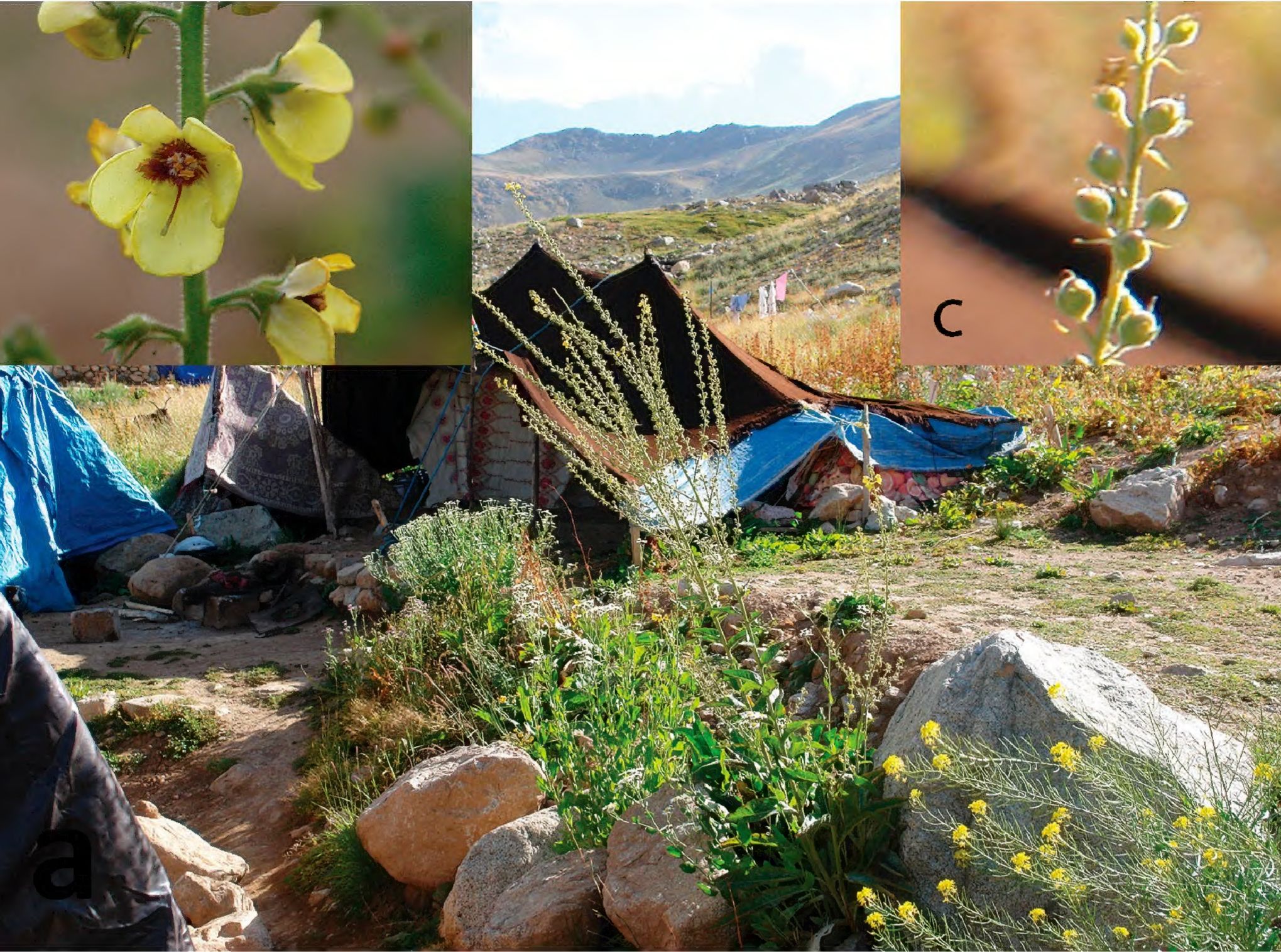
His photograph of the plant, printed with the description, shows it growing among boulders right beside black tents and blue tarpaulins, with bare mountain slopes behind[1]. The coordinates he gives put the place about 12 km north of the town of Colemêrg[1].
At first sight it looked like two mulleins already known from the region, Verbascum oreophilum and V. pyramidatum: the same branched hairs on flowers and fruits, the same glandular-haired flowering shoot. Fırat checked it against the keys and herbarium specimens in Wan, Ankara, Geneva and Gothenburg, and found it was neither[1].
The name
In July 2015 he published it in the open-access journal PhytoKeys as a species new to science, Verbascum kurdistanicum, a name meaning 'of Kurdistan'[1][2]. The holotype, the specimen that fixes the name, is kept in the herbarium of Van Yüzüncü Yıl University (VANF); duplicates went to herbaria in Ankara (ANK, GAZI, HUB) and Edinburgh (E)[1]. Kew's checklist accepts the name[3].
Mulleins are a big genus: about 360 species worldwide. Fırat's paper counts about 245 in Turkey alone, 193 of them found nowhere else[1]. Botanists split the genus into two sections by its seeds, and every Turkish mullein falls in the one whose seeds are ridged crosswise and pitted, Bothrospermae[1]. Within that crowd, V. kurdistanicum belongs to the small group with four stamens instead of five, about 30 species[1].
What to look for
Fırat's description[1]:
- A biennial, living for two years, 35 cm to 1.7 m tall, with a stout, upright, branched stem. The plant is densely covered in star-shaped hairs below and in short-stalked glandular hairs higher up.
- Leaves. A dense rosette of narrow, lance-shaped basal leaves, 8 to 30 cm long (with the stalk) and 2.5 to 4.5 cm wide, with distinctly wavy edges. The stem leaves are small, 2.5 to 4 cm long, and get smaller towards the flowers.
- Flowers. One flower to each small bract, on a stalk 5 to 10 mm long. The calyx is split almost to its base into narrow, pointed lobes. The yellow corolla is 2 to 3 cm across, with rounded, unequal lobes.
- Stamens. Four, their filaments clothed in purple-violet wool; the two lower ones are bare near the tip.
- Fruit. An egg-shaped capsule 10 to 15 mm long, densely covered in star-shaped hairs.
That fruit is the easiest way to tell it from its two look-alikes, whose capsules are only 4 to 8 mm long. Their calyx lobes are also broader, oblong rather than narrowly lance-shaped[1]. Both relatives are perennials, and V. pyramidatum usually has five stamens rather than four[1].
One plateau, one population
So far V. kurdistanicum is known from that one place on the Berçelan plateau, on limestone rocks and steppe between 2,600 and 2,800 m[1]. It flowers in June and July and fruits in July and August[1]. Kew's checklist gives its native range simply as Turkey[3].
Fırat counted 304 mature plants, within an area of only about 10 to 20 km². He also wrote that the habitat "continues to decline because of agricultural activities and other local uses", and proposed that the species be listed as Critically Endangered, the highest category of threat for a species still in the wild[1]. That proposal has not yet become a formal assessment: the plant is not evaluated on the IUCN Red List[4].
Outside the paper, no photograph of a wild plant seems to exist: iNaturalist, for example, has no observation of it[5]. Fırat's three pictures, and the pressed specimens in Wan, Ankara and Edinburgh, are what we have.
A name with a past
The name kurdistanicum had been written on a mullein once before, 127 years earlier.
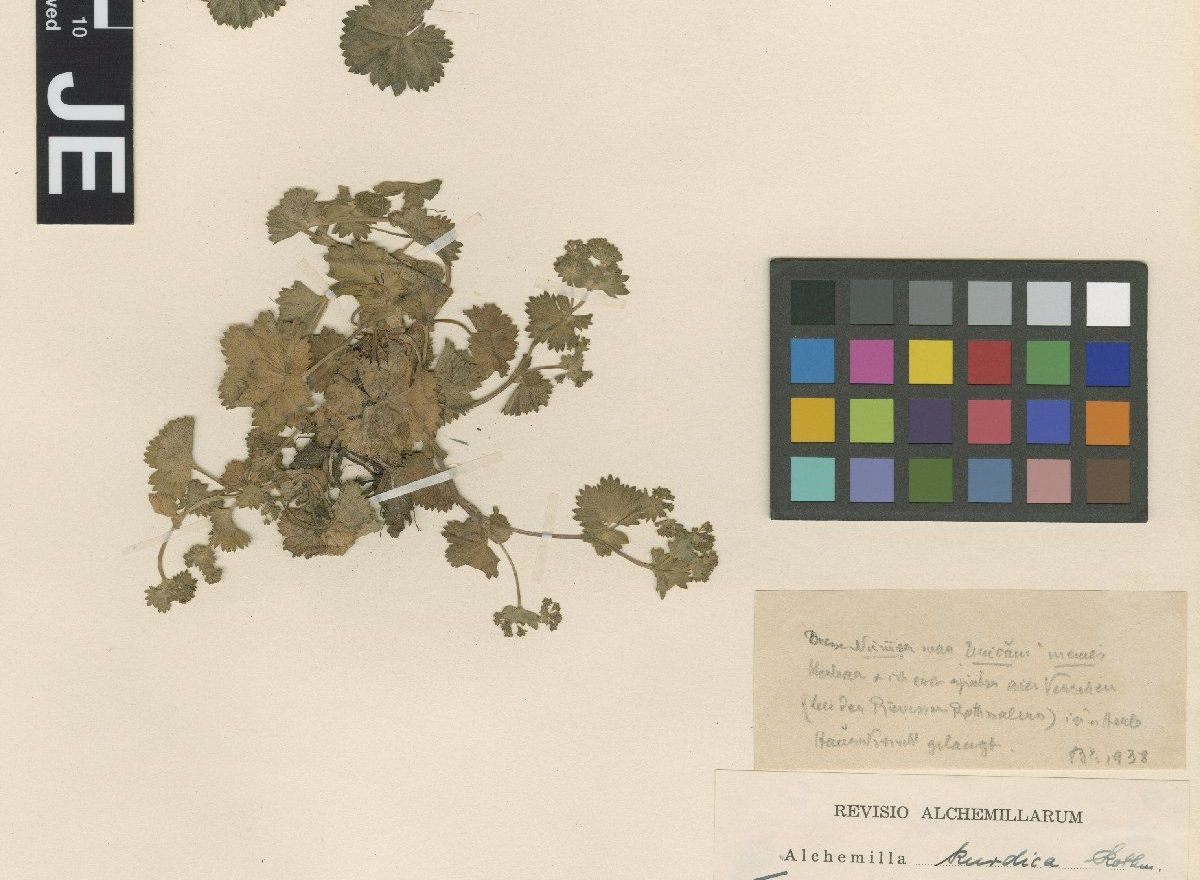
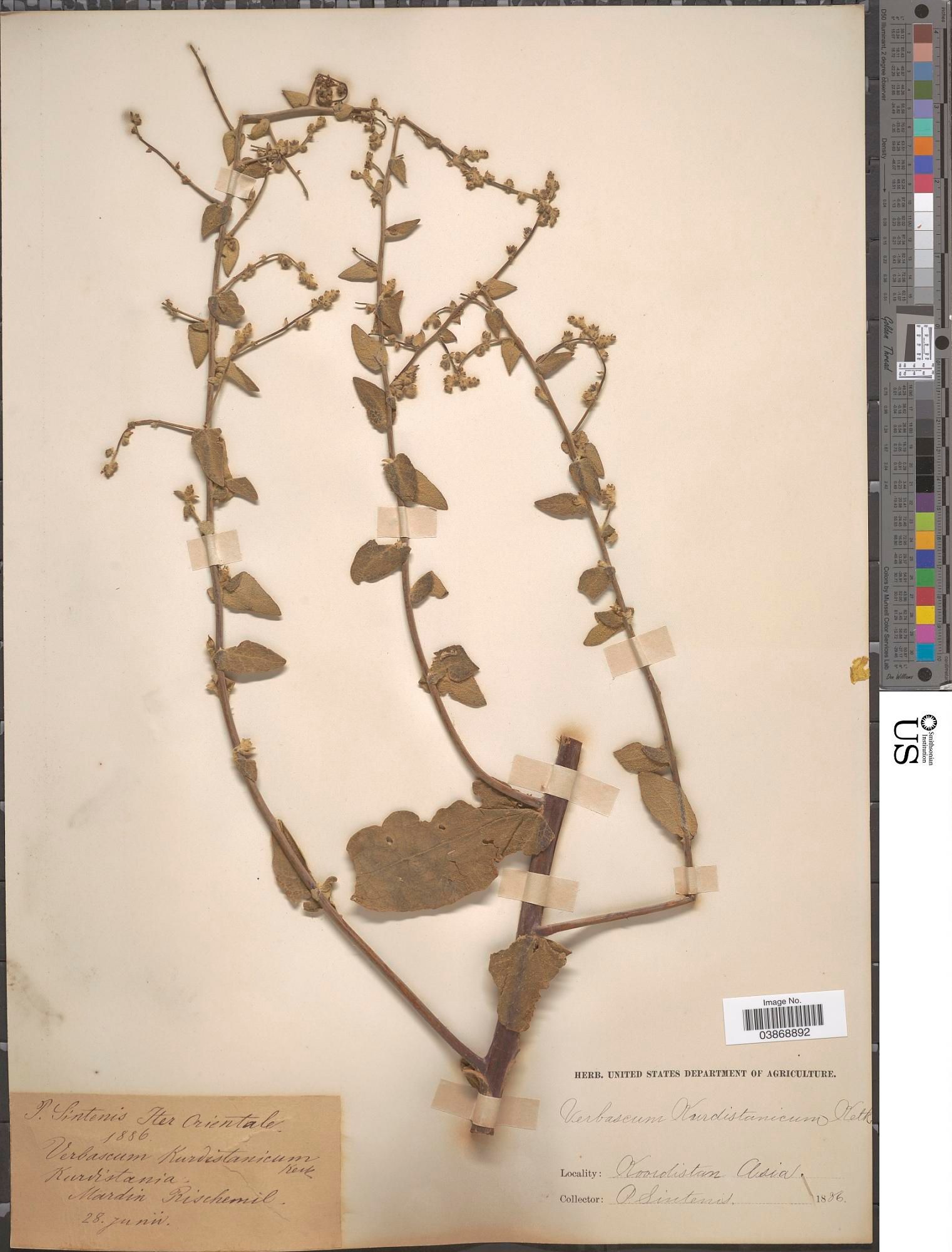
On 28 June 1888 the plant collector Paul Sintenis (1847–1907)[2] was working around Mêrdîn (Mardin), on his journey he called the Iter Orientale[6][7]. (The sheet's labels say 1886, but his other Mêrdîn sheets are all from 1888[7].) At a place his label spells "Rischemil" he pressed a tall, widely branched mullein, and the handwritten label reads Verbascum Kurdistanicum, followed by an author's abbreviation we cannot read with certainty, and Kurdistania[6]. A sheet of it reached the herbarium of the US Department of Agriculture and is now in the US National Herbarium at the Smithsonian[6].
That Verbascum kurdistanicum was never published: the International Plant Names Index knows only Fırat's name of 2015[2]. Whatever Sintenis's mullein is, it was collected some 270 km west of Berçelan, more than a century before Fırat found his plant, and nothing connects it with his species except the word on its label. GBIF, the database through which the Smithsonian shares the record, has simply matched the old handwritten name to the new one[6].
Kurdish names and uses
No Kurdish name has been recorded for Verbascum kurdistanicum itself. Fırat gives the name used for mulleins in general in the province: "In Hakkâri Province, indigenous people use the name Masîjark for Verbascum", citing his own dictionary of Kurdish plant names[1]. It is a genus name, for mulleins as a group.
The same name appears in Ehmedê Dirihî's dictionary of Kurdish plant names: masîjark for another mullein, Verbascum oreodoxum, and, from a different source, for the climbing plant Anamirta cocculus. On the same page Dirihî lists the related names masîjehrik and masîjehrk for several mulleins (V. oreodoxum, V. sinuatum, V. calvum)[8].
Mulleins have a place in Kurdish traditional medicine. A 2020 study of the mulleins of Başûr counts about a dozen species "commonly employed in the Kurdish traditional medicine, especially for treating burns and other skin diseases". For one of them, V. calvum, fresh leaves are laid on a cleaned burn, or dried leaves and flowers are boiled down to a gel that is smeared on the wound[9]. No use has been recorded for V. kurdistanicum itself.
These are records of traditional use, not medical advice.
Sources
- 1.Fırat, M. (2015). Verbascum kurdistanicum (Scrophulariaceae), a new species from Hakkâri, Turkey. PhytoKeys 52: 89–94. doi:10.3897/phytokeys.52.5188https://doi.org/10.3897/phytokeys.52.5188
- abdegp. 90.
- cp. 91, Fig. 1.
- f
- hp. 89.
- ipp. 89–90.
- jnopqp. 92.
- kpp. 90–91.
- lmp. 92, Table 1.
- PhytoKeys 52: 90. phytokeys.pensoft.nethttps://phytokeys.pensoft.net/article/5188/download/xml/accessed 14 November 2026
- pp. 90–92. phytokeys.pensoft.nethttps://phytokeys.pensoft.net/article/5188/download/xml/accessed 14 November 2026
- p. 92 (page from the XML page-break markers). phytokeys.pensoft.nethttps://phytokeys.pensoft.net/article/5188/download/xml/accessed 14 November 2026
- 2.International Plant Names Index. Royal Botanic Gardens, Kew, Harvard University Herbaria and Australian National Herbarium.
- abdVerbascum kurdistanicum Fırat, PhytoKeys 52: 90 (2015).
- cauthor record for Paul Ernst Emil Sintenis.
- urn:lsid:ipni.org:names:77148112-1. ipni.orghttps://www.ipni.org/n/77148112-1accessed 14 November 2026
- 3.Plants of the World Online. Royal Botanic Gardens, Kew.
- abVerbascum kurdistanicum.
- plant_name_id 3003441. powo.science.kew.orghttps://powo.science.kew.org/taxon/urn:lsid:ipni.org:names:77148112-1accessed 14 November 2026
- 4.↩IUCN Red List category via GBIF: Verbascum kurdistanicum, not evaluated.
- 5.↩iNaturalist. Verbascum kurdistanicum (taxon 1179916). inaturalist.orghttps://www.inaturalist.org/
- 6.abcdUS National Herbarium, Smithsonian Institution, specimen 03868892, P. Sintenis 1199, Mardin, 1888 (via GBIF).
- 7.abUS National Herbarium, Smithsonian Institution, P. Sintenis's 1888 collections from Mardin (via GBIF).
- 8.↩Ahmet Kasımoğlu (Ehmedê Dirihî) (2013). Ferhenga Navên Nebatan a Kurdî (Dictionary of Kurdish Plant Names). Mardin Artuklu University, Institute of Living Languages in Turkey (ISBN 978-605-4202-12-6), p. 530.
- 9.↩Amin, H. I. M., Hussain, F. H. S., Gilardoni, G., Thu, Z. M., Clericuzio, M. & Vidari, G. (2020). Phytochemistry of Verbascum species growing in Iraqi Kurdistan and bioactive iridoids from the flowers of Verbascum calvum. Plants 9(9): 1066. doi:10.3390/plants9091066https://doi.org/10.3390/plants9091066
- 10.Ehmedê Dirihî (2007). Flora Kurdistanê (II). institutkurde.orghttps://www.institutkurde.org/publications/kurmanci/
- 11.Birgül Murat (2025). Nazımiye (Tunceli) ilçesinin etnobotanik özellikleri. tez.yok.gov.trhttps://tez.yok.gov.tr/UlusalTezMerkezi/
- 12.F. Hooshidari (2009). Medicinal plants of Kurdistan province (گیاهان دارویی استان کردستان). ijmapr.areeo.ac.irhttps://ijmapr.areeo.ac.ir/article_7319.html
Last updated 20 November 2026