How it got its name
- Named by
- Hub.-Mor., 1955Published in Bauhinia 1: 31
A mullein from the road to Bidlîs
On 3 July 1951 a small party of botanists travelled from Ergani through Amed (Diyarbakır) and Farqîn (Silvan) to Misirc (Kurtalan). The next day, 4 July, they took the road from Misirc through Hawêl (Baykan) up to Bidlîs (Bitlis)[1]. It was one of the sixteen collecting journeys Arthur Huber-Morath made between 1935 and 1969, and that summer he had three companions: Heinrich Reese, Jany Renz (1907–1999) and Charles Simon[1][2]. Reese did not reach Bidlîs. On an earlier stage of that summer's trip, a side journey from Xarpêt (Elazığ) towards Erzincan and Erzurum, he died at the age of 71, "in the midst of his beloved Anatolian plant world", Huber-Morath wrote; it was Reese who in 1935 had first introduced him to "the magic of the Orient"[3] (our translation).
Somewhere on that road between Hawêl and Bidlîs, Renz, Simon and Huber-Morath all pressed the same grey-leaved mullein. Huber-Morath's own account puts the spot 23 km north of Hawêl, at 1,030 m, in an oak wood on schist, where it grew with two oaks, Quercus brantii and Q. infectoria, and a wild pistachio, Pistacia khinjuk[3]. Renz wrote on his label "between Baykan and Bitlis, at km 60 from Kurtalan, ca. 1000 m, 4 July 1951"[4]; Simon noted that it grew in an "open stand of oak" (lichter Quercus-bestand) at 1,020 m, about 66 km from Kurtalan[5].
Huber-Morath (1901–1990)[2] took it for a species new to science. In December 1955 he described it in the first issue of Bauhinia, the journal of the Basel Botanical Society, as Verbascum kurdicum, "the Kurdish mullein"[2][3]. The new species was one of many in his long paper on the mulleins and their relatives in the Orient, and it got a plate of its own, Plate 7[3]. He gave the type locality as "Vilayet Bitlis (Kurdistan)"[3].
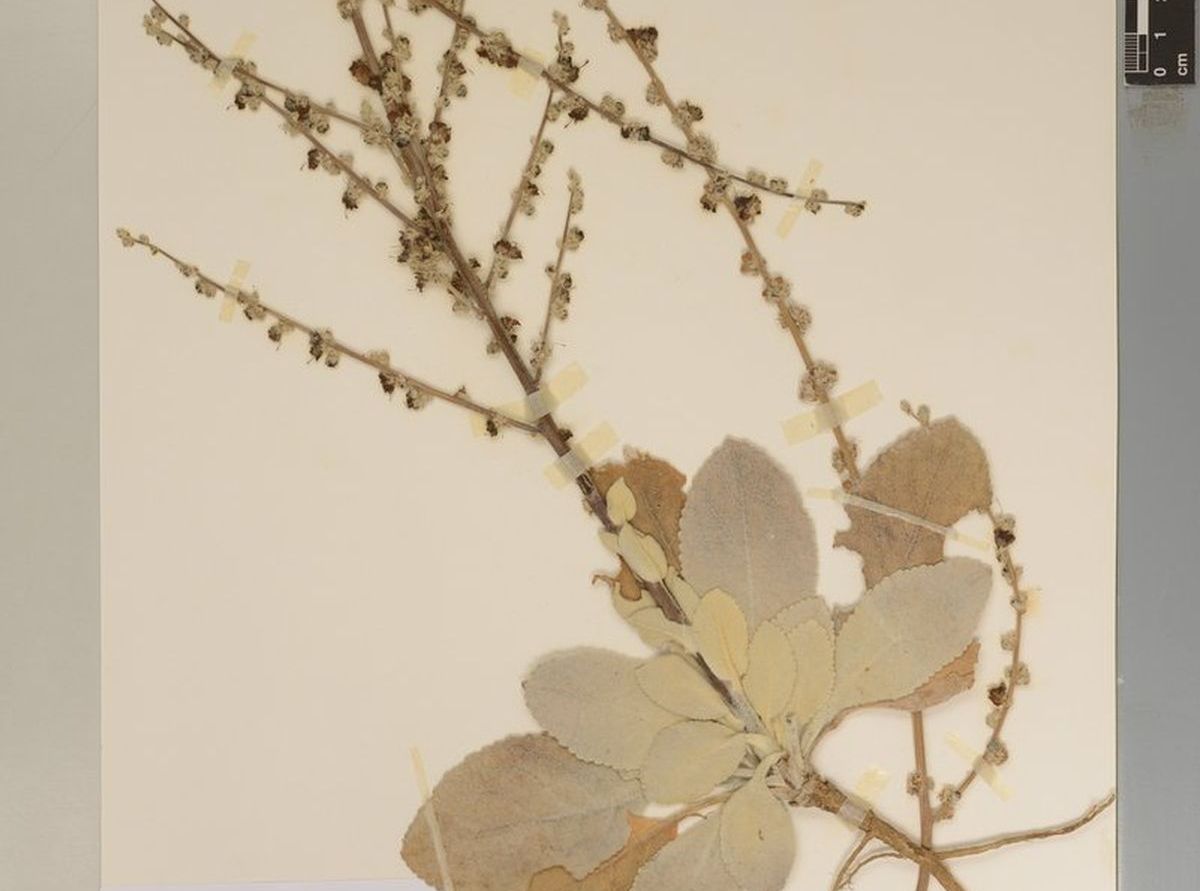
Huber-Morath kept the holotype, his own number 10645, in his herbarium; the duplicates went to the herbaria of Renz and Simon[3]. Those two sheets are now in Basel, each marked in red ink ISOTYPUS: a duplicate of the type gathering[4][5].
The man who knew the mulleins
Verbascum, the mulleins, was Huber-Morath's great subject. His obituary in Bauhinia says he mastered the treatment of "the complex genera Verbascum and Achillea"[6]. He wrote the account of Verbascum for Peter Hadland Davis's Flora of Turkey (vol. 6, pp. 461–603, 1978) and for Rechinger's Flora Iranica (1981)[6], and the University of Basel made him an honorary doctor of botany in 1972[6]. His journeys, he wrote, were made "together with friends and colleagues"[1].
Verbascum kurdicum is in his Flora of Turkey account: a hand-written note on both Basel isotypes reads "Davis V6 p. 556"[4][5].
Older than its name
The plant was not new to herbaria in 1951, only to science.
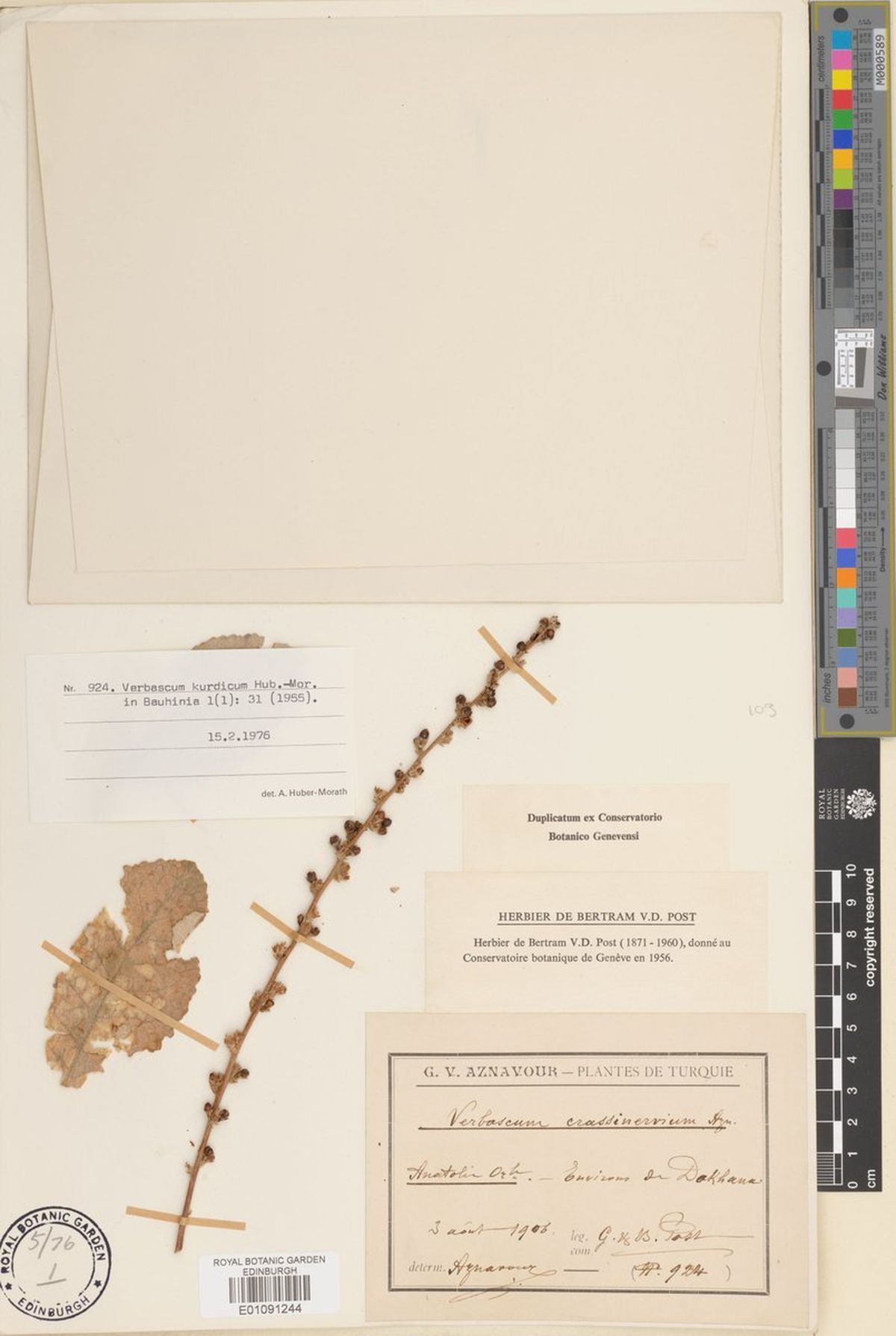
On 3 August 1906, almost half a century earlier, a mullein was gathered in what the label calls Anatolie Orientale ("eastern Anatolia"), near a place written "Dakhana" (our reading of the handwriting), collected or sent by "G. & B. Post". The botanist Georges Vincent Aznavour (1861–1920)[2] identified it on his label "Plantes de Turquie" with a name of his own: Verbascum crassinervium, "the thick-veined mullein"[7]. That name is not in the International Plant Names Index, so he seems never to have published it[7]. The sheet stayed in the herbarium of Bertram V. D. Post (1871–1960), which went to Geneva in 1956, and a duplicate from Geneva reached Edinburgh. On 15 February 1976, shortly before the duplicate reached Edinburgh, Huber-Morath identified it and wrote a new label: "Verbascum kurdicum Hub.-Mor. in Bauhinia 1(1): 31 (1955)"[7].
What it looks like
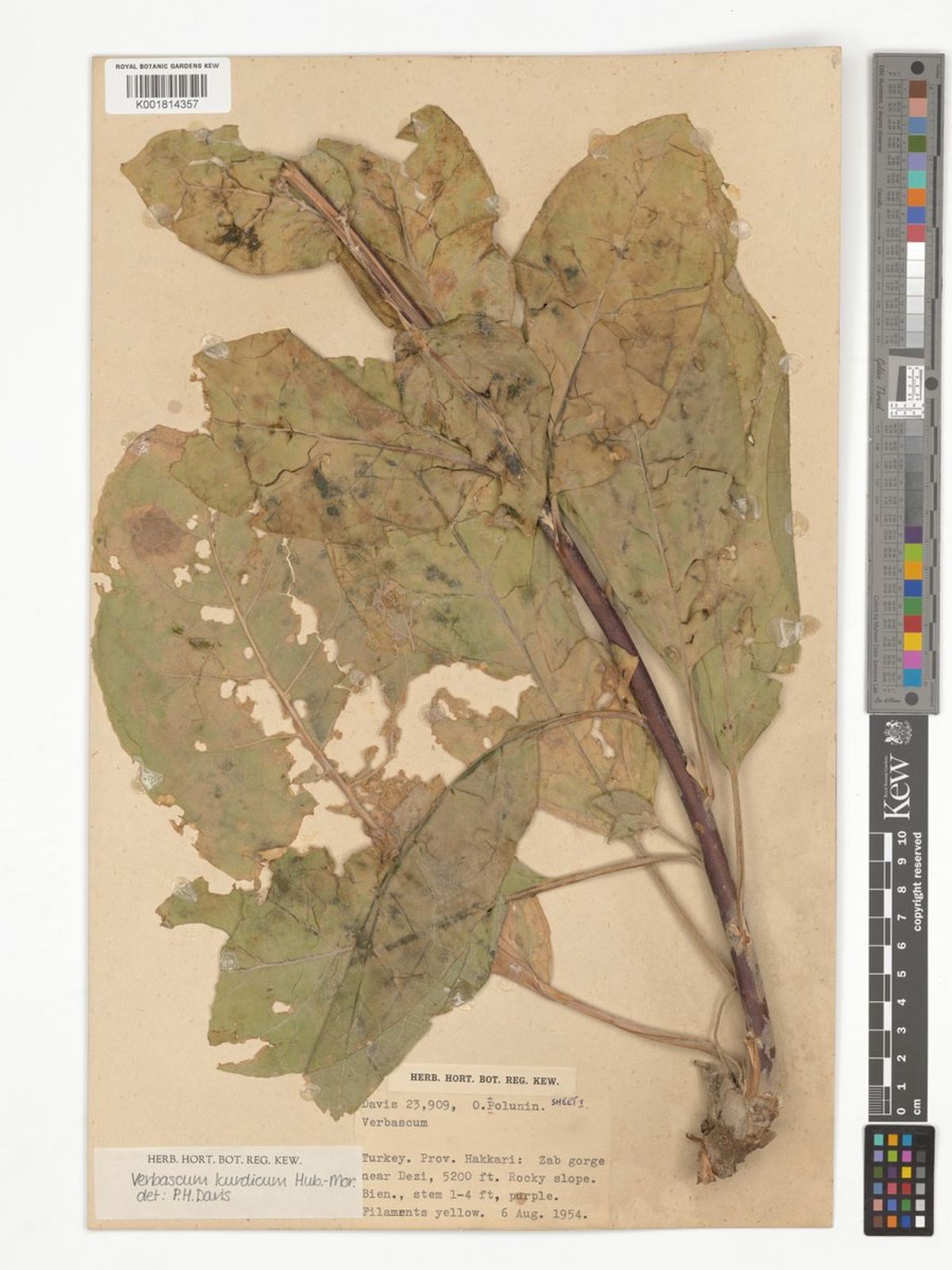
No photograph of a living plant seems to exist: iNaturalist has no observation of it[8], and the GBIF records are all herbarium sheets[4][5][9][9][9][9][9][7][7][10]. What we know comes from Huber-Morath's description and from the pressed plants and their labels.
- A biennial. Huber-Morath's description begins planta biennis[3], Kew's checklist gives it as a biennial[11], and the collectors say the same: "Bien.", "Biennial"[9][9][9][9], that is, a plant that lives for two years.
- Felt. The whole plant is covered with a dense white felt pressed close to the surface, without glandular hairs[3]; on the type sheets it looks grey[4][5].
- Leaves. The type sheets show a basal rosette of broad leaves with scalloped edges[4][5]. Huber-Morath gives the blades of the basal leaves as 5–10 cm long and 3–5 cm wide, elliptic to obovate and finely scalloped, on stalks 1–5 cm long; the stem leaves are smaller, narrower and stalkless[3].
- Stem. Huber-Morath described a plant 50–70 cm tall, with several slender, upright stems, tinged red and losing their felt with age[3]. "Stem 1–4 ft, purple", wrote Davis and Oleg Polunin in the Zab gorge in 1954[9]: roughly 30 to 120 cm. On the scans the pressed stems of several sheets look purplish red[9][9].
- Flowers. The flowering shoot branches widely, like a loose candelabra, with small flowers in clusters along slender side branches[4][5][9]; the spike at the tip alone is 30–50 cm long[3]. The clusters hold three to seven flowers and are already spaced apart when they open. The corolla is yellow and small, 10–15 mm across, and the calyx only 2–2.5 mm long[3]. A collector in the Zab gorge in 1970 wrote simply "Fls. yellow"[7].
- Stamens. The stalks of the stamens are densely woolly, except that the two front ones are bare at the tip[3]. Huber-Morath described the hairs as long and whitish[3], but the collectors in the field kept noting them as yellow: "Filaments yellow", "Filament hairs yellow", "Filaments pale yellow"[9][9][9][9].
- Fruit. A small, broadly obovate capsule, 3–3.5 mm long, felted at least when young, about as long as the calyx[3].
Where it grows
Kew's checklist gives its native range as eastern Turkey to northern Iraq[11]. In Kurdish terms, every specimen with a place we could read comes from the mountains of Bakur, along the valleys of the Zab (Zê) and its neighbours, close to the border with Başûr:
- Bidlîs: the type locality, between Hawêl (Baykan) and Bidlîs, 23 km north of Hawêl, in an open oak wood on schist, 1,000–1,030 m, 4 July 1951[4][5][3].
- Wan (Van): rocky slopes of a ravine, 8 km north of Satak, 21 July 1954[9].
- Colemêrg (Hakkâri):
- the gorge of the Zab near Dez, at 5,200 feet (about 1,600 m), on a rocky slope, 6 August 1954[9];
- Çelê (Çukurca), 1,200 m, rocky limestone slopes in oak scrub, 12 June 1966[9];
- the Zab gorge 8 km below the town of Colemêrg, 1,250 m, rocky limestone slopes, 21 June 1966[9], and again "near turning to Hakkari", on a dry, steep rock slope at 1,220 m, 4 June 1970[7];
- on the road from Qilaban (Uludere) to Colemêrg, on rock at 1,480 m and in a stream gully at 2,000 m, 20 July 1983[10].
- Cizîr (Cizre): the Kasrik gorge, 10–11 km from Cizîr, on rocky limestone slopes at only 400 m, 7 May 1966[9].
That is a plant of rocks, limestone, schist and oak scrub, from about 400 to 2,000 m. It was collected in flower or young fruit from early May, in the low gorge near Cizîr, to early August, on the slopes above the Zab at about 1,600 m[9][9].
The Zab rises in these mountains and flows on into Başûr, so the range of Verbascum kurdicum may well cross the border, as Kew's checklist suggests[11]. We have not found a specimen from Başûr yet.
Many mulleins, many names
Ehmedê Dirihî's dictionary of Kurdish plant names (2013) gives Verbascum kurdicum six Kurdish names, all built the same way: the name of a familiar mullein plus kurdan, echoing the scientific name[12]:
- helgomê kurdan[12]
- hergomê kurdan[12]
- masîcankê kurdan[12]
- pelpihûnê kurdan[12]
- çuxleta heranî kurdan[12]
- zelweyê kurdan[12]
These are dictionary names, made after the scientific name. Only two carry a place code, Çewlîg (helgomê kurdan and çuxleta heranî kurdan)[12]. But each one leans on an older folk name. In the same dictionary helgom is a name for the mulleins in general, marked as from Çewlîg[12]; pelpihûn, masîcank, zelve and çuxletê heran are names of the great mullein, V. thapsus[12]; zelve and masîcanik also of V. speciosum[12]. Dirihî's Turkish column is a small surprise: next to three of the Kurdish names it gives baykan sığırkuyruğu, the "Baykan mullein", probably after the district of the type locality[12].
Mulleins are not only names. In 1933 a collector at Zawîte near Duhok, in Başûr, noted of another mullein, V. sinuatum, that "meat is wrapped and cooked in basal leaves to make 'dolma'", and that its Kurdish name there was kavlapir. At Mahad in Şêxan (Shaikhan) the same species was called masi jarrak[13].
Another mullein of these mountains carries the name of a people. In 1907 Joseph Bornmüller named Verbascum carduchorum, "of the Carduchi"[2]. It is one of the two mulleins Huber-Morath called the closest relatives of V. kurdicum, with V. kotschyi: their ranges border on its own, to the south-east and the south-west. V. kurdicum differs from both in its stamens, with the two front ones bare at the tip, in its smaller calyx and flowers, and in its more clearly scalloped basal leaves[3]. The same 1949 list records V. carduchorum from Hinnis near Ain Sifni (Şêxan), from Atrush, "in crevice on limestone boulder", and from a rocky ravine at Zawîte, all in July 1933[13].
Sources
- 1.Huber-Morath, A. (1982). Reisen durch Anatolien 1935–1969. Bauhinia 7(3): 167–176.
- 2.International Plant Names Index. Royal Botanic Gardens, Kew, Harvard University Herbaria and Australian National Herbarium.
- 3.Huber-Morath, A. (1955). Verbreitung der Gattungen Verbascum, Celsia und Staurophragma im Orient. Bauhinia 1(1): 1–83.
- 4.abcdefghHerbarium of the Basel Botanical Society, isotype BASBG-00000234 (J. Renz, 1951), via GBIF.
- 5.abcdefghHerbarium of the Basel Botanical Society, isotype BASBG-00000233 (C. Simon, 1951), via GBIF.
- 6.Heitz, Ch., Rieder, H. P. & Brodtbeck, Th. (1990). Dr. Dr. h.c. Arthur Huber-Morath, 1901–1990. Bauhinia 9(3): 181–189.
- 7.Royal Botanic Garden Edinburgh Herbarium (E), specimen catalogue (via data.rbge.org.uk and GBIF). data.rbge.org.ukhttps://data.rbge.org.uk/herb/
- 8.↩iNaturalist. Verbascum kurdicum (taxon 1111572), checked 15 November 2026. inaturalist.orghttps://www.inaturalist.org/
- 9.Royal Botanic Gardens, Kew – Herbarium Specimens. via GBIF. gbif.orghttps://www.gbif.org/dataset/cd6e21c8-9e8a-493a-8a76-fbf7862069e5
- afjknswK001814357 and K001814356, and Royal Botanic Garden Edinburgh, E01091241 and E01091242 (P. H. Davis & O. Polunin 23909, 1954), via GBIF.
- brK001814355, and Royal Botanic Garden Edinburgh, E01091243 (P. H. Davis & O. Polunin 22976, 1954), via GBIF.
- cgovxK001814359, and Royal Botanic Garden Edinburgh, E01091246 (P. H. Davis 42655, 1966), via GBIF.
- dhptK001814354, and Royal Botanic Garden Edinburgh, E01091245 (P. H. Davis 44821, 1966), via GBIF.
- eilmquK001814358, and Royal Botanic Garden Edinburgh, E01091247 (P. H. Davis 45358, 1966), via GBIF.
- 10.abHerbarium of the Basel Botanical Society, BASBG-00053064 and BASBG-00053065 (M. Nydegger, 1983), via GBIF.
- 11.Plants of the World Online. Royal Botanic Gardens, Kew.
- abcVerbascum kurdicum.
- plant_name_id 2454772. powo.science.kew.orghttps://powo.science.kew.org/taxon/urn:lsid:ipni.org:names:811214-1accessed 14 November 2026
- 12.Ahmet Kasımoğlu (Ehmedê Dirihî) (2013). Ferhenga Navên Nebatan a Kurdî (Dictionary of Kurdish Plant Names). Mardin Artuklu University, Institute of Living Languages in Turkey (ISBN 978-605-4202-12-6).
- 13.abBlakelock, R. A. (1949). The Rustam Herbarium, 'Iraq. Systematic List. Part III. Kew Bulletin 4(4): 528, p. 534.
- 14.Ehmedê Dirihî (2007). Flora Kurdistanê (II). institutkurde.orghttps://www.institutkurde.org/publications/kurmanci/
- 15.Birgül Murat (2025). Nazımiye (Tunceli) ilçesinin etnobotanik özellikleri. tez.yok.gov.trhttps://tez.yok.gov.tr/UlusalTezMerkezi/
- 16.F. Hooshidari (2009). Medicinal plants of Kurdistan province (گیاهان دارویی استان کردستان). ijmapr.areeo.ac.irhttps://ijmapr.areeo.ac.ir/article_7319.html
- Herbaria Basel, sheet BASBG-00000234 (Verbascum kurdicum, Type; Renz), via GBIF.
- BASBG-00000234. api.gbif.orghttps://api.gbif.org/v1/occurrence/6572639489accessed 14 November 2026
- BASBG-00000234, -00000233. api.gbif.orghttps://api.gbif.org/v1/occurrence/6572639489accessed 14 November 2026
- Herbaria Basel, sheet BASBG-00000233 (Verbascum kurdicum, Type; Simon s.n.), via GBIF. BASBG-00000233. api.gbif.orghttps://api.gbif.org/v1/occurrence/6572676180accessed 14 November 2026
Last updated 20 November 2026