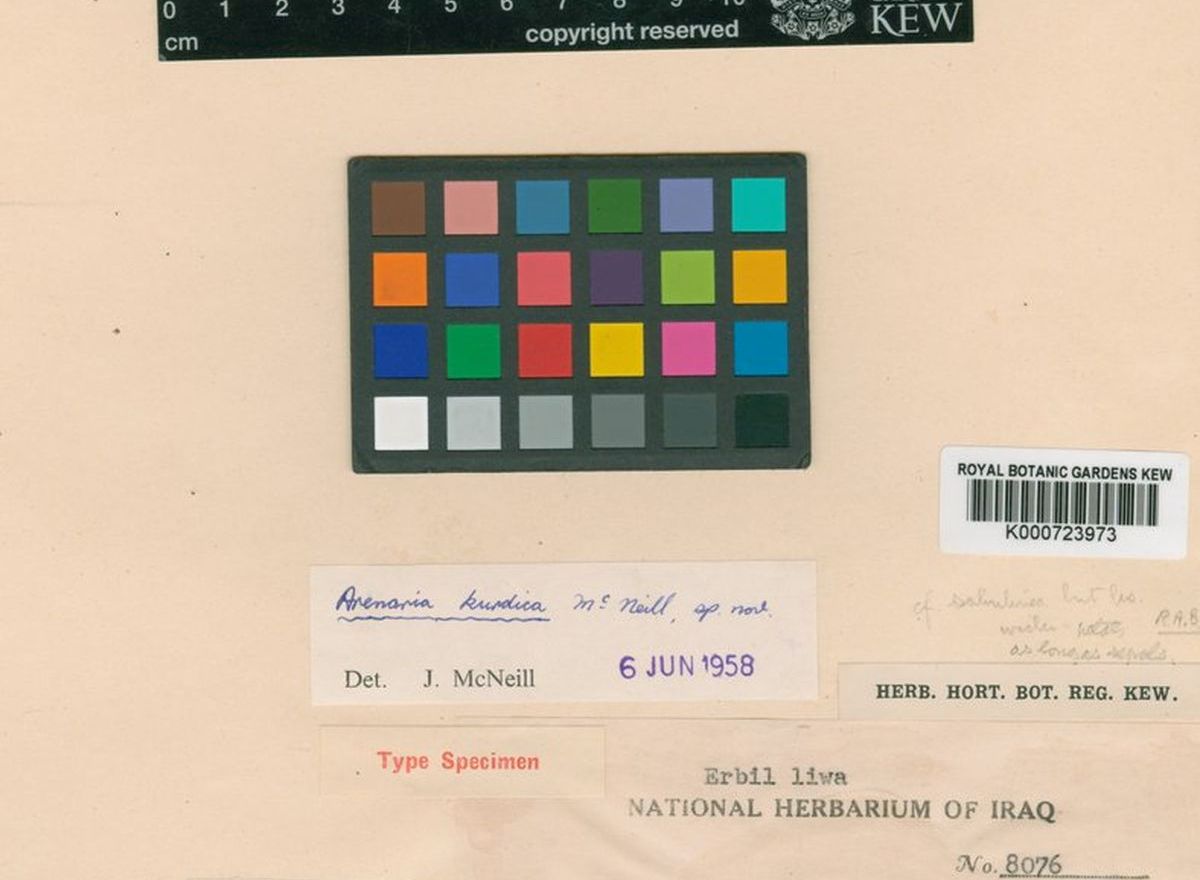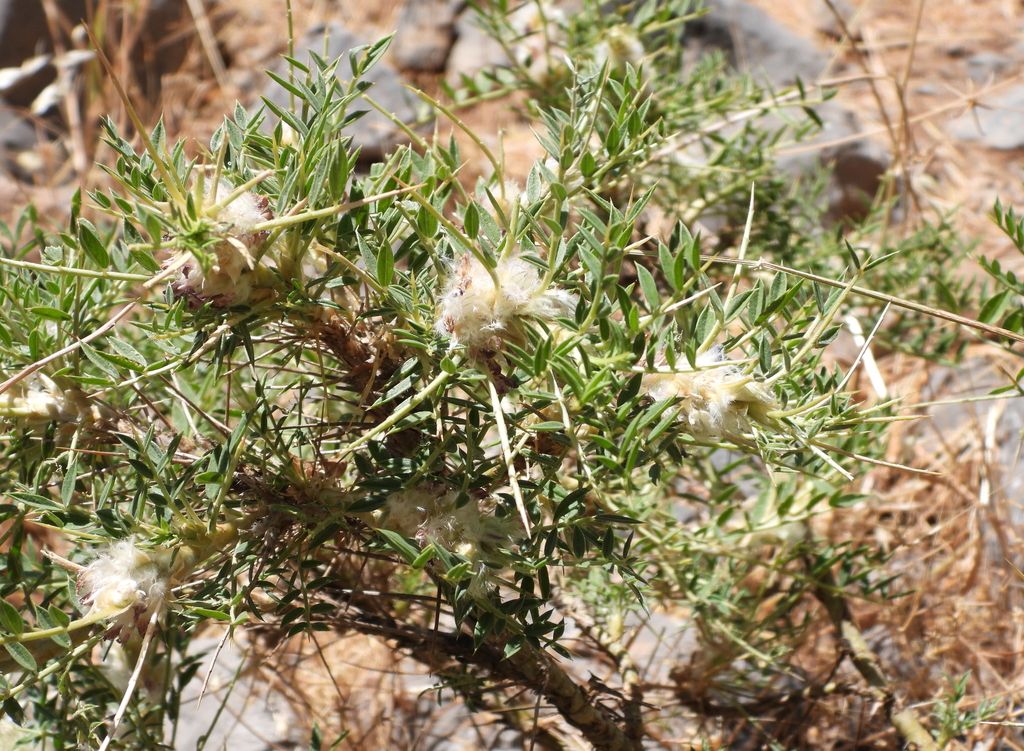
Alchemilla kurdica is a lady's mantle[1], a member of the genus Alchemilla in the rose family[2], from the high mountains of South Kurdistan (Başûr). The specimen its name rests on was pressed at 2,900 metres on Helgurd in May 1893[3]. A 2009 survey of the mountain lists it among the endemic plants recorded there, but only from old records: the surveyors did not find it[4].
Since then the record has stayed thin. There is not a single observation of it on iNaturalist, and GBIF, the global biodiversity database, holds just three herbarium sheets, all from Helgurd[5][6]. This is the story of those sheets, and of a group of plants so tangled that botanists still disagree on how many species it contains.
How it got its name
- Named by
- Rothm., 1938Published in Beih. Bot. Centralbl., Abt. 2. 58: 268
A botanist on Helgurd, 1893
In 1892 and 1893 the botanist Joseph Bornmüller (1862–1948)[7] travelled through Persia and the neighbouring Ottoman lands, in Mesopotamia, Assyria and Kurdistan, collecting plants on a journey he called the Iter Persico-turcicum, "the Persian-Turkish journey"[3][8]. His route took him through Kerkûk (Kirkuk) and Hewlêr (Erbil)[8].
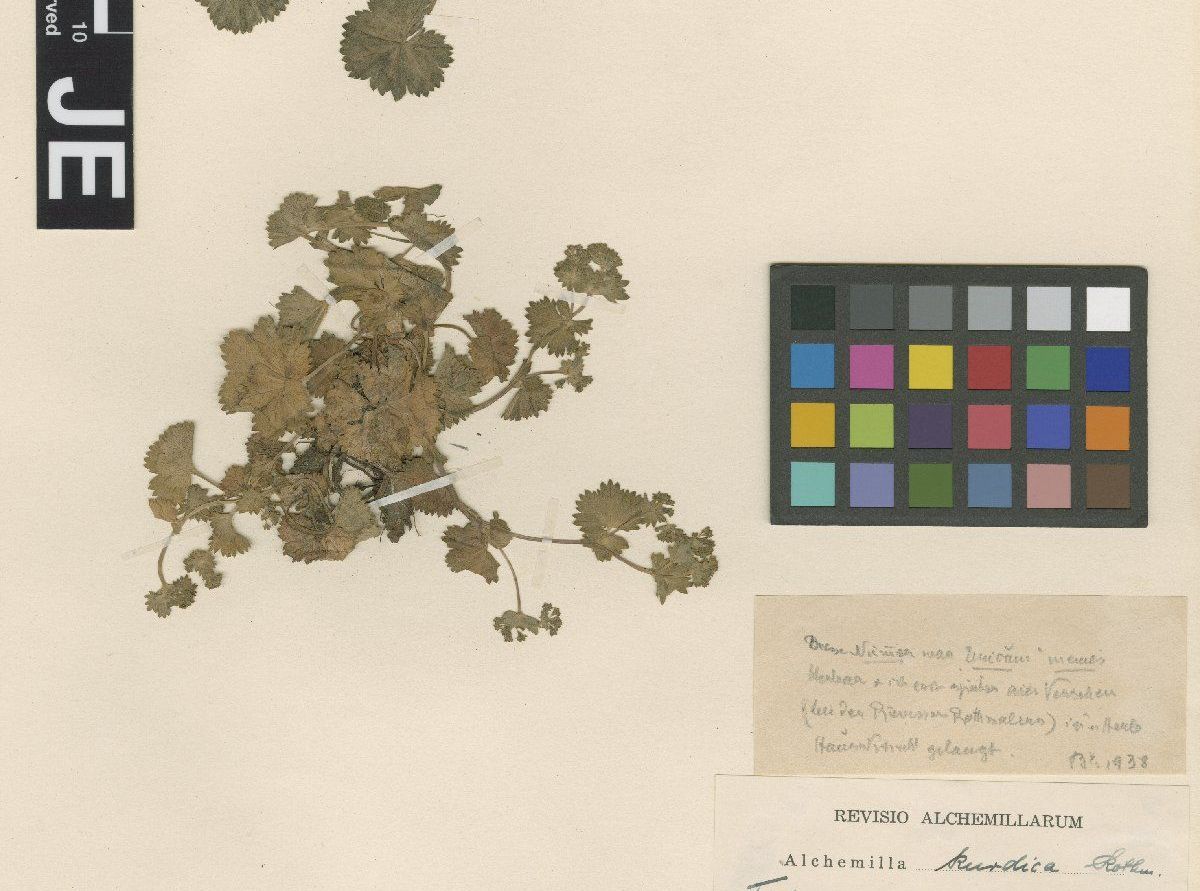
On 26 May 1893 he was high on Helgurd, in the alpine zone at 2,900 metres. His printed label reads Kurdistania: Riwandous ad fines Pers., that is, Kurdistan, in the district of Rewandiz (Rowanduz) towards the Persian border, and by hand he added the alpine zone of Helgurd[3]. There he gathered a small lady's mantle and numbered it 1056. He took it for a mountain form of the common European lady's mantle and wrote it up as Alchemilla vulgaris var. alpestris f. alpina[3].
The sheet is now in the Herbarium Haussknecht in Jena, Germany, under the barcode JE 00029194[3]. Its scan shows two low tufts of long-stalked, rounded leaves, each shallowly lobed and toothed along the edge[3].
Forty-four years in a drawer
Lady's mantles are among the most difficult plants a botanist can take on. The genus Alchemilla is "probably the best known group with autonomous apomixis"[9]: in the Eurasian species the embryo in the seed forms without fertilisation[9], so every slightly different line can copy itself, seed after seed. Trying to make sense of that variation has "led to the description of many micro-species"[9], and estimates of the genus run from at least 250 to as many as 1,000 species[9].
In the 1930s the botanist Werner Rothmaler (1908–1962)[7] took on the lady's mantles of the Orient, the species "to which my work was mainly devoted", as he put it, and he borrowed specimens from several herbaria, among them Bornmüller's own in Weimar[10]. On 25 September 1937 he fixed a printed "Revisio Alchemillarum" label to Bornmüller's number 1056, wrote on it Alchemilla kurdica Rothm., and underlined the word Typus[3]. In Rothmaler's view it was not a form of the common lady's mantle at all, but a species new to science.
The name was published in 1938, in a paper by Bornmüller in the Beihefte zum Botanischen Centralblatt, which is why its author is written "Rothm. in Bornm."[7]. The epithet kurdica means "Kurdish", and IPNI's record carries a single remark: "Kurdistan"[7].
Back on the mountain, 1947
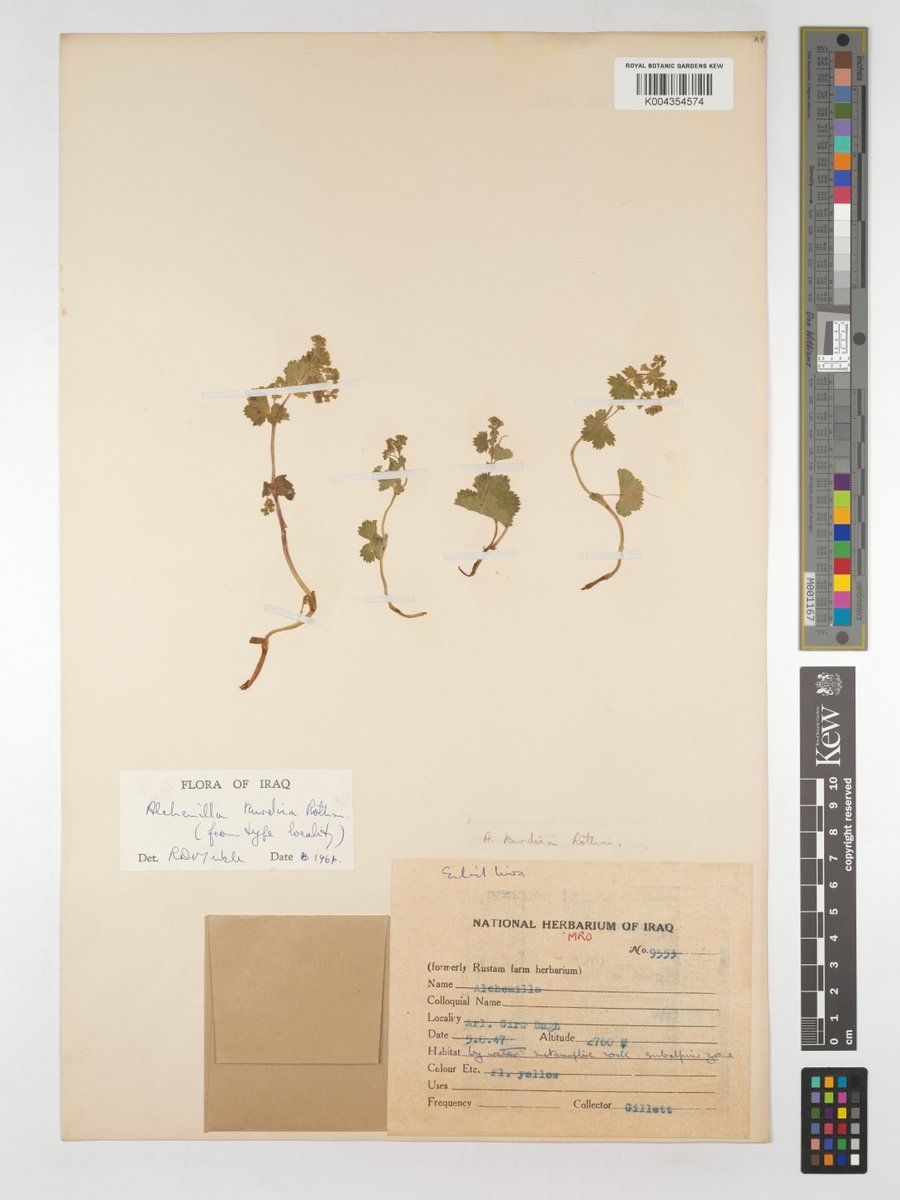
The next specimen in the public record is more than fifty years younger. On 5 June 1947 Jan Bevington Gillett (1911–1995)[7], then employed as botanist by the Government of Iraq[11][12], collected a lady's mantle at 2,760 metres on "Arl Gird Dagh", the name his label uses for Helgurd[13].
Gillett's label, number 9553, is brief: "by water", on metamorphic rock in the subalpine zone, flowers yellow[13]. It is printed for the National Herbarium of Iraq, "formerly Rustam farm herbarium"[13], a collection that had lost part of its specimens "during the troubles of 1941"[11].
In 1961 R. D. Meikle, naming plants for the Flora of Iraq, identified Gillett's gathering as Alchemilla kurdica and added a note: "(from type locality)", that is, from the mountain where Bornmüller's type was found[13]. Two sheets of it are kept at Kew[13].
A closer look
We have not been able to read the 1938 description, so the details here come from the specimens and from later studies:
- small plants with long-stalked, rounded, lobed and toothed leaves, as on the type sheet[3];
- flowers noted as yellow by Gillett[13];
- pollen grains about 23 thousandths of a millimetre long and 16 wide, slightly elongated, according to a 2015 study of the lady's mantles of Iran[14];
- a close relative: botanists have treated it as closely allied to Alchemilla fluminea[14].
Whether it needs that pollen at all is another matter. If, like its Eurasian relatives, it sets seed on its own, it does not: in lady's mantles that do, working pollen is simply unnecessary[9].
Only on Helgurd?
Helgurd rises to about 3,613 metres in the Hewlêr (Erbil) governorate of the Kurdistan Region[4], near the border with East Kurdistan (Rojhilat). It belongs to the Hasarost range of the Zagros, keeps some snow all summer, and has important alpine and mountain streams; its plant life ranges from thorn-cushion vegetation to the alpine zone[4]. Nature Iraq's 2009 survey lists Alchemilla kurdica among the endemic plants recorded on Helgurd, together with Astragalus helgurdensis and Tulipa kurdica, but marks it as known only from old records: its botanists did not see it in 2009[4].
The wider record is less tidy:
- In 1938 Rothmaler wrote that only one lady's mantle, A. persica, had so far been known from Persia[10]. Flora Iranica (1969) later treated 31 species, and the Flora of Iran (1993) 24[14].
- In 1988 the botanist Maboubeh Khatamsaz[7] recorded A. kurdica as new to Iran, from near Hamadan at 2,750 metres[15], and it was one of the 18 species in the 2015 pollen study[14].
- Kew's checklist gives its native range as "Kazakhstan to N. Iraq", citing Flora Iranica (1969) and Flora Kazakhstana (1961)[2]. We have not been able to check the Kazakh record, far away in Central Asia.
So it is not confined to Helgurd after all. What is certain is how thin the record is: one gathering on Helgurd in 1893, one in 1947, at least one from Iran, and not one photograph of a living plant[15][5][6]. On its own mountain, nobody has reported seeing it since[4].
The mountain in 2009
In 2009, Nature Iraq's survey named the pressures on Helgurd's plants and animals: land mines, which it rated a high threat, a high level of hunting, and small vegetable plots and rubbish dumps that could become a problem if they spread[4]. Alchemilla kurdica has not been assessed for the IUCN Red List[16].
Names
We have found no Kurdish name recorded for this lady's mantle. For the genus as a whole, Ehmedê Dirihî's dictionary of Kurdish plant names gives vaşê vayan[17]; that is a genus name, still to be checked, not a name for this species.
Sources
- 1.↩Catalogue of Life, vernacular names via the GBIF Backbone Taxonomy. English names for Alchemilla, via GBIF. gbif.orghttps://www.gbif.org/dataset/d7dddbf4-2cf0-4f39-9b2a-bb099caae36c
- 2.Plants of the World Online. Royal Botanic Gardens, Kew.
- abAlchemilla kurdica.
- plant_name_id 2939680. powo.science.kew.orghttps://powo.science.kew.org/taxon/urn:lsid:ipni.org:names:720715-1accessed 14 November 2026
- 3.abcdefghHerbarium Haussknecht, Jena (JE), specimen records (JACQ) via GBIF. Jena: holotype of Alchemilla kurdica, JE 00029194 (Bornmüller 1056, 1893), via GBIF. api.gbif.orghttps://api.gbif.org/v1/occurrence/3028980654
- 4.abcdefNature Iraq (2009). Halgurd Mountain (IQ017). Key Biodiversity Areas of Iraq.
- 5.abGBIF.org GBIF Backbone Taxonomy and occurrence records. occurrence records for Alchemilla kurdica (accessed 15 November 2026). gbif.orghttps://www.gbif.org/
- 6.abiNaturalist. Alchemilla kurdica (taxon 1110346; accessed 15 November 2026). inaturalist.orghttps://www.inaturalist.org/
- 7.International Plant Names Index. Royal Botanic Gardens, Kew, Harvard University Herbaria and Australian National Herbarium.
- 8.abMagnus, P. (1899). J. Bornmüller, Iter Persico-turcicum 1892/93. Fungi, Pars II. Verhandlungen der Zoologisch-Botanischen Gesellschaft in Wien 49: 87–103.
- 9.Gehrke, B., Bräuchler, C., Romoleroux, K., Lundberg, M., Heubl, G. & Eriksson, T. (2008). Molecular phylogenetics of Alchemilla, Aphanes and Lachemilla (Rosaceae) inferred from plastid and nuclear intron and spacer DNA sequences, with comments on generic classification. Molecular Phylogenetics and Evolution 47: 1030–1044. doi:10.1016/j.ympev.2008.03.004https://doi.org/10.1016/j.ympev.2008.03.004
- 10.Rothmaler, W. (1938). Systematik und Geographie der Subsektion Calycanthum der Gattung Alchemilla L. Repertorium specierum novarum regni vegetabilis, Beihefte 100: 59–93.
- 11.abBlakelock, R. A. (1948). The Rustam Herbarium, 'Iraq. Systematic List. Part I. Kew Bulletin 3(3): 404–405, p. 375.
- 12.↩Blakelock, R. A. (1951). The Rustam Herbarium, 'Iraq. Part IV. Kew Bulletin 6(3), p. 457.
- 13.abcdefRoyal Botanic Gardens, Kew – Herbarium Specimens. via GBIF, 1947), via GBIF. gbif.orghttps://www.gbif.org/dataset/cd6e21c8-9e8a-493a-8a76-fbf7862069e5
- 14.abcdFaghir, M. B., Attar, F., Shahi Shavvon, R. & Mehrmanesh, A. (2015). Pollen morphology of the genus Alchemilla L. (Rosaceae) in Iran. Turkish Journal of Botany 39(2): 267–279. doi:10.3906/bot-1406-23https://doi.org/10.3906/bot-1406-23
- 15.abKhatamsaz, M. (1988). Studies on the Rosaceae family in Iran, new taxa and new records. Iranian Journal of Botany 4(1): 111–125.
- 16.↩IUCN Red List status via GBIF: Not Evaluated.
- 17.↩Ahmet Kasımoğlu (Ehmedê Dirihî) (2013). Ferhenga Navên Nebatan a Kurdî (Dictionary of Kurdish Plant Names). Mardin Artuklu University, Institute of Living Languages in Turkey (ISBN 978-605-4202-12-6).
- GBIF occurrence records of herbarium type specimens (per-record URL in each fact). occurrence 3029006201 (JE 00029194). api.gbif.orghttps://api.gbif.org/v1/occurrence/3029006201accessed 14 November 2026
Last updated 20 November 2026