How it got its name
- Named by
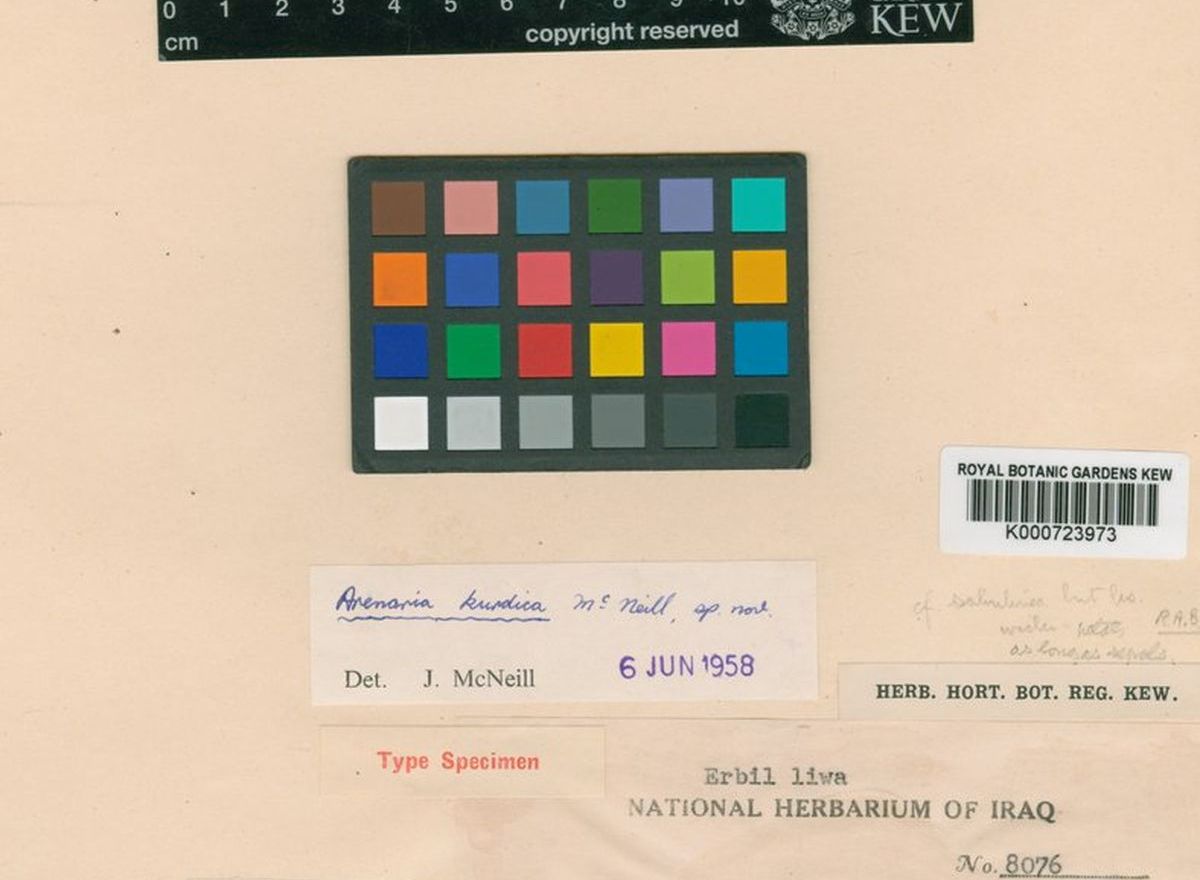
- Maroofi & R.M.Fritsch, 2011Published in Ann. Bot. Fenn. 48: 353
- Type collected by
- Fattahi, Tavakoli & Hatami1 June 1989
A pink pompom on the mountain floor
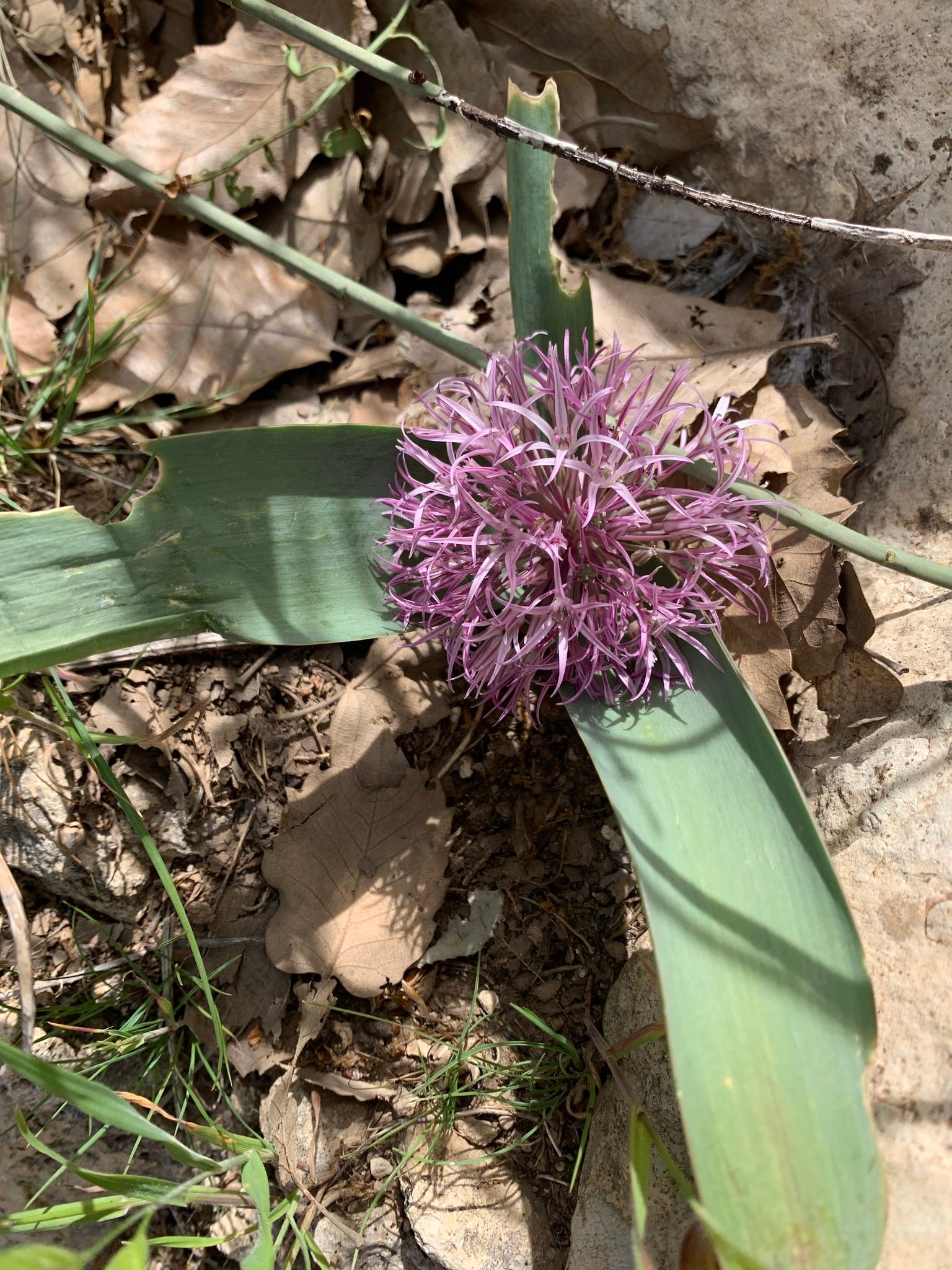
Picture a fist-sized ball of pink-lilac flowers sitting almost on the ground, cupped by three thick, wavy, yellow-green leaves. That is Allium kurdistanicum, a wild onion known so far only from the high mountains of Rojhilat (East Kurdistan)[1].
It hardly lifts its flowers at all: the flower stalk rises just 2 to 5 cm above the soil, while the leaves grow 7 to 17 cm long, so the head of flowers rests among them[1]. The plant lives through the year as a bulb, 2 to 5 cm across, wrapped in blackish-brown skins[1][2].
A name for Kurdistan
The first known specimen was collected on 1 June 1989 by Fattahi, Tavakoli and Hatami, at 2,450 m, at a place the label calls Gardaneh Khan, 15 km north-east of Bane (Baneh) in Kurdistan province[1][3]. The specimen went to the TARI herbarium[1], where it waited more than twenty years for a name.
In 2001 a second gathering was made by Hooshidari on Dalani mountain near Merîwan (Marivan), at 2,000 m[1]. In 2011 the botanists Hossein Maroofi, of the agricultural and natural-resources research centre in Sine (Sanandaj), and Reinhard M. Fritsch, of the IPK plant-genetics institute in Gatersleben, described it as a species new to science, in a paper led by Hamid Razyfard[1][3]. They named it kurdistanicum, "of Kurdistan". The paper gives no explanation of the name, but both specimens it cites come from Kurdistan province[1].
The description appeared in a paper on four new onions from Iran in the journal Annales Botanici Fennici[1].
A thorny family
Allium kurdistanicum belongs to a small, tricky group of onions, section Acanthoprason[1], a name built from the Greek for "thorn" and "leek". Its members share a family look: short flower stalks carrying many flowers, leaves longer than the stalk, and pink or purple petals whose central vein turns stiff after flowering, so that the old flower heads become prickly[1][4]. In A. kurdistanicum the petals stay stiff once the flowers fade, and in fruit each flower opens into a little star[1].
Botanists find them hard to tell apart. The authors of the 2011 paper call the section "taxonomically the most problematic" of its subgenus, and quote the botanist Wendelbo, who in 1971 called it "one of the most difficult groups"[1]. The count keeps rising: Flora Iranica recognised 13 species of the section in Iran, and later work raised this to 21[5]. Most grow high up in the Alborz and Zagros mountains, many are found nowhere outside Iran's borders, and several are "rare and known from few localities"[4][6][5].
Under the microscope, too, it keeps to the family pattern. In 2015 botanists counted its chromosomes for the first time: 16, in two sets of eight, like every other species of the section they studied[4].
How to tell it apart
Its two closest look-alikes, according to its describers, are A. haemanthoides and A. zagricum[1]:
- Leaves. A. kurdistanicum has narrow, lance-shaped leaves only 1–2 cm wide, pale yellow-green, not glossy, with a fine purple edge that is often minutely toothed[1]. A. zagricum has much larger, wider and glossy leaves, and A. haemanthoides wider ones too[1].
- Flower head. A dense half-ball of dozens of flowers, 5–6 cm across, on lilac flower stalks up to 2.5 cm long[1]. A. zagricum has bigger heads[1].
- Petals and stamens. The petals are narrow, pointed, 11–13 mm long, pink to lilac with a darker central vein, shorter than in both relatives and held straight, where theirs curve back[1]. The stamens are lilac with darker tips, and longer than in A. haemanthoides[1].
Genetic data place it among samples of two other species of the group, A. austroiranicum and A. ubipetrense, a little apart from them, and its describers suggested it belongs with the A. derderianum group of species, which also have narrow leaves and dark-tipped stamens[1].
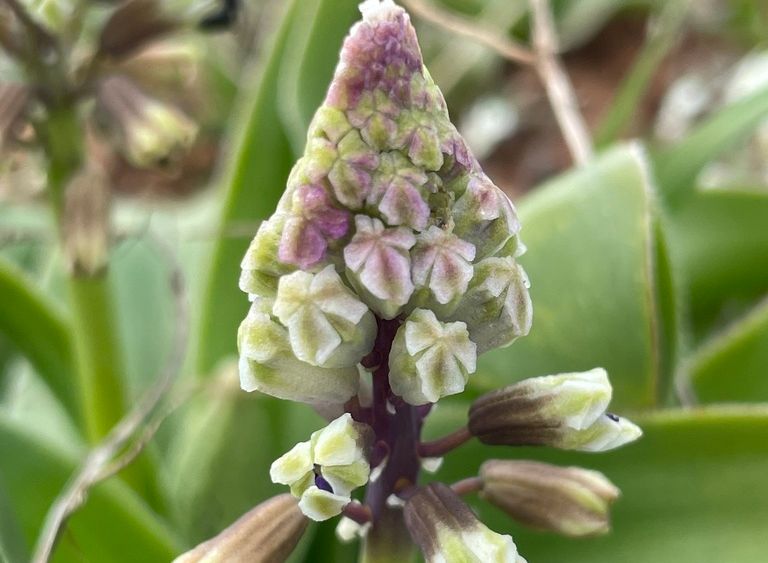
A. haemanthoides also grows near Merîwan: a 2018 pollen study sampled it at Almaneh village at 1,400 m[7].
Where it grows
Every record so far comes from the mountains of Kurdistan province in Rojhilat:
- Bane: the type locality, 15 km north-east of the town, at 2,450 m[1].
- Seqiz (Saqqez): a population sampled for the chromosome count, at 2,251 m[4]. By its published coordinates it lies only about 5 km from the type locality, in the same mountains.
- Merîwan: Dalani mountain, at 2,000 m[1].
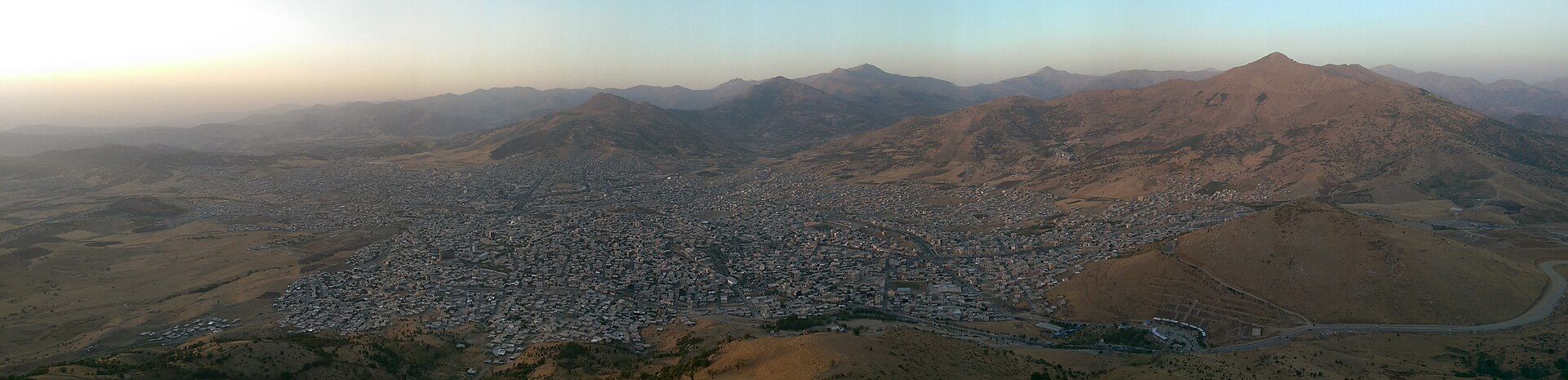
Its describers wrote that it was "known only from the type location near the Iraqi border", and that "occurrence in Iraq seems very probable"[1]: the type locality is close to the border with Başûr (South Kurdistan). Kew's checklist already lists the species for Iraq as well as Iran, with the range "N. Iraq to NW. Iran"[2][3]. We have not found a published record from Başûr, so for now its known home is the mountains of Rojhilat, between 2,000 and 2,450 m.
None of the sources describes its habitat. Its section as a whole is one of alpine and subalpine places[1], and two of its recently described relatives grow on gravelly, rocky or stony limestone slopes[5].
A short season
It flowers and fruits in May and June[1]. The Merîwan specimen was gathered on 16 April, at 2,000 m[1]; the Bane one on 1 June, 450 m higher[1].
Onions like these live fast above ground. The authors of a 2017 study of the section describe them as spending only about four months of the year above ground, and flowering for about a week[6]. The rest of the year the bulb waits under the soil.
Wild onions in the Kurdish kitchen
No use and no Kurdish name have been recorded for A. kurdistanicum itself. But wild onions are a familiar food in the same part of Kurdistan. In a 2024 study of foraging among Hawrami and Mukriyani Kurds in Rojhilat[8]:
- Allium paradoxum, called Pichek, was one of the three plants named by more than half of all the people interviewed. Its leaves are eaten raw, in soups and to flavour bread, and the authors call it "a critical species of the Hawramani culture".
- Allium jesdianum, called Surkabna, is cooked whole in soup, by both Hawrami and Mukriyani families.
- Allium iranicum, called Kanival or Knivali, is mixed into bread dough as a seasoning, in Hewraman (Hawraman).
Allium kurdistanicum may yet turn out to be eaten somewhere too. For now it is known from three collections in two mountain areas of Rojhilat, around Bane and Merîwan[1][4], a small pink onion with the name of Kurdistan in its own.
Sources
- 1.Maroofi, H. & Fritsch, R. M. (2011). Four new species of Allium (Alliaceae) from Iran. Annales Botanici Fennici 48(4): 352 ff. (A. kurdistanicum pp. 353–356). doi:10.5735/085.048.0407https://doi.org/10.5735/085.048.0407
- aiac
- bpp. 355–356.
- cdefhvwaaabp. 355.
- gkmypp. 352–353.
- jp. 353.
- lqruxzp. 356.
- npstpp. 353, 356.
- opp. 353, 355–356.
- Ann. Bot. Fennici 48: 355 (species heading p. 353). sekj.orghttps://www.sekj.org/PDF/anbf48/anbf48-352.pdfaccessed 14 November 2026
- p. 355. sekj.orghttps://www.sekj.org/PDF/anbf48/anbf48-352.pdfaccessed 14 November 2026
- p. 356. sekj.orghttps://www.sekj.org/PDF/anbf48/anbf48-352.pdfaccessed 14 November 2026
- 2.Plants of the World Online. Royal Botanic Gardens, Kew.
- abAllium kurdistanicum.
- plant_name_id 468272. powo.science.kew.orghttps://powo.science.kew.org/taxon/urn:lsid:ipni.org:names:77114928-1accessed 14 November 2026
- 3.International Plant Names Index. Royal Botanic Gardens, Kew, Harvard University Herbaria and Australian National Herbarium.
- abcAllium kurdistanicum Maroofi & R.M.Fritsch.
- urn:lsid:ipni.org:names:77114928-1. ipni.orghttps://www.ipni.org/n/77114928-1accessed 14 November 2026
- 4.Akhavan, A., Saeidi, H., Zarre, Sh. & Rahiminejad, M. R. (2015). Chromosome numbers and karyotype features of selected species of Allium L. (Amaryllidaceae) sect. Acanthoprason in Iran. Iranian Journal of Botany 21(2): 158–164.
- 5.Akhavan, A., Saeidi, H. & Fritsch, R. M. (2014). Allium kuhrangense (Amaryllidaceae) a new species of Allium sect. Acanthoprason from Iran. Phytotaxa 170(3): 213–218. doi:10.11646/phytotaxa.170.3.7https://doi.org/10.11646/phytotaxa.170.3.7
- 6.abAkhavan Roofigar, A. & Saeidi, H. (2017). Homoplasy patterns of morphological characters of sects. Acanthoprason and Asteroprason in the genus Allium L. based on phylogeny of nrDNA ITS sequences (in Persian). Taxonomy and Biosystematics 9(30): 71–82.
- 7.↩Hosseini, Sh. (2018). Pollen morphology of some Allium species (Amaryllidaceae) from Iran. Iranian Journal of Botany 24(2): 105–113, p. 106. doi:10.22092/ijb.2018.116674.1191https://doi.org/10.22092/ijb.2018.116674.1191
- 8.↩Naji Sulaiman, Fereshteh Salehi, Renata Sõukand, Andrea Pieroni, et al. (2024). Cultural vs. State Borders: Plant Foraging by Hawraman and Mukriyan Kurds in Western Iran. doi:10.3390/plants13071048https://doi.org/10.3390/plants13071048
- 9.Ehmedê Dirihî (2007). Flora Kurdistanê (II). institutkurde.orghttps://www.institutkurde.org/publications/kurmanci/
- 10.Birgül Murat (2025). Nazımiye (Tunceli) ilçesinin etnobotanik özellikleri. tez.yok.gov.trhttps://tez.yok.gov.tr/UlusalTezMerkezi/
- 11.Roman Hovsepyan, Nina Stepanyan-Gandilyan, Hamlet Melkumyan, Lili Harutyunyan (2016). Food as a marker for economy and part of identity: traditional vegetal food of Yezidis and Kurds in Armenia. doi:10.1016/j.jef.2016.01.003https://doi.org/10.1016/j.jef.2016.01.003
- 12.Ahmet Kasımoğlu (Ehmedê Dirihî) (2013). Ferhenga Navên Nebatan a Kurdî (Dictionary of Kurdish Plant Names). Mardin Artuklu University, Institute of Living Languages in Turkey (ISBN 978-605-4202-12-6).
Last updated 20 November 2026