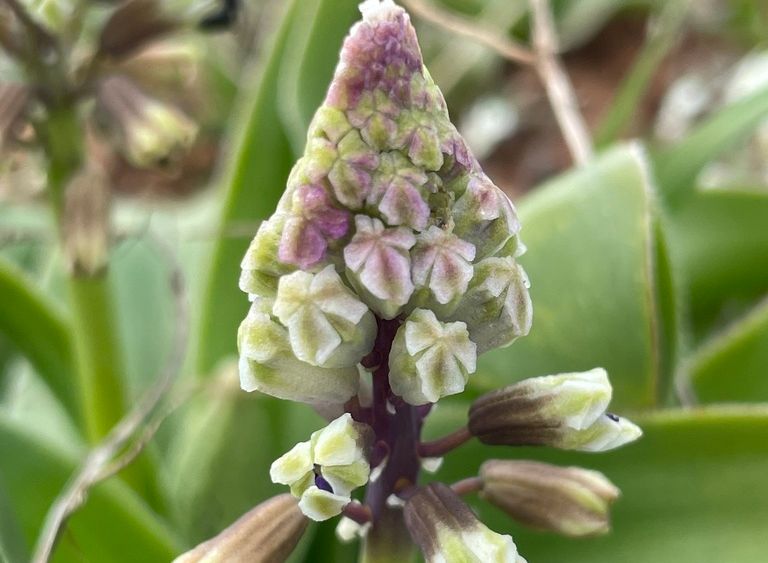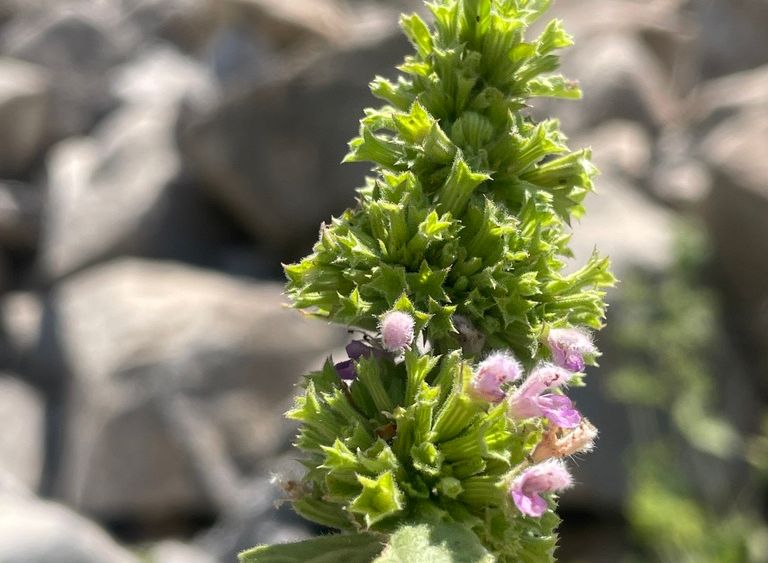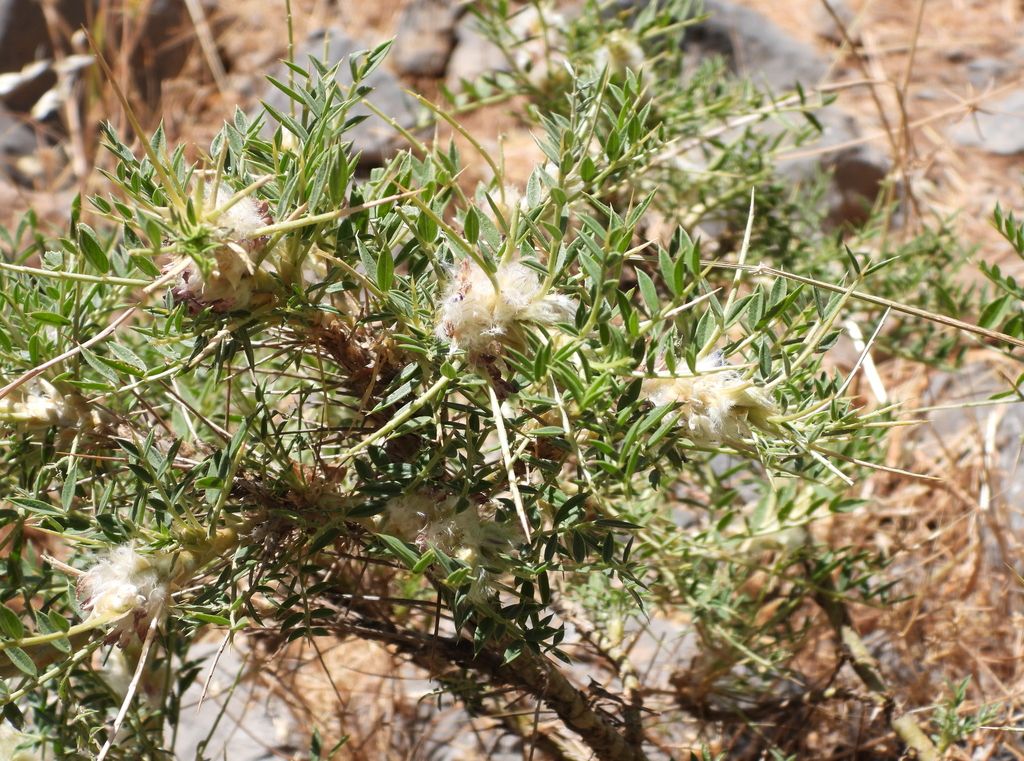
Astragalus kurdicus is a thorny, grey-green shrub of the high mountains of Bakur and Başûr, about a metre tall, with small pink flowers wrapped in white wool. It was first collected on Mount Gara in 1841, it was named after Kurdistan in 1849, and for a long time it was best known for something it gives off: tragacanth, a gum that travelled from the Kurdish mountains to the drug markets of London.
How it got its name
- Named by
- Boiss., 1849Published in Diagn. Pl. Orient. 9: 84
A thorn bush on Mount Gara
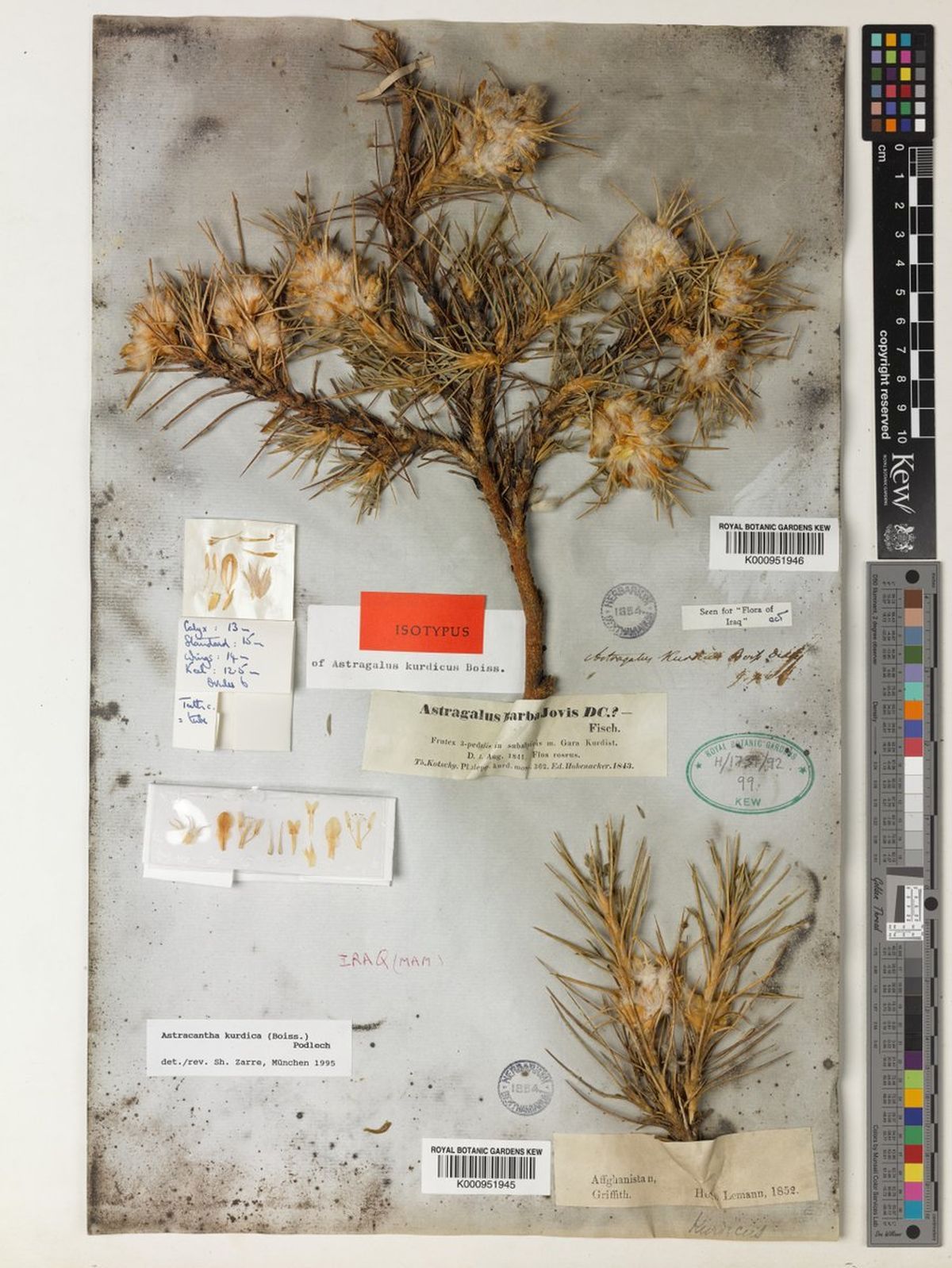
On 1 August 1841 the botanist Theodor Kotschy was in the subalpine zone of Mount Gara in Başûr when he collected a shrub about three feet high with pink flowers. His printed label reads, in Latin: "A shrub 3 feet tall in the subalpine zone of Mount Gara in Kurdistan. 1 August 1841. Flowers pink."[1]
Kotschy's plants were sent out to herbaria in 1843 by Hohenacker as "plants of Aleppo, Kurdistan and Mosul", and this one went out as number 362 under a borrowed name, Astragalus barba-jovis, with a question mark[1]. Duplicates of that gathering still sit in herbaria from Kew, Paris and Geneva to Washington and Jerusalem[2].
The botanist Pierre Edmond Boissier looked more closely. In 1849 he published it as a species new to science and named it Astragalus kurdicus, the Kurdish astragalus[3]. His note on where it grew is a single line:
Hab. in subalpinis montis Gara Kurdistaniae.
It grows in the subalpine zone of Mount Gara in Kurdistan.[3]
The guess on the label was wrong, he explained: the botanist Fischer had doubtfully referred the plant to A. barba-jovis, but that is "a very different species", with much shorter leaves and silvery leaflets[3].
That same August, on the same mountain, Kotschy also collected the plant that became the Kurdish hollyhock, Alcea kurdica[4]. Mount Gara gave two plants a Kurdish name in one month.
Armour made of old leaves
The most striking thing about the plant is how it defends itself. Boissier described it as "very much branched, the whole plant clothed with old, pressed-down, spiny leaf-stalks"[3]. In this group of astragalus the stalk of each leaf outlives its leaflets and hardens into a strong, lasting spine[5], so every twig ends up wrapped in the thorns of earlier years. In 1872 Boissier added that these old spines are blackish and 1 to 1½ inches (about 2.5 to 4 cm) long[6].
- a woody shrub 3 to 4 feet tall (about 1 to 1.2 m), with bare older branches;
- leaves of 4 to 5 pairs of narrow leaflets, each about 3 to 4 lines (some 7 to 9 mm) long and ending in a spiny tip; Boissier first saw them as pale green with a few close-lying hairs[3], and later as silvery with pressed-down hairs[6];
- small clusters of 2 to 6 flowers in the leaf axils, spaced out along the base of the young shoots into a short, loose spike;
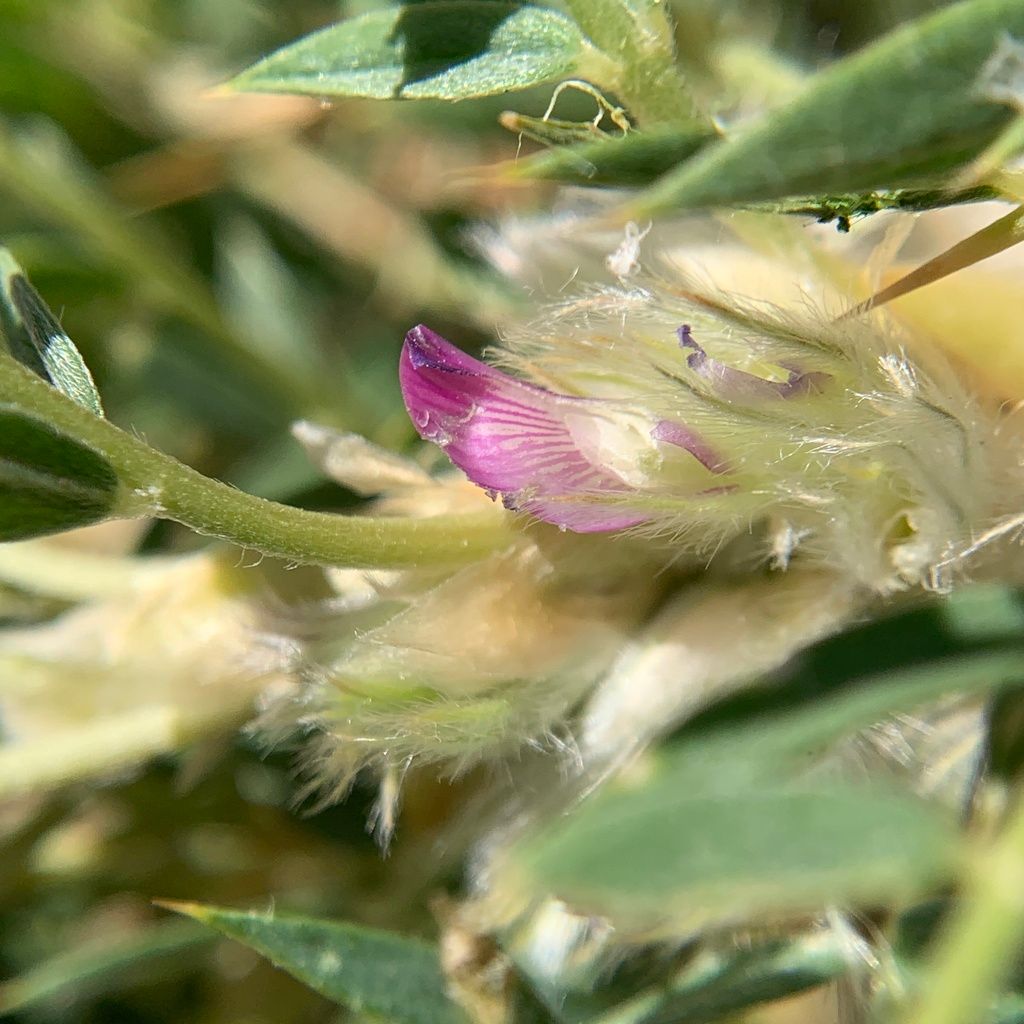
- a calyx so thickly covered in white hairs that the flower heads look like tufts of wool;
- a pink corolla that only just sticks out of the calyx.
Boissier also noticed that "in this species the number of flowers in the axils varies remarkably"[6].
Tragacanth: a gum from the mountains of Kurdistan
Cut the stem of a gum-bearing astragalus and you find something strange. The pith and the rays running out from it are not soft tissue but "a hard translucent gum-like mass, becoming gelatinous in water". Under the microscope this turns out to be the plant's own cells, their walls swelling and turning into gum[5]. That gum is tragacanth, which soaks up so much water that with fifty times its weight it still makes a thick mucilage[5]. It has been known since antiquity: Theophrastus named Media among its homelands in the 3rd century BC[5].
In 1879 the pharmacists Friedrich August Flückiger and Daniel Hanbury listed the species that supply it, in their great history of plant drugs, Pharmacographia. Number 8 on their list is A. kurdicus, "a shrub 3 to 4 feet high, native of the mountains of Cilicia and Cappadocia, extending thence to Kurdistan"[5]. The botanist Heinrich Haussknecht, whose observations, they wrote, related chiefly to Kurdistan and Persia[5], told them that the so-called Aintab tragacanth, named after Dîlok (Aintab, today Gaziantep), came chiefly from A. kurdicus and its close relative A. stromatodes[5]. Boissier thought the two were so alike, and grew so close together, that A. stromatodes might be just a form of the Kurdish plant[6].
The main gum country in Pharmacographia runs from Asia Minor through Armenia and Kurdistan into Persia, and Kurdistan is one of its great regions: tragacanth was gathered "throughout Kurdistan from Mush for 500 miles in a south-eastern direction as far as the province of Luristan", including the highlands south of Lake Wan (Van) and west of Lake Urmia[5]. Where the gum was tapped, as their correspondent in Smyrna described it, peasants cleared the earth from around the stems in July and August and cut into the bark; over the next three or four days the gum oozed out and dried in flakes. In Kurdistan and Persia, though, Haussknecht said that most of the gum was simply gathered where it had come out of the plants by itself[5].
The gum then went down to Baghdad and on to Europe. In the London drug sales, "the tragacanth of Kurdistan and Persia shipped from Bagdad" was sometimes sold "under the incorrect name of Syrian Tragacanth"; it came in very fine, large pieces, more translucent and ribbon-like than the gum shipped from Smyrna[5].
Tragacanth is still used today, commonly as an emulsifier in food, medicines and related products, and the ribbons are still the best grades. A 2021 review still names A. kurdicus among the plants it comes from[7].
Where it grows
Kew's checklist gives its native range as south-eastern and eastern Turkey to north-eastern Iraq[8]. In Kurdish terms, this is a plant of the mountains of Bakur and Başûr, whose range reaches west to Mereş (Kahramanmaraş) and the mountains of Cilicia and Cappadocia[5][6][2]. Herbarium sheets trace it across Kurdistan[2]:
- Başûr: Mount Gara, the type locality[3][1]; the ridge above Amêdî (Amadiya), at about 6,000 feet, in August 1933[1]; and Sersang near Duhok in 1955 and 1957[2]. In July 2026 it was photographed in flower in the mountains north of Duhok[9].
- Bakur: the Sasun valley in the Bitlis district, where the botanist Heinrich von Handel-Mazzetti labelled it in 1910 as from "Kurdistania media", central Kurdistan; the southern slopes of the Kambos mountains above Tutu near Bedlîs (Bitlis) at 2,000 m; the Sat mountains between Gever (Yüksekova) and Varegös at 2,150 m; near a pass on the road to Elkî (Beytüşşebap) at 2,350 m; and the Bingöl mountains at 2,100 m[2].
- Further west: Haussknecht found it in 1865 on the Akher Dagh above Mereş at about 5,000 feet, together with A. stromatodes[6][2], and it has been collected there again since, as well as between Develi and Saimbeyli, at 1,900 to 2,120 m[2].
The sheets with heights give roughly 1,500 to 2,350 m. The dated gatherings run from late June to mid-August, and the plants were in flower in July and August[1][1][2][9].
Named for the Kurds, twice
In 1936 the botanist Alexander Eig studied a specimen E. R. Guest had collected above Amêdî in 1933 and wrote a new name on it: Astragalus kurdicus subsp. kurdorum, "of the Kurds"[1]. Eig died in 1938, and the name was only published in 1955, in his systematic study of the astragali of the Near East[10]. So this one plant carries the Kurds in its name twice: once for the country, kurdicus, and once for the people, kurdorum.
The shrub has had other names too. In 1983 it was moved to the genus Astracantha, as Astracantha kurdica[8], the name written on the Kew isotype in 1995[1]; Kew's checklist today keeps it in Astragalus[8].
Kurdish names
We have not found a folk name recorded for this species in particular. Guest's label from Amêdî has a printed line for the "Native Name", and it was left empty[1].
Ehmedê Dirihî's dictionary of Kurdish plant names lists two names for it, gewenê kurdan and gunîyê kurdan[11]. Both are dictionary names that translate the Latin, "the Kurds' gewen" and "the Kurds' gunî", and carry no region or informant. Gewen and gunî themselves are names the same dictionary gives for the astragalus genus as a whole[11].
Sources
- 1.Royal Botanic Gardens, Kew – Herbarium Specimens. via GBIF. gbif.orghttps://www.gbif.org/dataset/cd6e21c8-9e8a-493a-8a76-fbf7862069e5
- 2.abcdefghHerbarium specimens of Astragalus kurdicus at E, K, W, NGBB and other herbaria, via GBIF (gbif.org/species/5352926).
- 3.Boissier, E. (1849). Diagnoses Plantarum Orientalium Novarum, ser. 1, no. 9. Genève.
- 4.↩Schlechtendal, D. F. L. von (1843). Plantae Kotschyanae nonnullae, novae censitae. Linnaea 17: 124–128.
- 5.Flückiger, F. A. & Hanbury, D. (1879). Pharmacographia: a history of the principal drugs of vegetable origin, met with in Great Britain and British India. 2nd ed.: 174–178. London: Macmillan.
- 6.Boissier, E. (1872). Flora Orientalis 2. Genève & Basel. archive.orghttps://archive.org/details/floraorientaliss02bois
- 7.↩Taghavizadeh Yazdi, M. E., Nazarnezhad, S., Mousavi, S. H., Amiri, M. S., Darroudi, M., Baino, F. & Kargozar, S. (2021). Gum Tragacanth (GT): A Versatile Biocompatible Material beyond Borders. Molecules 26(6): 1510. doi:10.3390/molecules26061510https://doi.org/10.3390/molecules26061510
- 8.Plants of the World Online. Royal Botanic Gardens, Kew.
- abcAstragalus kurdicus.
- plant_name_id 2660393. powo.science.kew.orghttps://powo.science.kew.org/taxon/urn:lsid:ipni.org:names:478184-1accessed 14 November 2026
- 9.abiNaturalist. observation 382279740 (Ibrahim Hirory, Duhok, 2026). inaturalist.orghttps://www.inaturalist.org/
- 10.International Plant Names Index. Royal Botanic Gardens, Kew, Harvard University Herbaria and Australian National Herbarium.
- ↩Astragalus kurdicus Boiss.; A. kurdicus subsp. kurdorum Eig; author record for A. Eig.
- urn:lsid:ipni.org:names:478184-1. ipni.orghttps://www.ipni.org/n/478184-1accessed 14 November 2026
- 11.abAhmet Kasımoğlu (Ehmedê Dirihî) (2013). Ferhenga Navên Nebatan a Kurdî (Dictionary of Kurdish Plant Names). Mardin Artuklu University, Institute of Living Languages in Turkey (ISBN 978-605-4202-12-6).
- 12.Ehmedê Dirihî (2007). Flora Kurdistanê (II). institutkurde.orghttps://www.institutkurde.org/publications/kurmanci/
Last updated 20 November 2026