Bellevalia kurdica is a bulb plant of North Kurdistan (Bakur)[1][2][3], and one of the youngest plants to carry the Kurds in its name. It was described in 2014 by the botanist Mehmet Fırat of Van Yüzüncü Yıl University in Wan (Van)[1][2][1]. In the words of its record in the International Plant Names Index, it is named after "the Kurdish people who have been living in the geography where it was discovered for thousands of years"[1].
It is also one of the least known. Almost everything published about it fits in a few lines, and no photograph of it is openly available. What follows is what the record does say, and where it falls silent.
How it got its name
- Named by
- Fırat, 2014Published in Bellevalia Spec. Anatolia : 200
- Type collected by
- Mehmet fırat30 April 2014
A book with a Kurmanji title
Bellevalia kurdica was not published in a journal but in a book: Fırat's own 200-page work on the genus, published by Sitav in Wan and dated 14 August 2014[1][2]. Its title is given in three languages, English, Kurmanji and Turkish, and the Kurmanji line names the region the plants come from in Kurdish terms: Li Kurdistana Bakur Sê Cureyên Nû Yên Bellevalia, "three new species of Bellevalia in North Kurdistan"[1] (our translation). (The English line says "East Anatolia"; the Turkish says "Doğu Anadolu".)
The three new species are named after the land and the people:
- B. kurdica, after the Kurds[1];
- B. siirtensis, after Sêrt (Siirt) province, where its type was collected[1];
- B. hakkariensis, after Colemêrg (Hakkâri), where it was discovered[1].
The book has never been put online, and the editors of the International Plant Names Index note that they have not seen it themselves[1]. That is why the plant's full description, and even the exact place where it was found, are not in any source we could open.
30 April 2014
Here is what the index does record. The type specimen, the plant to which the name is tied for good, is Fırat's collection number 30540, gathered on 30 April 2014. The holotype and a duplicate are kept at VANF[1], the herbarium of Van Yüzüncü Yıl University[4]. From field to print took a little over three months.
On the same day Fırat collected number 30541, the type of B. siirtensis: "12 km from Eruh to Siirt, near road and steppe, 806 m", in Dih (Eruh) district of Sêrt[1]. A year earlier, on 4 April 2013, he had gathered the type of B. hakkariensis at 715 m in steppe near Derecik in Şemzînan (Şemdinli), at a place the record calls Merga nergisa[1].
Where exactly the Kurdish Bellevalia grew is not stated. A list of the bulb plants of "East Anatolia" by Fırat and two colleagues, published the following year, places it in a single square of the grid botanists use for the Flora of Turkey: C9, the same square as the Dih–Sêrt road where B. siirtensis was found[2][1]. The list marks it as endemic[2], and all its known records lie in Bakur. The consecutive numbers suggest the two were gathered on the same trip, but the published record does not say how close together they grew.
What kind of plant it is
Kew's checklist, Plants of the World Online, lists it as an accepted species, a bulbous geophyte of the temperate zone[3]: a plant that spends much of the year underground as a bulb. In the 2015 survey it is one of 313 bulb, corm and tuber plants listed for a study area that the authors covered in fieldwork from 1999 to 2014[2].
The only later study we found looked at its pollen. In 2019 Birol Başer, Fırat and Rıza Binzet examined the pollen of B. kurdica, B. siirtensis and B. hakkariensis under the light and the scanning electron microscope, the first such study of these three species[5]. The three proved much alike in pollen size and surface pattern: the grains are shed singly, are oval, have one long furrow (a sulcus), and carry a surface patterned like a fine net[5].
There is no other trace of it in the big public databases. The Global Biodiversity Information Facility (GBIF) holds no specimen or observation under the name, and iNaturalist, where people share photographs of wild plants, has no entry for it at all[6]. Anyone who finds and photographs it could add a first picture to the record, as long as an expert confirms the species.
Why Bellevalia?
The genus is two centuries older than its Kurdish member. In 1808 the botanist Philippe Picot de Lapeyrouse (1744–1818)[1] described a new kind of spring bulb from the warm meadows of the Pyrenean valleys, where, he wrote, no plant was more common in spring, and called it Bellevalia[7][1].
The name honours Pierre Richer de Belleval (1564–1632)[1], professor of botany at Montpellier in 1598, to whom, Lapeyrouse wrote, the university's garden "owed its existence and its main fame", and who had been "forgotten by all botanists, although the honour of a dedication has become almost trivial"[7] (our translation).
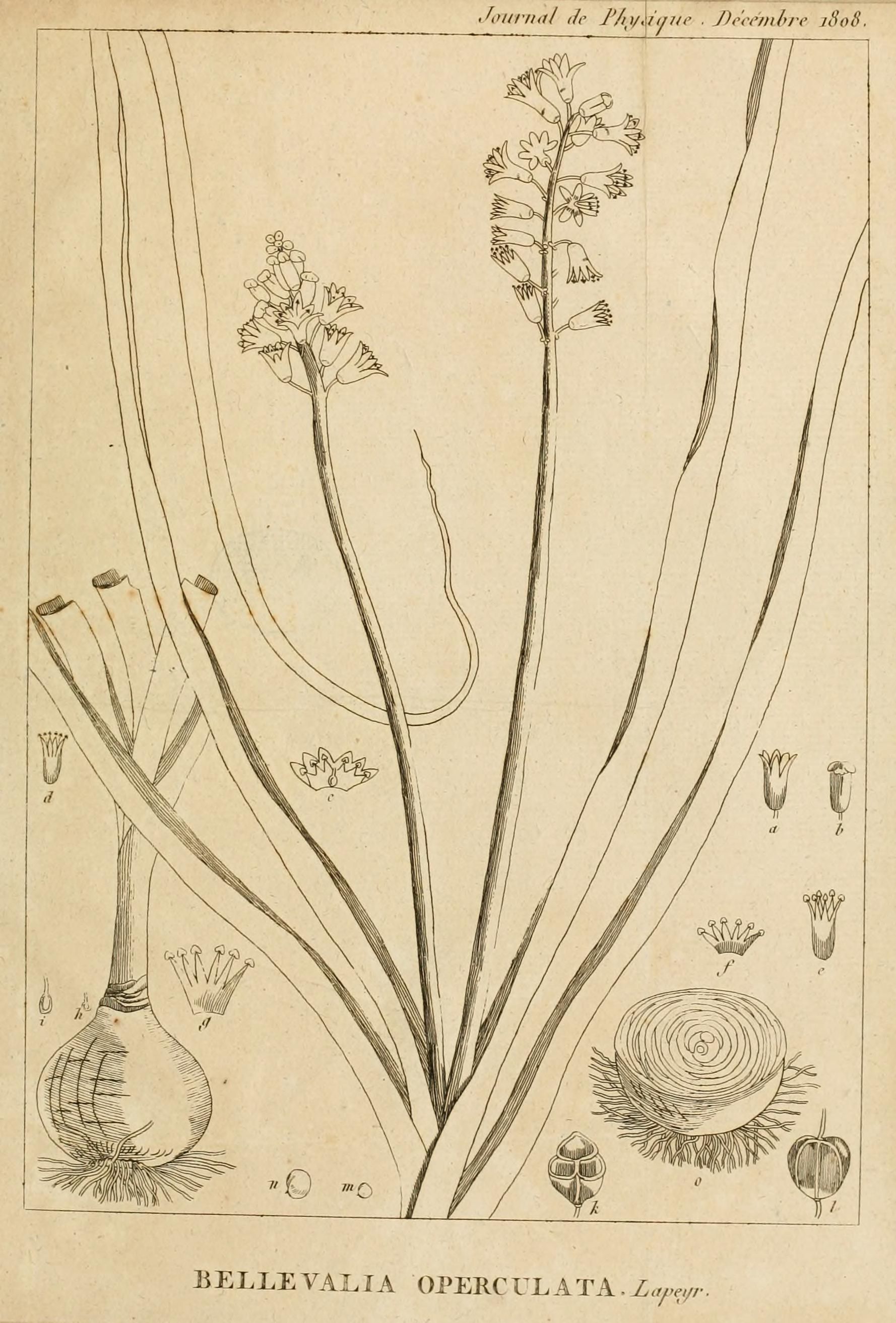
His plate shows a round bulb, long strap-shaped leaves and spikes of small bell-shaped flowers[7]. The species he drew, B. operculata, is today treated as a synonym of B. romana[1][3]. From the Pyrenees the genus reaches across the Mediterranean to Central Asia[3], and Kurdistan lies well within that range.
Its name in Kurdish
No Kurdish name has been recorded for Bellevalia kurdica itself. For the genus as a whole, two Kurdish plant-name lists give names:
- gêleqir, glossed "species of hyacinth", in Edîb Polat's Flora Kurdistanê of 2006[8];
- çawke cilan, with gêlegir and simbila koyan listed alongside it, in Ehmedê Dirihî's dictionary of Kurdish plant names (2013)[9].
These are genus names, to be checked: they belong to Bellevalia in general, not to this species, and are quoted here exactly as each source prints them.
Sources
- 1.International Plant Names Index. Royal Botanic Gardens, Kew, Harvard University Herbaria and Australian National Herbarium.
- abdefgjkBellevalia kurdica Fırat, and its publication record (Bellevalia Spec. Anatolia, 2014).
- cauthor record: Fırat, Mehmet.
- hilmnBellevalia siirtensis Fırat and Bellevalia hakkariensis Fırat.
- oqauthor records for Picot de Lapeyrouse and Richer de Belleval.
- prBellevalia Lapeyr. and Bellevalia operculata Lapeyr.
- urn:lsid:ipni.org:names:77336862-1. ipni.orghttps://www.ipni.org/n/77336862-1accessed 14 November 2026
- 2.abcdefFırat, M., Karavelioğulları, F. A. & Aziret, A. (2015). Geophytes of East Anatolia (Turkey). Manas Journal of Agriculture and Life Science 5(1): 38–53.
- 3.Plants of the World Online. Royal Botanic Gardens, Kew.
- abBellevalia kurdica.
- cdBellevalia Lapeyr. and Bellevalia operculata Lapeyr.
- plant_name_id 3312424. powo.science.kew.orghttps://powo.science.kew.org/taxon/urn:lsid:ipni.org:names:77336862-1accessed 14 November 2026
- 4.↩VANF Herbarium, Van Yüzüncü Yıl University, virtual herbarium catalogue.
- 5.abBaşer, B., Fırat, M. & Binzet, R. (2019). Ultrastructure and pollen micromorphology of three endemic Bellevalia (Asparagaceae) species in Turkey. Fresenius Environmental Bulletin 28(2A): 1077–1081.
- 6.↩Global Biodiversity Information Facility (GBIF) and iNaturalist, searches for Bellevalia kurdica, 15 November 2026.
- 7.Picot de Lapeyrouse, P. (1808). Bellevalia, nouveau genre de plante de la famille des Liliacées. Journal de Physique, de Chimie, d'Histoire Naturelle et des Arts 67: 425–427, pl. I.
- 8.↩Edîb Polat (2006). Flora Kurdistanê (I). institutkurde.orghttps://www.institutkurde.org/publications/kurmanci/
- 9.↩Ahmet Kasımoğlu (Ehmedê Dirihî) (2013). Ferhenga Navên Nebatan a Kurdî (Dictionary of Kurdish Plant Names). Mardin Artuklu University, Institute of Living Languages in Turkey (ISBN 978-605-4202-12-6), p. 158.
Last updated 20 November 2026