Arenaria kurdica is a tiny white-flowered annual, no more than about 5 cm tall[1], known from one mountain in South Kurdistan (Başûr): Sefîn, the mountain above Şeqlawe (Shaqlawa) in the Hewlêr (Erbil) region[1][2]. As far as the published record goes, it has been collected exactly once, on a single day in May 1947, and the three small plants from that day, pressed onto a single sheet at Kew, are still all that the published record holds of it[2][3].
How it got its name
- Named by
- McNeill, 1961Published in Notes Roy. Bot. Gard. Edinburgh 23: 510
A day on Sefîn, 9 May 1947
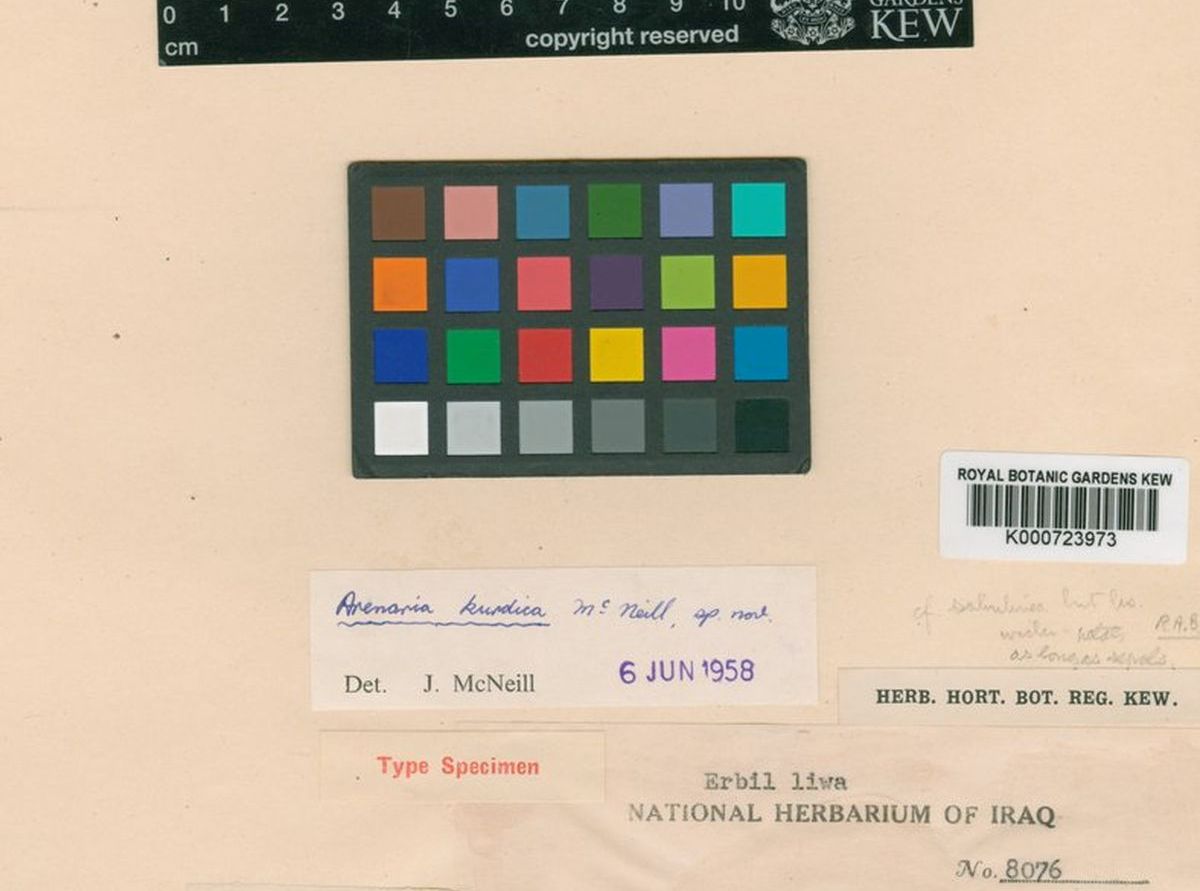
The collector was Jan Bevington Gillett (1911–1995)[4], at the time employed as botanist by the Government of Iraq[5]. On 9 May 1947 he was on the north side of Sefîn at about 1,200 m, in oak forest, on limestone rocks. His label notes that the flowers were white and the plant "occasional" there[1][3]. The plants were only just coming into flower[6].
His label still survives, typed on the form of the National Herbarium of Iraq, "(formerly Rustam farm herbarium)", number 8076[3]. Under "Name" it says only Arenaria. The line for "Colloquial Name" was left blank[3]. The habitat line reads "Oak forest formation, limestone crats, N. Aspect": "crats" is almost certainly a slip for "crags", and when the species was described the author printed it with a careful (sic)[1][3].
"Cf. sabulinea, but…"
Next to the label is a faint pencil note, initialled "R.A.B."[3]. They are almost certainly those of R. A. Blakelock of Kew, who in the late 1940s was working through the Rustam Herbarium's plants from Iraq[5], and whose opinion on this very specimen the Flora of Iraq records[2]. The note reads, as far as we can make it out, "cf. sabulinea but lvs. wider, petals as long as sepals"[3]. Put simply: it looks like Arenaria sabulinea, an annual sandwort of the limestone rocks between Birecik and Mêrdîn (Mardin)[6], but not quite. The Flora describes the same hesitation: Blakelock thought Gillett's plant might sit between A. leptoclados and A. sabulinea in the shape of its leaves and the length of its sepals[2].
Blakelock also wrote about the plant in print. In one of his lists of the flora of Iraq, published in 1957, he noted that Gillett's plant looked like A. sabulinea but had wider leaves and shorter petals, and he suggested it might be a new species. He would not describe it, though: there was too little material, and the annual sandworts were notoriously difficult[6].
The plant then waited for a specialist. That was John McNeill (born 1933)[4], whose doctoral thesis at Edinburgh, Taxonomic studies in the Alsinoideae, dealt with the part of the pink family (Caryophyllaceae) to which the sandworts belong[1]. On 6 June 1958 he added a new slip to the sheet: "Arenaria kurdica McNeill, sp. nov.", a new species[3]. He published it in 1961, from the University of Liverpool, in the Notes from the Royal Botanic Garden Edinburgh[1], and included it two years later in his revision of the Alsinoideae of "the Orient"[2][6]. Gillett's sheet at Kew became its holotype, the single specimen to which the name is tied for good[1][3].
The epithet kurdica means "Kurdish": the plant is named after the land where Gillett found it. The genus name Arenaria comes from the Latin arena, sand, which is why these plants are called sandworts in English.
How to tell it apart
McNeill's Latin description is short and exact[1]:
- a low annual, up to about 5 cm, covered all over in short hairs, some simple and some tipped with glands;
- few leaves, ovate to lance-shaped and narrowing into a short stalk, which are already withering when the plant flowers;
- a loose, branching head of 5 to 9 flowers on stalks 4–7 mm long;
- sepals only 2–2.5 mm long with three veins, and white petals of the same length, lance-shaped and just barely split at the tip;
- a small, almost round capsule that opens by six valves.
He separated it from its relative A. pamphylica by the small three-veined sepals that are about as long as the petals and by the rounded capsule, and from A. sabulinea by its broader leaves and smaller petals[1]: much the same points Blakelock had pencilled on the sheet[3].
Telling such small annuals apart is not easy. McNeill named the annual sandworts of this group as one of the most complex groups in his whole study, plants in which self-pollination is probably the rule[6].
In the Flora of Iraq's key, two characters together set it apart from the other annual sandworts of Iraq: after flowering the little flower stalks bend sharply downwards, and the sepals are about as long as the petals[2]. The stalks alone are not enough: A. sabulinea can bend its fruit stalks too[2].
The odd one out
In his 1963 revision McNeill placed the plant in the section Orientales, about twenty species of sandworts that he called "characteristically Mediterranean"[6]. Arenaria kurdica was the exception: "the only Irano-Turanian member of a predominantly Mediterranean section"[6], that is, the only one that belongs to the flora of the dry inland highlands and steppes of western and central Asia rather than to the Mediterranean. On his map of the group, its single point lies further east than any other[6].
McNeill had no doubt that it was a good species[6]. Its nearest relative, he wrote, was A. pamphylica, but it showed "an approach" towards A. sabulinea: its sepals have only three, almost unbranched nerves, and its capsule is rather round[6]. In his view, the group reaches A. sabulinea, a species so unusual that he gave it a section of its own, through the little plant from Sefîn[6]. Blakelock's pencilled "cf. sabulinea" fits that view.
One mountain, two visitors
Gillett was not the first botanist on Sefîn in May. On 6 May 1893, fifty-four years earlier, the botanist Joseph Bornmüller (1862–1948)[4] was travelling east from Hewlêr on the road to Şeqlawe. On the slopes of Sefîn, at 700 m, he collected a sandwort that he took for Arenaria sabulinea, but with unusually short flower stalks, only about twice as long as the calyx, "not many times" as in the usual plant. He named it var. brevipes, "short-stalked"; a week earlier he had found the same form on limestone hills near Kerkûk (Kirkuk)[7]. Three days later, on 9 May 1893, he was again on the slopes of Sefîn, "Kuh-i-Sefin (Kurdistan)", at 900 m[7].
Was Bornmüller's short-stalked sandwort the same plant Gillett found? None of the sources we read says so. McNeill could not check: he never saw Bornmüller's specimens, which he could not trace in the herbarium at Jena, and he listed A. sabulinea for Iraq only with a question mark[6]. The Flora of Iraq lists A. sabulinea only as an "imperfectly known species" for Iraq, noting Bornmüller's Şeqlawe gathering among the records[2]. It is an open question for anyone who can compare the two collections.
Where it grows
Kew's checklist gives its range simply as "N. Iraq"[8]. In Kurdish terms that is one mountain in Başûr. The Flora of Iraq calls it endemic and rare, and lists no locality other than Gillett's[2]: limestone at about 1,200 m, in flower in May[2], on the north side of the mountain in oak woodland[1][3]. (The Flora's distribution line says "Alpine zone", although the label records oak forest at 1,200 m.)
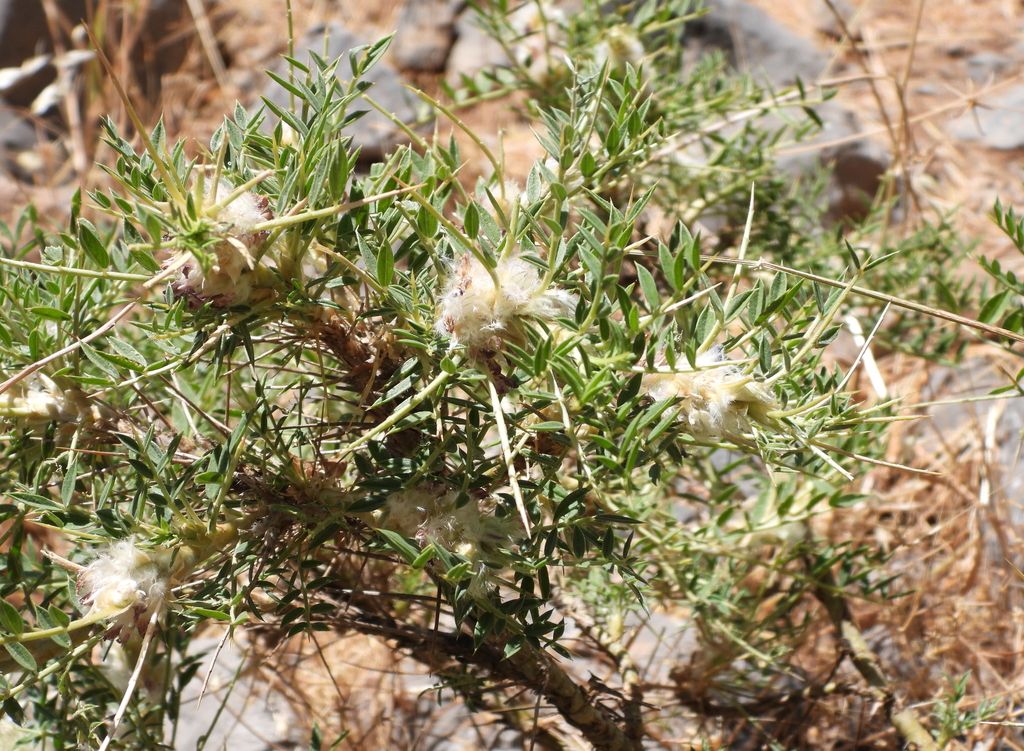
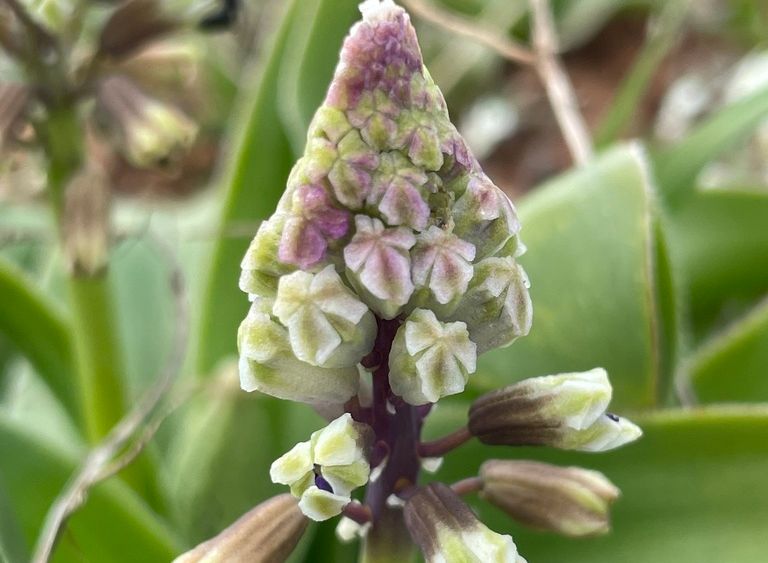
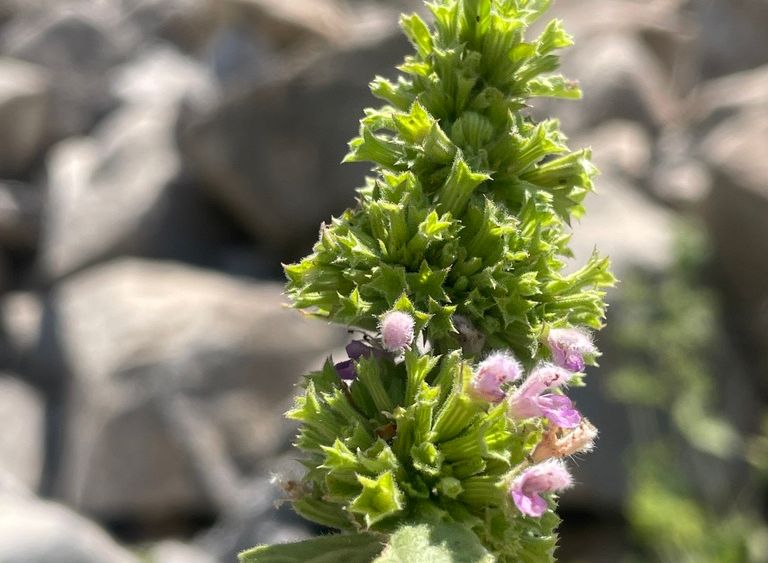
The Global Biodiversity Information Facility (GBIF) holds no other specimen of it: the only other sheet filed under the name, in Paris, turns out to be a different plant[3][9]. In May 2026 an iNaturalist user posted photographs of a small sandwort from near Şeqlawe as Arenaria kurdica[10]. No one else has confirmed the identification yet, so for now it is a lead, not a record. If it holds, it would be the first sighting of the plant in almost eighty years.
The species has not been assessed for the IUCN Red List[9].
Its name in Kurdish
No Kurdish name was recorded with the plant: the "Colloquial Name" line on Gillett's label is empty[3]. Ehmedê Dirihî's dictionary of Kurdish plant names lists it as gulxîzê kurdan[11]. That is a dictionary name, formed after the Latin ("… of the Kurds"), rather than a name collected from people who know the plant.
Sources
- 1.McNeill, J. (1961). New species of Arenaria and Minuartia. Notes from the Royal Botanic Garden Edinburgh 23: 507–513.
- 2.Ghazanfar, S.A. & Edmondson, J.R. (eds) (2016). Flora of Iraq, Volume 5, part 1: Elatinaceae to Sphenocleaceae. Royal Botanic Gardens, Kew.
- 3.abcdefghijklmRoyal Botanic Gardens, Kew – Herbarium Specimens. via GBIF, herbarium specimen K000723973, holotype of Arenaria kurdica (via GBIF, occurrence 912561685). gbif.orghttps://www.gbif.org/dataset/cd6e21c8-9e8a-493a-8a76-fbf7862069e5
- 4.International Plant Names Index. Royal Botanic Gardens, Kew, Harvard University Herbaria and Australian National Herbarium.
- abcArenaria kurdica McNeill; author records for McNeill, Gillett and Bornmüller.
- urn:lsid:ipni.org:names:151337-1. ipni.orghttps://www.ipni.org/n/151337-1accessed 14 November 2026
- 5.abBlakelock, R. A. (1948). The Rustam Herbarium, 'Iraq. Systematic List. Part I. Kew Bulletin 3(3): 404–405.
- 6.McNeill, J. (1963). Taxonomic studies in the Alsinoideae: II. A revision of the species in the Orient. Notes from the Royal Botanic Garden Edinburgh 24(3): 241-404. archive.orghttps://archive.org/details/notes-from-royal-botanic-garden-edinburgh-24-003-241-404
- 7.Bornmüller, J. (1911). Iter Persico-turcicum 1892–1893. Beihefte zum Botanischen Centralblatt 28(2): 148–149.
- 8.Plants of the World Online. Royal Botanic Gardens, Kew.
- ↩Arenaria kurdica.
- plant_name_id 2649611. powo.science.kew.orghttps://powo.science.kew.org/taxon/urn:lsid:ipni.org:names:151337-1accessed 14 November 2026
- 9.abGBIF.org GBIF Backbone Taxonomy and occurrence records. occurrence records and IUCN category for Arenaria kurdica (accessed 15 November 2026). gbif.orghttps://www.gbif.org/
- 10.↩iNaturalist. observation 358661017 (Şeqlawe, 5 May 2026; identification unconfirmed). inaturalist.orghttps://www.inaturalist.org/
- 11.↩Ahmet Kasımoğlu (Ehmedê Dirihî) (2013). Ferhenga Navên Nebatan a Kurdî (Dictionary of Kurdish Plant Names). Mardin Artuklu University, Institute of Living Languages in Turkey (ISBN 978-605-4202-12-6).
Last updated 20 November 2026