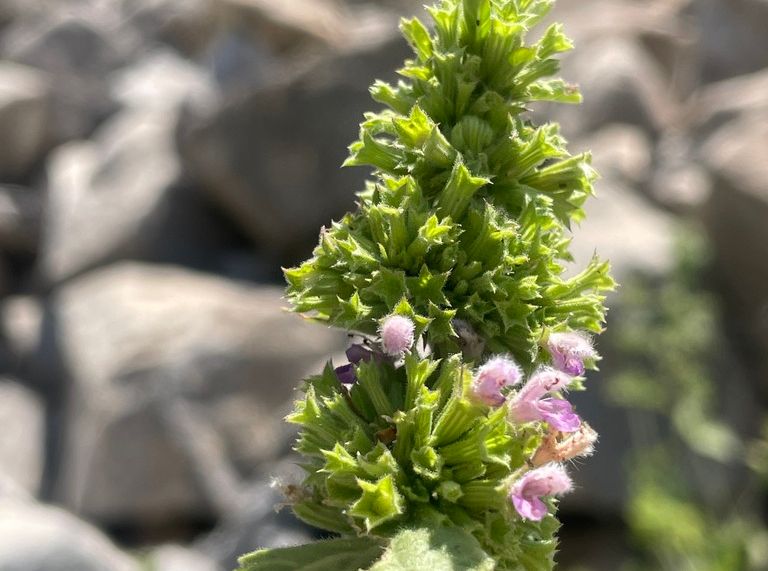
Black horehound is a rank-smelling, purple-flowered member of the mint family that Europe has known for centuries as a weed of roadsides, hedges and rubbish heaps[1][2][3]. In Kurdistan it has a form of its own, Ballota nigra subsp. kurdica, first collected on the shady rocks of Mount Gara in 1841[4][5]. The botanist who named it thought the species had probably begun in or near Anatolia, where its forms are most varied and some still grow on undisturbed rocks rather than on waysides[4].
How it got its name
- Named by
- L., 1753Published in Sp. Pl. : 582
A weed with a long pedigree
When Carl Linnaeus gave the plant its scientific name in 1753, he described its home in four words: Habitat in Europae ruderatis, "it lives in the rubbish places of Europe" (our translation)[1]. Two centuries before him, the German physician Leonhart Fuchs had said much the same in his great herbal of 1542: it grows "along roads, by houses, hedges, cemeteries and in other shady places" (our translation)[2].
Fuchs described a bushy herb with square, blackish, slightly hairy stems, leaves like horehound's but larger, a heavy smell, and purple flowers set in rings around the stem. He gave it a full-page woodcut[2]:
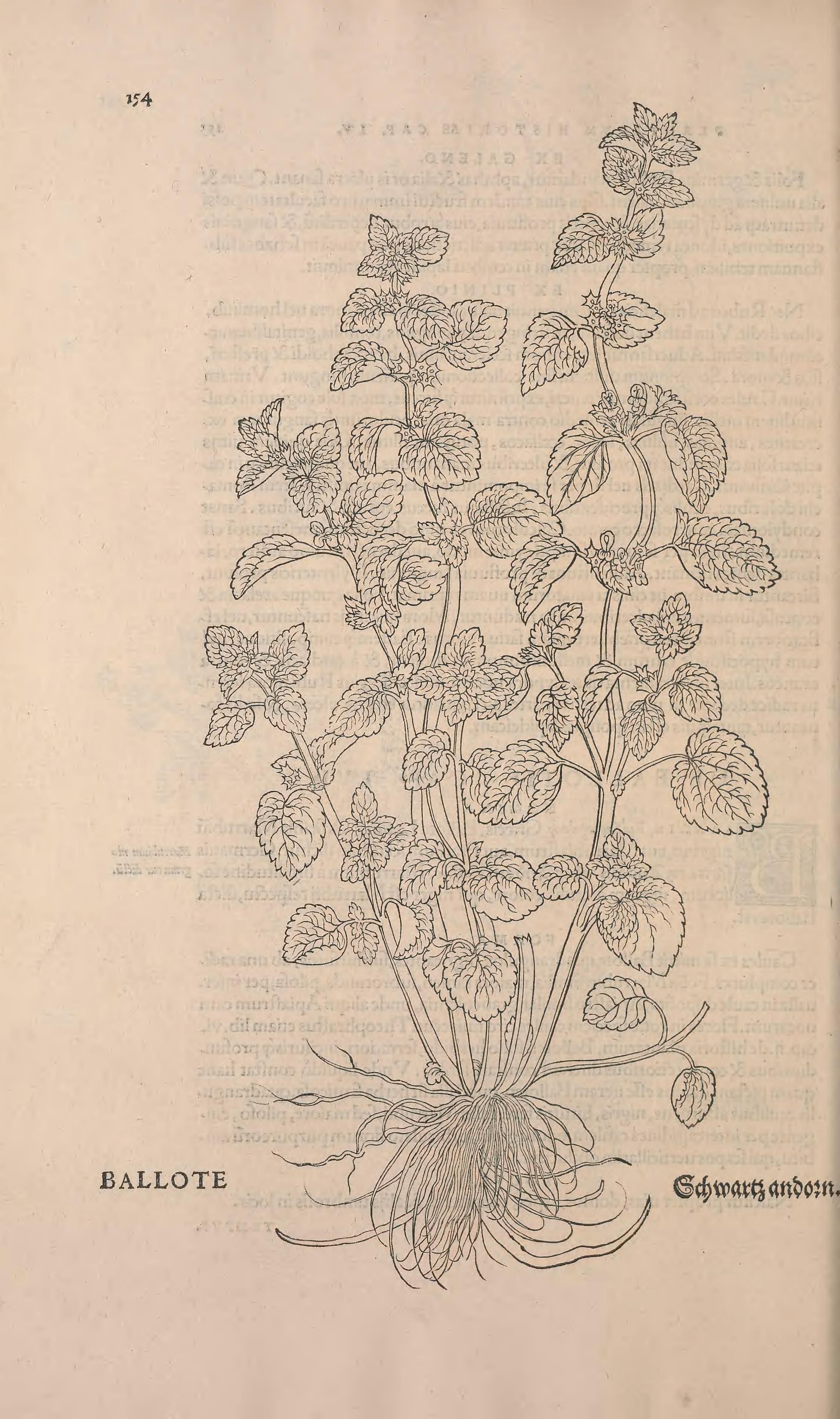
In his herbal it flowers at the end of June and the beginning of July, the best time to pick it[2]. In Kurdistan its own subspecies flowers later, from July to September[4].
Black, stinking and false: a plant of many names
The Greeks called it ballōtē, or melamprasion[2]. The apothecaries of Fuchs's day sold it as Marrubium nigrum, "black horehound", or as Prassium foetidum, "stinking horehound", and the Germans called it schwartz Andorn, "black horehound", or Andorn weible, "female horehound" (our translations)[2]. Fuchs explained the name: Marrubium because its leaves look like those of true horehound, nigrum because its stem is black compared with horehound's[2]. Linnaeus took the old Greek name for the genus, Ballota, and kept "black" for the species: Ballota nigra[1]. Its English names today are black horehound and fetid horehound[6].
Kurdish has names for it too. Ehmedê Dirihî's dictionary of Kurdish plant names lists gezikê derewîn for Ballota nigra[7], with the Turkish yalancı ısırgan, "false nettle", beside it. On the same page the dictionary gives gezik for the nettles (Urtica) and gezika derewîn / gezikê derewîn for the dead-nettles (Lamium)[7]: like the English "dead-nettle", the name seems to describe a plant that looks like a nettle but does not sting (our reading). The dictionary also records şiramok, from Çeko Kocadax's dictionary[7]. For the Kurdish subspecies it gives gezikê derewînê kurdan[7], a dictionary name formed from the Latin.
Dog bites and ulcers
Fuchs collected what the ancient authors had written about its uses. From Dioscorides: the leaves, spread on with salt, heal dog bites, and with honey they clean foul ulcers. Paul of Aegina and Pliny the Elder said the same of dog bites[2]. We have not found a published record of the plant's use in Kurdistan.
These are records of historical use, not medical advice.
The Kurdish plant from Mount Gara
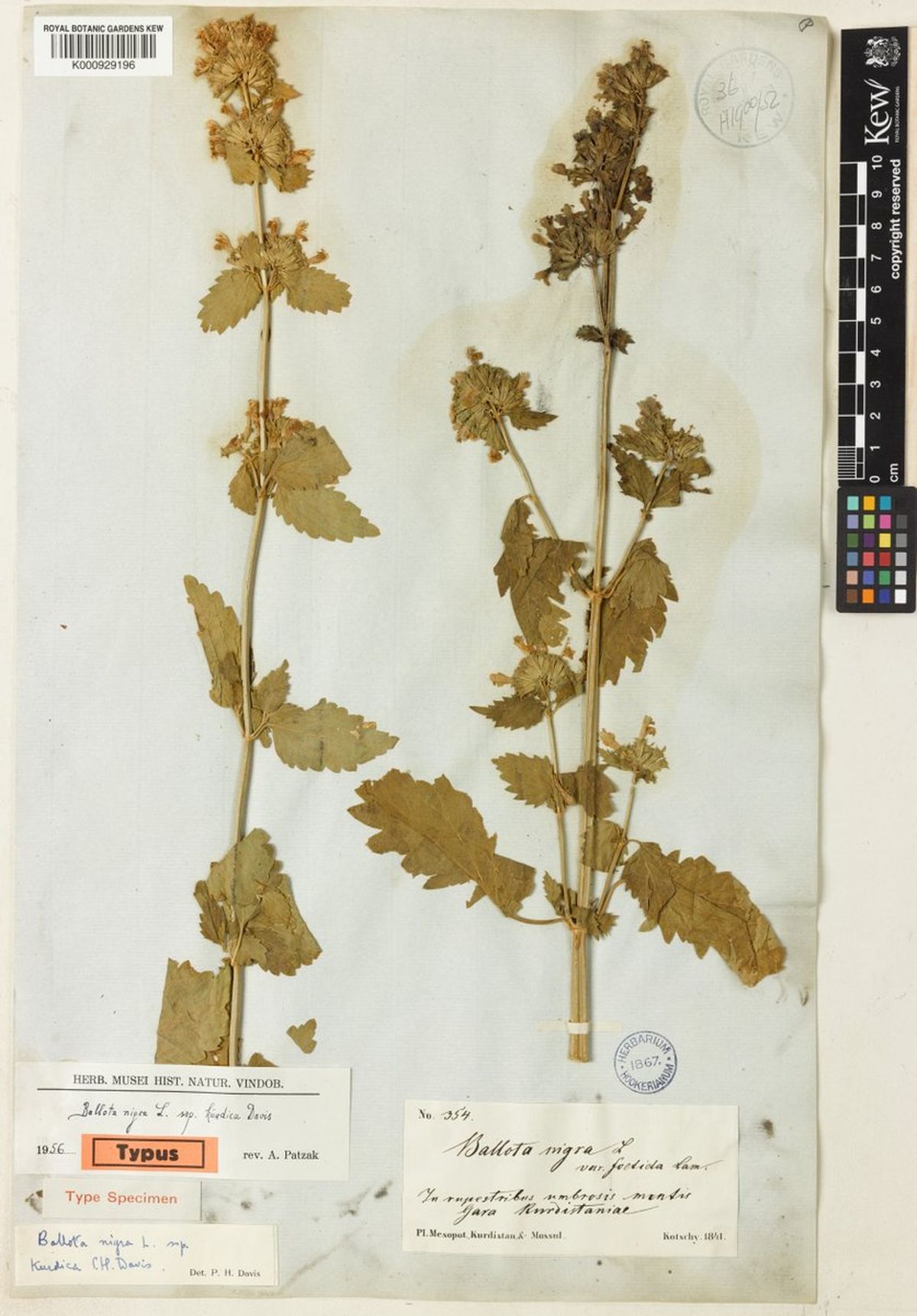
In 1841 the botanist Theodor Kotschy (1813–1866)[8] was collecting in Kurdistan, and on the shady rocks of Mount Gara he gathered a black horehound[5][9]. It was the same journey, and the same mountain, that gave science the Kurdish hollyhock. His specimens were sent out under number 354 with a printed label, "Pl. Mesopot. Kurdistan & Mossul.", and sheets of it are still kept at Kew and in herbaria in Vienna, Washington, Halle and the Netherlands[5][9].
At first nobody thought it special. The handwritten label on the Kew sheet calls it simply Ballota nigra var. foetida[5], a name that goes back to Lamarck's Ballota foetida of 1778; Patzak treats foetida as the form native to western, central and southern Europe[10]. The Kew sheet carries the stamp of the Herbarium Hookerianum, dated 1867[5], and it then lay in the herbarium for most of a century.
In 1952 the botanist P. H. Davis took a closer look. He found that the black horehound of the region has a shape of its own, and described it as a new subspecies, Ballota nigra subsp. kurdica, with Kotschy's Gara sheet at Kew as the holotype[4]. He placed it plainly: subsp. kurdica grows "in Kurdistan (of both Turkey and Iraq)"[4]. A. Patzak, who revised the whole group a few years later, marked the sheet as the type in 1956[5] and summed up its range in one word: Verbreitung: Kurdistan ("distribution: Kurdistan")[10].
Wild in the mountains, a weed elsewhere
What makes the Kurdish plant interesting is where it grows. Davis noticed that the two new subspecies he described, the Kurdish one and an Anatolian one, "often grow in undisturbed habitats, such as shady rocks, whereas the European races are recorded from waste ground, roadsides and hedge banks"[4]. Black horehound is the most widespread and most variable species of its genus[10], and Davis thought "it seems probable that B. nigra originated in or near Turkey, where the maximum morphological diversity is found"[4]. That region, we would add, takes in Bakur. Patzak, for his part, wrote that the original home of that western European form, subsp. foetida, can no longer be known for certain, because it has spread so widely as a weed[10]. He even suggested how it reached Sweden, probably only in the 15th or 16th century: sailing ships returning from western Europe loaded sand and rubble from around the harbours as ballast, and the plant came with it and spread inland from the port towns[10].
So the plant Linnaeus knew from Europe's rubbish heaps may have begun on wild, rocky ground in Anatolia and Kurdistan. It has kept travelling since: Kew's checklist now lists it as introduced as far away as Siberia, New Zealand, the eastern United States and Argentina, and even in Great Britain and Ireland[3].
What to look for
Davis's description and key[4] still work in the field. Compared with its relatives, the Kurdish subspecies has:
- tall stems, up to 1.3 m, almost hairless or velvety, branching stiffly near the top;
- oblong-ovate, pointed leaves 4–7 cm long, with 10–13 coarse, irregular teeth;
- a calyx (the green cup around the flower) about 8 mm long, narrow and nearly cylindrical, hardly widening as the fruit ripens;
- short, broad, triangular calyx teeth, 1.5–2 mm long, standing upright or spreading, each ending abruptly in a fine point about 1 mm long.
Patzak added that the flower is pink and about 14 mm long, and that its tube sticks out well beyond the calyx. In his key it is this long tube that singles out the Kurdish subspecies[10].
Where it grows
The records of subsp. kurdica come from three parts of Kurdistan[4][11][5][12][10]:
- South Kurdistan (Başûr): the shady rocks of Mount Gara, the type locality[4][5]; a stream bank at 2,100 m, east-north-east of a place E. R. Guest wrote down as "Seri Hassan Beg", in July 1932[4]; the eastern slopes of Qendîl (Qandil) towards Pushtashan, at 2,000 m, where Rechinger collected it[10]; and recently, photographed in flower, Siya Gwez and Sharbazher in the province of Silêmanî (Sulaymaniyah), in September 2023 and July 2026[12].
- North Kurdistan (Bakur): clayey ground at 1,600 m in the Teng valley near Mûş (Muş), where Kotschy collected it on 9 September 1859, on a journey his labels call the Iter cilicico-kurdicum[4][11]. Patzak found this plant "a more strongly deviating form" (our translation), almost hairless in all its parts[10]. He also referred to the subspecies a gathering by Davis and Oleg Polunin from Kotum in the province of Bidlîs (Bitlis), at 1,900 m, which he thought leans towards the Anatolian subspecies[10].
- East Kurdistan (Rojhilat): the Chehel Chashmeh mountains 44 km north-east of Merîwan (Marivan), on slate at 2,000 m, where Karl Heinz Rechinger collected it on 7 July 1971[5].
Patzak also referred one gathering from the Akher Dagh, labelled "northern Syria", to the Kurdish subspecies: young plants just opening their first flowers, which matched Kotschy's type from Gara well. So he called it native to "Kurdistan and Syria"[10]. The known gatherings lie between about 1,600 and 2,350 m[4][5][10].
The species has not been evaluated for the IUCN Red List[13].
Other horehounds of Kurdistan
Black horehound is not the only Ballota in Kurdistan. In the second part of his revision, in 1959, Patzak recorded two relatives with woody bases and smaller pink flowers, whose tube hardly sticks out of the calyx[14]:
- Ballota aucheri, a half-shrub with stems 40–50 cm tall, covered all over in dense, silky grey-white felt, with broad, almost round leaves and flowers about 12 mm long. Patzak gives its range as southern Iran and "Iraqi Kurdistan", with gatherings between Hewlêr (Erbil) and Rewandiz at 700–1,000 m, and on rocks in a gorge of Mount Şingal (Sinjar) above the town[14].
- Ballota saxatilis, with pale pink flowers 10–11 mm long, which Patzak records from south-western Anatolia through Bakur ("Türkisch-Kurdistan"), Syria and Lebanon to the Sinai. He lists two gatherings under that heading: on rocks near Kâhta, and on stony ground at Mêrdîn (Mardin), labelled under Diyarbekir[14].
Sources
- 1.abcLinnaeus, C. (1753). Species Plantarum. 2: 899. Biodiversity Heritage Library, page 358920.
- 2.Fuchs, L. (1542). De historia stirpium commentarii insignes. Basel: 153–155.
- 3.Plants of the World Online. Royal Botanic Gardens, Kew.
- abBallota nigra L.
- plant_name_id 19633. powo.science.kew.orghttps://powo.science.kew.org/taxon/urn:lsid:ipni.org:names:444976-1accessed 14 November 2026
- 4.Davis, P.H. (1952). Additamenta ad Floram Anatoliae: III. Notes from the Royal Botanic Garden Edinburgh 21(2): 61-98.
- 5.Royal Botanic Gardens, Kew – Herbarium Specimens. via GBIF. gbif.orghttps://www.gbif.org/dataset/cd6e21c8-9e8a-493a-8a76-fbf7862069e5
- 6.Catalogue of Life, vernacular names via the GBIF Backbone Taxonomy.
- ↩English names of Ballota nigra (via GBIF).
- api.gbif.orghttps://api.gbif.org/v1/species/2926894/vernacularNamesaccessed 14 November 2026
- 7.Ahmet Kasımoğlu (Ehmedê Dirihî) (2013). Ferhenga Navên Nebatan a Kurdî (Dictionary of Kurdish Plant Names). Mardin Artuklu University, Institute of Living Languages in Turkey (ISBN 978-605-4202-12-6).
- 8.International Plant Names Index. Royal Botanic Gardens, Kew, Harvard University Herbaria and Australian National Herbarium.
- ↩author record for Theodor Kotschy.
- urn:lsid:ipni.org:names:444976-1. ipni.orghttps://www.ipni.org/n/444976-1accessed 14 November 2026
- GBIF and World Flora Online: Ballota nigra subsp. kurdica P.H.Davis.
- 9.abDuplicates of Kotschy 354 in the herbaria W, US, HAL and WAG (via GBIF).
- 10.Patzak, A. (1958). Revision der Gattung Ballota Section Ballota. Annalen des Naturhistorischen Museums in Wien 62: 57–86.
- 11.abKotschy's 1859 gatherings from the Teng valley: Kew K005767521 and Naturalis L.2779490 (via GBIF).
- 12.abiNaturalist. observations 181218332, 380769498 and 382296272 by Arya Aras. inaturalist.orghttps://www.inaturalist.org/
- 13.↩IUCN Red List category of Ballota nigra (via GBIF).
- 14.Patzak, A. (1959). Revision der Gattung Ballota Section Acanthoprasium und Section Beringeria. Annalen des Naturhistorischen Museums in Wien 63: 33–81.
Last updated 20 November 2026