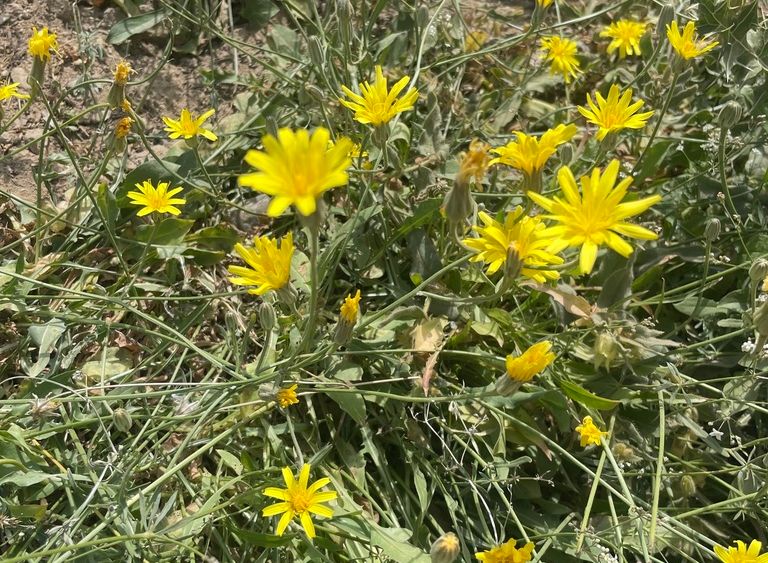
Convolvulus kurdistanicus is a wiry, white-flowered bindweed from the foothills of the Zagros, described in 2002 from Rojhilat[1][2]. It is one of about 190 species in its genus[2], and one of the least known: the published record we could find holds just two gatherings of it, one on each side of today's Iran–Iraq border, and botanists do not agree on what the second one is[2][1].
How it got its name
- Named by
- Mozaff., 2002Published in Pakistan J. Bot. 34: 395
- Type collected by
- V. Mozaffarian
A bindweed that does not climb
Most people meet Convolvulus as field bindweed, C. arvensis, the twining "cosmopolitan weed"[2]. But the genus's real home is dry country. It is "principally a genus of dry, stony and sandy habitats from sea level to around 3000 m", and it is most diverse in the Irano-Turanian region, with more species in Iran than anywhere else[2]. Already in 1875 Boissier's Flora Orientalis listed 66 species from the Middle East, and later collectors kept adding more[2]. Iran alone has 39, ten of them found nowhere else[3].
Many of these dry-country bindweeds have given up climbing altogether. Convolvulus kurdistanicus belongs to a group the monograph of the genus describes as "erect unarmed undershrubs with stiff, thin, woody, subfastigiate branches and (usually) few, relatively small leaves"[2]: small bushes of upright, broom-like stems.
Found near Salas-e Babajani
The plant was found and named by the botanist Valiolah Mozaffarian (born 1953), of the Research Institute of Forests and Rangelands in Tehran[4][1]. He collected the specimen that became its type himself, under his own number 79475, at about 1,200 m, 5 km from Salas-e Babajani on the way to Kanirash and Azgale, in the province of Kirmaşan (Kermanshah) in Rojhilat[1]. That sheet, the holotype, is kept in the herbarium in Tehran known by the code TARI[1][2].
In December 2002 he published it in the Pakistan Journal of Botany, in a short paper that also named a new cherry, Cerasus yazdiana, and a new Dionysia[4][1]. The epithet kurdistanicus means "of Kurdistan", where the type was found.
What it looks like
The fullest account in English is in the 2015 world monograph of Convolvulus by John Wood and colleagues, who summarised Mozaffarian's description and drawing[2]:
- a perennial undershrub with a woody taproot, from which rise many silky-haired stems up to 50 cm tall;
- thread-like leaves that sit directly on the stem (the leaves at the base are unknown);
- flowers in small, forked clusters of 3 to 5, at the tips and along the sides of the stems;
- smooth, ovate sepals ending in a small point;
- a white flower about 1.8 cm long, with fine hairs along the bands that run down the middle of the corolla;
- a hairless ovary and a smooth capsule holding a single seed.
There is one puzzle in it. Mozaffarian's text gives the sepals as 8 mm long, but the drawing published with it shows them only 4–4.5 mm. Wood and his colleagues, who had not seen the type specimen, thought the drawing the "more probable" of the two[2].
In the monograph's key it sits among the bindweeds with almost smooth sepals, finely haired stems and thread-like leaves, and is told apart from its nearest neighbour in the key, C. koieanus, by its ovate sepals[2].
Two sheets, five names
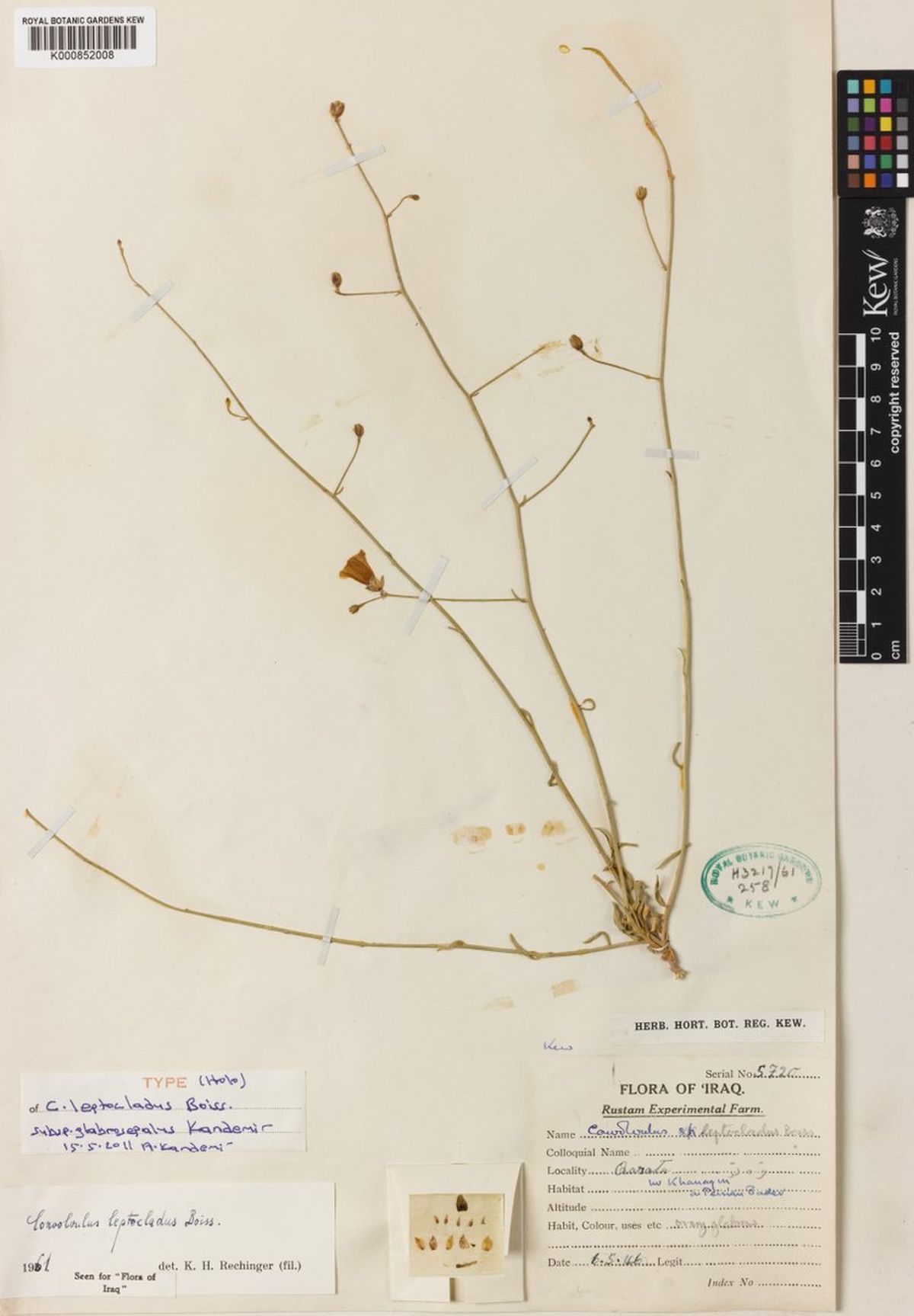
The second gathering is much older than the species. On 5 and 6 May 1946 the botanist Ali Al-Rawi[1] collected a small bindweed at a place his label calls Qara Tu (Qarati in the 2025 Flora of Iraq)[1], near Xaneqîn (Khanaqin) in Başûr, for the herbarium of the Rustam Experimental Farm, under the number 5720[5][5]. Two sheets of it reached Kew. One of them still carries a dried flower[5].
Over the following eight decades the same plants collected four different names from botanists, and a fifth from a database:
- 1946. The printed "Flora of 'Iraq" label names it Convolvulus cf. leptocladus, "compare leptocladus", and a note on it records "ovary glabrous"[5][5].
- 1961. Karl Heinz Rechinger, examining the sheets for the Flora of Iraq, identified them as Convolvulus leptocladus itself[5][5], a species otherwise known only from southern Iran[2].
- 2011. On 15 May 2011 Ali Kandemir labelled the two sheets as the type of a new subspecies, C. leptocladus subsp. glabrosepalus ("with smooth sepals")[5][5].
- 2015. Wood and his colleagues saw Kandemir's annotation but found that Al-Rawi's plant "seems to fit perfectly" with C. kurdistanicus, as long as its sepals are the 4.5 mm of the drawing and not the 8 mm of the text, and they counted it as the only record of the species outside Iran[2].
The story did not end there. In December 2025 the new Flora of Iraq volume published Kandemir's subspecies, with Al-Rawi's sheet as its holotype[1]. The online catalogue of the Global Biodiversity Information Facility (GBIF) files the same two sheets under a fifth name, yet another species, C. sarothrocladus[5][5]. So the plant from Qara Tu is, depending on whom you follow, C. kurdistanicus or a smooth-sepalled form of a southern Iranian species.
A cousin from Luristan
The monograph points to one more open question. Convolvulus kurdistanicus is "extremely close" to C. koieanus, a bindweed that the botanist Mogens Køie collected in Luristan and that Joseph Bornmüller described in 1945[2]. The two differ only in the ovary: hairless in C. kurdistanicus, hairy in C. koieanus. Because they grow in neighbouring provinces of Iran, Wood and his colleagues thought it "quite possible" that they will turn out to be one species[2].
Where it grows
Kew's checklist gives its native range as "N. Iraq to NW. Iran" and calls it a subshrub of the temperate zone[6]. In Kurdish terms, the two gatherings come from Rojhilat (the type, near Salas-e Babajani in Kirmaşan) and from Başûr (Qara Tu near Xaneqîn), both along the foot of the Zagros on either side of today's border[1][5]. The type was collected at about 1,200 m[1]. The 2025 Flora of Iraq, as summarised by IPNI, puts Qara Tu at only about 50 m[1], a figure that looks low for the Xaneqîn area. No source we could read says anything about its habitat or flowering time, though Al-Rawi's plant was in flower in early May[5].
It may simply be overlooked. GBIF holds no occurrence records under its name, iNaturalist has no observations of it[7], and its status has never been assessed for the IUCN Red List[7]. A 2017 study of the whole bindweed family (Convolvulaceae) in Iran does not mention it[3]. As far as we could find, no photograph of the living plant has been published.
Its name in Kurdish
No Kurdish name has been recorded for this species. Kurdish has a rich vocabulary for bindweeds in general, though: Ehmedê Dirihî's dictionary of Kurdish plant names gives more than thirty names for the genus Convolvulus, among them leflefok, lawlaw and pêçek[8]. They belong to the bindweeds as a group, not to this particular plant.
Sources
- 1.International Plant Names Index. Royal Botanic Gardens, Kew, Harvard University Herbaria and Australian National Herbarium.
- acdefjkConvolvulus kurdistanicus Mozaff., Pakistan J. Bot. 34(4): 395 (2002), with type data; author record for V. Mozaffarian.
- bghilConvolvulus leptocladus subsp. glabrosepalus Kandemir, Flora of Iraq 7(1): 40 (2025); author records for A. Kandemir and A. Al-Rawi.
- urn:lsid:ipni.org:names:60439911-2. ipni.orghttps://www.ipni.org/n/60439911-2accessed 14 November 2026
- 2.Wood, J. R. I., Williams, B. R. M., Mitchell, T. C., Carine, M. A., Harris, D. J. & Scotland, R. W. (2015). A foundation monograph of Convolvulus L. (Convolvulaceae). PhytoKeys 51: 1–282. doi:10.3897/phytokeys.51.7104https://doi.org/10.3897/phytokeys.51.7104
- 3.abSayadi, S. & Mehrabian, A. R. (2017). Distribution patterns of Convolvulaceae in Iran: priorities for conservation. Rostaniha 18(2): 181–197.
- 4.abMozaffarian, V. (2002). Studies on the flora of Iran, new species and new records. Pakistan Journal of Botany 34(4): 391–396.
- 5.Royal Botanic Gardens, Kew – Herbarium Specimens. via GBIF. gbif.orghttps://www.gbif.org/dataset/cd6e21c8-9e8a-493a-8a76-fbf7862069e5
- 6.Plants of the World Online. Royal Botanic Gardens, Kew.
- ↩Convolvulus kurdistanicus.
- plant_name_id 483114. powo.science.kew.orghttps://powo.science.kew.org/taxon/urn:lsid:ipni.org:names:60439911-2accessed 14 November 2026
- 7.abGBIF.org GBIF Backbone Taxonomy and occurrence records. (Global Biodiversity Information Facility), taxon 3677587, and iNaturalist, taxon 1107393, consulted 15 November 2026. gbif.orghttps://www.gbif.org/
- 8.↩Ahmet Kasımoğlu (Ehmedê Dirihî) (2013). Ferhenga Navên Nebatan a Kurdî (Dictionary of Kurdish Plant Names). Mardin Artuklu University, Institute of Living Languages in Turkey (ISBN 978-605-4202-12-6).
- 9.Edîb Polat (2006). Flora Kurdistanê (I). institutkurde.orghttps://www.institutkurde.org/publications/kurmanci/
Last updated 20 November 2026