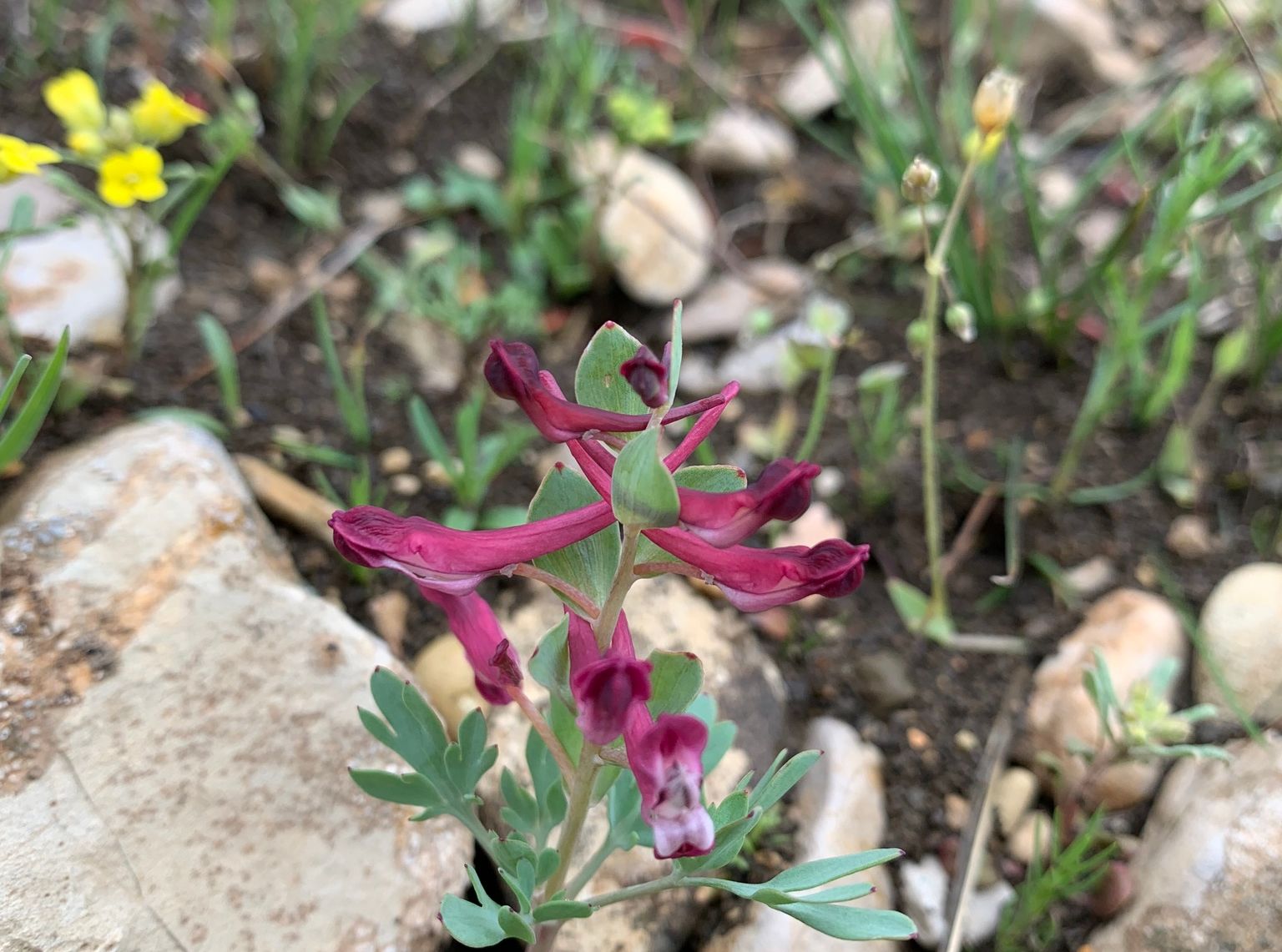
Corydalis oppositifolia is a small spring flower of the high mountains that grows from a solid tuber and blooms close to the melting snow[1][2]. Each stem carries just two leaves, set opposite each other, and a short spike of tubular, spurred flowers in shades from white with maroon tips to deep purple[3][4][2]. The species reaches from Anatolia to western Iran[5], but its eastern form, subsp. kurdica, belongs to Kurdistan: Magnus Lidén, who gave it its current name, placed it in "Kurdistan (SE Anatolia, N Iraq, NW Iran)", in high mountains near the snowline[2].
How it got its name
- Named by
- DC., 1821Published in Syst. Nat. 2: 114
Two leaves, face to face
The name comes from the botanist Augustin Pyramus de Candolle (1778–1841)[6], who described it in 1821 from a dried plant in the herbarium of the Paris museum[3]. It had been collected "in Mesopotamia, between Aleppo and Mosul" by the naturalist Guillaume-Antoine Olivier (1756–1814)[3][6], whose plants from Persia and Mesopotamia turn up again and again in the same volume[3].
Candolle split the genus Corydalis into three groups by their look. His first group had a long, spindle-shaped root, a single unbranched stem and only two stem leaves, set opposite each other. In the whole genus he knew only two such plants, both from the Orient, both strongly blue-grey and both opposite-leaved[3]. One of them he called oppositifolia, "with opposite leaves". He described a stem three to five inches tall, two grey-green leaves, each cut into three, and flowers an inch long with a straight, blunt spur[3].
Those two leaves can play a trick on the eye. When they sit close on the stem, their stalked segments fan out so that the plant seems to wear a ring of six leaves, as both Candolle (for its close relative) and later Boissier noticed[3][1].
"Between all its forms there are transitions"
In 1867 Pierre Edmond Boissier gathered most of the opposite-leaved corydalis of the Orient into a single species, C. rutaefolia, and listed Candolle's C. oppositifolia as one of its synonyms[1]. He recorded these plants "in the alpine zone, at melting snows", from western Anatolia and Cyprus to Lebanon, Armenia and northern Persia, and from "Assyria", represented by Olivier's plant[1]. He noted a solid tuber, pleasantly pink flowers and leaf segments that vary in how deeply they are cut, blunt or pointed, large or small, and closed with a sentence that sums up the whole group: Inter omnes formas transitus adsunt, "between all its forms there are transitions" (our translation)[1].
That variability has followed the plant ever since. On 26 June 1893 the botanist Joseph Bornmüller collected it in the alpine zone of Helgurd, "on the Persian border", at 3,000 m, and labelled it C. verticillaris, a species described from Persia[7][3]. Eighty years later Per Wendelbo agreed, calling it a "broad-lobed form" of that species[7]. Today the sheet is filed in Edinburgh under C. oppositifolia[7].
By the snow on Cilo, 1954
On 9 August 1954 the botanists Peter Hadland Davis and Oleg Polunin were high on Cilo in Colemêrg (Hakkari), at about 11,000 feet. Beside the snow they gathered a small corydalis and wrote on its label: "By snow. Fls white, maroon tips"[8].
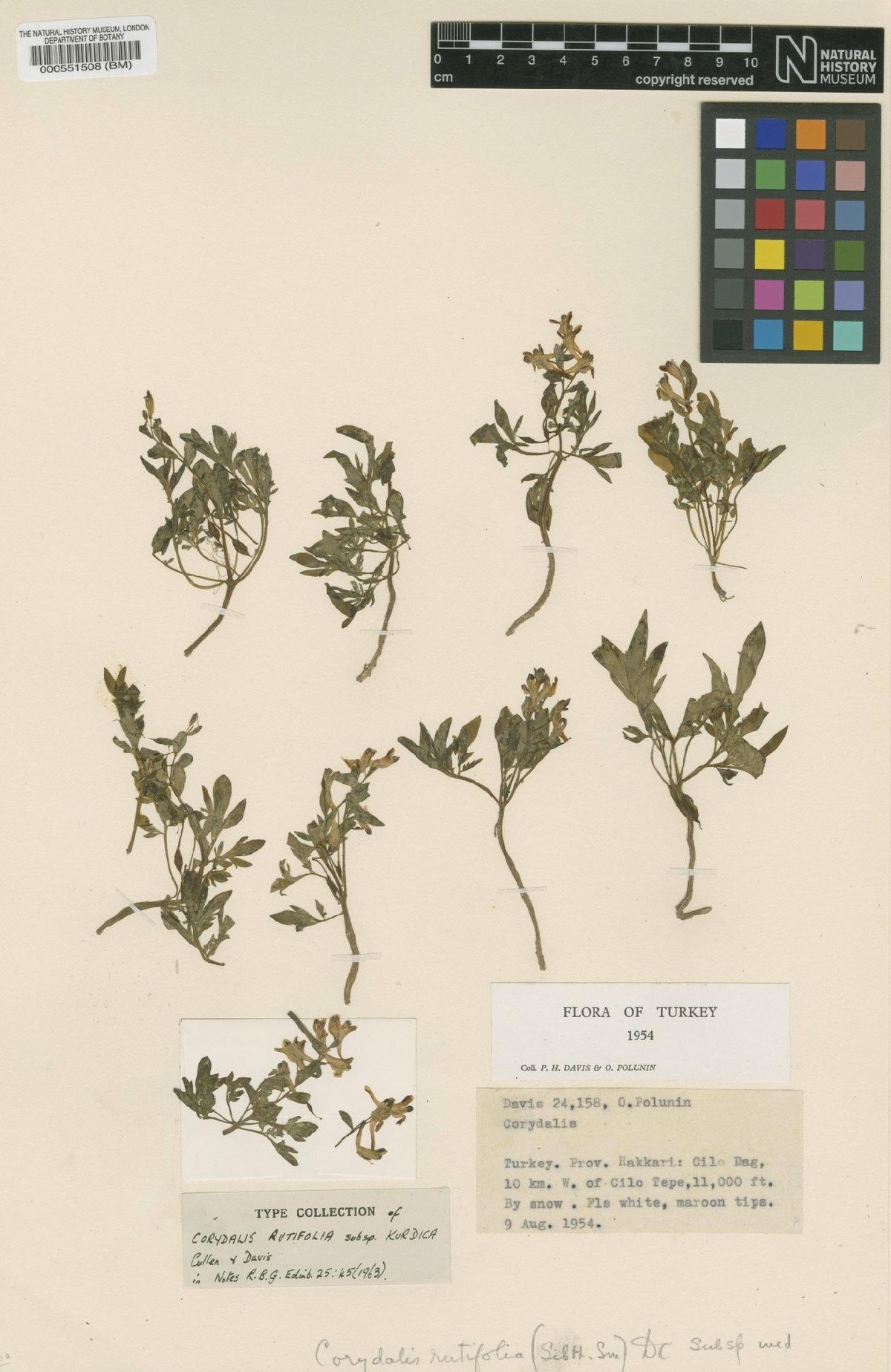
Another sheet of the same gathering is kept at the Royal Botanic Garden Edinburgh, where the original specimen of the subspecies is held. Even there the name did not settle at once: a later slip by Wendelbo on that sheet reads C. verticillaris[7][2].
Earlier that summer they had collected the same plant on Pelli Dağ in Bidlîs (Bitlis), near the late snow line, with maroon flowers, and on Artos in Wan (Van), by melting snow, with "pinkish maroon" ones[4][7][7].
One species, then two
In 1963 James Cullen, working in Edinburgh "in the light of recent material collected by Davis in Cyprus, Crete and Turkey", decided that all these opposite-leaved plants, except the much more finely cut C. verticillaris, were best treated as subspecies of one variable species, C. rutifolia[4]. He recognised four: one on Cyprus, one on Crete, a widespread one from Anatolia to Lebanon, and a new one from the Cilo plants, which he named subsp. kurdica, "the most easterly representative" of the group[4]. Its leaves were cut three, rarely four, times into narrow, almost linear segments, and its flowers were 15–18 mm long[4]. Cullen also suspected that earlier records of C. verticillaris from Turkey "almost certainly" belonged to his new subspecies[4].
That same year he put the name on herbarium sheets from Başûr. Plants that R. Wheeler Haines had found "frequent in turf of open hillside" at Hacî Omeran (Haji Omran) on 29 March 1958, and had labelled C. verticillaris, Cullen redetermined in 1963 as subsp. kurdica[7].
Twenty-five years later Lidén looked at the group again, this time with living plants. Working with the rich collection of living tuberous corydalis grown at the Gothenburg Botanical Garden, he found that the accepted view did not hold[2]. He brought back Candolle's old name and moved the Kurdish plant under it: Corydalis oppositifolia subsp. kurdica (Cullen & Davis) Lidén, the name it carries today[2][5]. The brackets record that Cullen and Davis described it first.
Lidén was frank about how slippery the plant is. The Kurdish subspecies, he wrote, is "very variable in leaf segmentation, and covers most of the variation-range" of its neighbours, and the line between the two subspecies "is not very clearcut, and may perhaps rather represent a clinal variation", a gradual change across the map[2]. The regional floras had filed it under other names: Flora Iranica partly under C. verticillaris and Flora of Iraq under C. rutifolia[2].
What to look for
- A small plant from a solid, irregular tuber, with roots in bunches[2][1].
- An unbranched stem with just two leaves, opposite each other and without stalks[3][2].
- In subsp. kurdica, leaves divided two or three times into lance-shaped, pointed lobes, the end lobe usually much bigger than the side ones[2]. In the other subspecies, which grows in northern and eastern Anatolia, the lobes are rounded to elliptic and more or less equal[2].
- Flowers 20–25 mm long, deeply and evenly coloured, with a spur of 11–18 mm and a distinct rim at the tip of the outer petals; Cullen measured the Cilo plants at 15–18 mm[2][4].
- Fruits with 11–13 seeds[2].
All the species in its group are self-sterile, Lidén noted: a flower cannot set seed with its own pollen[2].
White with maroon tips, or deep purple
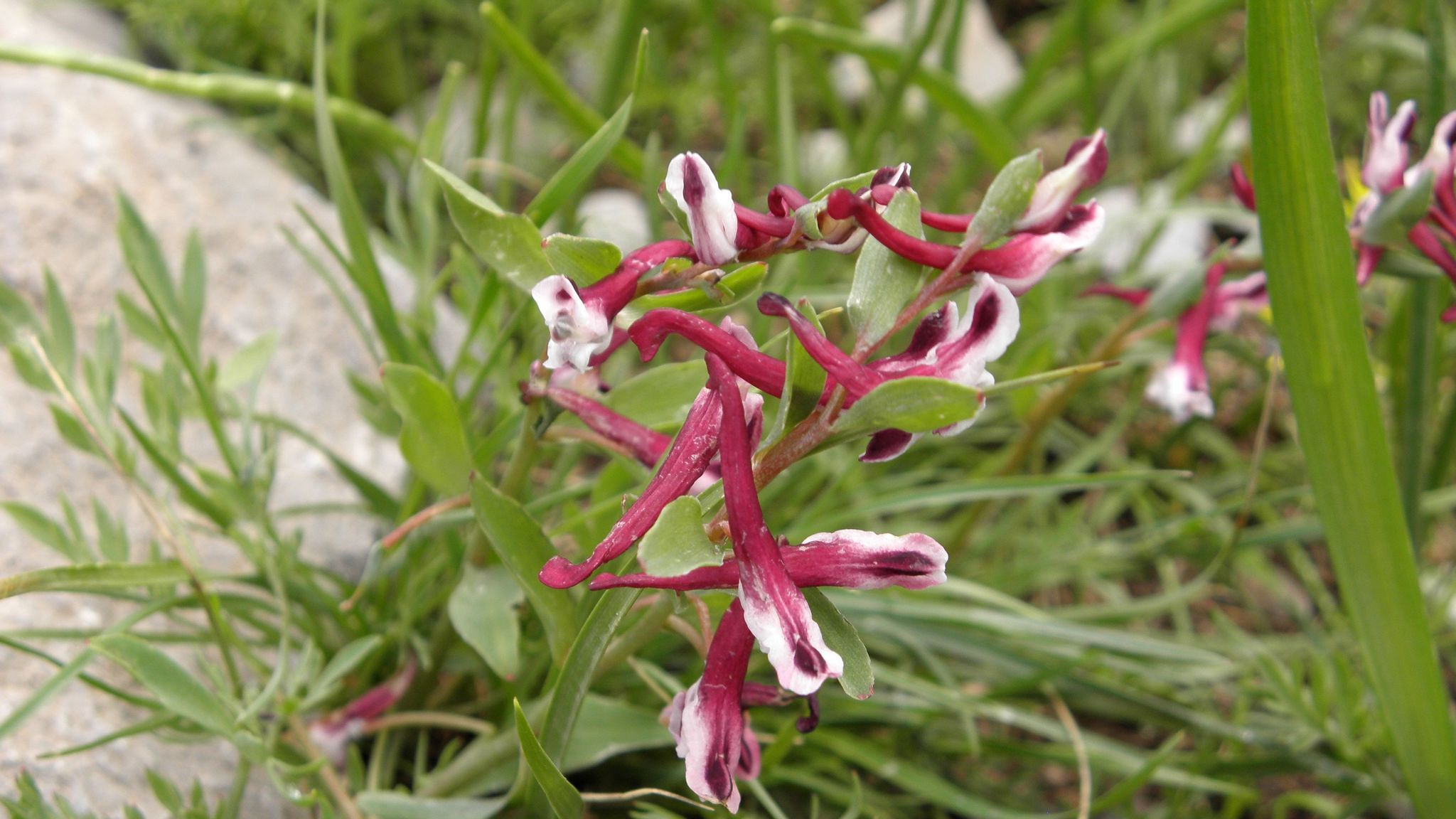
The labels and photographs show how much the colour varies. On Cilo the flowers were "white, maroon tips"; on Artos "pinkish maroon"; on Pelli Dağ "maroon"[4][8]. Boissier wrote of pleasantly pink flowers for the whole group[1], and Lidén of a purple corolla[2]. In a photograph from near Colemêrg the flowers are white and crimson; in one from Silêmanî (Sulaymaniyah) they are a deep magenta[9][9].
Where it grows
Kew's checklist gives the species' native range as Turkey to western Iran[5]. The Kurdish subspecies is a plant of the high mountains of Bakur, Başûr and Rojhilat, near the snowline at 1,000–3,500 m[2]. Records include:
- Bakur: Cilo in Colemêrg, at about 3,300 m, the type locality[4][8]; Artos in Wan, 2,800 m, and Pelli Dağ in Bidlîs, 3,000 m[4]; and lower down on Sat Dağ in Colemêrg, on shady rocks at 1,450 m[7][2].
- Başûr: Helgurd at 3,000 m[7]; Hacî Omeran, in the turf of an open hillside[7]; Sersing (Sersang) at 5,000 feet (about 1,500 m), below a steep, damp cliff on a north-facing slope[7]; and recent photographs from Silêmanî governorate[9].
- Rojhilat: a sheet from Merîwan (Marivan) at 850 m, filed under the species[7].
The Sersing sheet shows the plant's knack for confusing botanists one last time: Cullen named it as the widespread subspecies of Anatolia and Lebanon, not as kurdica, and it is now filed simply as C. oppositifolia[7].
Flowering with the melting snow
The plant flowers when the snow lets it. Boissier placed it "at melting snows" and gave its flowering time simply as spring[1]. The dates on the flowering records run from late March to August: late March on the hillside at Hacî Omeran and around Silêmanî[7][9], May near Colemêrg and at Sersing, where Haines called his plants "belated"[7][9], late June on Helgurd[7], and July and August for the highest gatherings, beside the last snow on Pelli Dağ, Artos and Cilo[8][7][7].
Kurdish names
Ehmedê Dirihî's dictionary of Kurdish plant names gives şepirze for this plant, citing one of his sources; the Turkish column of the same row prints the same word[10]. He also lists şepirzeya kurdan, without a source; it looks like a name formed after the Latin kurdica[10].
Şepirze is not only a corydalis name. The plant-name list "Flora Kurdistanê" in Kurmancî, the Kurdish Institute of Paris's journal on the Kurmanji dialect, gives şepirze, alongside şerpeze, giyapetatok, kartolok and kartolek, for orchids of the genus Orchis[11]. Dirihî also gives sewl for the genus Corydalis as a whole, a name that on the same page heads rows for cockscomb (Celosia cristata) and an amaranth (Amaranthus), so it may be a mix-up[10].
Sources
- 1.Boissier, E. (1867). Flora Orientalis, vol. 1. Basel & Geneva: H. Georg. archive.orghttps://archive.org/details/floraorientaliss01bois
- 2.Lidén, M. (1988). Tuberous Corydalis in the Mediterranean checklist area. Notes from the Royal Botanic Garden Edinburgh 45(2): 349–363. doi:10.24823/nrbge.1989.3530https://doi.org/10.24823/nrbge.1989.3530
- 3.Candolle, A. P. de (1821). Regni vegetabilis systema naturale. 2: 114–115.
- 4.Cullen, J. (1963). Materials for a Flora of Turkey: VII. Notes from the Royal Botanic Garden Edinburgh 25(1): 41–48. doi:10.24823/nrbge.1963.2634https://doi.org/10.24823/nrbge.1963.2634
- 5.Plants of the World Online. Royal Botanic Gardens, Kew.
- acCorydalis oppositifolia.
- bCorydalis oppositifolia subsp. kurdica.
- plant_name_id 2739048. powo.science.kew.orghttps://powo.science.kew.org/taxon/urn:lsid:ipni.org:names:672397-1accessed 14 November 2026
- 6.International Plant Names Index. Royal Botanic Gardens, Kew, Harvard University Herbaria and Australian National Herbarium.
- abauthor records for Candolle and Olivier.
- urn:lsid:ipni.org:names:672397-1. ipni.orghttps://www.ipni.org/n/672397-1accessed 14 November 2026
- 7.Royal Botanic Garden Edinburgh Herbarium (E), specimen catalogue (via data.rbge.org.uk and GBIF). data.rbge.org.ukhttps://data.rbge.org.uk/herb/
- abcipherbarium specimen E00410826 (Bornmüller 846, Helgurd), via GBIF.
- dherbarium specimen E00410820, via GBIF.
- eqherbarium specimen E00410822 (Davis & Polunin 22492, Pelli Dağ), via GBIF.
- frherbarium specimen E00410823 (Davis & Polunin 22796, Artos Dağ), via GBIF.
- gjnherbarium specimen E00410825 (Haines, Haji Omran), via GBIF.
- hherbarium specimen E00410821 (Davis 45593, Sat Dağ), via GBIF.
- kmoherbarium specimen E00410817 (Haines 962, Sersang), via GBIF.
- lherbarium specimen E00410816 (Jacobs 6492, Marivan), via GBIF.
- 8.abcdNatural History Museum, London, herbarium specimen BM000551508 (isotype of C. rutifolia subsp. kurdica), via GBIF.
- 9.iNaturalist. inaturalist.orghttps://www.inaturalist.org/
- 10.Ahmet Kasımoğlu (Ehmedê Dirihî) (2013). Ferhenga Navên Nebatan a Kurdî (Dictionary of Kurdish Plant Names). Mardin Artuklu University, Institute of Living Languages in Turkey (ISBN 978-605-4202-12-6).
- 11.↩Ehmedê Dirihî (2007). Flora Kurdistanê (II). p. 2. institutkurde.orghttps://www.institutkurde.org/publications/kurmanci/
Last updated 20 November 2026