Cousinia kurdistanica is a spiny member of the daisy family, from the thistle tribe (Cardueae)[1], that is known only from its type locality, at about 1,500 m by Zrêbar (Zarivar) Lake near Merîwan (Marivan) in East Kurdistan (Rojhilat)[2]. It was named only in 2010[1][2]. Its original description cites a single specimen, the type, and we found no other record of it[1][3].
How it got its name
- Named by
- Attar, 2010Published in Iran. J. Bot. 16: 169
- Type collected by
- Kaffash
A lake with a long memory
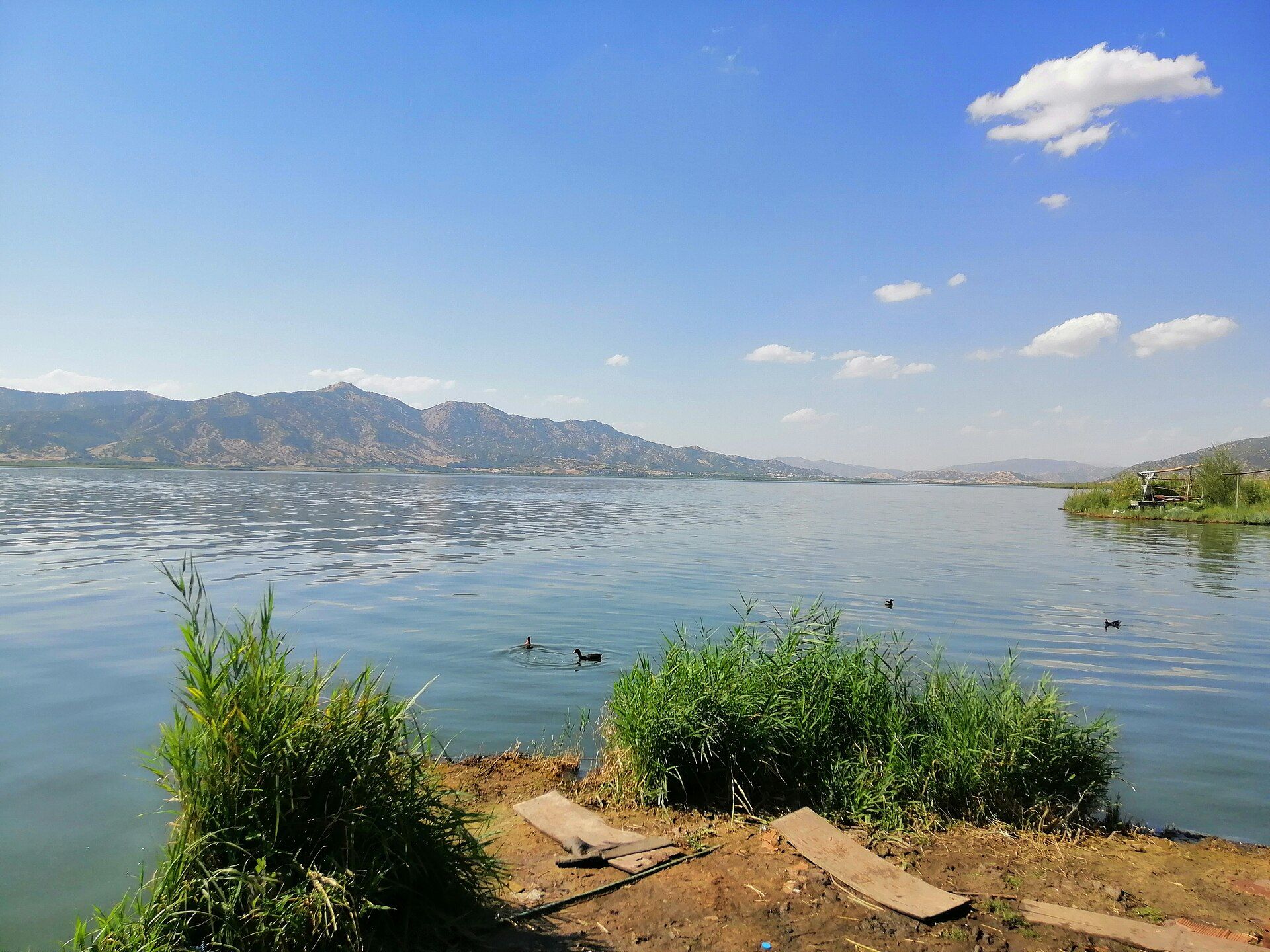
Zrêbar lies at 1,285 m in a long valley between wooded mountains, close to Merîwan[4]. It is a lake of springs: its fresh water rises from the ground, some of it bubbling up through the lake bed, and it spreads over some 850 hectares while staying on average only about 3 m deep[4]. Oak is the dominant tree on the slopes around it, with wild pear, hawthorn and wild almond, and botanists have counted 271 plant species around its shores, according to a 2016 article on the lake[4].
The lake also keeps a record of its own past. Pollen that settled in its mud over thousands of years shows the land around Zrêbar as a cold, dry wormwood (Artemisia) steppe in the last ice age, then, from about 10,000 years ago, an open savanna with oak and pistachio trees, which only after about 6,000 years ago closed into the oak forest that still covers the hills[5][4].
The type, kept in Sine
The plant was collected by Kaffash, at about 1,500 m by Zrêbar[2], some 200 m higher than the lake[2][4]. That specimen, number 3232, became the holotype, the single sheet to which the name is tied for good. It is kept in Sine (Sanandaj), in the herbarium of the Research Center of Agriculture and Natural Resources of Kurdistan[2]. A plant named after Kurdistan, with its reference specimen still in Kurdistan.
The species was described by Farideh Attar of the Central Herbarium of the University of Tehran[1][6], in a full revision of one large group of Cousinia in Iran, written with S. B. Djavadi and published in the Iranian Journal of Botany in 2010[1]. The revision named ten species new to science, each "described and illustrated", C. kurdistanica among them[1]. The herbarium in Sine was one of those whose specimens the authors studied[1]. The abstract spells the new name kurdestanica, while the key and the accepted name use kurdistanica[1][2][7].
The revision also took a side in an argument. Two years earlier, Iraj Mehregan and J. W. Kadereit had cut the same section, across its whole range, from 110 published species to 31[8]. Attar and Djavadi disagreed: merging so many species, they wrote, does "not seem logical"[1]. The number, shape and texture of the bracts matter in telling these plants apart, they argued, and, following the botanist Karl Heinz Rechinger, they added a fact of the plants' lives: the pappus of Cousinia, the tuft of hairs on each seed, is brittle and does not carry the seed far, so many species really are confined to very small areas[1]. Their abstract lists 42 species that they treat as distinct, against the last published revision of the section, besides the ten new ones such as C. kurdistanica[1].
What it looks like
The first description gives a careful portrait of the single plant, and is honest about what is missing. Its Latin begins: "Perennis, ca. 30 cm alta, olivacea, parte inferior ignota": a perennial about 30 cm tall, olive-coloured, its lower part unknown[1]. The base of the plant and its basal leaves were never seen. What the type does show[1]:
- a stem branched from the middle, cobwebby-woolly, with a continuous wing running down it from the leaves;
- lower leaves about 9 × 3 cm, lance-shaped, cut into toothed lobes, each tooth ending in a spine about 3 mm long; the upper leaves gradually smaller and well below the flower heads;
- single heads at the ends of the branches, 4 to 4.5 cm across, with about 70 flowers;
- an involucre of about 110 bracts in ten rows; the middle bracts end in a lance-shaped appendage about 10 × 2 mm, with a prominent midrib and one tiny spine on each side, spreading away from the head;
- pink florets about 20 mm long, with pink anthers;
- blackish seeds about 3 × 2 mm, shaped like an upturned pyramid, finely toothed at the top.
The description says nothing about habitat or flowering time beyond the place and the height[1]. The authors compare it with C. lurorum, a species found along fields in the province of Kirmaşan (Kermanshah), which has smaller heads, about 3 cm across, half as many flowers and fewer, broader bracts[1].
A genus named after a philosopher of the mind
Cousinia has about 700 species and is one of the most diverse genera of Central and South-West Asia[1]. Its name has an unexpected origin. In 1827 the botanist Henri Cassini (1781–1832)[2] was given a single dried specimen by a colleague, Gay, who had received it as a thistle, Carduus orientalis. Cassini decided it was no true thistle but "a new and very remarkable genus", which, he wrote, "we dedicate to the celebrated psychologist Victor Cousin"[9]. In 1827 "psychologist" was a word for a philosopher of the mind. The 2010 revision gets this wrong: it says the genus was "probably" named after "Louis Cousin (a French academician)"[1], but Cassini's own words leave no doubt. So some seven hundred spiny plants, this Kurdish one among them, carry the name of Victor Cousin, a thinker rather than a botanist.
How to know it
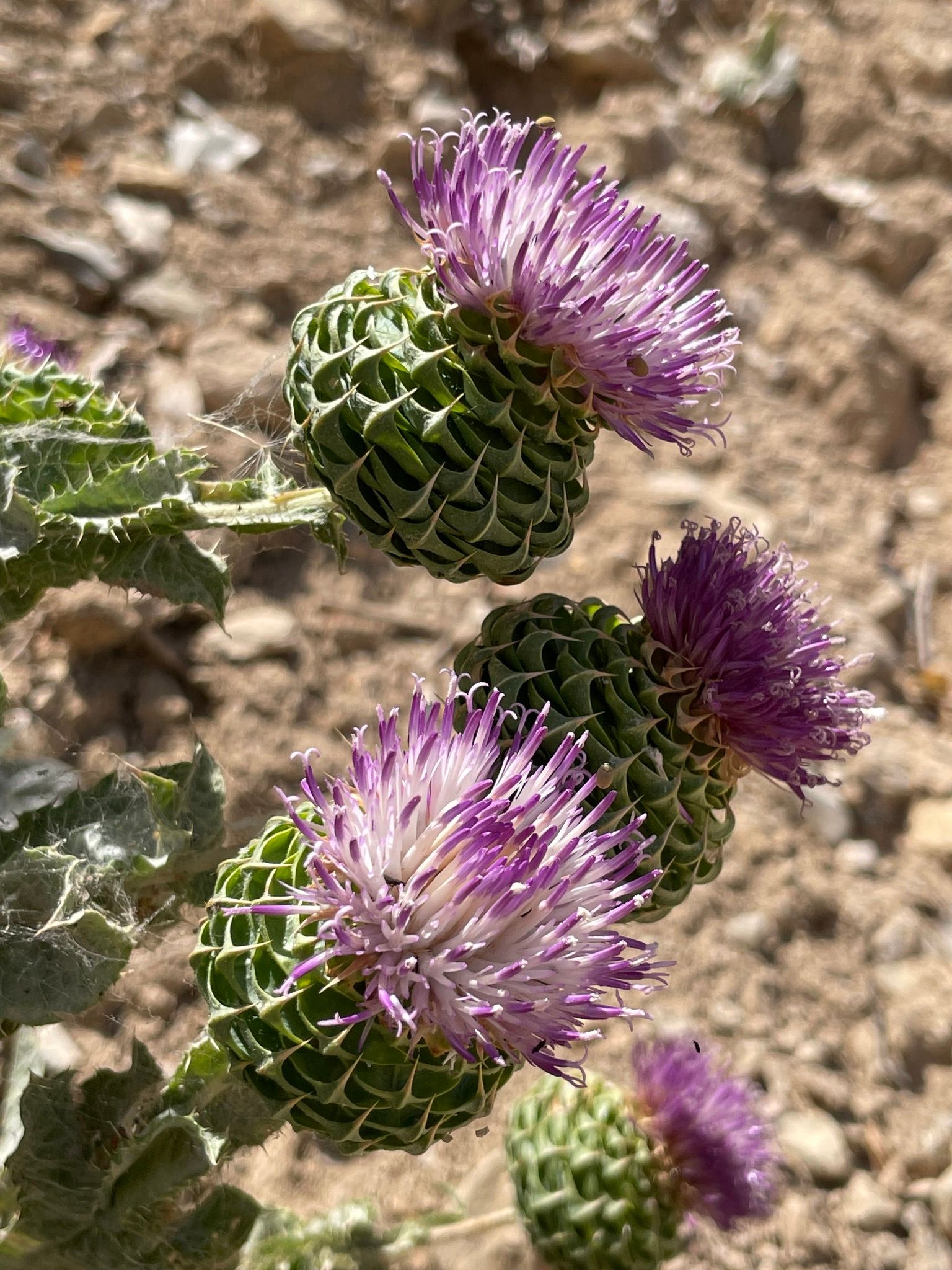
C. kurdistanica belongs to section Cynaroides, the largest group in the genus, with 89 species[1]. The section is recognised by two features: leaves whose bases run down the stem, and flower heads wrapped in bracts that end in a free tip, an "appendage"[1]. All its species are, in the revision's words, "Irano-Turkestanian elements", and most of them grow in a very small area[1]. Iran is the heart of the section, with 77 of its species, 66 of them found nowhere else[1].
Inside this crowd of look-alikes, the revision's identification key picks out C. kurdistanica by the bracts around its flower heads. In many species of the section the tips of the middle bracts lie flat against the head; in C. kurdistanica they stand out from it[1]. The last step of the key gives the plant away by two things: the whole plant is olive-coloured, and the tips of the middle bracts are lance-shaped and spreading. Its partner in that last step, C. sefidiana, is green, with about 60 flowers and arrow-shaped tips that curl back and cover the outer bracts[1].
New plants from around Merîwan
The hills between Merîwan and Bane have given botany several new plants in recent years. In the same volume of the Iranian Journal of Botany, Attar and Hossein Maroofi of the Kurdistan research centre described another new Cousinia, C. iranshahriana, from rocky slopes at the Gozeh-Koreh pass on the road from Bane (Baneh) to Merîwan[6]. In 2016 Maroofi and H. Ghaderi named Pentanema kurdistanicum, another member of the daisy family, found among rocks on subalpine cliffs near Merîwan, of which only a few plants were seen[10]. And around Zrêbar itself grows Tetrataenium nephrophyllum, a plant found only in Iran, which the English summary of a 2016 article on the lake even calls endemic to the lake[4].
Where it grows
Kew's checklist gives its native range simply as Iran[7]. In Kurdish terms that is one locality in Rojhilat: by Zrêbar at about 1,500 m[2]. There are no other specimens, photographs or observations of it in the Global Biodiversity Information Facility (GBIF), and none on iNaturalist[3]. What does exist is a short stretch of its DNA, a sequence of the ribosomal ITS region, filed in the public sequence databases under the same collection number, 3232[3]. Botanists use this marker to work out how the many species of Cousinia are related: a 2022 study used it on 50 Iranian species of Cousinia to test how section Cynaroides and its neighbour, section Platyacanthae, are related[11].
So for now C. kurdistanica is known to us from one gathering, its type sheet in Sine with its photograph and drawing, and one string of letters in a database. As far as we know, nobody has yet described the lower part of the plant. The oak-covered hills around Zrêbar are the place to look for it again.
Its name in Kurdish
No Kurdish name has been recorded for this species. Ehmedê Dirihî's dictionary of Kurdish plant names gives şiwale dire for the genus Cousinia as a whole[12]: a name for the group, not for this particular plant.
Sources
- 1.Attar, F. & Djavadi, S. B. (2010). A taxonomic revision of Cousinia, sect. Cynaroides (Asteraceae, Cardueae) in the flora of Iran. Iranian Journal of Botany 16(1): 130–184.
- 2.International Plant Names Index. Royal Botanic Gardens, Kew, Harvard University Herbaria and Australian National Herbarium.
- 3.abcGlobal Biodiversity Information Facility (GBIF): occurrence 3351550909 (sequence MK005178) and species record 9342474.
- 4.abcdefMaroufi, H. & Ali Ehyaei, A. (2016). Zarivar Lake: the largest fresh water spring in Iran (in Persian). Iran Nature 1(1): 61–65. doi:10.22092/irn.2016.107531https://doi.org/10.22092/irn.2016.107531
- 5.↩van Zeist, W. (1967). Late quaternary vegetation history of western Iran. Review of Palaeobotany and Palynology 2: 301–311. doi:10.1016/0034-6667(67)90159-5https://doi.org/10.1016/0034-6667(67)90159-5
- 6.abAttar, F. & Maroofi, H. (2010). Cousinia (sect. Albidae) iranshahriana (Asteraceae, Cardueae), a new endemic species from Kurdistan province, Iran. Iranian Journal of Botany 16(2): 197–199.
- 7.Plants of the World Online. Royal Botanic Gardens, Kew.
- abCousinia kurdistanica.
- plant_name_id 3043994. powo.science.kew.orghttps://powo.science.kew.org/taxon/urn:lsid:ipni.org:names:77106950-1accessed 14 November 2026
- 8.↩Mehregan, I. & Kadereit, J. W. (2008). Taxonomic revision of Cousinia sect. Cynaroideae (Asteraceae, Cardueae). Willdenowia 38: 293–362. doi:10.3372/wi.38.38201https://doi.org/10.3372/wi.38.38201
- 9.↩Cassini, H. (1827). In: Dictionnaire des sciences naturelles, 2nd ed., vol. 47: 503–505 (genus Cousinia). pp. 503–505.
- 10.↩Maroofi, H. & Ghaderi, H. (2016). Pentanema kurdistanicum (Inuleae, Asteraceae), a new species from subalpine cliffs of Kurdistan, Iran. Phytotaxa 253(3): 223-226. doi:10.11646/phytotaxa.253.3.7https://doi.org/10.11646/phytotaxa.253.3.7
- 11.↩Atazadeh, N., Sheidai, M., Attar, F. & Koohdar, F. (2022). Molecular phylogeny and morphometric analyses in the genus Cousinia Cass. (Asteraceae), sections Cynaroideae Bunge and Platyacanthae Rech. f. Caryologia.
- 12.↩Ahmet Kasımoğlu (Ehmedê Dirihî) (2013). Ferhenga Navên Nebatan a Kurdî (Dictionary of Kurdish Plant Names). Mardin Artuklu University, Institute of Living Languages in Turkey (ISBN 978-605-4202-12-6).
Last updated 20 November 2026