How it got its name
- Named by
- Rastegar, Maroofi & Tabad, 2021Published in Phytotaxa 508: 69
- Type collected by
- M.A.Tabad28 August 2018
Where it grows in Kurdistan
At 2500–2900 m above sea level.
A small Heracleum under the snow line
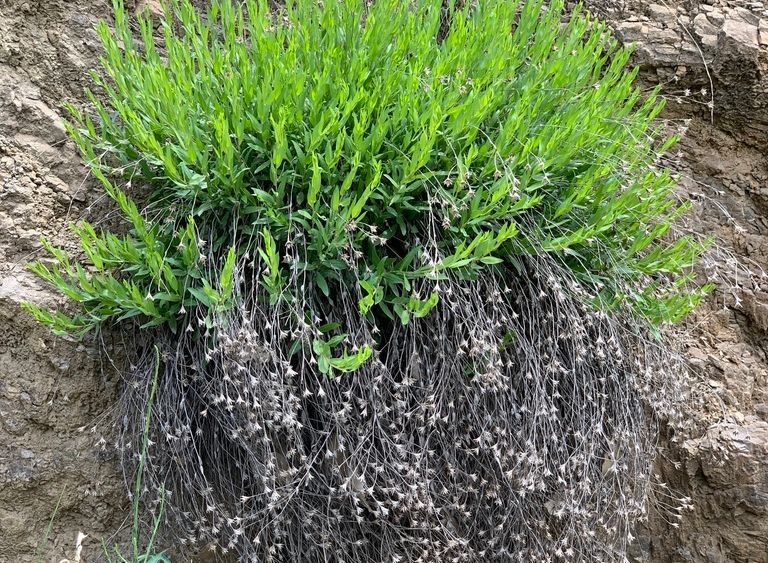
Heracleum kurdistanicum is a miniature of its genus. It is an aromatic perennial of the carrot family (Apiaceae), only 6 to 35 cm tall, that grows on the rocks of a single mountain in Rojhilat (East Kurdistan)[1]. The species most like it stand up to 55 cm[1], and its Kurdish namesake across the border, Heracleum kurdicum, up to a metre[2].
That mountain is Dalanpar, in the district of Şino (Oshnavieh)[1][3], in the high country near the borders with Başûr and Bakur[1][4]. There the plant lives in what its describers call "subalpine cold, snowy, humid rocky habitats", between 2,500 and 2,900 m[1]. It flowers in July and August and ripens its fruit in August and September, in the short mountain summer[1].
As far as botanists know, it grows nowhere else. Its describers know it "only from small populations on Dalanpar Mountain"[1], and Kew's checklist gives its whole range as north-western Iran[5]. It has never been assessed for the IUCN Red List[6]. It belongs to Heracleum, a genus with twelve species in Iran alone[2].
Three botanists and one mountain
The plant was found by people who kept coming back. Mohammad Aref Tabad, a graduate in medicinal plants from an institute in Kirmaşan (Kermanshah), and Hosein Maroofi and Azad Rastegar of the Kurdistan agricultural and natural resources research centre in Sine (Sanandaj)[1] spent years on Dalanpar. In 2021 they wrote that their "floristic studies in Dalanpar Mountain during the last six years made a collection of rare and endangered species"[3].
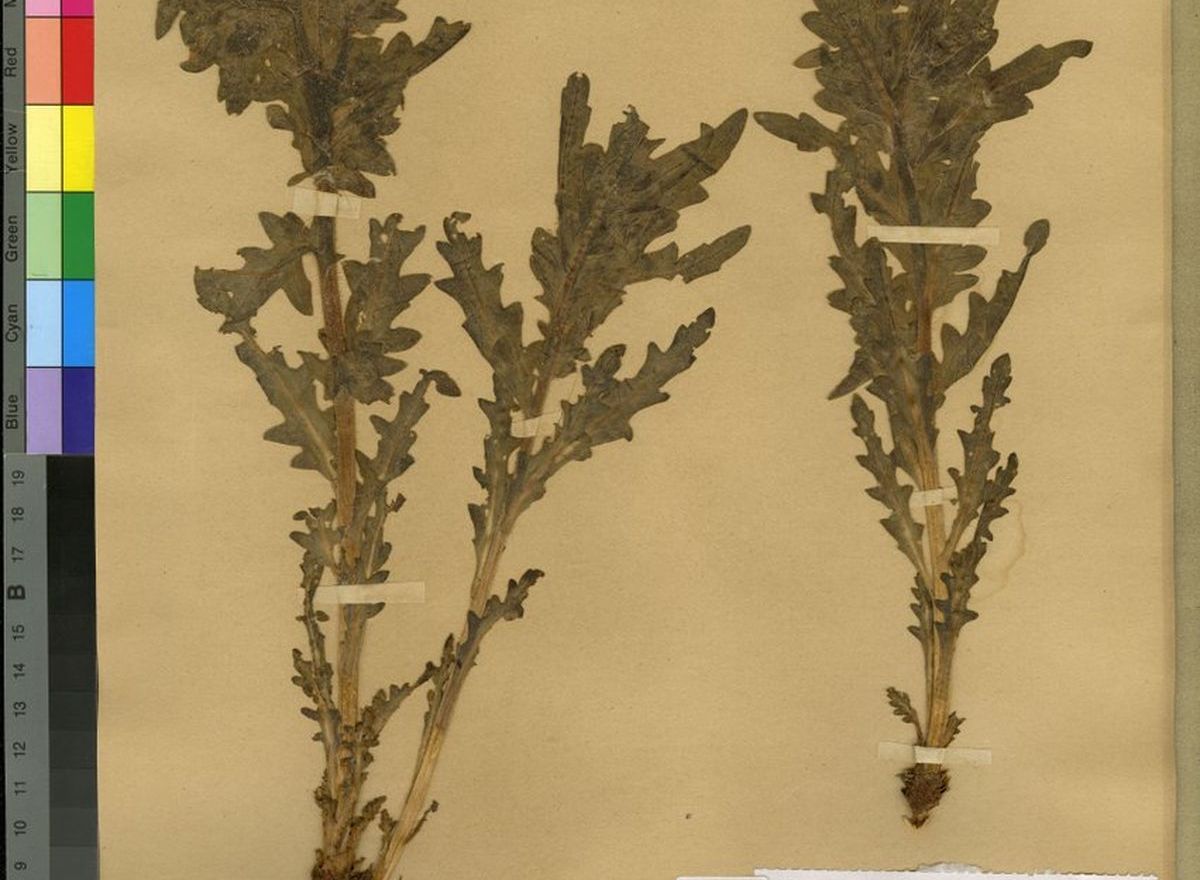
This Heracleum came from those years of collecting. Tabad pressed it on 11 July 2017 at 2,650 m, and again later that July at 2,700 m[1]. The specimen that now carries the name, the holotype, is his number 13939, collected at 2,750 m on 28 August 2018, when the plant was in fruit[1]. It is kept in the herbarium HKS, with a duplicate in the herbarium TARI[1].
Those same summer days on Dalanpar turned up more than one surprise:
- On 11 July 2017, the day of that first gathering, Tabad also collected a member of the daisy family at 2,980 m. In 2022 the three botanists described it as a new species, Tanacetum urmiense, named after the city of Wirmê (Urmia), and they collected it again on Dalanpar on 28 August 2018, the same day as the Heracleum holotype[4].
- Tanacetum urmiense is known only from Dalanpar and one other mountain, with fewer than 200 plants on each, and its describers assessed it as Critically Endangered[4].
- In 2021 they also reported a species new to the flora of Iran from Dalanpar: Geranium kurdicum, until then known from Colemêrg (Hakkâri) and Başûr[3], first described in 1910 from the alpine meadows of Helgurd[7]. On Dalanpar they counted fewer than 60 flowering plants in about 500 m² of open, rocky limestone ground[3].
So one mountain on the edge of Rojhilat holds a Heracleum named for Kurdistan, a Geranium whose name means "Kurdish", and a Tanacetum named after Wirmê.
Named for Kurdistan
The botanists published the species in June 2021 in the journal Phytotaxa[1][8]. They did not leave the name to guesswork:
The specific epithet refers to Kurdistan, the land from which the new species was collected.[1]
Kurdistanicum means "of Kurdistan". The full name, Heracleum kurdistanicum Rastegar, Maroofi & Tabad, records the three authors[8].
What to look for
Its describers give a careful portrait[1]:
- a small, aromatic perennial, 6 to 35 cm tall, its base wrapped in the papery remains of old leaf stalks;
- stems up to 5 mm thick, rough with scimitar- and sickle-shaped hairs;
- lower leaves made of three leaflets: two almost round side leaflets, 1.2 to 5 cm long and toothed, and a larger end leaflet, round to oval, up to 10 cm long, with a heart-shaped base;
- umbels, the umbrellas of flowers, on just 4 to 8 rays of unequal length, 2.5 to 10 cm long in fruit, with hardly any bracts beneath them (none to two);
- white or purple petals, all much the same size: the outer flowers of the umbrella are not enlarged, as they are in some of its relatives[2];
- a rough fruit, broader towards the top and slightly notched there, about 12 by 10 mm.
A plant without close relatives
Botanists usually describe a new species by setting it beside its nearest relative. Here they could not: in their words the plant has no close relatives by its form, so they compared it with the two species most like it, Heracleum argaeum and H. schelkovnikovii, and found it differs from both in habit, leaves, fruits and the number and size of its umbrella rays[1]. It is also the smallest of the three. H. argaeum stands 30 to 55 cm tall and H. schelkovnikovii 10 to 25 cm, sometimes 40 cm[1].
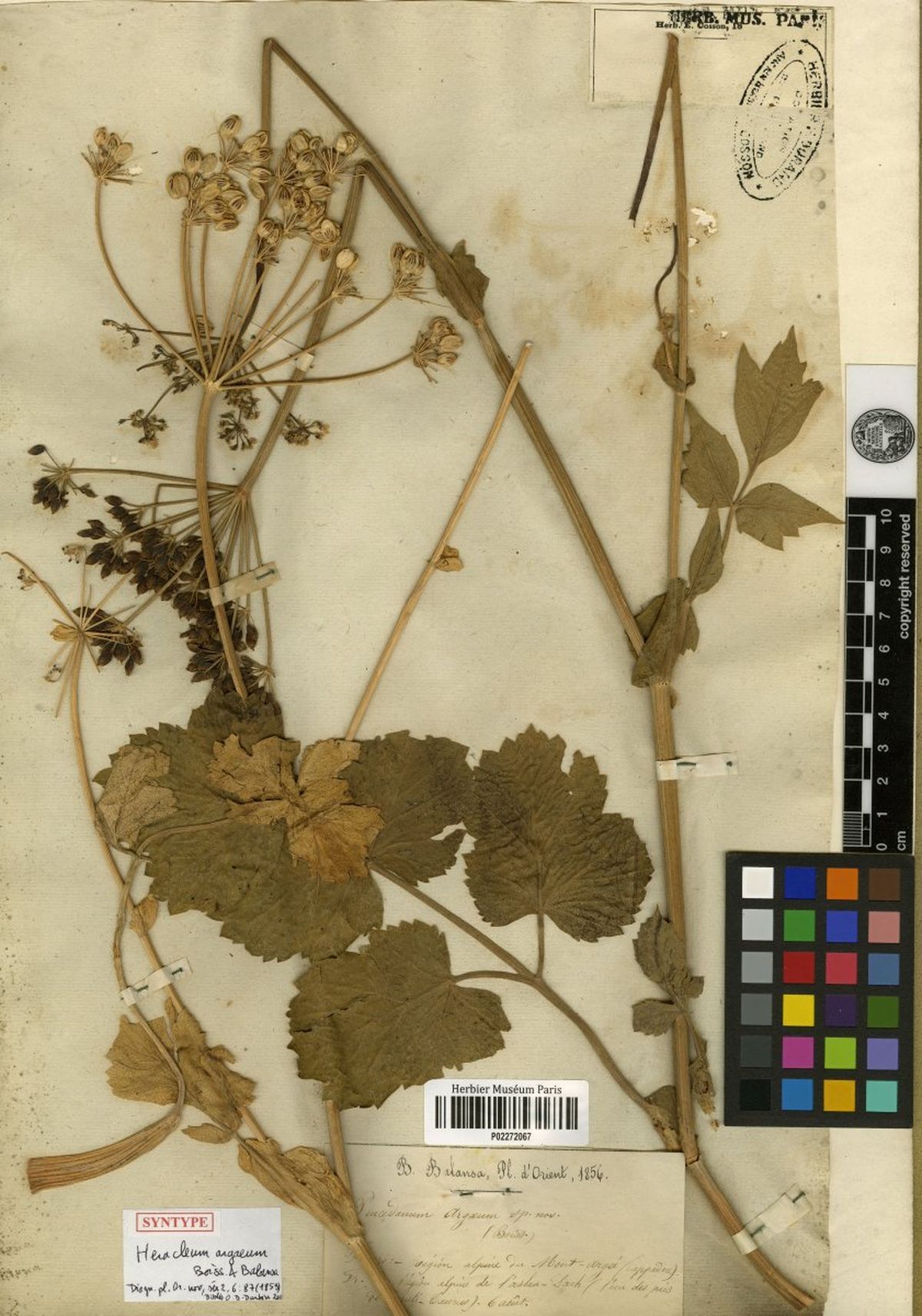
H. argaeum is a plant of Anatolia[5]. Its name points to Mount Argaeus, today's Erciyes, where the collector B. Balansa gathered it in flower in 1856; his label reads "région alpine du mont Argée (Cappadoce)". His label first names it Peucedanum argaeum, "sp. nov.". The fruits on the same sheet come from another peak of the Anti-Taurus, gathered on 6 August[9].
Two of a kind, in name only
Three years later a second Heracleum named after the Kurds appeared, across the border in Bakur. In 2024 Mehmet Fırat described Heracleum kurdicum from the Bala plateau in the Cilo mountains of Colemêrg (Hakkâri), at 2,700 to 2,800 m[2]. He compared it with H. kurdistanicum point by point: his plant is 60 to 100 cm tall against 6 to 35 cm, with 7 to 14 umbrella rays against 4 to 8, and strongly enlarged outer petals against none. His verdict: "These two species are different in every respect."[2]
A name still waiting
No Kurdish name has been recorded for Heracleum kurdistanicum in any source we checked. That is no surprise: the plant was given its scientific name only in 2021, and it lives high on one mountain.
Its bigger relatives do have Kurdish names. Ahmet Dirihî's dictionary of Kurdish plant names, published in 2013, lists so for several species of Heracleum, including Heracleum platytaenium and H. trachyloma (and, on the same page, for two wild beets), and solan for H. persicum and H. trachyloma[10]. The page on Heracleum kurdicum has more on these names.
Perhaps the people who live below Dalanpar have a name for this small, aromatic plant of the rocks. If you know one, we would like to hear it.
Sources
- 1.Tabad, M.A., Maroofi, H. & Rastegar, A. (2021). Heracleum kurdistanicum (Apiaceae; Tordylieae), a new subalpine species from Dalanpar Mountain, NW Iran. Phytotaxa 508(1): 68-76. doi:10.11646/phytotaxa.508.1.6https://doi.org/10.11646/phytotaxa.508.1.6
- 2.abcdeFırat, M. (2024). Heracleum kurdicum sp. nov. (Apiaceae), a new species from Hakkari (Turkey). Adansonia, sér. 3, 46(21): 223-237. doi:10.5252/adansonia2024v46a21https://doi.org/10.5252/adansonia2024v46a21
- 3.Rastegar, A., Maroofi, H. & Tabad, M. A. (2021). Geranium kurdicum. a new record for the flora of Iran. Iranian Journal of Botany 27(2): 103–105. doi:10.22092/ijb.2021.354364.1321https://doi.org/10.22092/ijb.2021.354364.1321
- 4.abcRastegar, A., Maroofi, H. & Tabad, M.A. (2022). Two new species of Tanacetum (Anthemideae, Asteraceae) from western Iran. Phytotaxa 561(1): 111–. doi:10.11646/phytotaxa.561.1.11https://doi.org/10.11646/phytotaxa.561.1.11
- 5.Plants of the World Online. Royal Botanic Gardens, Kew.
- aHeracleum kurdistanicum.
- bWorld Checklist of Vascular Plants (WCVP) and Catalogue of Life, via GBIF: distribution of Heracleum argaeum.
- plant_name_id 3274555. powo.science.kew.orghttps://powo.science.kew.org/taxon/urn:lsid:ipni.org:names:77219955-1accessed 14 November 2026
- 6.↩IUCN Red List status via GBIF: Not Evaluated.
- 7.↩Bornmüller, J. (1910). [Geranium kurdicum Bornm., nov. spec.]. Repertorium Specierum Novarum Regni Vegetabilis 8: 81-82, p. 82. archive.orghttps://archive.org/details/mobot31753002588652
- 8.International Plant Names Index. Royal Botanic Gardens, Kew, Harvard University Herbaria and Australian National Herbarium.
- abHeracleum kurdistanicum Rastegar, Maroofi & Tabad.
- urn:lsid:ipni.org:names:77219955-1. ipni.orghttps://www.ipni.org/n/77219955-1accessed 14 November 2026
- 9.↩Muséum national d'Histoire naturelle, Paris, herbarium specimen P02272067, syntype of Heracleum argaeum Boiss. & Balansa (B. Balansa, 1856), via GBIF.
- 10.↩Ahmet Kasımoğlu (Ehmedê Dirihî) (2013). Ferhenga Navên Nebatan a Kurdî (Dictionary of Kurdish Plant Names). Mardin Artuklu University, Institute of Living Languages in Turkey (ISBN 978-605-4202-12-6), p. 711.
Last updated 20 November 2026