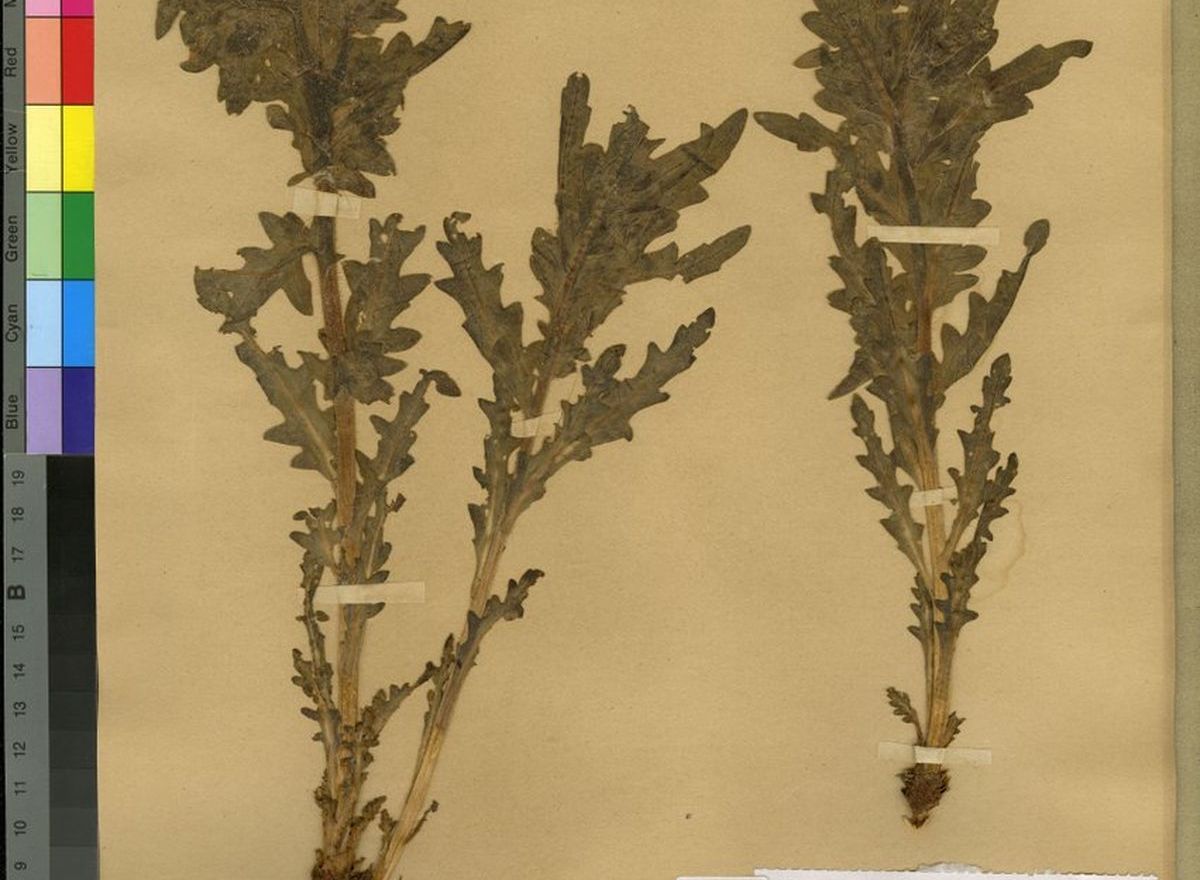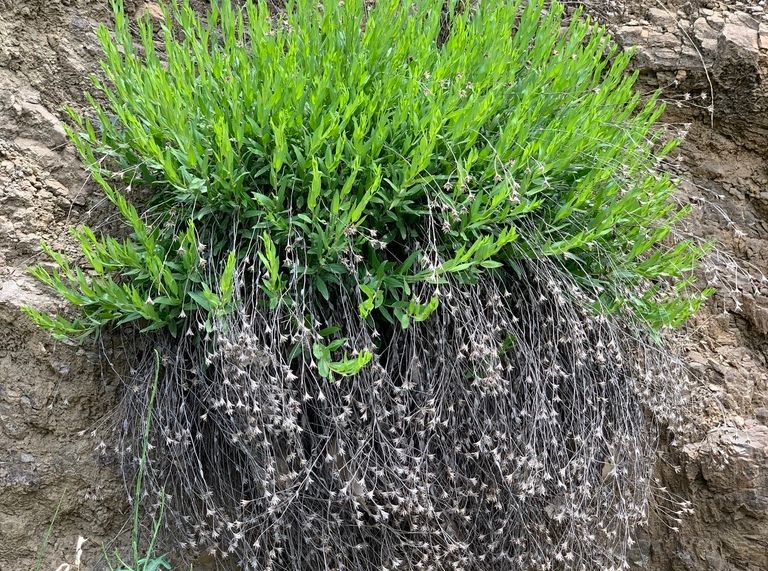
Hirtellina kurdica is a small, woody-based plant of the thistle family that grows in cracks in limestone cliffs in the mountains where Başûr (South Kurdistan) meets Bakur (North Kurdistan)[1][2]. From a tough base it sends up a crowd of straight, slender stems with bright green, gland-dotted leaves, and at their tips a few narrow, scaly flower heads with pale purple florets[1]. It was first collected in 1951, and until 2019 every published record came from Başûr[1][2][3]. In Şirnex (Şırnak) province, local people call it by a Kurdish name of its own: Tehnovik[2].
How it got its name
- Named by
- (Merxm. & Rech.f.) Dittrich, 1996Published in Boissiera 51: 75
A traveller's plant, August 1951
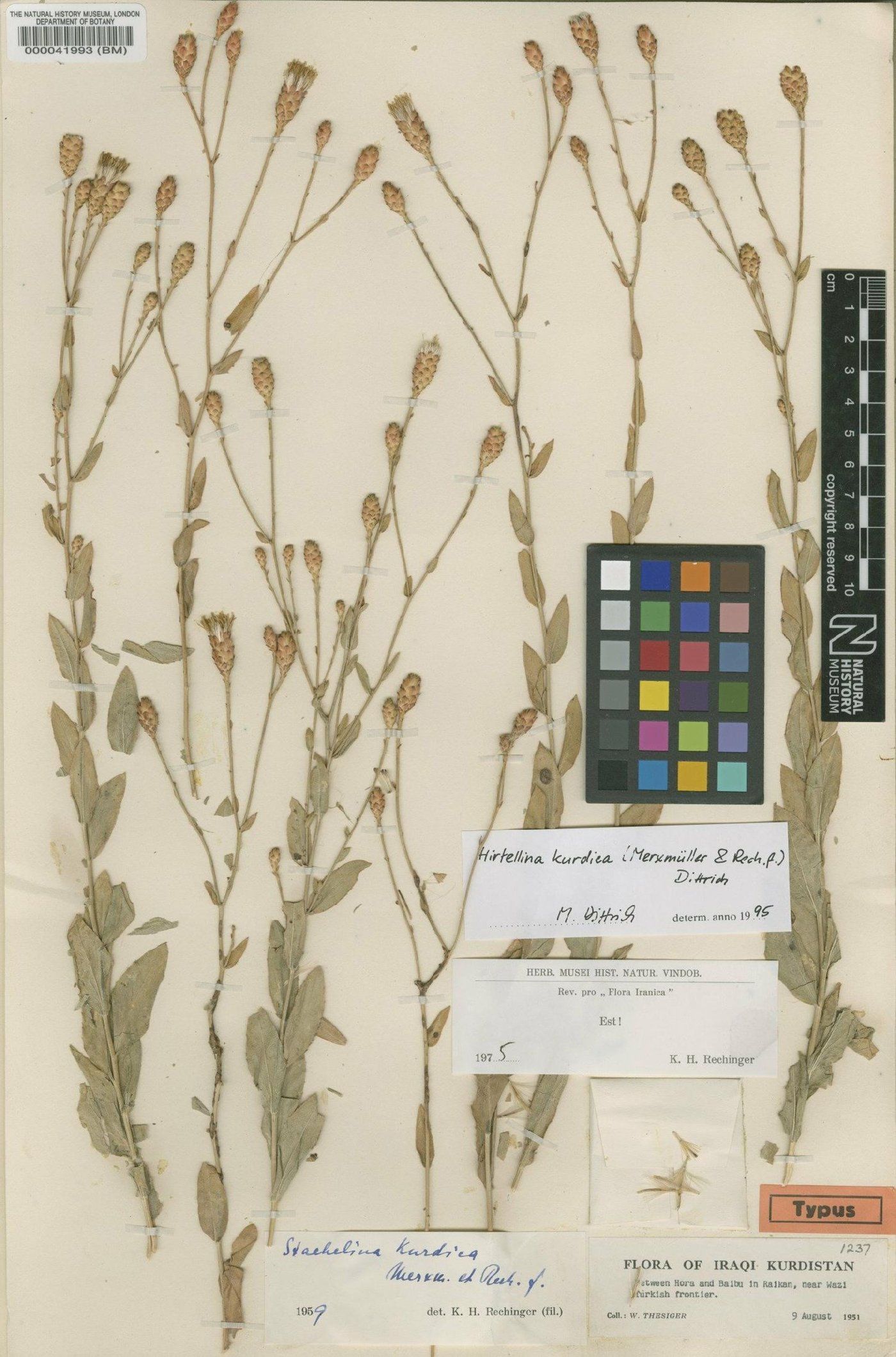
The first known specimen was picked on 9 August 1951 by Wilfred Thesiger, the traveller, who journeyed through Başûr in the late summer and autumn of 1950 and again in 1951[3][4]. His notebooks from those journeys, now at Eton College, record day by day the routes he took, the villages he passed and the mountains he climbed, with notes on local customs and words[4].
Thesiger also pressed plants on the way. His label for this one, printed "Flora of Iraqi Kurdistan", reads "Between Hora and Baibu in Raikan", that is in Rêkan (Raikan), a district close to the border with Bakur, which the label calls the "Turkish frontier"[1][3]. The sheet is now in the Natural History Museum in London, and it is the type: the specimen the scientific name is tied to for good[1][3].
Named in 1959
Thesiger's plant reached two botanists, Hermann Merxmüller (1920–1988) and Karl Heinz Rechinger (1906–1998)[5]. In 1959 they described it as a new species, Staehelina kurdica, in the journal of the German Botanical Society[5]. The epithet kurdica, "Kurdish", points to Kurdistan, where it was found[1][3].
By then Rechinger had gathered the plant himself, twice in July 1957 in Behdînan, the Duhok region: on 4 July in the limestone mountains north of Zaxo, near the village of Sharanish on Jabal Khantur, and on 10 July in "fissures of limestone rocks" above Sersing (Sarsang), between Duhok and Amêdî (Amadiya), both at about 1,200 m[6][7]. A month and a half later the botanist R. W. Haines found it at Sersing too, and A. D. Q. Agnew collected it there again in 1961[7].
Staehelina or Hirtellina?
Staehelina is an old Linnaean genus of small shrubby plants, named after the Swiss botanist Benedikt Stähelin (1695–1750)[1]. In 1827 the botanist Henri Cassini (1781–1832) named a second genus for plants of the same group, Hirtellina[1][5].
In 1995 the botanist Manfred Dittrich (1934–2016) looked at Thesiger's sheet and wrote a new name on it: Hirtellina kurdica[3][5]. He published the new combination the following year, on the same page as those for its relatives H. fruticosa and H. lobelii[5]. In 2003 Werner Greuter, in the Euro+Med treatment of the thistle tribe, also kept Hirtellina as a genus split off from Staehelina[8]. Kew's checklist follows Dittrich and accepts Hirtellina kurdica[9].
Not everyone has been convinced. A 2013 study by Barres and colleagues, as Mehmet Fırat sums it up, found that the group as a whole is a natural one but left open whether the two genera should be kept apart[2]. The Flora of Iraq, published by Kew in 2019, still lists the plant as Staehelina kurdica[1]. Both names refer to the same plant from the same cliffs; the "(Merxm. & Rech.f.)" in the current name records who described it first.
What to look for
The Flora of Iraq describes it like this[1]:
- a plant with a woody base, from which rise many straight, unbranched stems up to 45 cm tall, smooth but densely rough with tiny glands;
- leaves without stalks, oval to broadest above the middle, 3–5 cm long and 1.2–2.1 cm wide, finely toothed, densely dotted with glands on both sides and bright green, larger and more crowded towards the base of the stem;
- two or three (rarely up to five) flower heads in a loose cluster, on stalks 1–5 cm long;
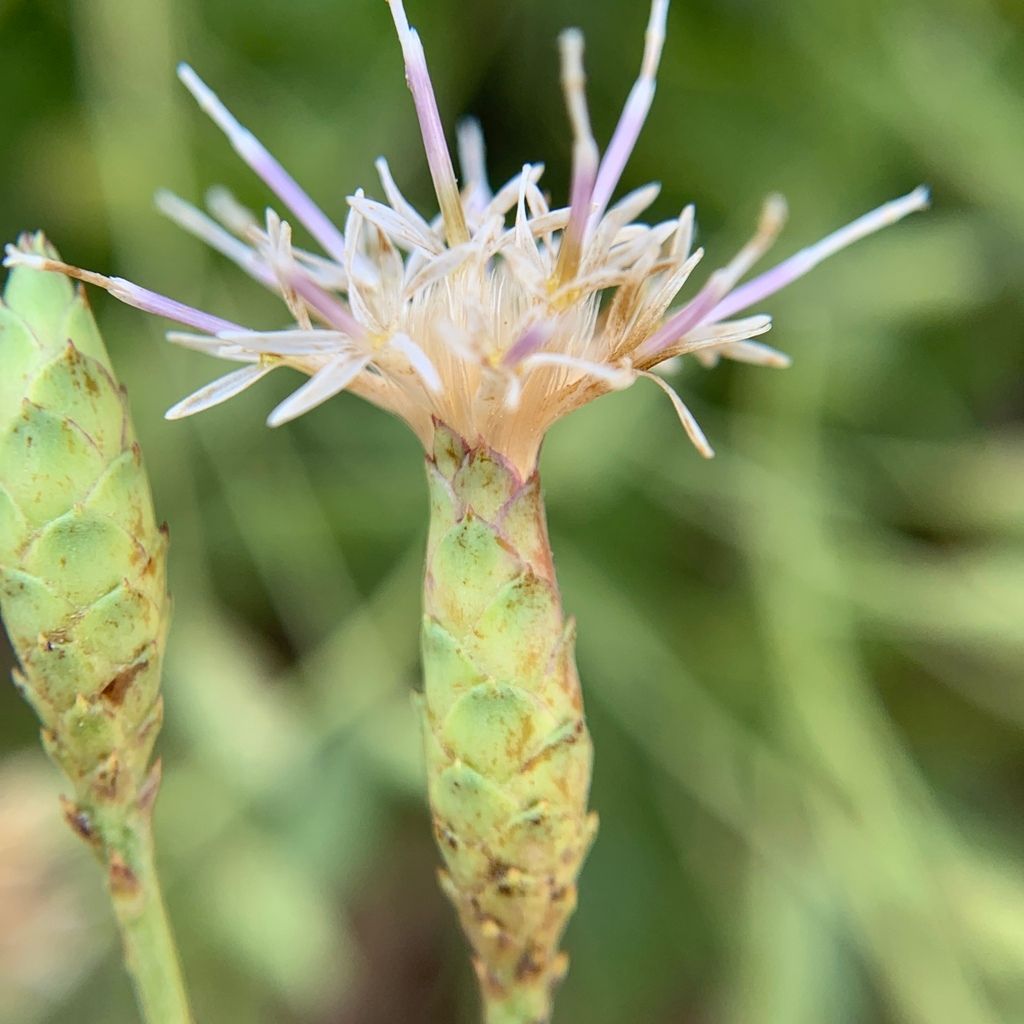
- each head about 2.7 cm long, egg-shaped in bud and cylindrical in flower, wrapped in seven or eight rows of hard, broad, pale bracts with hairy edges and brown, pointed tips;
- pale purple florets;
- small fruits densely covered in white silky hair, each topped by a 12 mm crown of off-white bristles.
The plants Mehmet Fırat found in Bakur were taller, with flowering stems 25–70 cm long[2]. Its relative H. lobelii, the other Hirtellina that grows in Turkey, has much narrower leaves, 1.5–4 mm wide against 8–21 mm in H. kurdica[2].
Cliffs on both sides of the border
Until 2019 every published record came from the far north of Başûr: Rêkan, Jabal Khantur north of Zaxo, and Sersing[1][6][7]. The Flora of Iraq calls it "rare and local in the northern sector of the mountain region of Iraq" and lists it as endemic, found nowhere else[1].
Then Mehmet Fırat, a botanist at Van Yüzüncü Yıl University, published it as new to the flora of Turkey[2]. In October 2013 and 2014 he had collected it on the Cûdî (Cudi) mountains, in the Göndek area and near Silopî (Silopi), on Gabar in the district of Cizîr (Cizre), and on the road from Sêrt (Siirt) to Dih (Eruh), on rocky slopes, in rock crevices and on dry, bushy limestone slopes between 850 and 1,350 m[2].
There is an earlier find, too. A specimen in the herbarium of the Botanical Institute of Barcelona, collected by T. Dirmenci and B. Yıldız on 17 August 2008 "between Hakkari and Şırnak", near Ortaköy, is filed as Staehelina kurdica[10]. That places the plant between Colemêrg (Hakkâri) and Şirnex five years before Fırat's first collections.
Today Ibrahim Hirory's photographs from around Hiror, north of Duhok, show it still clinging to bare rock in Behdînan[11].
Summer flowers, autumn flowers
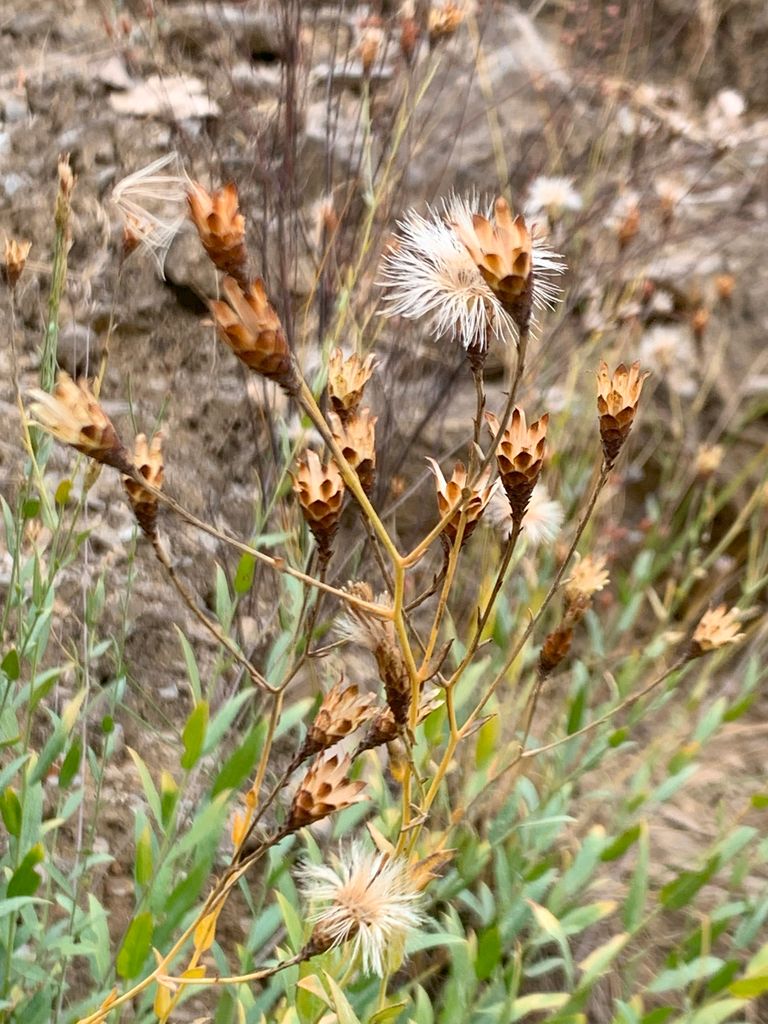
The sources disagree on when it flowers. The Flora of Iraq gives June to August for flowers and fruit[1], and Thesiger's type was picked on 9 August[3]. Fırat found it flowering in October and November on the Bakur side[2]. The photographs from near Duhok add flowers in early September, from a plant so far identified only by the photographer, and ripe seed heads in early November[11].
Its Kurdish name
In Şirnex, Fırat writes, local people call the plant Tehnovik[2]. It is the only Kurdish name for it that we have found. The great Kurdish plant-name dictionary of Ehmedê Dirihî (2013) has no entry for it under either scientific name[12].
Sources
- 1.abcdefghijklmDavies, F. G. (2019). Staehelina. In: Ghazanfar, S. A., Edmondson, J. R. & Hind, D. J. N. (eds), Flora of Iraq 6: Compositae, pp. 34–35. Royal Botanic Gardens, Kew.
- 2.abcdefghijFırat, M. (2019). Hirtellina kurdica (Asteraceae); a species new to the flora of Turkey, with contributions to its taxonomy. Iranian Journal of Botany 25(1): 30–35.
- 3.abcdefgNatural History Museum, London, herbarium specimen BM000041993 (type of Staehelina kurdica), via GBIF.
- 4.abEton College Library, Thesiger papers: MS 433 06 04 01 (Kurdistan notebook, 1950) and MS 433 06 04 02 (Iraq, Kurdistan, Marshes notebook, 1951).
- 5.International Plant Names Index. Royal Botanic Gardens, Kew, Harvard University Herbaria and Australian National Herbarium.
- 6.abNatural History Museum Vienna (W) – Herbarium. via GBIF, herbarium specimen W 1978-0006499 (Rechinger 11905), via GBIF.
- 7.abcRoyal Botanic Garden Edinburgh Herbarium (E), specimen catalogue (via data.rbge.org.uk and GBIF). herbarium specimens E00460941 (Rechinger 10781), E00460940 (Haines 1242) and E00460939 (Agnew), via GBIF. data.rbge.org.ukhttps://data.rbge.org.uk/herb/
- 8.↩Greuter, W. (2003). The Euro+Med treatment of Cardueae (Compositae): generic concepts and required new names. Willdenowia 33: 49–61. doi:10.3372/wi.33.33104https://doi.org/10.3372/wi.33.33104
- 9.Plants of the World Online. Royal Botanic Gardens, Kew.
- ↩Hirtellina kurdica.
- plant_name_id 3040648. powo.science.kew.orghttps://powo.science.kew.org/taxon/urn:lsid:ipni.org:names:991716-1accessed 14 November 2026
- 10.↩Institut Botànic de Barcelona, herbarium specimen BC-978919 (Dirmenci & Yıldız 16939), via GBIF.
- 11.abiNaturalist. observations 250169552, 283476060 and 407620767 (Ibrahim Hirory). inaturalist.orghttps://www.inaturalist.org/
- 12.↩Ahmet Kasımoğlu (Ehmedê Dirihî) (2013). Ferhenga Navên Nebatan a Kurdî (Dictionary of Kurdish Plant Names). Mardin Artuklu University, Institute of Living Languages in Turkey (ISBN 978-605-4202-12-6).
- Natural History Museum London, herbarium sheet BM000041993 (Staehelina kurdica, Type; Thesiger 1237), via GBIF. BM000041993. api.gbif.orghttps://api.gbif.org/v1/occurrence/1057504721accessed 14 November 2026
- Naturhistorisches Museum Wien, herbarium sheet W 1978-0006499 (Staehelina kurdica; Rechinger 11905), via GBIF.
- W 1978-0006499 (Rechinger 11905). api.gbif.orghttps://api.gbif.org/v1/occurrence/1849005025accessed 14 November 2026
- W 1978-0006499; also RBGE E00460941 (1200 m). api.gbif.orghttps://api.gbif.org/v1/occurrence/1849005025accessed 14 November 2026
- Ghazanfar, S.A., Edmondson, J.R. & Hind, D.J.N. (eds) (2019). Flora of Iraq, Volume 6: Compositae. Royal Botanic Gardens, Kew. ISBN 978-1-84246-685-8, p. 35. kew.iro.bl.ukhttps://kew.iro.bl.uk/server/api/core/bitstreams/4f012cdf-8c78-42a4-8b06-666b032a15c1/content#page=44accessed 14 November 2026
Last updated 20 November 2026