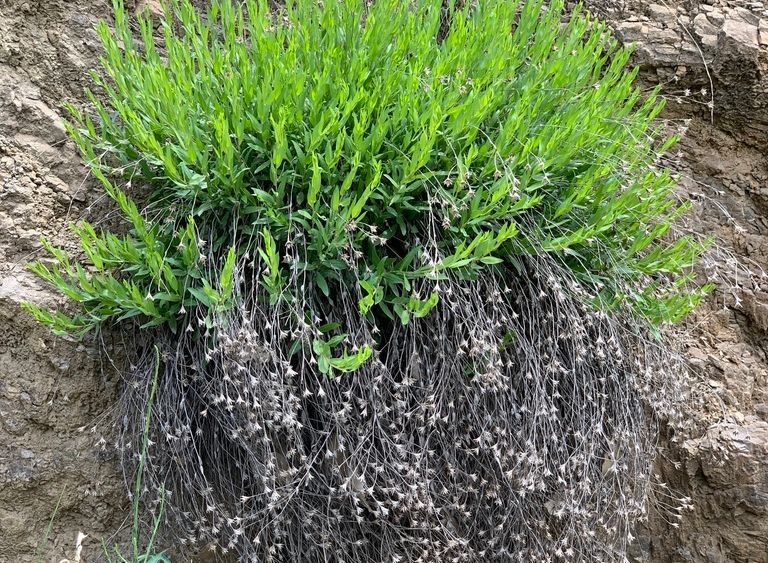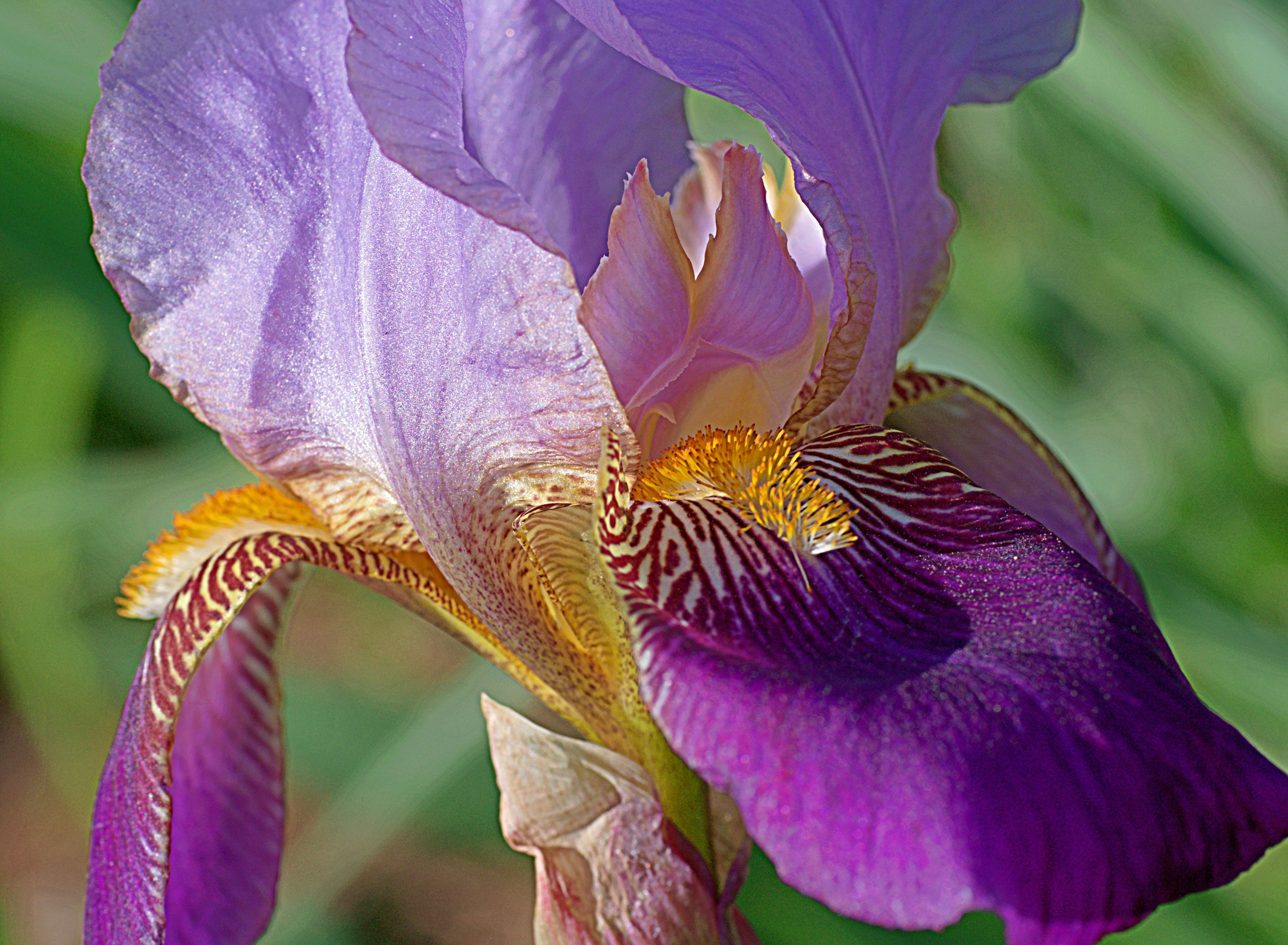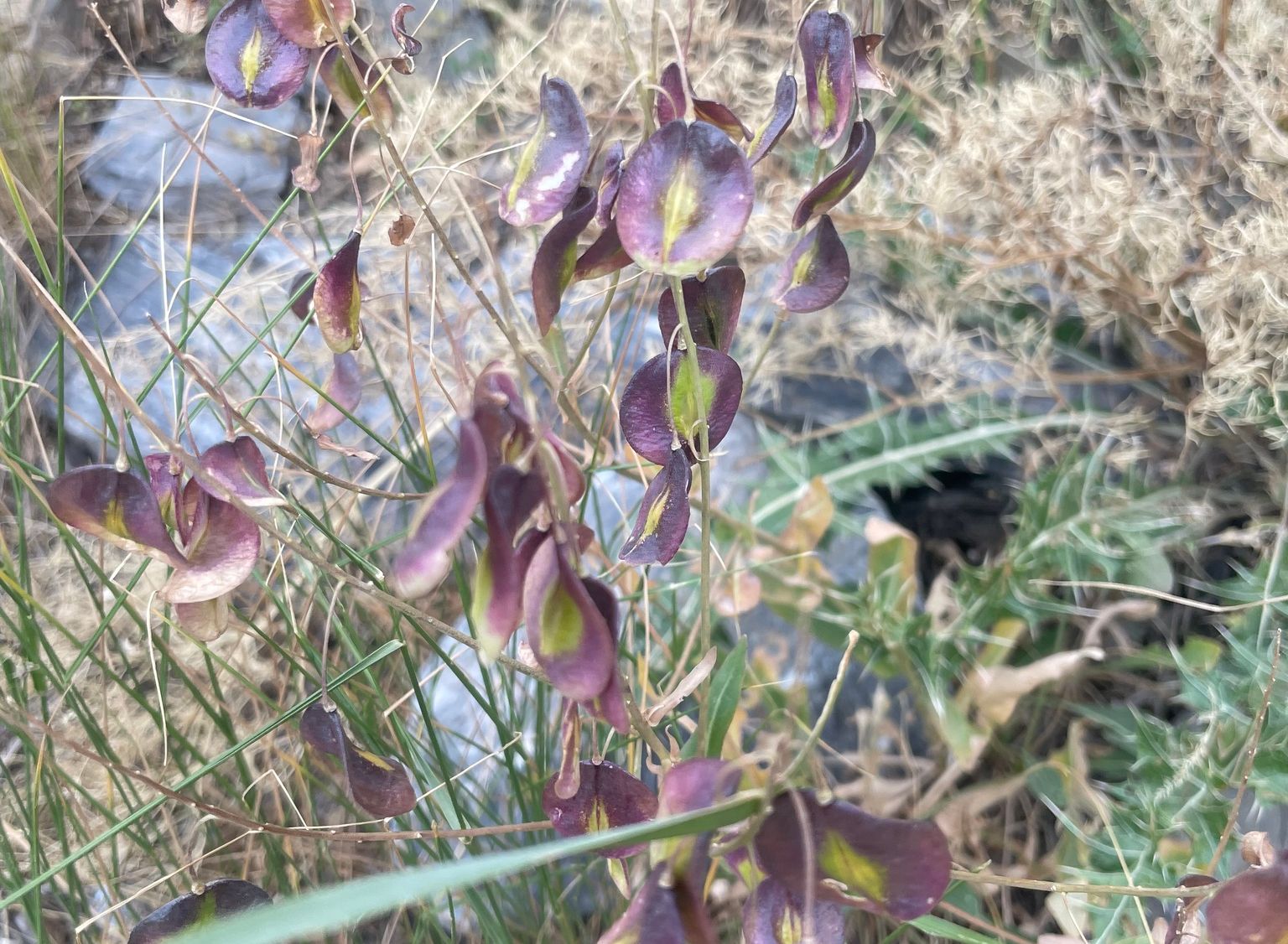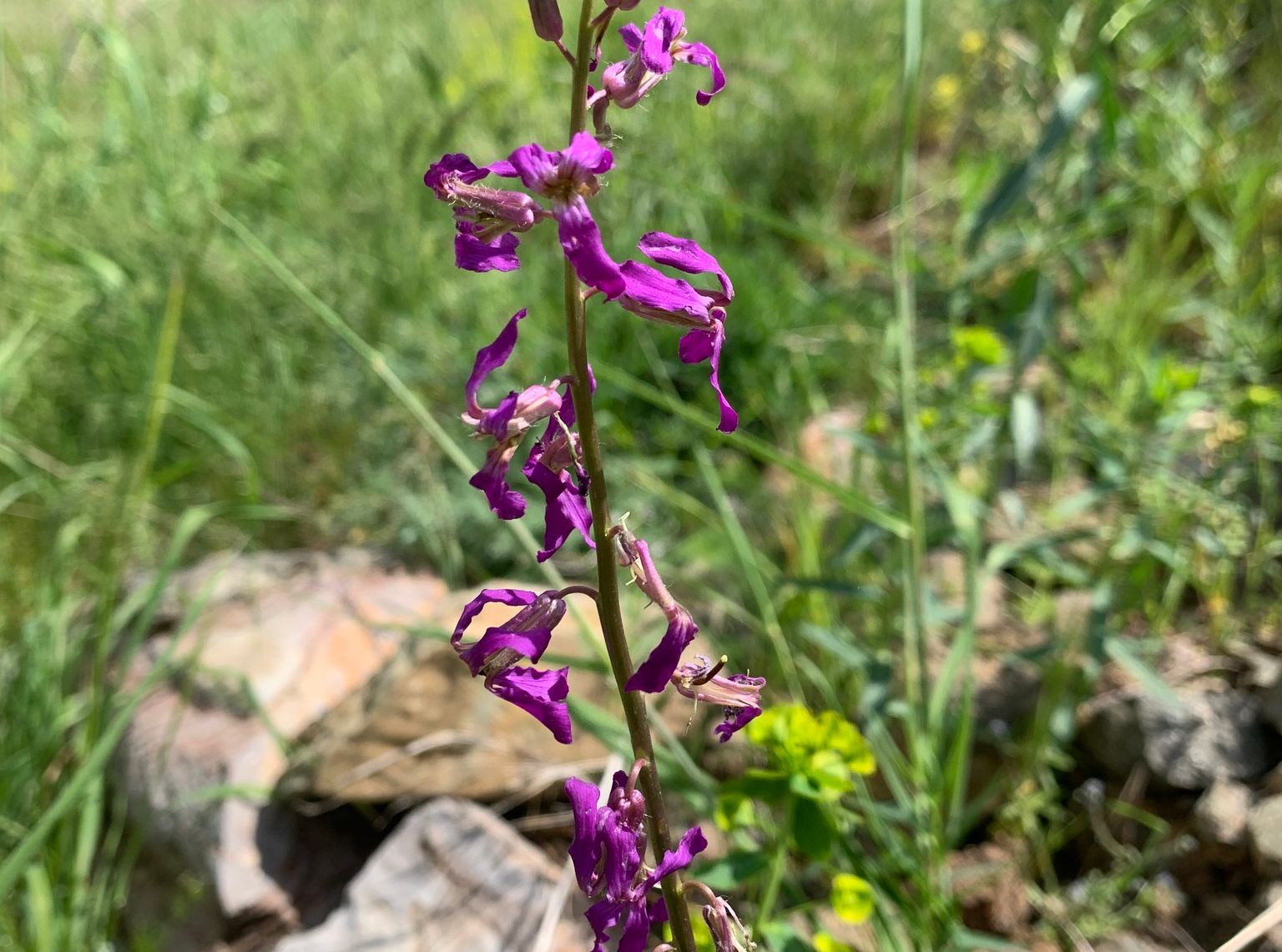
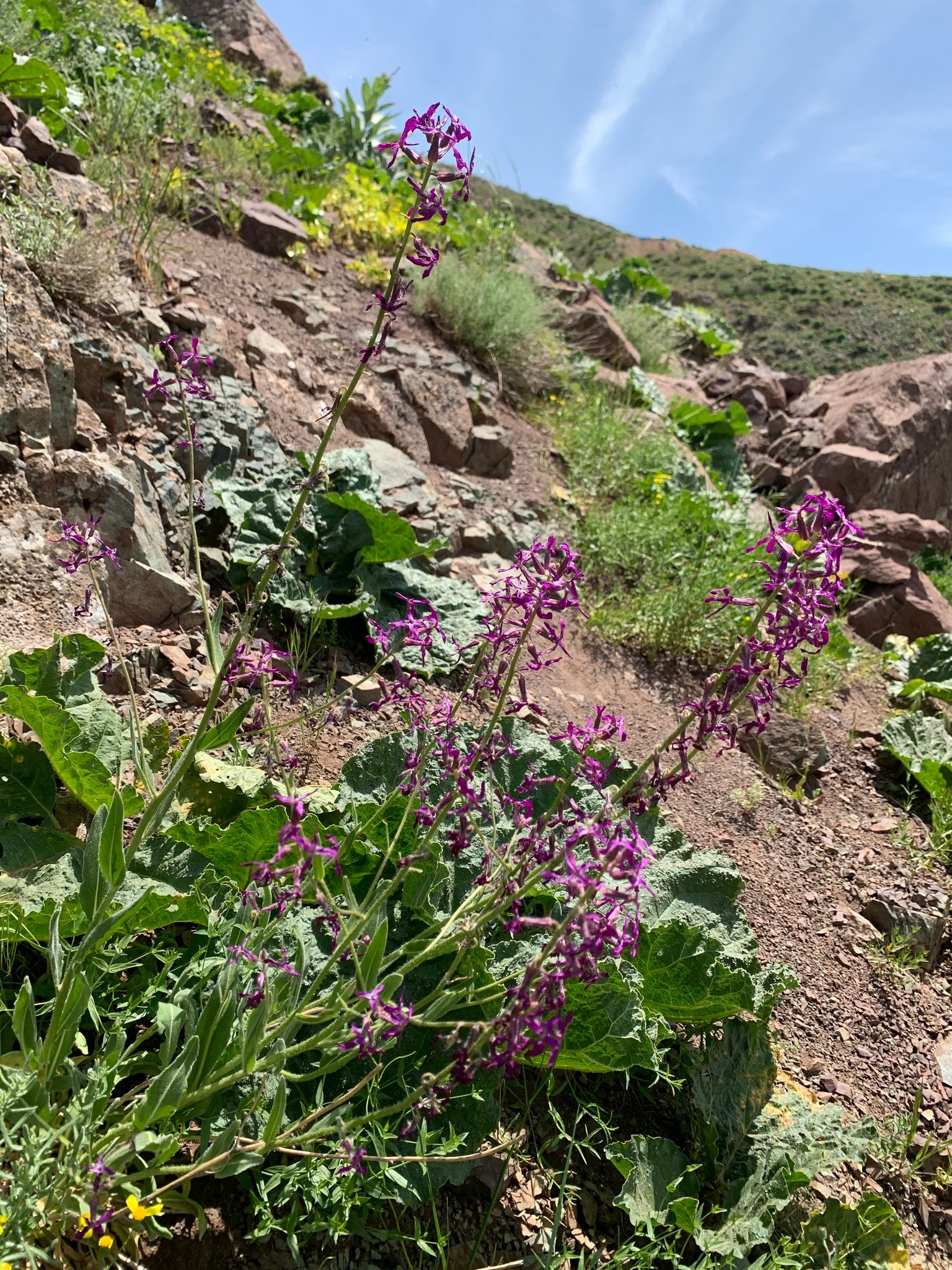
Hesperis kurdica is a perennial of the high mountains of Kurdistan, a member of the cabbage family (Brassicaceae) with spikes of deep violet flowers in May and June[1][2]. It was described in 1964 from the slopes of Helgurd in South Kurdistan (Başûr), where it grows above 2,000 m on ground that lies under snow all winter[1]. Its seed pods are long, thin and hang down like strings, up to 9 cm long[1].
How it got its name
- Named by
- F.Dvořák & Hadač, 1964Published in Preslia 36: 307
Found on Helgurd, June 1960
In 1960 and 1961 the botanist Emil Hadač (1914–2003)[3] was in Iraq collecting plants. Most of his excursions were made with A. D. Q. Agnew and Richard Wheeler-Haines, some also with the assistants Waleed al-Hashimi and Faisal abd'el Kader, and his specimens went to the National Museum in Prague[4].
In early June 1960 he was high on Helgurd, at a place his labels call Sarcal, at the foot of the mountain, about 2,200 m up[1]. Over a few days, between 4 and 7 June, he collected a violet-flowered Hesperis there several times: beside a stream and among the stands of a wild rhubarb, Rheum ribes[1]. He also noted the company the plant kept. On Helgurd it was frequent among the rhubarb, with tulips, the umbellifer Prangos ferulacea and the grape hyacinth Bellevalia kurdistanica, another plant named after Kurdistan[1]. A year later, on 6 and 7 June 1961, he found it again with Faisal abd'el Kader in the Rewandiz (Rawanduz) district, near the village of Sakri Sakran at about 2,000 m and in the valley of Hassar-i-Sakran[1].
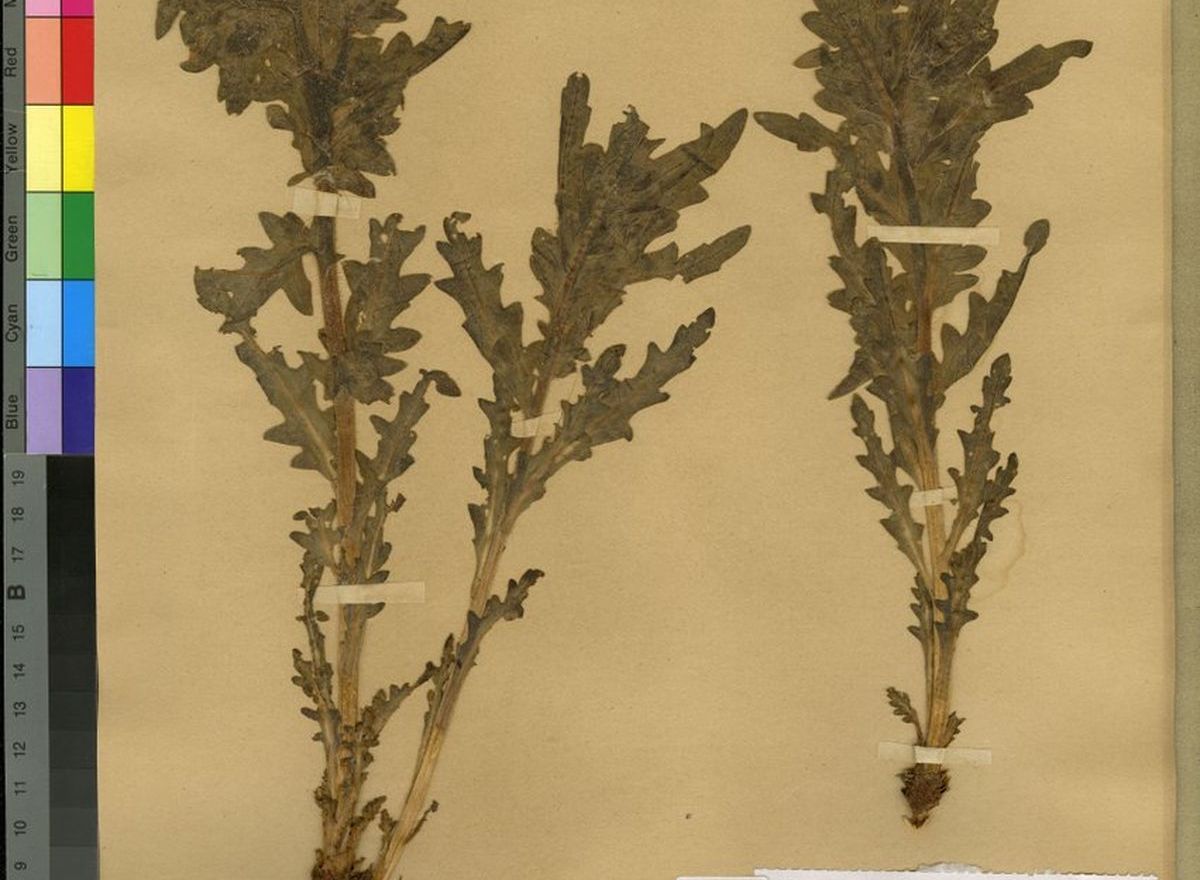
Back in Czechoslovakia he worked on the plant with František Dvořák (1921–2016)[3], who worked on the genus Hesperis at the university in Brno[1][3]. In 1964 the two named it Hesperis kurdica, "the Kurdish Hesperis", in the Czech botanical journal Preslia[1]. Hadač's gathering number 2153, kept in the herbarium of the National Museum in Prague (PR), became the holotype, the specimen the name is tied to for good[1]. Their Latin habitat note sums up the plant's home in one line:
Habitat decliviis hiemi tempore nive protectis, solo serpentinico vel basaltico parum stabili, altitudine supra 2000 m s. m.
It grows on slopes protected by snow in winter, on unstable serpentine or basaltic soil, at altitudes above 2,000 m.[1] (our translation)
A Kurdish plant collected a century earlier
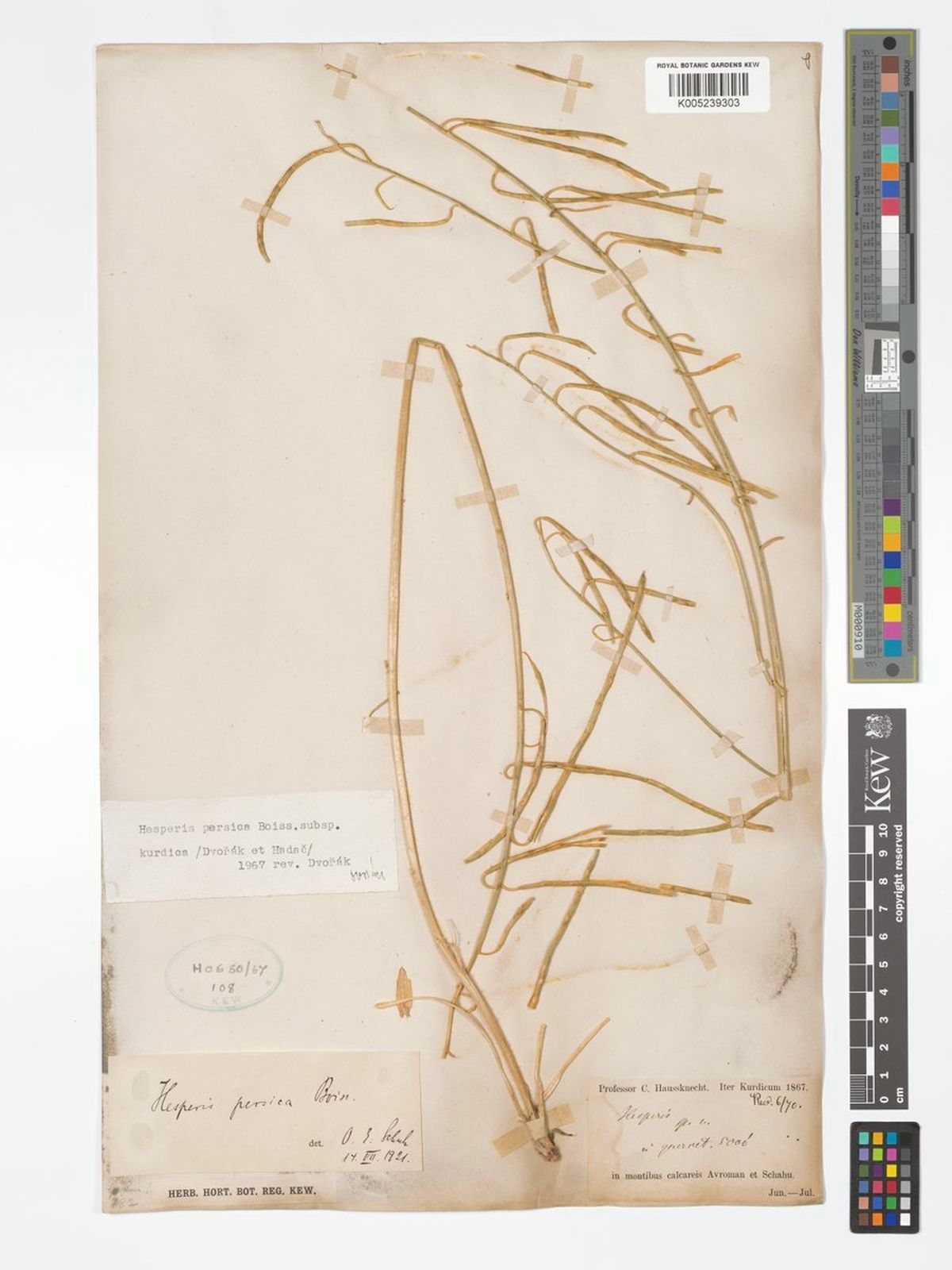
Hadač was not the first botanist to press this plant. At Kew there is a sheet with a printed label: "Professor C. Haussknecht. Iter Kurdicum 1867", "Haussknecht's Kurdish journey, 1867"[5]. Heinrich Carl Haussknecht (1838–1903)[3] gathered it "in the limestone mountains of Avroman and Schahu", that is, Şaho in East Kurdistan (Rojhilat) and Hewraman, on the line between Rojhilat and Başûr, in June or July[5]. Handwritten on the label is a note that seems to read "Hesperis sp. n.": a new species[5]. If we read it right, he suspected as much almost a hundred years before anyone published it.
The sheet then had a long wait. In 1921 the botanist O. E. Schulz filed it under the already known Hesperis persica[5]. Only in 1967 did Dvořák go through it and add a typed slip giving it the Kurdish name, as Hesperis persica subsp. kurdica[5].
Species or subspecies?
That slip shows Dvořák changing his mind. In 1968 he named a variety of the Kurdish plant, var. unguiculata[3]. By 1972 he treated it not as a species of its own but as a subspecies of Hesperis persica, as H. persica subsp. kurdica[3].
Recent works go further. Duran (2016) and the Flora of Iran (Assadi et al. 2017) sink the Kurdish plant into H. persica altogether, and a 2018 study of its seeds and pollen agreed with them[6]. Kew's checklist, on the other hand, accepts Hesperis kurdica as a species[2]. In 1964 Dvořák and Hadač separated it from H. persica by three features: violet petals, seed pods that are hairless even when young, and hairs that never carry glands[1].
What to look for
Dvořák and Hadač's Latin description[1]:
- a perennial with a taproot, its base wrapped in the withered remains of earlier years' leaves;
- an upright, unbranched stem, sparsely covered, like the leaves, with long simple hairs without glands;
- basal leaves lyre-shaped or oblong, about 15 cm long including a stalk of up to 11 cm, toothed at the edges; the stem leaves stalkless, the middle ones up to 8 × 2.5 cm, the upper ones narrow and pointed, up to 5 cm long;
- branched flower spikes of intensely violet flowers, with a violet calyx 7–11 mm long and violet petals with a long claw and an oblong blade 9–12 mm long;
- short flower stalks that thicken and curve downwards as the fruit ripens, so the pods hang;
- hanging pods 5–9 cm long and only 2–3 mm wide, hairless, with thick walls that do not split open easily;
- dark seeds 2–3 mm long[1]. An Iranian study measured them at 2–2.8 mm, brown, with a wavy surface[6].
Where it grows
Kew gives its native range as Turkey to Iran, recorded from Iran, Iraq and Turkey[2]. In Kurdish terms the records we have seen are almost all from Başûr and Rojhilat:
- Başûr: Helgurd and the Rewandiz district, the type area[1]; Mount Marmarut near Rewandiz, collected by E. R. Guest in April 1932; Jabal Rus near Zaxo (Zakho), May 1932; Hacî Omeran (Haji Omran), 1951; the Mawelian Dagh east of Rewandiz at 1,150 m, 1959; and Hewraman above Darimar[5]. People photographed it in flower around Çoman in May 2022 and 2023[7].
- Rojhilat: Haussknecht's Şaho and Hewraman, 1867[5]; near Sine (Sanandaj), 1962[5]; the Qotur valley west of Xoy (Khoy), towards the border with Bakur, 1971[5]; and between Merîwan (Marivan) and Pawe (Paveh) at 2,500 m[6].
We have not seen a specimen from Bakur, although Kew counts it for Turkey[2]. Under the broader name H. persica subsp. kurdica, Iranian herbaria also file plants from far beyond Kurdistan, from Fars in the south to the Alborz mountains of Mazandaran and Tehran[6]. How far the plant really reaches depends on where botanists draw its limits.
Its place is high, open ground: slopes that keep their snow into spring, on loose serpentine or basalt, above 2,000 m, flowering in May and June[1]. The other records come from a little lower, down to about 1,150 m[5].
Its names in Kurdish
The plant-name list Flora Kurdistanê, compiled by Edîb Polat for the Kurmancî working group of the Kurdish Institute of Paris (2006) and continued by Ehmedê Dirihî (2007), gives two names for Hesperis kurdica: qaçmûk and şewbor[8][9]. Beside the names it even prints a botanical drawing of the plant[8][9]. Its other columns translate them as "acem menekşesi" (Turkish), "variété de julienne" (French, "a kind of dame's violet") and "common dame's violet" (English)[8].
Ehmedê Dirihî's dictionary of Kurdish plant names (2013) sorts them differently. It gives a dictionary name whose wording mirrors the Latin, şewboya kurdan, for Hesperis persica subsp. kurdica[10], with no region or informant code. It puts qaçmûk together with şewboy and şewgule under the garden species Hesperis matronalis[10]. So the same names are given both to the wild Kurdish plant and to its cultivated cousin.
Sources
- 1.Dvořák, F. & Hadač, E. (1964). Hesperis kurdica Dvořák et Hadač sp. nova. Preslia 36: 307–308.
- 2.Plants of the World Online. Royal Botanic Gardens, Kew.
- abcdHesperis kurdica.
- plant_name_id 2847523. powo.science.kew.orghttps://powo.science.kew.org/taxon/urn:lsid:ipni.org:names:285047-1accessed 14 November 2026
- 3.International Plant Names Index. Royal Botanic Gardens, Kew, Harvard University Herbaria and Australian National Herbarium.
- abcdefHesperis kurdica, H. kurdica var. unguiculata (Kew Bull. 21: 459, 1968), H. persica subsp. kurdica (Scripta Fac. Sci. Nat. Univ. Purkyn. Brun., Biol. 1(10): 239, 1972); author records for Dvořák, Hadač and Haussknecht.
- urn:lsid:ipni.org:names:285047-1. ipni.orghttps://www.ipni.org/n/285047-1accessed 14 November 2026
- 4.↩Hadač, E. & Chrtek, J. (2002). A contribution to the Ranunculaceae of Iraq. Časopis Národního muzea, Řada přírodovědná 171(1–4).
- 5.Royal Botanic Gardens, Kew – Herbarium Specimens. via GBIF. gbif.orghttps://www.gbif.org/dataset/cd6e21c8-9e8a-493a-8a76-fbf7862069e5
- 6.Eslami Farouji, A., Khodayari, H. & Assadi, M. (2018). Taxonomic significance of pollen and seed micromorphology in the genus Hesperis L. (Brassicaceae). Iranian Journal of Botany 24(2): 91–104. doi:10.22092/ijb.2018.121073.1198https://doi.org/10.22092/ijb.2018.121073.1198
- 7.↩iNaturalist. observations 127817533 (16 May 2022), 162009013 (12 May 2023) and 184227135 (7 May 2023), all near Çoman. inaturalist.orghttps://www.inaturalist.org/
- 8.abcEdîb Polat (2006). Flora Kurdistanê (I). institutkurde.orghttps://www.institutkurde.org/publications/kurmanci/
- 9.abEhmedê Dirihî (2007). Flora Kurdistanê (II). institutkurde.orghttps://www.institutkurde.org/publications/kurmanci/
- 10.abAhmet Kasımoğlu (Ehmedê Dirihî) (2013). Ferhenga Navên Nebatan a Kurdî (Dictionary of Kurdish Plant Names). Mardin Artuklu University, Institute of Living Languages in Turkey (ISBN 978-605-4202-12-6), pp. 745, 1112.
Last updated 20 November 2026