Onosma kurdica is a low, silvery, tufted perennial of the borage family (Boraginaceae) with heads of long, tubular flowers that open white and fade to pink[1]. It is known only from East Kurdistan (Rojhilat), from rocky mountains around Bîcar (Bijar), north-east of Sine (Sanandaj)[1][2][3]. Only two wild gatherings are known, made in 1966 and 1971 and both published by Teppner in 1980[1], and recent botanists call it "a restricted endemic species"[2].
How it got its name
- Named by
- Teppner, 1980Published in Phyton (Horn) 20: 141
Two gatherings near Bîcar
The first known plant was found on 22 May 1966 by the plant collector J. C. Archibald, 40 km west of Bîcar, at about 2,000 m. The label, as Teppner quotes it, gives a precise picture of the spot: "clay filled ledges between slabs of volcanic rock"[1]. That specimen went to the herbarium of the Royal Botanic Garden Edinburgh[1].
Five years later, on 1 July 1971, Jenifer Lamond[4], a companion named Terme and the botanist Karl Heinz Rechinger (1906–1998)[4] collected it on Hamzeh Arab, a mountain south-east of Bîcar, between 2,200 and 2,600 m[1]. Their specimen, Rechinger's number 42621, is now the holotype, the sheet to which the name is tied for good, in the Natural History Museum in Vienna (W)[1].
Fruits from that gathering travelled on as well.
A Kurdish plant in an Austrian garden
The nutlets from Hamzeh Arab were sown in the botanical garden of the University of Graz in Austria, where the plants grew under culture number BOR 274[5][6][7]. The botanist Herwig Teppner (born 1941)[4], who was working through a difficult group of Onosma species, studied them there: his colour photographs of it and his chromosome counts, made from root tips, came from the Graz plants[1]. In his paper he thanked Rechinger for plant material and Werner Häfeli for looking after the cultures, and asked collectors to keep sending him Onosma fruits[1].
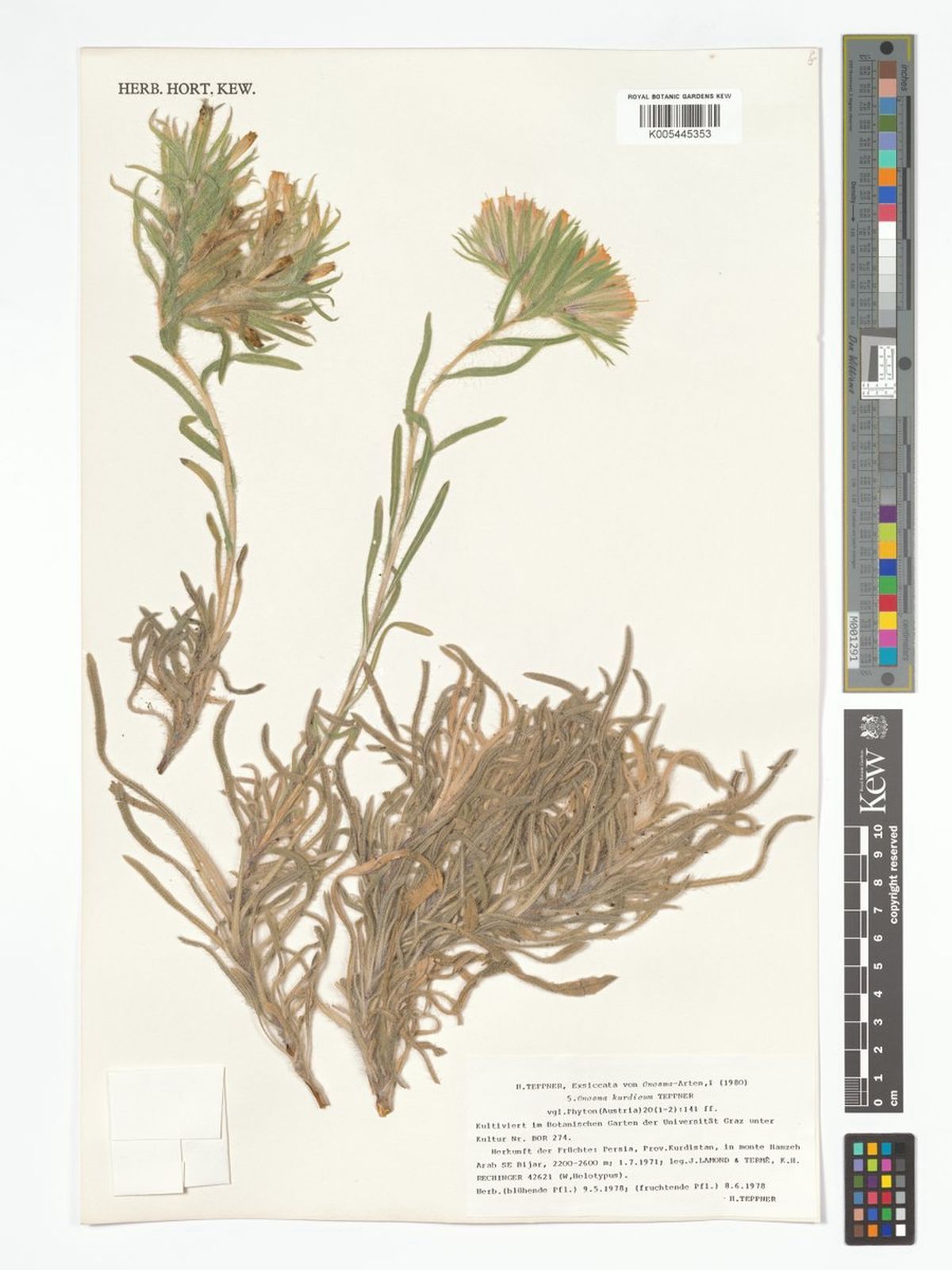
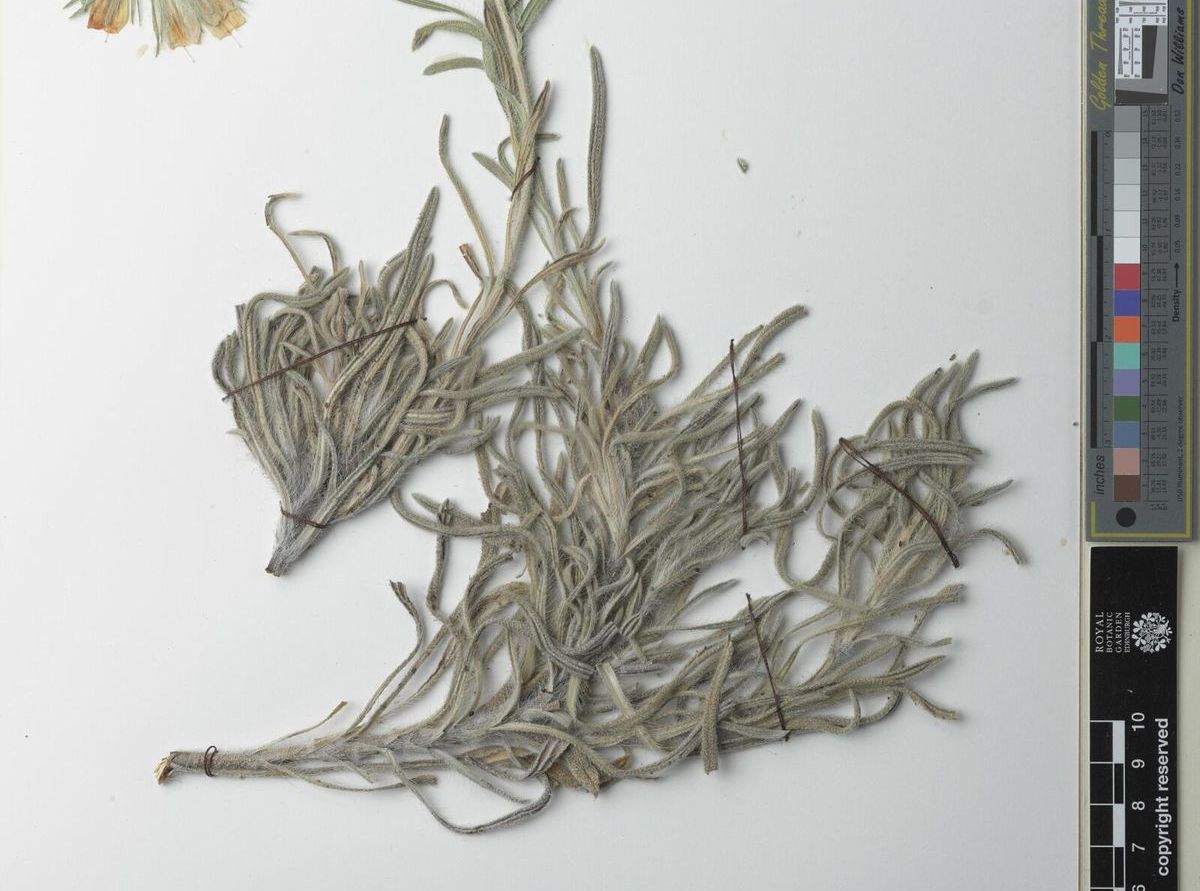
Most of his cultures, he wrote, had yielded enough herbarium material to issue as exsiccata[1]. In 1978 he pressed the garden plants twice, in flower on 9 May and in fruit on 8 June, and sent sheets out to other herbaria as number 5 of his series Exsiccata von Onosma-Arten ("dried specimens of Onosma species")[5][6][7]. Copies are kept in Graz, at Kew and in Edinburgh, each with the same typed label tracing the seed back to Hamzeh Arab[5][6][7]. Most of what can be seen of this plant today, including the photo at the top of this page, comes from that one batch of seed grown in Austria.
Teppner published the species in February 1980, in a study of the Onosma alboroseum group in the journal Phyton, as Onosma kurdicum[1]. Two of the paper's colour figures show it, both from the Graz culture BOR 274[1]. The name databases now spell it Onosma kurdica[3][4]. The epithet means "Kurdish". Teppner did not explain his choice, but both gatherings he knew came from what his paper calls "Persisch-Kurdistan", Persian Kurdistan, around Sine[1].
Its closest relatives
Onosma is a large genus of about 230 to 240 species, mostly of dry habitats, with its main centres of diversity in Iran and Turkey[2][8]; a recent review counts 32 species in South Kurdistan (Başûr) alone[8]. Teppner placed O. kurdica in a small group of six species around O. alboroseum, closest to O. sorgeri and O. rascheyanum[1].
What sets it apart from those two is above all its calyx: its long sepals are as long as the tubular corolla, and its flowers are packed in dense heads[1]. In its general look it is more like O. sorgeri, Teppner wrote, "but very striking because of the sepals as long as the corollas"[1] (our translation). In O. rascheyanum, by his measurements, the sepals are only 12 to 18 mm long in flower, against 20 to 25 mm in O. kurdica[1].
O. rascheyanum was described from the Anti-Lebanon, but it reaches the mountains of Kurdistan too. Teppner's list of its sheets runs from Lebanon to Helgurd (1893 and 1957), the mountains of Hewraman and Şaho (1867), Wan and the hills around Sine. One of those sheets was collected by Archibald on 24 May 1966, 3 km north of Zarineh: two days after his find of O. kurdica[1].
In 2022 a team describing four new Onosma species from Iran compared two of them, O. madjnoniani and O. riahii, with O. kurdica and separated them mainly by their leaves[2].
What to look for
From Teppner's description[1]:
- a perennial, lying along the ground, much branched and woody in its older parts, with sterile leaf rosettes between the flowering stems; new rosettes keep forming in the leaf axils, which gives all the plants of this group their dense, cushion-like growth[1];
- rosette leaves very narrow, 1.5 to 11 cm long but only 1 to 6 mm wide, densely covered with star-shaped hairs that make the plant look silvery, with long bristles, up to 4 to 5 mm, standing out along the edges;
- flowering stems upright or lying on the ground, the flowering part about 10 to 20 cm long, up to 25 cm in fruit, with one or two coiled flower clusters that stay almost head-like;
- sepals lance-shaped, 20 to 25 mm long in flower and growing to 28 to 34 mm in fruit;
- a tubular corolla 23 to 26 mm long, yellowish in bud, white when open, and flushed pink over the front 5 to 7 mm as it fades and dries;
- smooth, shiny nutlets 4.8 to 6.5 mm long and 3.1 to 3.5 mm wide, roughly triangular in cross-section.
The pressed sheets show the colour change well: the oldest flowers in each head have turned a warm pink at the tips[5][6].
Four sets of chromosomes
Teppner counted the chromosomes of the Graz plants and found O. kurdica to be tetraploid: it carries four sets of chromosomes instead of the usual two[1]. The counts were untidy, though. They varied by about two either way from cell to cell, and meiosis, the cell division that makes pollen and egg cells, looked "somewhat disturbed", so he asked for further study. An earlier count of 2n = 30 for this plant, he noted, had been published in 1974 under the name O. rascheyanum, before he had split O. kurdica off as a species of its own[1].
Where it grows
Everything known places O. kurdica in Rojhilat, in the mountains of Bîcar (Bijar) county in Kurdistan province[1][2]:
- Hamzeh Arab, south-east of Bîcar, 2,200 to 2,600 m: the type locality (1971)[1];
- 40 km west of Bîcar, about 2,000 m, on clay-filled ledges between slabs of volcanic rock (1966)[1].
Kew's checklist records its native range simply as Iran[3]. The 2022 study cites only the type gathering[2], none of the sources checked for this page reports a later wild find, and there are no photographs of wild plants on iNaturalist or GBIF. Anyone who walks the hills around Bîcar between late May and early July, when both wild gatherings were made, and finds a silvery tuft with white-and-pink flower heads may be looking at one of the least-known plants named after the Kurds.
Kurdish names
No Kurdish name has been recorded for Onosma kurdica itself. For the genus, Ehmedê Dirihî's dictionary of Kurdish plant names lists several names (genus names, to be checked)[9]:
- giyaşîrînî and mijmije[9];
- mismisik and mismiseka zurayin[9];
- taro sincik from Dêrsim[9] and zingilzava from Çinar[9].
Its relative O. alboroseum, after which Teppner named the whole group, has the local names Mıjmıjok around Çermik near Amed (Diyarbakır)[10] and Mısmısık around Arıcak near Xarpêt (Elazığ)[11], both in North Kurdistan (Bakur), spelled as the two studies print them.
Sources
- 1.Teppner, H. (1980). Die Onosma alboroseum-Gruppe (Boraginaceae). Phyton (Horn) 20(1–2): 135–157.
- abcw
- deuyp. 143.
- fgmxp. 142.
- hpp. 137, 141.
- ip. 136.
- jp. 137.
- kpp. 135, 141.
- lp. 141 and plates.
- nospp. 141–142.
- pp. 155.
- qpp. 142–143.
- rvpp. 143–144.
- tpp. 137, 142.
- p. 142. zobodat.athttps://www.zobodat.at/pdf/PHY_20_1_2_0135-0157.pdfaccessed 14 November 2026
- p. 143. zobodat.athttps://www.zobodat.at/pdf/PHY_20_1_2_0135-0157.pdfaccessed 14 November 2026
- pp. 142–143. zobodat.athttps://www.zobodat.at/pdf/PHY_20_1_2_0135-0157.pdfaccessed 14 November 2026
- pp. 136–137.
- p. 141.
- 2.abcdefMehrabian, A. R., Mozaffarian, V. & Naghizadeh, S. (2022). Four new species of Onosma (Boraginaceae) from Iran as an important diversity centre of the genus in the world. Collectanea Botanica 41: e003. doi:10.3989/collectbot.2022.v41.003https://doi.org/10.3989/collectbot.2022.v41.003
- 3.Plants of the World Online. Royal Botanic Gardens, Kew.
- abcOnosma kurdica Teppner.
- plant_name_id 2392669. powo.science.kew.orghttps://powo.science.kew.org/taxon/urn:lsid:ipni.org:names:119702-1accessed 14 November 2026
- 4.International Plant Names Index. Royal Botanic Gardens, Kew, Harvard University Herbaria and Australian National Herbarium.
- abcdOnosma kurdica Teppner, and author records for Teppner, Rechinger and Lamond.
- urn:lsid:ipni.org:names:119702-1. ipni.orghttps://www.ipni.org/n/119702-1accessed 14 November 2026
- 5.abcdRoyal Botanic Garden Edinburgh Herbarium (E), specimen catalogue (via data.rbge.org.uk and GBIF). herbarium specimen E00936522 (H. Teppner, Exsiccata von Onosma-Arten I, no. 5), via GBIF. data.rbge.org.ukhttps://data.rbge.org.uk/herb/
- 6.abcdRoyal Botanic Gardens, Kew – Herbarium Specimens. via GBIF, herbarium specimen K005445353 (same series), via GBIF. gbif.orghttps://www.gbif.org/dataset/cd6e21c8-9e8a-493a-8a76-fbf7862069e5
- 7.abcHerbarium of the University of Graz, specimen GZU 000272982 (same series), via GBIF.
- 8.abJabbar, A. A., Abdullah, F. O., Hassan, A. O. et al. (2022). Ethnobotanical, phytochemistry, and pharmacological activity of Onosma (Boraginaceae): an updated review. Molecules 27(24): 8687. doi:10.3390/molecules27248687https://doi.org/10.3390/molecules27248687
- 9.Ahmet Kasımoğlu (Ehmedê Dirihî) (2013). Ferhenga Navên Nebatan a Kurdî (Dictionary of Kurdish Plant Names). Mardin Artuklu University, Institute of Living Languages in Turkey (ISBN 978-605-4202-12-6).
- 10.↩İsa Çiçek (2019). Çermik ilçesi ve köylerinin (Diyarbakır) etnobotanik özellikleri. tez.yok.gov.trhttps://tez.yok.gov.tr/UlusalTezMerkezi/
- 11.↩Şükrü Olgun (2019). Arıcak (Elazığ) ilçesinin etnobotanik özellikleri. tez.yok.gov.trhttps://tez.yok.gov.tr/UlusalTezMerkezi/
Last updated 20 November 2026