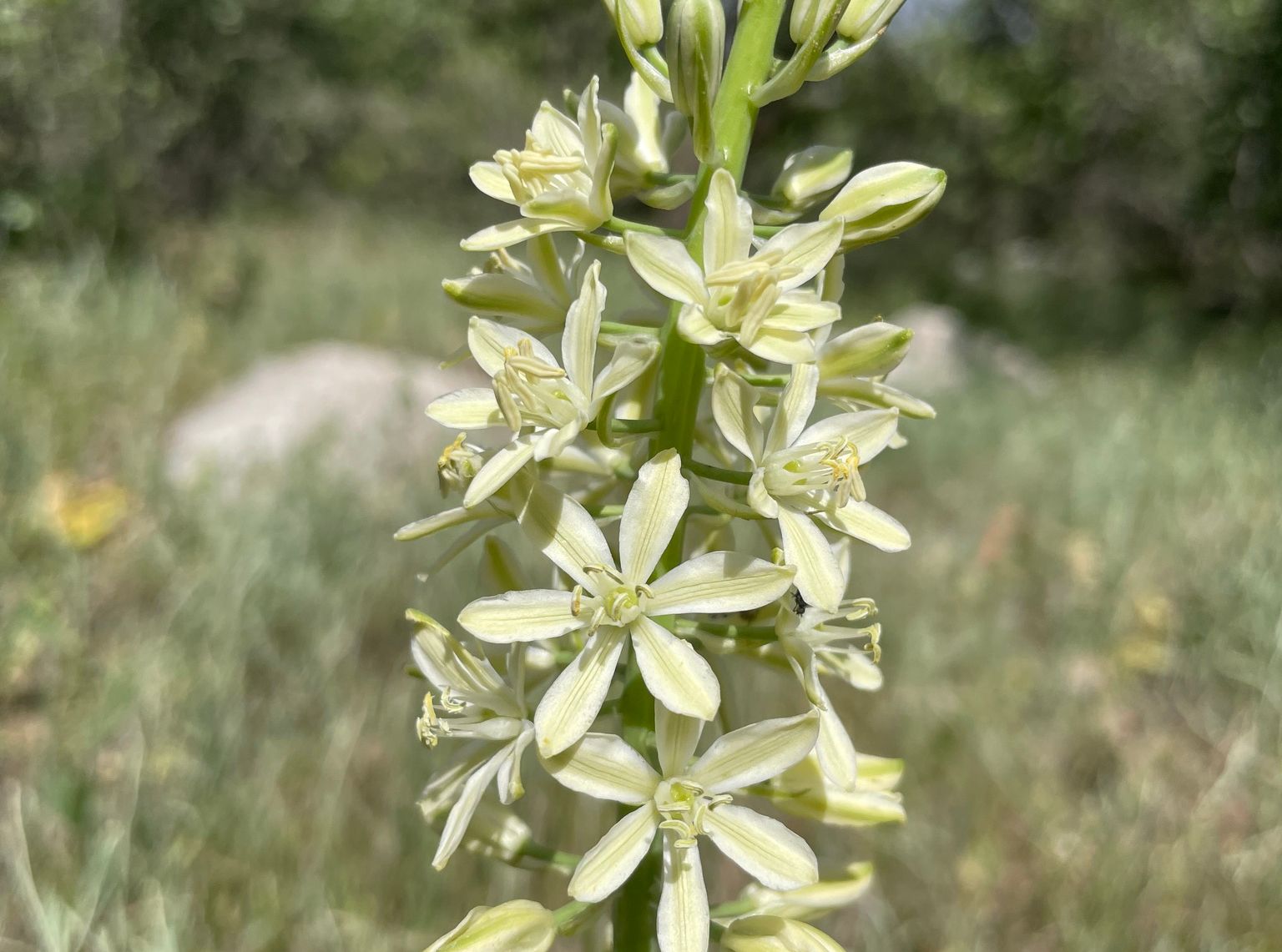
Ornithogalum kurdicum is a star-of-Bethlehem[1] on a grand scale: a bulb plant with leaves up to 5.5 cm wide and a spike of milk-white, star-shaped flowers that can stand almost two feet tall[2]. It grows in the hills and mountains of South Kurdistan (Başûr), and in 2023 it was also reported from East Kurdistan (Rojhilat)[3][4]. It was first found on Sefîn, the mountain above Şeqlawe (Shaqlawa) in the Hewlêr (Erbil) region, in May 1893[2][5].
How it got its name
- Named by
- Bornm., 1908Published in Repert. Spec. Nov. Regni Veg. 5: 135
Three "most elegant" specimens
In the spring of 1893 the botanist Joseph Bornmüller (1862–1948)[6] was well into a journey of almost two years through Persia and its neighbouring lands[7]. From Baghdad he travelled north to Kerkûk (Kirkuk) and Hewlêr, and at the beginning of May he turned east "into the Kurdish mountains". He made his base in the small village of Şeqlawe, which he found "extremely well placed on the eastern slope of the Kuh-i-Sefin", whose rocky slopes and ravines held "a surprisingly rich and interesting flora of the rarest types"[7] (our translation).
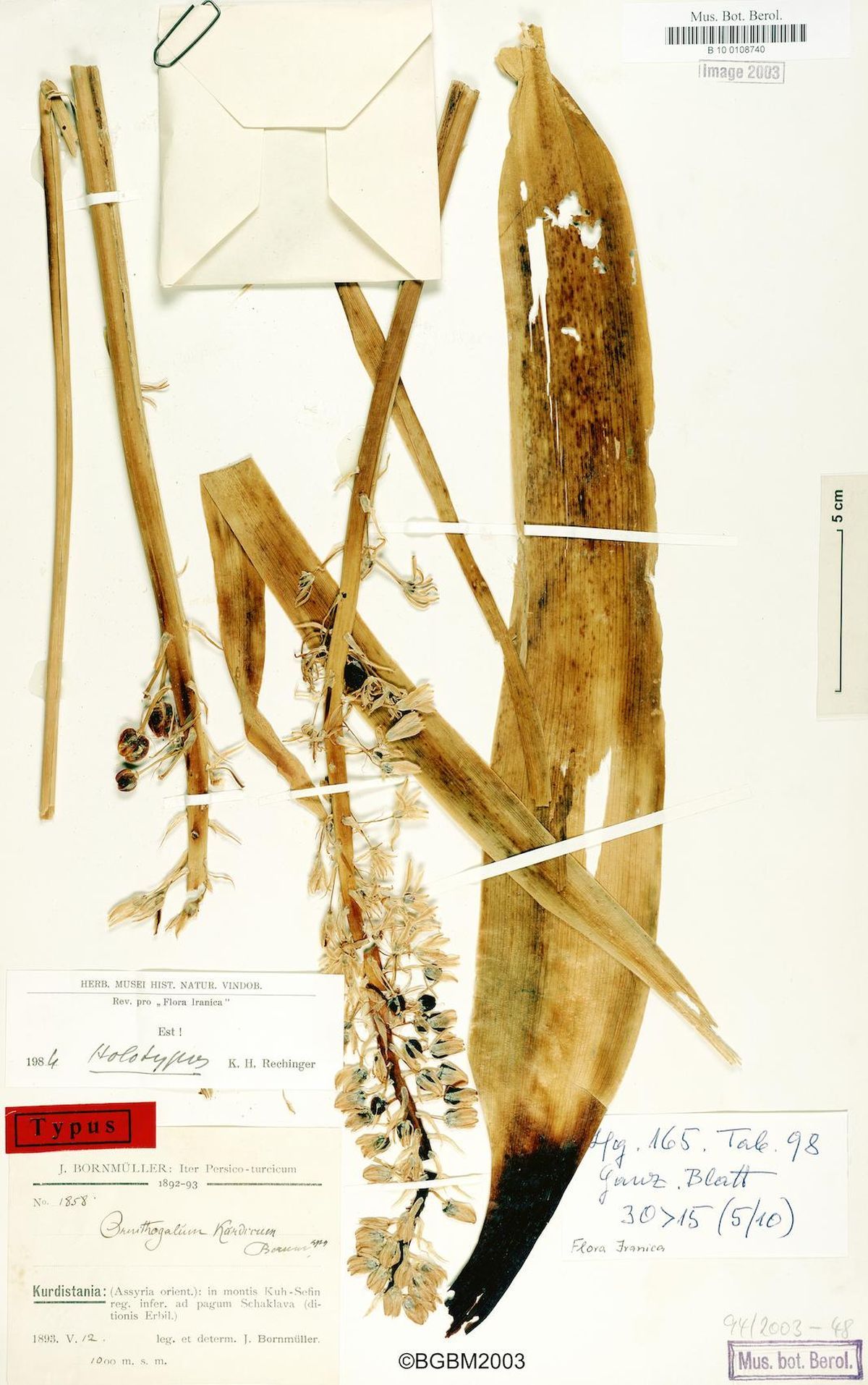
On 12 May 1893, at about 1,000 m on the mountain above the village, he found a large star-of-Bethlehem with very broad leaves[2][5]. He kept three plants, his number 1858[5], in his own herbarium[2]. Fifteen years later, in 1908, he described them as a new species and named it after the land where he had found it: Ornithogalum kurdicum, in Latin "the Kurdish star-of-Bethlehem". The title of his short paper calls the place "the flora of Assyrian Kurdistan"[2], the label of the specimens simply begins Kurdistania[5].
His Latin note on the find is unusually warm for a botanical description:
Kurdistania (Assyria orientalis): Montis Kuh Sefin in regione media supra pagum Schaklava, 1000 m s. m. (12. V. 1893 detexi). Specimina tria elegantissima in herbario meo asservantur.
Kurdistan (eastern Assyria): in the middle zone of Mount Sefîn above the village of Şeqlawe, 1,000 m above sea level (discovered 12 May 1893). Three most elegant specimens are kept in my herbarium.[2] (our translation)
He called it "a very remarkable new species"[2]. He placed it next to Ornithogalum arcuatum, from which it differed sharply in its dense spike, short flower stalks (about 1 cm), and much broader petals with a wide yellowish stripe. He then mentioned two other broad-leaved species that were still undescribed, one from Mesopotamia and one from western Persia, and ended with a line that shows how impressed he was. Next to O. kurdicum and these two, he wrote, O. pyrenaicum and the many forms of O. narbonense "are all most insignificant plants"[2] (our translation).
More than a century later, Azad Rastegar and colleagues drew the same line in two features: O. kurdicum has shorter flower stalks than O. arcuatum (10 to 15 mm against 15 to 30 mm), and its petals are broadest towards the tip rather than narrowly elliptic-oblong[4].
The specimen that carries the name
Today his plants are in the herbarium of the Botanic Garden and Botanical Museum Berlin. Two sheets there carry his printed label for number 1858: one holds a whole plant, with leaves, flowering and fruiting spikes, the other only a few leaves[5]. In 1984 the botanist Karl Heinz Rechinger (1906–1998)[6], working on the Flora Iranica, looked at the first sheet and marked it "Holotypus"[5]. He illustrated it in the Flora Iranica in 1990 as plate 98[8][9]. Because the original material is on two sheets, botanists now count Rechinger's choice as a lectotype: the one specimen to which the name Ornithogalum kurdicum is permanently tied[8].
How to recognise it
Bornmüller's description gives a clear picture of the plant[2]:
- a rather large, egg-shaped bulb;
- 5 to 7 leaves, broadly strap-shaped and smooth; the two outer leaves are much the widest, up to 5.5 cm across and 20 to 40 cm long, the inner ones only 1 to 2 cm wide;
- a stout flowering stem, taller than the leaves, which with its spike reaches almost two feet;
- a long spike, 12 to 30 cm, loose below and densely packed, overlapping like tiles, towards the top;
- short flower stalks of almost equal length, lengthening to 1.5–2 cm in fruit, each with a thin, papery bract drawn out into a fine point, the uppermost bracts longer than the flowers;
- milk-white flowers with a broad yellow stripe on the back of each petal; the petals narrow, blunt, 10 to 11 mm long and 3 to 4 mm wide;
- a three-furrowed, egg-shaped capsule.
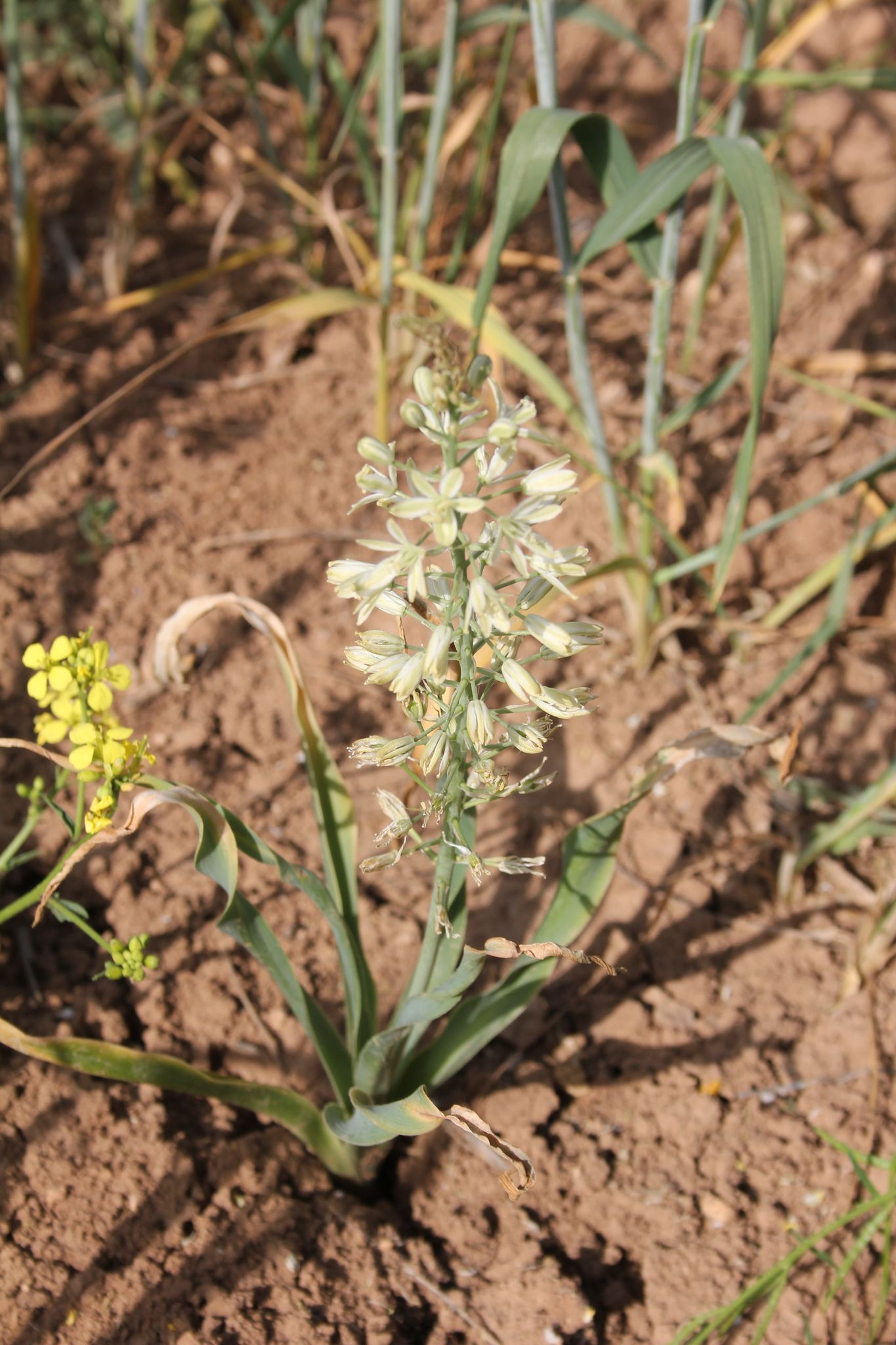
The plants that later collectors found were not always as tall as Bornmüller's. In the photographs from Qeredax and from a field near Simele the flowers are greenish-white with a pale green to yellowish band on the back[10]. Jan Gillett, who collected it on Qeredax in 1947, wrote "white with green stripe" on his label[11].
Collected again, under other names
For decades after 1908 the plant was found again and again in Başûr, but not recognised. The herbarium sheets at Kew and Edinburgh show how[11][12]:
- On 21 April 1932, Evan Guest (1902–1992)[6] collected it "in cornfields" near Dihok (Duhok) at 1,500 feet. He labelled it as a form of Ornithogalum narbonense[11], one of the very plants Bornmüller had called insignificant next to it[2].
- In the spring of 1947 the botanist Ali Al-Rawi[6] collected it twice: at Xurmal (Khurmal), at 800 m in April, and at Bekhair at 1,400 m on 8 May. The second time he wrote Urginea on the label, the name of a quite different bulb genus[11].
- On 22 April 1947 Jan Bevington Gillett (1911–1995)[6] gathered it on Qeredax (Qara Dagh) at 900 m. His label records its Kurdish name (see below)[11].
- On 11 May 1956 Richard Wheeler Haines (1906–1994)[6] found it at Şeqlawe again, back where Bornmüller had first seen it, "frequent in stony waste between vine fields" at 3,500 feet. In June 1959 he found it on Qeredax at 4,500 feet, "occasional in rich oak scrub"[11][12].
All these sheets were named Ornithogalum kurdicum later, in 1966 and 1972, by the botanist Per Wendelbo (1927–1981)[6]. For Gillett's plant from Qeredax he wrote "cfr. kurdicum", that is, "compare kurdicum": probably this species, but not certain[11]. In 1984 Rechinger, preparing the Flora Iranica, saw Haines's Qeredax sheet and confirmed the name[12].
Where it grows
Kew's checklist gives its native range as "N. Iraq to NW. Iran"[3]. In Kurdish terms that is a plant of Başûr and Rojhilat.
- Başûr: Sefîn above Şeqlawe, the type locality[2][5], and Şeqlawe again in 1956[11][12]; Dihok[11]; Bekhair[11]; Xurmal[11]; and the Qeredax range south of Silêmanî (Sulaymaniyah)[11][12]. Photographs posted on iNaturalist since 2018 add records from around Simele, Şarbajêr (Sharbazher), Qeredax and the Mzuri Bala area, in April and May[10].
- Rojhilat: in 2023 Azad Rastegar, Hosein Maroofi and Hiva Ghaderi reported it from Iran for the first time, in a paper on stars-of-Bethlehem from Kurdistan province that also described a new species named after Merîwan (Marivan), O. marivanense[4]. The specimens they cite, all kept in the herbarium with the code HKS, come from three gatherings in the province: one at Qeshlaq-Pol and two at the Darbande-Dezli pass[4]. Until then, they note, it was thought to grow nowhere but in northern Iraq, following the Flora of Iraq of 1985[4].
The labels give heights from about 450 m (1,500 feet near Dihok) to 1,400 m[2][11][12], and places as different as cornfields, stony waste ground between vineyards and rich oak scrub[11][12]. Collectors found it in flower from April to late May; Haines's June plant from Qeredax was already in fruit[11][12][10].
Ornithogalum or Loncomelos?
The genus Ornithogalum has long been treated as one large genus. Some botanists now split it into several smaller ones. In 2021 Mario Martínez-Azorín and colleagues moved O. kurdicum into one of these, Loncomelos, a group of species with long, tapering leaves, as Loncomelos kurdicus[8]. Kew's checklist does not follow the split and keeps Ornithogalum kurdicum as the accepted name[3], and so does this page. Rastegar and colleagues, who keep the large genus, place the plant in its subgenus Beryllis: stars-of-Bethlehem with a cylindrical cluster of many flowers (more than 15 to 20), petals that mostly carry a brown or greenish rib on the back, and a greenish or yellowish ovary[4].
Its names in Kurdish
Edîb Polat's plant list of 2006 in the journal Kurmancî gives the Kurmanji name hes for Ornithogalum kurdicum[13].
A field record agrees. When Jan Gillett collected the plant on Qeredax in 1947, he filled in the line "Colloquial Name" on his label: HAS (K)[11]. The label form is that of the old Rustam Herbarium, whose published list marks Kurdish names with "(K.)"[14]: so HAS was noted as a Kurdish name. It is the only Kurdish name we found written down next to a specimen of this plant, though Wendelbo later named that sheet only as "cfr. kurdicum"[11]. Whether hes and has are the same word is a question for a Kurdish reader.
Ehmedê Dirihî's dictionary of Kurdish plant names lists hesa kurdan and gives the Kurmancî journal as its source, although the journal prints only hes[13][15]. That is a dictionary name, formed after the Latin ("… of the Kurds"), rather than one collected from people who know the plant.
Across Kurdistan, people know other stars-of-Bethlehem better, mostly as food. In western Hewraman in Başûr, the young plants of Ornithogalum cuspidatum are called Gêlaxe or Rûske; they are boiled and then fried, and they turn up at the vegetable market of Xurmal[16], the same town where Al-Rawi collected O. kurdicum in 1947[11]. Kurmanji-speaking Yezidis and Kurds in Armenia call stars-of-Bethlehem (and grape hyacinths) siptǝkuk, and keep their leaves dried in braids[1]. These names belong to other species. Whether hes is used for O. kurdicum alone, or for other large stars-of-Bethlehem too, the sources don't say.
Conservation
The species has not been assessed for the IUCN Red List[17].
Sources
- 1.Roman Hovsepyan, Nina Stepanyan-Gandilyan, Hamlet Melkumyan, Lili Harutyunyan (2016). Food as a marker for economy and part of identity: traditional vegetal food of Yezidis and Kurds in Armenia. doi:10.1016/j.jef.2016.01.003https://doi.org/10.1016/j.jef.2016.01.003
- 2.Bornmüller, J. (1908). Ein neues Ornithogalum aus der Flora des assyrischen Kurdistan. Repertorium Specierum Novarum Regni Vegetabilis 5: 135.
- 3.Plants of the World Online. Royal Botanic Gardens, Kew.
- abcOrnithogalum kurdicum Bornm.
- plant_name_id 282916. powo.science.kew.orghttps://powo.science.kew.org/taxon/urn:lsid:ipni.org:names:539297-1accessed 14 November 2026
- 4.abcdefRastegar, A., Maroofi, H. & Ghaderi, H. (2023). A new species and two new records of Ornithogalum (Asparagaceae) from Kurdistan, western Iran. Annales Botanici Fennici 60(1): 23–28. doi:10.5735/085.060.0104https://doi.org/10.5735/085.060.0104
- 5.abcdefgBotanic Garden and Botanical Museum Berlin, herbarium specimens B 10 0108740 (lectotype) and B 10 0108741 of Ornithogalum kurdicum (via GBIF, occurrences 144881410 and 144881411).
- 6.International Plant Names Index. Royal Botanic Gardens, Kew, Harvard University Herbaria and Australian National Herbarium.
- 7.Bornmüller, J. (1911). Iter Persico-turcicum 1892–1893. Beihefte zum Botanischen Centralblatt 28(2): 148–149.
- 8.abcMartínez-Azorín, M., Dold, A. P., Crespo, M. B. & Alonso-Vargas, M. Á. (2021). New combinations in Hyacinthaceae subfam. Ornithogaloideae. Phytotaxa 524(1): 59–64. doi:10.11646/phytotaxa.524.1.7https://doi.org/10.11646/phytotaxa.524.1.7
- 9.↩Rechinger, K. H. (1990). Ornithogalum. In Flora Iranica 165: 119–132 (p. 122, tab. 98). Graz.
- 10.abciNaturalist. observations 69390475 (Simele, 2018), 142899396 (Şarbajêr, 2022), 279710058 (Qeredax, 2025) and 283390040 (Mzuri Bala, 2025). inaturalist.orghttps://www.inaturalist.org/
- 11.abcdefghijklmnopqrRoyal Botanic Gardens, Kew – Herbarium Specimens. via GBIF, herbarium specimens K002195085, K002195086, K002195087, K002195088, K002195089 and K002195090 (via GBIF). gbif.orghttps://www.gbif.org/dataset/cd6e21c8-9e8a-493a-8a76-fbf7862069e5
- 12.abcdefghRoyal Botanic Garden Edinburgh Herbarium (E), specimen catalogue (via data.rbge.org.uk and GBIF). herbarium specimens E00349132 and E00349133 (via GBIF). data.rbge.org.ukhttps://data.rbge.org.uk/herb/
- 13.abEdîb Polat (2006). Flora Kurdistanê (I). institutkurde.orghttps://www.institutkurde.org/publications/kurmanci/
- 14.↩Blakelock, R. A. (1948). The Rustam Herbarium, 'Iraq. Systematic List. Part I. Kew Bulletin 3(3): 404–405.
- 15.↩Ahmet Kasımoğlu (Ehmedê Dirihî) (2013). Ferhenga Navên Nebatan a Kurdî (Dictionary of Kurdish Plant Names). Mardin Artuklu University, Institute of Living Languages in Turkey (ISBN 978-605-4202-12-6).
- 16.↩Andrea Pieroni, Hiwa M. Ahmed, Hawre Zahir (2016). The spring has arrived: traditional wild vegetables gathered by Yarsanis (Ahl-e Haqq) and Sunni Muslims in Western Hawraman, SE Kurdistan (Iraq). doi:10.5586/asbp.3519https://doi.org/10.5586/asbp.3519
- 17.↩GBIF.org GBIF Backbone Taxonomy and occurrence records. occurrence records and IUCN category for Ornithogalum kurdicum (accessed 15 November 2026). gbif.orghttps://www.gbif.org/
Last updated 20 November 2026