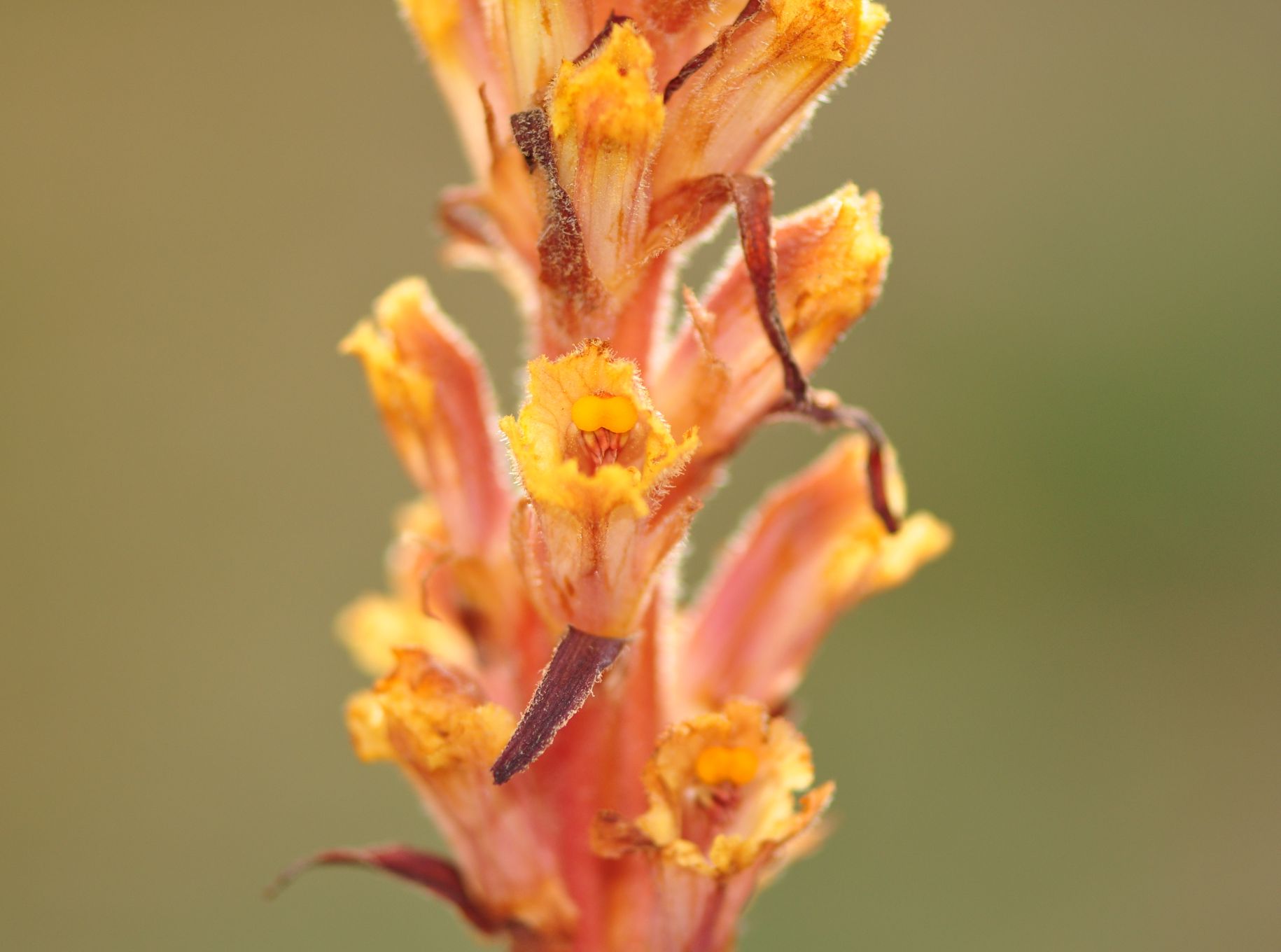
Orobanche kurdica, the Kurdish broomrape, is a plant without green leaves. It cannot make its own food: it is a holoparasite, which lives entirely off the roots of other plants[1]. What shows above ground in early summer is a stout, scaly stem with a dense spike of pale pink and yellowish flowers, often 45 to 50 cm tall[2]. It grows in the mountains of East Kurdistan (Rojhilat) and North Kurdistan (Bakur) and on into the Caucasus[1][3][3][4][5], and its name goes back to a few spikes collected in 1867 on Hewraman and Şaho.
How it got its name
- Named by
- Boiss. & Hausskn., 1879Published in Fl. Orient. 4: 505
On the roots of Hewraman and Şaho
In July 1867 the botanist Heinrich Carl Haussknecht (1838–1903)[6] was collecting in the mountains of Hewraman (Avroman) and Şaho (Shaho), between 8,000 and 9,000 feet[7][8]. Hewraman is a mountain region on both sides of today's border between Rojhilat and South Kurdistan (Başûr)[9]; Şaho rises nearby, in Rojhilat. Among the plants he pressed there was a broomrape, a stout spike with pale flesh-coloured flowers. On a small slip of paper, still kept with his specimens in Jena, he wrote down what the drying would erase[8]:
Stigm. lut. fl. pallide carneis … ad rad. Phlom., Tanaceti Chamaep. etc. in Avroman et Schahu 8–9000' Jul. 67
Stigma yellow, flowers pale flesh-coloured … on the roots of Phlomis, Tanacetum, Chamaepeuce etc. on Avroman and Shahu, 8,000–9,000 feet, July 1867.[8] (our translation)
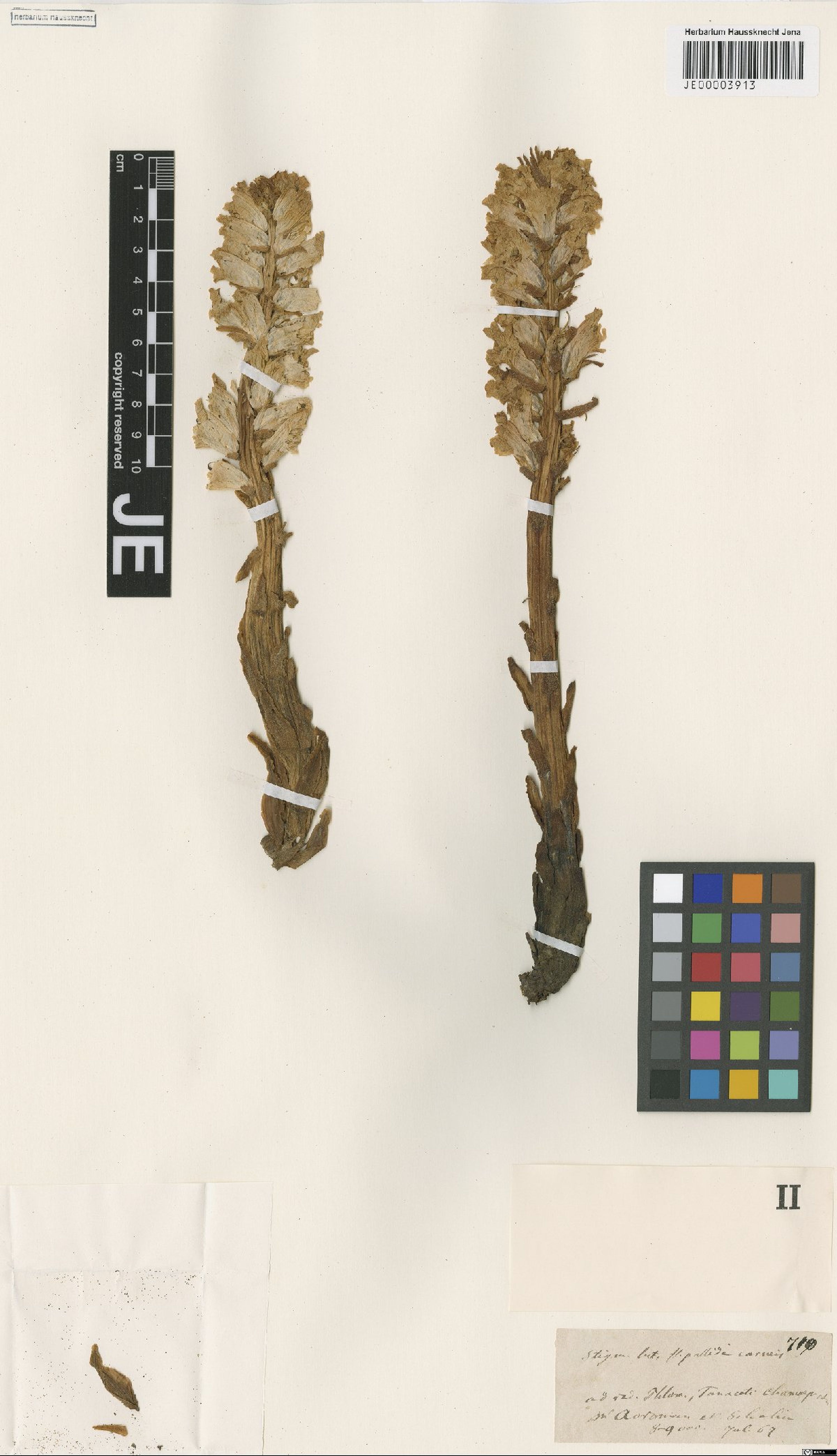
The specimens reached Pierre Edmond Boissier (1810–1885)[6] in Geneva (his "Haussk!" means he had seen Haussknecht's plants himself), and in 1879 Boissier published the plant in the fourth volume of his Flora Orientalis under both their names: Orobanche kurdica Boiss. & Hausskn.[7][6]. His note on where it grew follows the label closely: "Hab. ad Phlomides, Tanacetum, Carduaceas parasitica in montibus Avroman et Schahu Kurdistaniae Persicae 8-9000'", "parasitic on Phlomis, Tanacetum and thistles, in the mountains Avroman and Shahu of Persian Kurdistan, at 8,000–9,000 feet"[7]. Depending on which foot was meant, that is about 2,450–2,750 m or 2,600–2,900 m. The epithet kurdica, "Kurdish", comes straight from that line.
Haussknecht's gathering, number 710, went to several herbaria. In 2019 the botanist Renata Piwowarczyk and her colleagues chose the sheet in Geneva as the lectotype, the one specimen to which the name is now tied; duplicates in Jena and London are isolectotypes[2].
Who does it live on?
Every broomrape needs a host, and the Kurdish broomrape's host turned out to be the hardest thing about it.
Haussknecht named three: Phlomis, the Jerusalem sages; Tanacetum, the tansies; and Chamaepeuce, a thistle, which Boissier turned into "thistles" in general[7][8].
Forty-three years later the botanist František Nábělek was travelling through the mountains between Amêdî in Başûr and Colemêrg (Hakkâri, his "Gulamerik") in Bakur, in the mountains along today's border, in what his labels call north-eastern Kurdistan, on his Iter Turcico-Persicum of 1909–10[10]. In June 1910, near a village his labels spell Hašitha, he found the Kurdish broomrape twice: on a mountain he calls Siares at about 1,700 m, and on mount Dwile above the village at 2,100 m, where it grew "copiosa", in plenty, among oak scrub[10][11]. Both times it stood among the same plant, and he wrote his suspicion on the label:
Inter Cachrydem prangoidem; an in ea parasitica?
Among Cachrys prangoides; perhaps parasitic on it?[10] (our translation)
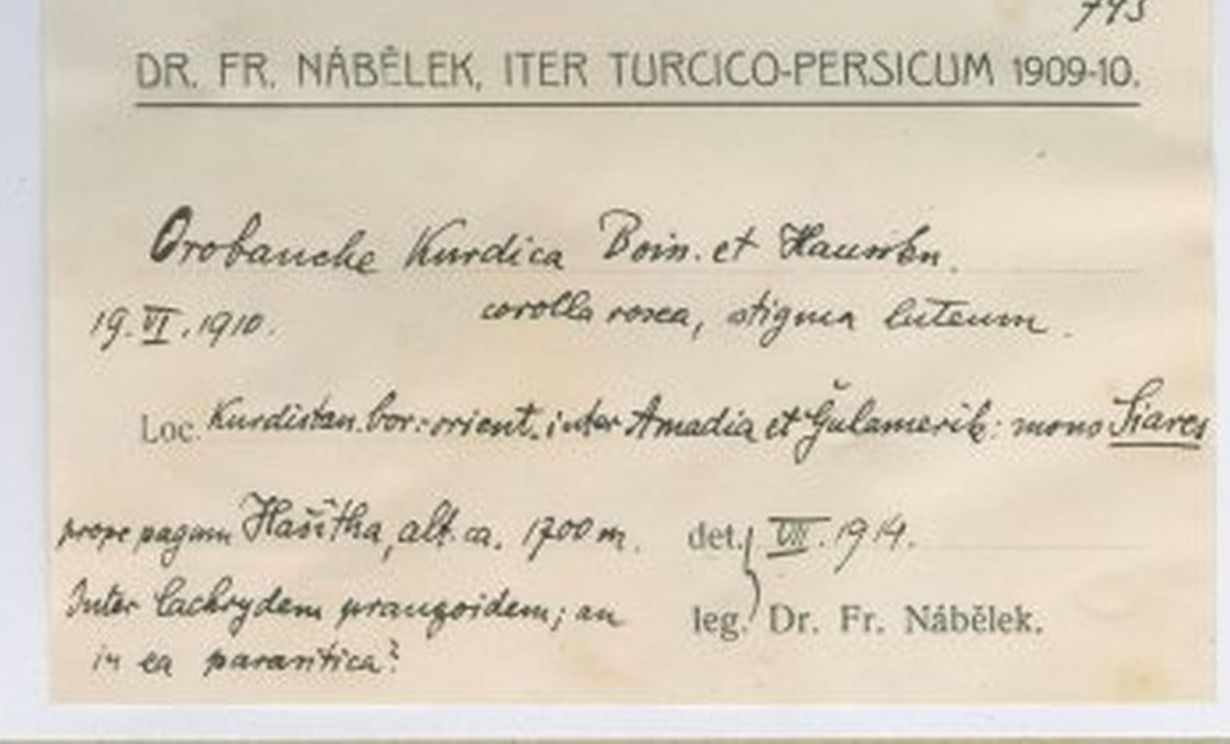
Cachrys prangoides belongs to the carrot family (Apiaceae), and today's botanical indexes count it as the same species as Prangos ferulacea[1]. More than a century after Nábělek's question mark, Piwowarczyk and her colleagues worked through the broomrapes of Armenia, where the Kurdish broomrape usually grows in large populations. The only hosts they record for it are species of Prangos, "usually P. ferulacea" and now and then P. pabularia[2]. Nábělek's guess from 1910 fits the modern record; Haussknecht's sages, tansies and thistles do not.
Not every old label agrees. A third Nábělek sheet, from mount Harefta near the village of Garaspi between Elbak (Başkale) and Qoçanis (Koçanis), at about 2,200 m, carries the name of a knapweed, Centaurea szowitsiana, in brackets[12]. In the 2019 study, knapweeds and their relatives are the hosts of a different species, O. kochii[2]. Which plant those spikes from Harefta were actually living on, the sheet cannot tell.
What to look for
Boissier's Latin description still fits the plant in the field[7]:
- the whole plant is sparsely covered with short papillae, as if lightly frosted;
- the stem is rather thick and set with long, narrow, blunt scales instead of leaves;
- the flower spike is long and fairly dense, "half a foot" (about 15 cm) in Boissier's specimens;
- each flower sits behind a narrow, blunt bract about as long as the corolla; the sepals are lanceolate, four- to five-veined, split in two at the tip and longer than the corolla tube;
- the corolla is nearly an inch long, pale flesh-coloured, broadly tube- to bell-shaped and barely curved at the tip, with wavy lips that have no fringe of hairs, the upper lip two-lobed, the lower three-lobed;
- the stigma is yellow.
The 2019 Armenian study gives the modern measurements: stems (25–)45–50(–60) cm tall, often slightly swollen or bulbous at the base, 15–16 mm across near the base; spikes of usually 30–40 flowers, sometimes as many as 70; corollas 28–30 mm long[2]. Its colour words cover the whole range seen in the field: "pale pinkish-yellow, pale rosaceous, yellowish-pink, pale yellowish, with dirty pale pink veins"[2]. Collectors' labels agree. Nábělek noted "corolla rosea, stigma luteum", pink with a yellow stigma, and on one sheet pale pinkish-violet flowers that had no scent[10][12]. On the pass above Gever (Yüksekova) in 1967 the collectors wrote "flowers cream throat pink, anthers yellow"[3].
Its closest look-alike is O. kochii. The Kurdish broomrape is the larger plant, with longer scales, more flowers and a bigger spike, and it grows on Prangos, not on knapweeds[2].
Where it grows
Kew's checklist gives its native range as eastern Turkey to the Caucasus and Iran, recorded from Iran, Iraq, Turkey, Transcaucasia and the North Caucasus[1]. In Kurdish terms it is a plant of the high mountains of Rojhilat and Bakur. Records from Kurdistan include:
- Rojhilat: Hewraman and Şaho, the type locality, 1867[7][8][2].
- Along today's border between Başûr and Bakur: Nábělek's two gatherings of June 1910 near the village he spells Hašitha, between Amêdî and Colemêrg, at 1,700 and 2,100 m[10][11].
- Bakur, around Colemêrg: Nábělek's third gathering of 1910, on Harefta between Elbak and Qoçanis, at about 2,200 m[12]; and the top of the pass from Bajirge to Gever (Yüksekova) near Delezi village, 2,500 m, on "upland hills, shale, grassy areas, meadow, subalpine flora", 29 June 1967[3].
- Bakur, around Lake Van (Gola Wanê): a ridge above the Kilise river between Çiyayê Sîpan (Süphan Dağı) and Erdîş (Erciş), 1,875 m, May 1966[3]; near Timar in the Westan (Gevaş) district, 2,030–2,575 m, June 2014, specimens identified by Golshan Zare, who has published on the broomrapes of Turkey[4][13]; and photographed the day before at Ebex (Çaldıran)[5].
- iNaturalist users have also photographed it near Pülümür in Dêrsim (2022) and near Bazîd (Doğubayazıt) (2024)[5].
Outside Kurdistan it grows in Armenia, where it is widespread, and further north into the Caucasus[2][1]. In Armenia the 2019 study found it on rocky slopes from the lower to the upper mountain belt, in subalpine meadows and oak woods, on old volcanoes and around ruins, fortresses and monasteries, mostly between 1,500 and 2,700 m[2].
It flowers in June and July, sometimes from May, and fruits in July and August[2]. All the Kurdish gatherings above fall between late May and July, except perhaps the sheet from Harefta, whose label seems to read 1 September[12].
One species, two names
In 1958 the botanist Tzvelev described a broomrape from the Caucasus in the Flora of the USSR as O. rosea[6]. Its lectotype, chosen in 2019, is a plant from Nakhchivan that grew on Prangos ferulacea[2]. When Piwowarczyk and her colleagues compared its type with Haussknecht's, they "did not find any clear difference" and treated O. rosea as the same species. As the older name, O. kurdica is the one that stands[2].
The same study gives its wider range as the region the authors call Armenia-Kurdistan, and Iran, Azerbaijan, Iraq and Turkey[2]. A broomrape is hard to name from a dried spike alone, and the host is part of the answer. The plants of Hewraman, Şaho and Colemêrg have not yet been studied the way the Armenian ones were.
It has not been assessed for the IUCN Red List[14]. For Armenia, the 2019 authors rate it Least Concern, as its populations there are usually large[2].
Its names in Kurdish
Kurdish has many names for broomrapes, and some of them have been given to this species.
- In 2007 the Kurdish Institute of Paris's journal Kurmancî printed a plant list, Flora Kurdistanê (II), prepared by Ehmedê Dirihî, that gives giyagurg, gurge, giyagurok and gurik for Orobanche kurdica, with vergvaş as the Zazaki name; its Turkish column has Kürt süpürge otu, canavarotu, its French orobanche du Kurdistan and its English Kurdish broomrape[15].
- In his 2013 Ferhenga Navên Nebatan a Kurdî, Dirihî gives most of the same words, giyagurg, giyagurok, gurik, vergvaş and many more, for broomrapes in general (the genus Orobanche)[16]. So these are best read as the Kurdish names for broomrapes, which the 2007 list applied to the Kurdish one.
- For the Kurdish broomrape itself the dictionary has dictionary names whose wording mirrors the Latin: giyagurgê kurdan, gurikê kurdan, vergvaşê kurdan, vila bêkoka kurdan and ziplinga kurdan, all with kurdan, "of the Kurds"[16].
- In its preface Dirihî uses the plant as his example of how such names can be made. The English call it kurdish broomrape, he writes, the French orobanche du kurdistan and the Turks şark baklakıranı, and Kurds, too, could call it agirokê kurdistan or mergvaşê kurdan[16].
None of these was recorded from people in the mountains where the plant grows, and none of the labels from Hewraman, Şaho or Colemêrg gives a local name[8][10][11][12][3]. What the people of Hewraman call the pink spikes that come up among the Prangos each June has still to be written down.
Sources
- 1.Plants of the World Online. Royal Botanic Gardens, Kew.
- 2.Piwowarczyk, R., Sánchez Pedraja, Ó., Moreno Moral, G., Fayvush, G., Zakaryan, N., Kartashyan, N. & Aleksanyan, A. (2019). Holoparasitic Orobanchaceae (Cistanche, Diphelypaea, Orobanche, Phelipanche) in Armenia: distribution, habitats, host range and taxonomic problems. Phytotaxa 386(1): 1–106. doi:10.11646/phytotaxa.386.1.1https://doi.org/10.11646/phytotaxa.386.1.1
- 3.Royal Botanic Gardens, Kew – Herbarium Specimens. via GBIF. gbif.orghttps://www.gbif.org/dataset/cd6e21c8-9e8a-493a-8a76-fbf7862069e5
- 4.abUniversity of Vienna herbarium (WU), sheets WU 0083648 and 0083649 (Gilli et al., 2014), via GBIF.
- 5.abciNaturalist. observations 148988379, 148635501, 127831676 and 240621257. inaturalist.orghttps://www.inaturalist.org/
- 6.International Plant Names Index. Royal Botanic Gardens, Kew, Harvard University Herbaria and Australian National Herbarium.
- abcOrobanche kurdica Boiss. & Hausskn. ex Boiss.; author records for Boissier and Haussknecht.
- dOrobanche rosea Tzvelev, Fl. URSS 23: 687 (1958).
- urn:lsid:ipni.org:names:662451-1. ipni.orghttps://www.ipni.org/n/662451-1accessed 14 November 2026
- 7.Edmond Boissier (1879). Flora Orientalis, vol. 4. H. Georg, Geneva and Basel (Internet Archive).
- 8.abcdefHerbarium Haussknecht, Jena (JE), specimen records (JACQ) via GBIF. Jena, isotype sheets JE 00003913 and JE 00003914 (Haussknecht 710, 1867), via GBIF. api.gbif.orghttps://api.gbif.org/v1/occurrence/3028980654
- 9.↩Ahmad, S. A. & Askari, A. A. (2015). Ethnobotany of the Hawraman region of Kurdistan Iraq. Harvard Papers in Botany 20(1): 85–89. doi:10.3100/hpib.v20iss1.2015.n8https://doi.org/10.3100/hpib.v20iss1.2015.n8
- 10.abcdefInstitute of Botany, Slovak Academy of Sciences, Bratislava, herbarium sheet SAV0003272 (Nábělek 743, 1910), via GBIF.
- 11.abcInstitute of Botany, Slovak Academy of Sciences, herbarium sheet SAV0003249 (Nábělek 726, 1910), via GBIF.
- 12.abcdeInstitute of Botany, Slovak Academy of Sciences, herbarium sheet SAV0003277 (Nábělek 747, 1910), via GBIF.
- 13.↩Zare, G. & Dönmez, A. A. (2013). Two new records of the genus Orobanche (Orobanchaceae) from Turkey. Turkish Journal of Botany 37(3): 597–603. doi:10.3906/bot-1205-44https://doi.org/10.3906/bot-1205-44
- 14.↩GBIF.org GBIF Backbone Taxonomy and occurrence records. IUCN Red List category for Orobanche kurdica (Not Evaluated). gbif.orghttps://www.gbif.org/
- 15.↩Ehmedê Dirihî (2007). Flora Kurdistanê (II). p. 2. institutkurde.orghttps://www.institutkurde.org/publications/kurmanci/
- 16.Ahmet Kasımoğlu (Ehmedê Dirihî) (2013). Ferhenga Navên Nebatan a Kurdî (Dictionary of Kurdish Plant Names). Mardin Artuklu University, Institute of Living Languages in Turkey (ISBN 978-605-4202-12-6).
- 17.Edîb Polat (2006). Flora Kurdistanê (I). institutkurde.orghttps://www.institutkurde.org/publications/kurmanci/
- 18.Ehmedê Dirihî, Eyûb Kiran, Xalidê Hekarî (2011). Flora Kurdistanê (III). institutkurde.orghttps://www.institutkurde.org/publications/kurmanci/
Last updated 20 November 2026