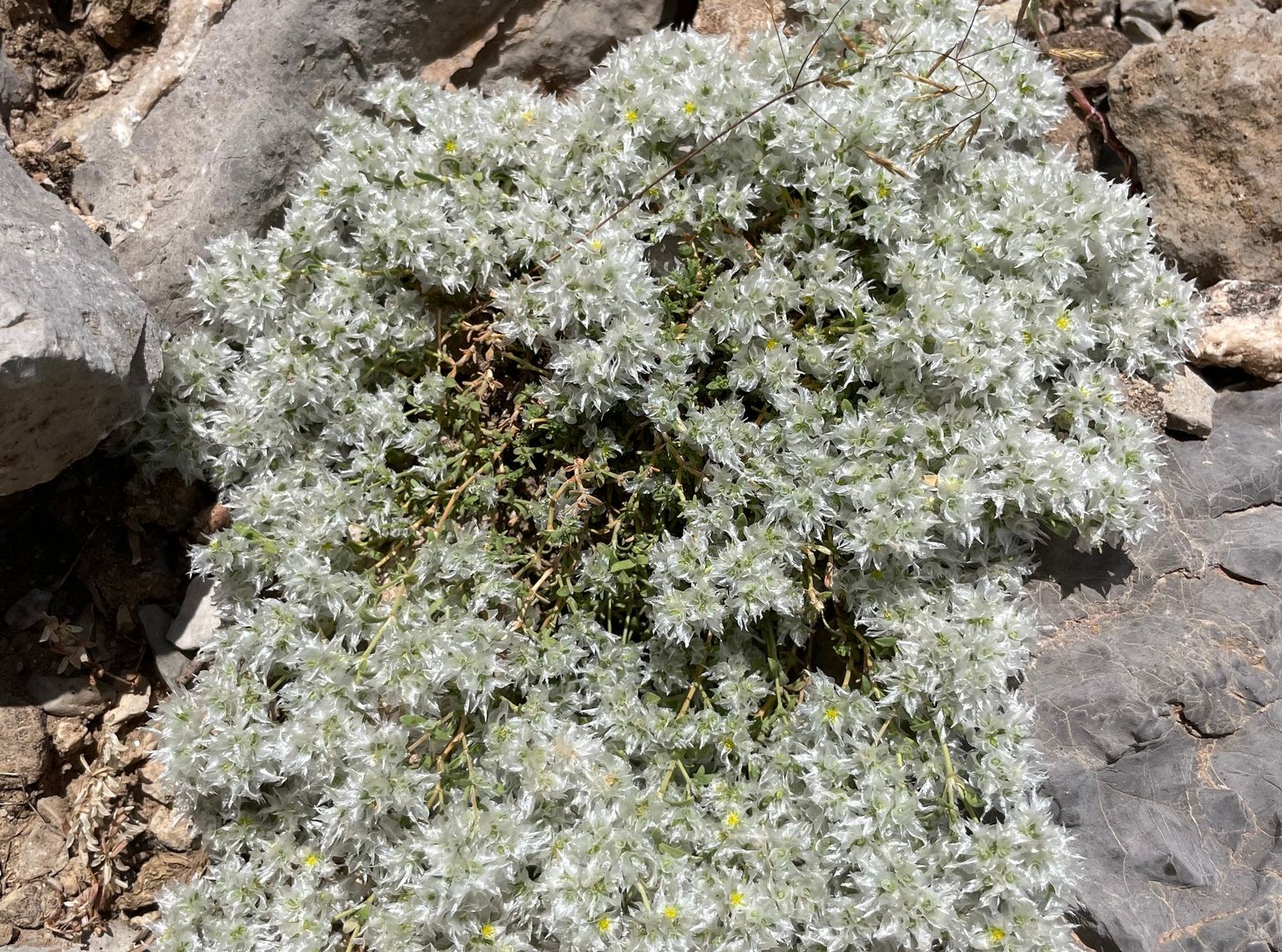
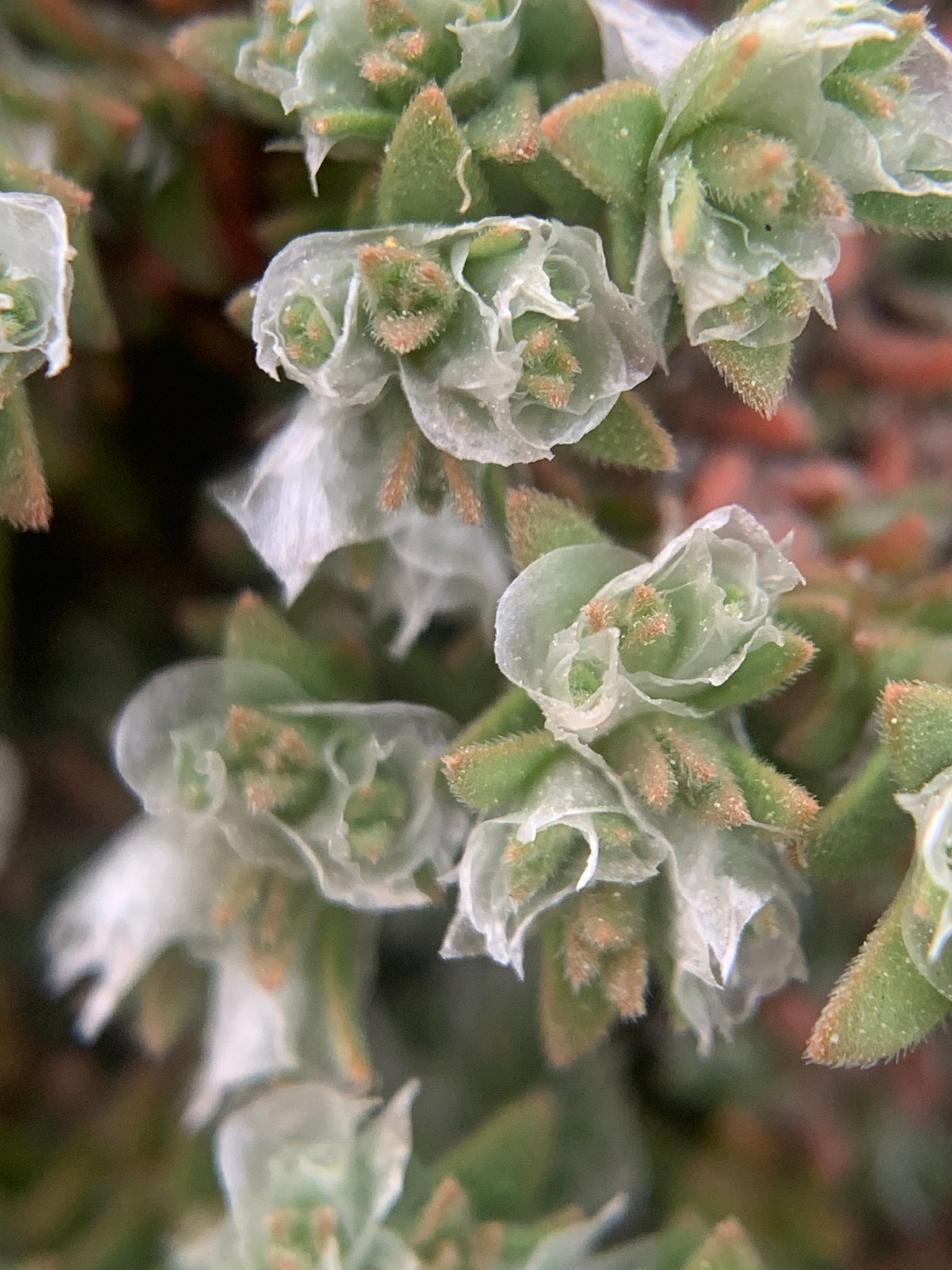
Paronychia kurdica is a low, mat-forming perennial of rocky slopes and rock crevices, with a woody base and short, much-branched stems[1]. Its tiny flowers are hidden among large, papery bracts, which give the whole plant a silvery-white shine[2][1]. It was described in 1843 from plants collected on the limestone summit of Mount Gara in Başûr (South Kurdistan), and it grows across Bakur, Başûr and Rojhilat[2][1][3]. In Arıcak, in the province of Xarpêt (Elazığ), people rub it between their palms as soap, and in Hizan it is eaten with salt against warts[4][5].
How it got its name
- Named by
- Boiss., 1843Published in Diagn. Pl. Orient. 3: 10
Where it grows in Kurdistan
At 90–1600 m above sea level.
On the summit of Gara, July 1841
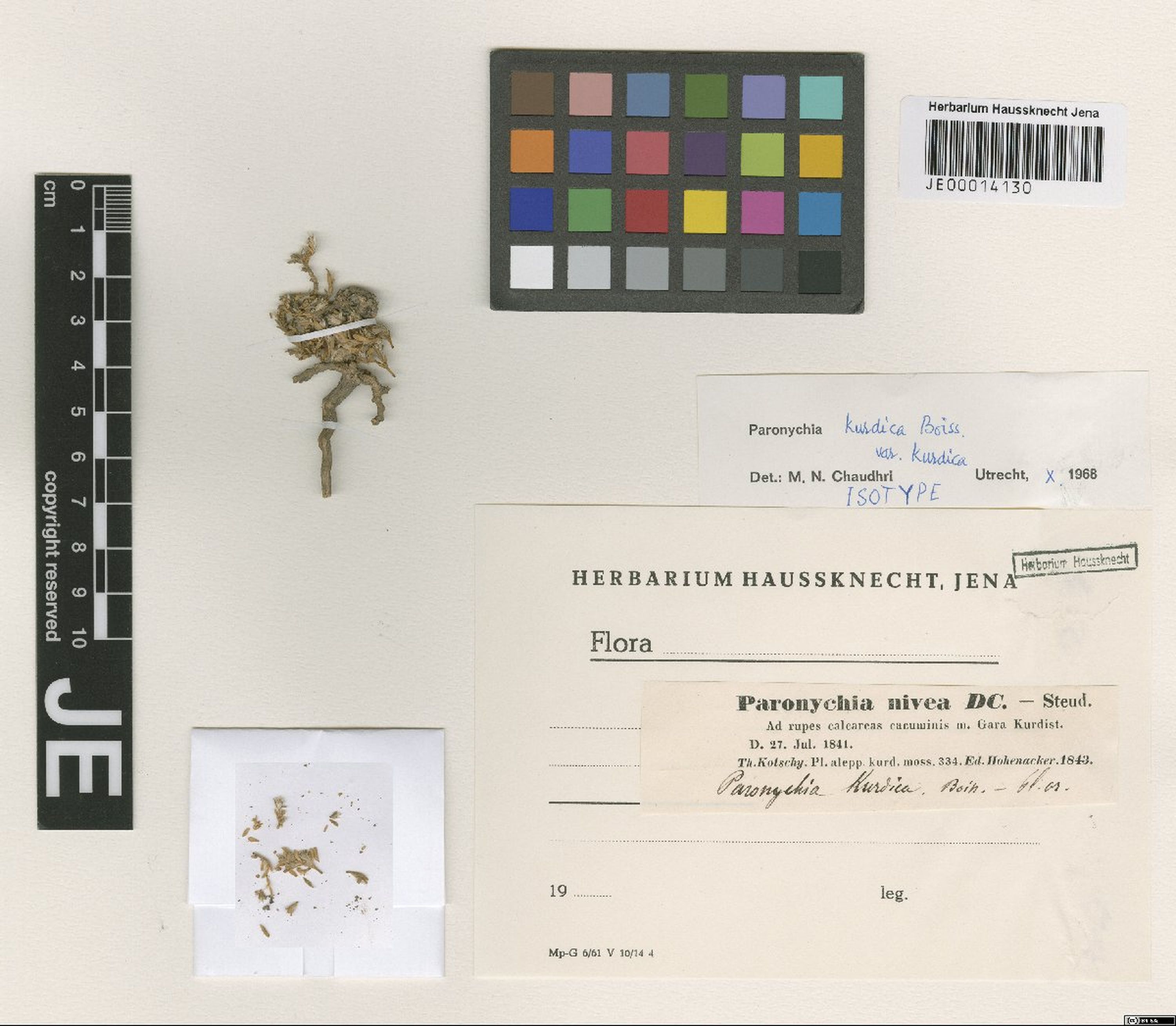
On 27 July 1841 the botanist Theodor Kotschy (1813–1866)[6] gathered a small, silvery plant "on the limestone rocks of the summit of Mount Gara, Kurdistan" (ad rupes calcareas cacuminis m. Gara Kurdist.)[7]. On the same mountain in Başûr, Kotschy also collected the Kurdish hollyhock, Alcea kurdica[8].
Kotschy was heading south. From Mosul he went down to Baghdad on a raft supported by animal skins, then by ship to Basra, and in 1842 he explored the Zagros mountains of southern Iran, then still unexplored by botanists[9].
His specimens were issued to herbaria by Rudolph Friedrich Hohenacker (1798–1874)[6] in 1843, as number 334 of Kotschy's "Pl. alepp. kurd. moss.": plants from Aleppo, Kurdistan and Mosul[7]. The printed label called the plant Paronychia nivea, a name credited to the botanist Steudel[2][7]. Duplicates of number 334 are still kept in at least ten herbaria, among them Geneva, Halle, Jena, Stockholm, Kew, Paris and the Smithsonian in Washington[1][10].
Not the snowy nivea
The botanist Edmond Boissier (1810–1885)[6] saw that the label was wrong. The true Paronychia nivea, "snowy", of de Candolle was a plant of south-western Europe, and Kotschy's plant from Gara was very different[2]:
- its stems are woody at the base and "as thick as a goose quill" (crassitie pennæ anserinæ);
- its branches are roundish rather than angled;
- its leaves are not pointed;
- its stipules and bracts are half the size;
- its sepals are three times shorter and blunt.
In November 1843 he published it as a new species, Paronychia kurdica, "the Kurdish Paronychia", and gave its home in one line: Hab. in cacumine montium Kurdistaniæ, Kotschy, "on the summit of the mountains of Kurdistan"[2][6]. It stands in his paper right after Paronychia chionaea, a mountain species from Anatolia that he had collected himself. He found the two most alike in their look and their flowers, but told the Kurdish plant apart by its narrow, oblong leaves (not oval ones), its woody stem, its narrower, long-pointed bracts and the shape of its sepals[2].
The specimen Boissier described is now the holotype in Geneva; the sheets in Halle, Jena and Stockholm are isotypes, duplicates of the same gathering[1]. The Jena sheet carries a slip from 1968, when the Paronychia specialist Mohammad Nazeer Chaudhri (1932–2010)[6] at Utrecht confirmed it as P. kurdica and marked it "isotype"[7].
Flowers in silver paper
Paronychia is a genus of about 110 species, found almost all over the world, with centres in the Mediterranean, Turkey, the south-east of the United States, Peru and Bolivia[1]. Its members are small herbs with their flowers in clusters, more or less hidden behind silvery, papery bracts[1]. Four species grow in Iraq[1]. The genus belongs to the pink family, Caryophyllaceae.
The Flora of Iraq (2016) describes P. kurdica like this[1]:
- a perennial with a woody base; stems 3–15 cm long, lying along the ground and much branched from the base, with short hairs;
- leaves 3–7 mm, narrowly oblong, more or less blunt, somewhat fleshy and hairy, sometimes overlapping like tiles; four papery stipules at each node;
- flower clusters (4–)10–15 mm across, many and crowded;
- bracts slantingly oval to round, pointed, almost twice as long as the flowers;
- flowers 3–3.5 mm, hairy, with five unequal sepals: three long outer ones and two short inner ones, the outer ones bent back at the tip;
- a single seed in a small, hairless fruit.
The bent-back, unequal sepals are what set it apart from the three other species in Iraq[1]. Boissier said the same in 1867: it looks like P. capitata, but its bracts are sharper and its unequal sepals curl back a little at the tip[11].
Chaudhri's monograph of 1968 adds finer details: petals only about 0.75 mm long, orange-yellow anthers and a bean-shaped seed about 1.25 mm long. He also noticed that the bracts seem to grow slowly at first and reach their full size only as the flowers mature[12]. He put P. kurdica in a new section, Heterosepalae, for the species whose sepals are distinctly unequal: their flowers are mostly 3–4.5 mm long, but some reach about 7 mm, the longest in the genus[12].
"A very variable species"
The Flora of Iraq calls it "a very variable species", some of whose specimens come very close to P. sinaica[1]. Chaudhri had said the same in 1968: "very variable in the form and size of the flowers, esp. of the sepals"[12]. Botanists have tried several times to split it:
- 1966: Chaudhri named a loosely tufted form with pointed leaves from Dersim, subsp. montis-munzur, after the Munzur mountains. Peter Hadland Davis and Ian Hedge had collected it on 16 July 1957 on rocky limestone slopes above Ovacık, at 1,900 m[13]. Its sepals are narrow, very hairy and strongly bent back[13]. Under the same subspecies Chaudhri also listed a plant that the collector Paul Sintenis (1847–1907)[6] had found on rocks by the Euphrates (Firat) at Egin (Kemaliye) in May 1890[13].
- 1966: in the same paper, a golden-green, very brittle form from rock ledges above the salt lake Tuz Gölü in central Anatolia, var. fragilis[13].
- 1968: in his Utrecht doctoral thesis, A revision of the Paronychiinae, Chaudhri named var. imbricata, with leaves overlapping like tiles. Its type was collected by R. Wheeler Haines on 22 May 1955 at about 800 m at Çermo (Jarmo), near Çemçemał (Chemchemal) in Başûr, which its type label places under Kirkuk[1][12]. The Flora of Iraq doubts it: at Kew, a duplicate of its type shows the same slanting bracts as ordinary P. kurdica, and some tile-leaved plants have the larger flower clusters too[1].
- 1968: in the same thesis, a greenish form, subvar. viridescens, whose bracts do not quite hide the flowers, "the whole plant thus appearing greenish". Its type is a plant that Th. Strauss collected on 19 May 1904 on Kuh-e-Shires, north of Harsin in Rojhilat[12].
In that thesis Chaudhri also rearranged his own names. He kept two subspecies, told apart mainly by their sepals and the size of their flowers, lowered var. fragilis to a subvariety and subsp. haussknechtii to a variety. Subsp. montis-munzur, he wrote, "differs markedly" from the typical subspecies, "but there are several intermediates"[12].
Kew's checklist keeps two subspecies today, subsp. kurdica and subsp. montis-munzur, and the variety fragilis. It folds var. imbricata back into subsp. kurdica, and moves another of Chaudhri's subspecies, haussknechtii, to a different species, P. boissieri[14]. The first chromosome count for the species was published in 2014, from plants grown from seed collected near Mahneshan in the province of Zanjan in Iran: 2n = 18, all of them with arms of roughly equal length[15]. In 2020 a second study found subsp. montis-munzur, collected between Erzincan and Pülümür, to be diploid with 2n = 18 as well[16].
Where it grows
Kew gives its native range as Turkey to Iran: Iran, Iraq, Turkey, Syria and Lebanon, and the Transcaucasus[14]. In Kurdish terms, herbarium records cover all three of Bakur, Başûr and Rojhilat:
- Başûr: the Flora of Iraq lists records from around Amêdî, Gali Mazurka, Zaxo (Zakho), Sersing (Sarsang) and Bamernê (Bamerny), the lower slopes of Qendîl (Qandil) near Ranya, Kajan mountain near Pêncwên (Penjwin), Xurmał (Khurmal), Çemçemał, Şingal (Jabal Sinjar), north of Kerkûk (Kirkuk) and Xaneqîn (Khanaqin), down to Mandali, and from Zewiya on Pîremegrûn (Pira Magrum)[1]. Heinrich Haussknecht (1838–1903)[6] had already collected it on the same massif, which the herbarium record gives as "Pir Omar Gudrun", in 1867, and František Nábělek found it among rocks at 1,300 m in Berwarî, between Amêdî (Amadiya) and Hašitha[3]. Chaudhri also lists it from Sefîn ("Kuh-Sefin") near Şeqlawe (Shaqlawa), collected by Bornmüller in 1893, from "Kuh Sanjaq" in 1959 and from near Pushtashan[12].
- Bakur: Sintenis collected it in 1888 on stony ground around Mêrdîn (Mardin); one of his sheets, in Washington, gives the locality simply as "Koordistan"[3]. Davis and Hedge found it in 1957 between Mêrdîn and Nisêbîn (Nusaybin), between Maden and Erxenî (Ergani), between Pertek and Xozat (Hozat) and around Ovacık in Dersim[3]. Chaudhri's 1968 list adds Sintenis's plants from Xarpêt (Harput, 1889) and Egin (1890), and gatherings by Davis, some with companions, between Sêrt (Siirt) and Baykan and on towards Bidlîs, between Wan (Van) and Erçek at 2,100 m, north of Satak, around Colemêrg (Hakkari) and towards Çukurca, between Midyat and Gercüş, and between Girze and Silopi[12].
- Rojhilat: it has been collected in the Qotur valley west of Xoy (Khoy), on the western shore of Lake Urmia, east of Sahneh, on Kuh-i-Parau in the Kirmaşan (Kermanshah) region, north of Harsin and at Bisitun[3][12].
Beyond Kurdistan it reaches the Caucasus, northern and southern Iran and northern Syria[11][14].
In Başûr it grows on rocky mountain slopes, serpentine rocks, rock crevices and dry silt ridges, from 90 to 1,600 m, flowering from May to July[1]. In Dersim, subsp. montis-munzur grows at 1,900 m[13]. For the whole species Chaudhri gave 100 to 2,300 m, "mostly above 500 m or around 1000 m", flowering from May to July[12]. Boissier's two notes, "on summits" in 1843 and "in rocky places" in 1867, still sum it up[2][11].
Soap, warts and wounds
Three field studies record how people use it:
- Arıcak (Elazığ): the plant is called Sabun mılçıko. People gather it from March to August and rub the ripe, above-ground parts in the palm of the hand to use as soap[4]. A related plant, Herniaria glabra, is called Sabun mılçıko zuray and is rubbed with water as a soap too[4]. The thesis that recorded these names says that most local plant names in Arıcak are Zazaki[4]. Further north, in Nazımiye in Dersim, Herniaria glabra is called Sabune mıleçko; there it is crushed with a stone and a little water into a lather to wash the hands, and boiled to wash skin affected by a disease that the thesis says is locally called milecıko[17].
- Hizan (Bidlîs): the above-ground parts are eaten raw with salt to treat warts[5].
- Midyat (Mêrdîn): in this region of four languages (Kurdish, Arabic, Syriac and Turkish) the plant was recorded under an Arabic name, Haşişılselulet, and drunk as an infusion for wounds and for the gall bladder[18].
The wart remedy from Hizan has a curious echo in veterinary science. In 2010 vets tested an extract of P. kurdica on 30 cows and heifers with warts (papillomas) on their teats and udders. Given by mouth or by injection, it cleared the warts completely in up to four-fifths of the animals in the best-treated groups within 90 days, better than in the untreated group; as an ointment it worked less well[19]. The plants for that extract came from the area of Çewlîg (Bingöl) and Xarpêt[20].
These are records of traditional use, not medical advice.
The names
Neither of the Kurdish plant-name dictionaries in the Flora Kurdica names database lists P. kurdica. The only Kurdish-language name recorded so far comes from a field study: Sabun mılçıko from Arıcak, quoted as the source gives it[4].
Sources
- 1.Kandemir, A. & Ghazanfar, S. A. (2016). Caryophyllaceae: Paronychia. In: Ghazanfar, S. A. & Edmondson, J. R. (eds), Flora of Iraq 5(1): 6–11. Royal Botanic Gardens, Kew.
- 2.Boissier, E. (1843). Diagnoses Plantarum Orientalium Novarum, ser. 1, no. 1. Geneva. archive.orghttps://archive.org/details/e.-boissier-diagnoses-plantarum-orientalium-novarum-series-1-vol.-1-no.-1-7-1843-1846
- 3.abcdeHerbarium specimens of Paronychia kurdica at Kew, Utrecht, Washington, Jena and Bratislava, via GBIF.
- 4.Şükrü Olgun (2019). Arıcak (Elazığ) ilçesinin etnobotanik özellikleri. tez.yok.gov.trhttps://tez.yok.gov.tr/UlusalTezMerkezi/
- 5.Demir, İ. (2020). An ethnobotanical study of medicinal plants used in Hizan district (Bitlis-Turkey). Yüzüncü Yıl Üniversitesi Tarım Bilimleri Dergisi 30(4): 732–741. doi:10.29133/yyutbd.730202https://doi.org/10.29133/yyutbd.730202
- 6.International Plant Names Index. Royal Botanic Gardens, Kew, Harvard University Herbaria and Australian National Herbarium.
- 7.abcdHerbarium Haussknecht, Jena (JE), specimen records (JACQ) via GBIF. Jena: isotype JE00014130 (Kotschy 334), via GBIF. api.gbif.orghttps://api.gbif.org/v1/occurrence/3028980654
- 8.↩Schlechtendal, D. F. L. von (1843). Plantae Kotschyanae nonnullae, novae censitae. Linnaea 17: 124–128.
- 9.↩Edmondson, J. R. & Lack, H. W. (2006). Karl Georg Theodor Kotschy's itinerary in southern Iran, 1841–42. Willdenowia 36: 579–588, pp. 579–580. doi:10.3372/wi.36.36154https://doi.org/10.3372/wi.36.36154
- 10.↩Duplicates of Kotschy 334 at Halle, Stockholm, Kew, Paris, Washington, Göttingen, Wageningen and San Francisco, via GBIF.
- 11.Boissier, E. (1867). Flora Orientalis, vol. 1. Basel & Geneva: H. Georg.
- abc1: 744.
- p. 744. archive.orghttps://archive.org/details/floraorientaliss01bois/page/n787/mode/1upaccessed 14 November 2026
- 12.Chaudhri, M. N. (1968). A revision of the Paronychiinae. Doctoral thesis, Rijksuniversiteit Utrecht.
- 13.abcdeChaudhri, M. N. (1966). Some new Paronychias from Turkey. Acta Botanica Neerlandica 15(1): 193–208.
- 14.Plants of the World Online. Royal Botanic Gardens, Kew.
- abcWorld Checklist of Vascular Plants (WCVP), Royal Botanic Gardens, Kew: Paronychia kurdica (2026).
- plant_name_id 2530398. powo.science.kew.orghttps://powo.science.kew.org/taxon/urn:lsid:ipni.org:names:435066-1accessed 14 November 2026
- 15.↩Mirzadeh Vaghefi, S. S., Jalili, A., Ghasemi, F. S. & Ashrafi, S. (2014). Chromosome numbers of Paronychia kurdica and Salsola yazdiana. Iranian Journal of Botany 20(2): 230–232.
- 16.↩Eroğlu, H. E., Altay, D., Budak, Ü. & Martin, E. (2020). Karyotypic phylogeny and polyploidy variations of Paronychia (Caryophyllaceae) taxa in Turkey. Turkish Journal of Botany 44: 245–254. doi:10.3906/bot-1911-16https://doi.org/10.3906/bot-1911-16
- 17.↩Birgül Murat (2025). Nazımiye (Tunceli) ilçesinin etnobotanik özellikleri. p. 57. tez.yok.gov.trhttps://tez.yok.gov.tr/UlusalTezMerkezi/
- 18.↩Akgül, A., Akgül, A., Şenol, S. G., Yıldırım, H., Seçmen, Ö. & Doğan, Y. (2018). An ethnobotanical study in Midyat (Turkey), a city on the silk road where cultures meet. Journal of Ethnobiology and Ethnomedicine 14: 12. doi:10.1186/s13002-017-0201-8https://doi.org/10.1186/s13002-017-0201-8
- 19.↩Apaydın, A. M. et al. (2010). Effects of Paronychia kurdica on teat and udder papillomatosis in cows. Revue de Médecine Vétérinaire 161(6): 267–271.
- 20.↩Torun, Z., Sadıkoğlu, N. & Günal, S. (2024). Antimicrobial activity of Paronychia kurdica … Anatolian Journal of Pharmaceutical Sciences 3(1). 142–151.
- Boissier, E. (1843). Diagnoses Plantarum Orientalium Novarum, ser. 1, no. 3. Geneva, ser. 1, 3: p. 10. archive.orghttps://archive.org/details/e.-boissier-diagnoses-plantarum-orientalium-novarum-series-1-vol.-1-no.-1-7-1843-1846/page/n210/mode/1upaccessed 14 November 2026
- Ghazanfar, S.A. & Edmondson, J.R. (eds) (2016). Flora of Iraq, Volume 5, part 1: Elatinaceae to Sphenocleaceae. Royal Botanic Gardens, Kew, p. 11. kew.iro.bl.ukhttps://kew.iro.bl.uk/server/api/core/bitstreams/7456e852-fcdb-44ce-acd9-147ae89d24eb/content#page=22accessed 14 November 2026
Last updated 20 November 2026