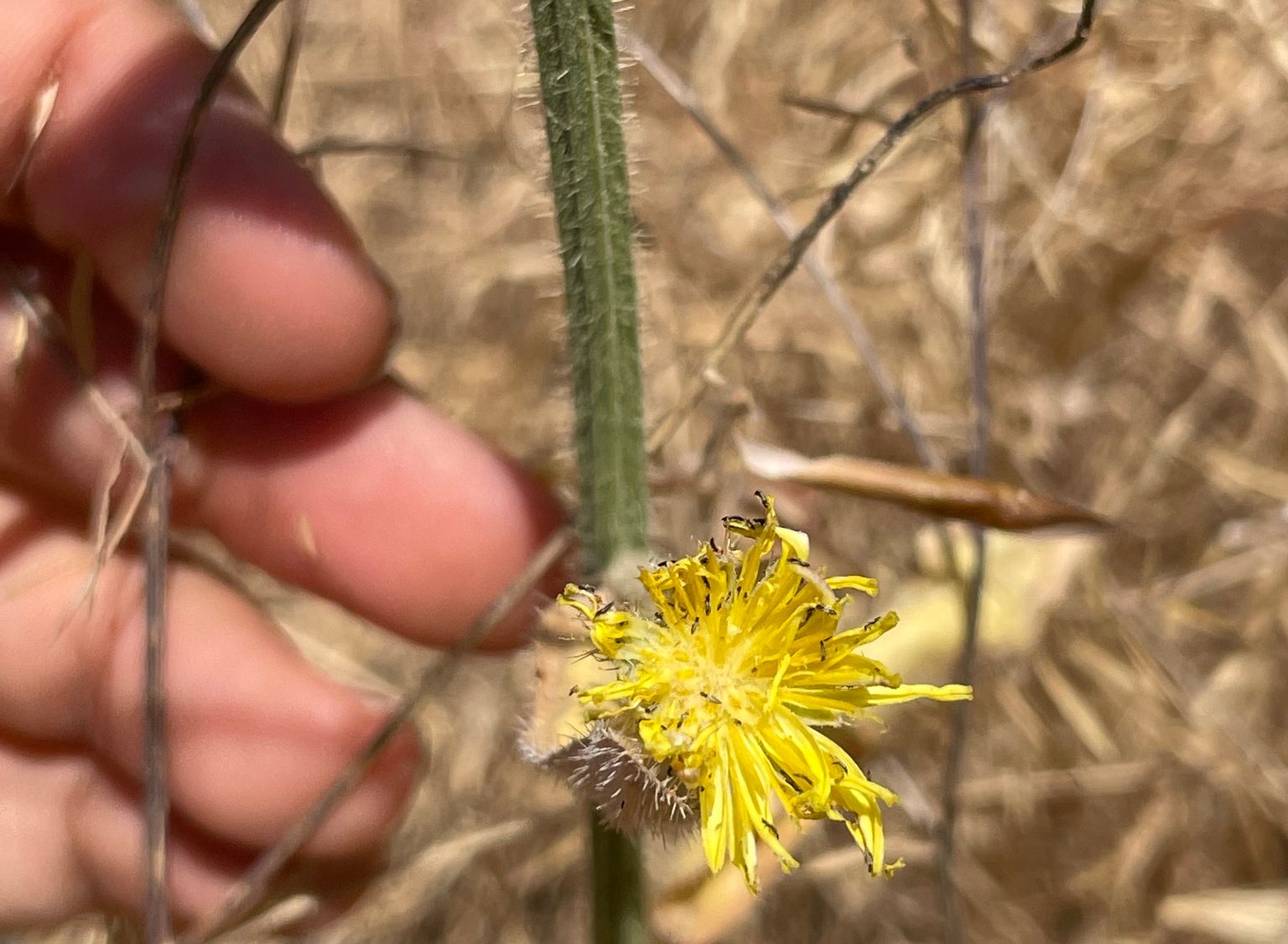
High on the cliffs of Şaho (Shaho) and Hewraman (Avroman), in East Kurdistan (Rojhilat), a small yellow-flowered relative of the daisies roots in deep grooves of bare rock, short of water and nutrients[1]. Pentanema kurdistanicum is a tuft of slender, hairy stems no more than about 15 cm long, and it was named for science only in 2016[1]. Its authors know it from a few small populations between 2,500 and 2,700 m, none of them more than 15 to 20 plants[1].
How it got its name
- Named by
- Maroofi & Ghaderi, 2016Published in Phytotaxa 253: 223
- Type collected by
- Hiva Ghaderi19 July 2014
Where it grows in Kurdistan
At 2500–2700 m above sea level.
A gathering above Bendol
On 19 July 2014 the botanist Hiva Ghaderi collected the plant in the mountains by the village of Bendol, about 30 km south to south-east of Merîwan (Marivan), at 2,600 m[1][2]. A second gathering followed at the same place on 23 August 2015[1]. Both sheets are kept in the HKS herbarium[1].
With Hosein Maroofi, of the agricultural and natural-resources research centre of Kurdistan province in Sine (Sanandaj), Ghaderi described it as a new species in the journal Phytotaxa on 29 March 2016, under the title "Pentanema kurdistanicum (Inuleae, Asteraceae), a new species from subalpine cliffs of Kurdistan, Iran"[1][2]. The name, they write, "refers to the collection region of this plant, Kurdistan Province"[1]: kurdistanicum is Latin for "of Kurdistan".
Maroofi has named other plants of these mountains. A year earlier, with Mahfouz Advay, he had described Campanula kurdistanica, a bellflower from the slopes of Şaho between Merîwan and Pawe (Paveh)[2].
Small, hairy and yellow
The plant is a perennial with a woody base[1]. What to look for, from the original description[1]:
- many thin stems, 4–12 (rarely 15) cm long, curving up from the base, reddish brown, and densely covered, mostly towards the top, with white hairs made of several cells;
- prominent resting buds wrapped in dense, long, soft hairs;
- small, untoothed leaves 5–15 (rarely 20) mm long and 2–8 mm wide, yellowish green, covered on both sides with soft hairs and pale yellow, glossy glands;
- a single flower head at the tip of each stem, bell-shaped, 5–7 mm long and 8–12 mm wide;
- many yellow ray florets, each with three small teeth at the tip and hairy on the outside, around a disc of small tubular florets;
- tiny seeds 1.2–1.5 mm long, topped by a ring of white bristles.
It flowers in June and July[1].
Five threads
That ring of bristles, the pappus, seems to be what the genus name points to. When Henri Cassini set up Pentanema in 1818, he described its pappus as "de cinq squamellules unisériées … filiformes", five thread-like scales in a single row[3]. He gave no explanation of the name, but in Greek pente means "five" and nēma "thread" (our reading of the Greek). Pentanema kurdistanicum keeps to the number: the pappus of its disc florets has 5 bristles[1].
For a long time botanists did not keep Pentanema apart. In his Flora Orientalis of 1875, Edmond Boissier treated it as a section of the genus Inula, distinguished by its small, hairy seeds, few pappus bristles and small flower heads[4]. In 2018 a DNA study of the Inula group found that neither Inula nor Pentanema as then defined formed a natural group, and gave Pentanema a new, wider outline[5].
A cousin found in 1867
The plant's closest relatives, according to Maroofi and Ghaderi, are Pentanema flexuosum, of "the west of Iran" in their words, and P. prasinurum from eastern and south-eastern Afghanistan[1]. The first of these was found on the very same mountains, almost 150 years earlier.
In 1867 the botanist Carl Haussknecht (1838–1903)[2] was travelling in Kurdistan. The printed labels of that journey read Iter Kurdicum 1867, "the Kurdish journey"[6]. On limestone rocks above Cwanro (Javanrud), at 6,000 feet (about 1,800 to 1,950 m, depending on which foot was meant), he collected a small plant with thin, twisting stems. Its label reads "Pentanema Aucheri Boiss. aff.", that is, close to Pentanema aucheri; the printed line beneath names the place as "in montibus calcareis Avroman et Schahu", in the limestone mountains of Hewraman and Şaho[6].
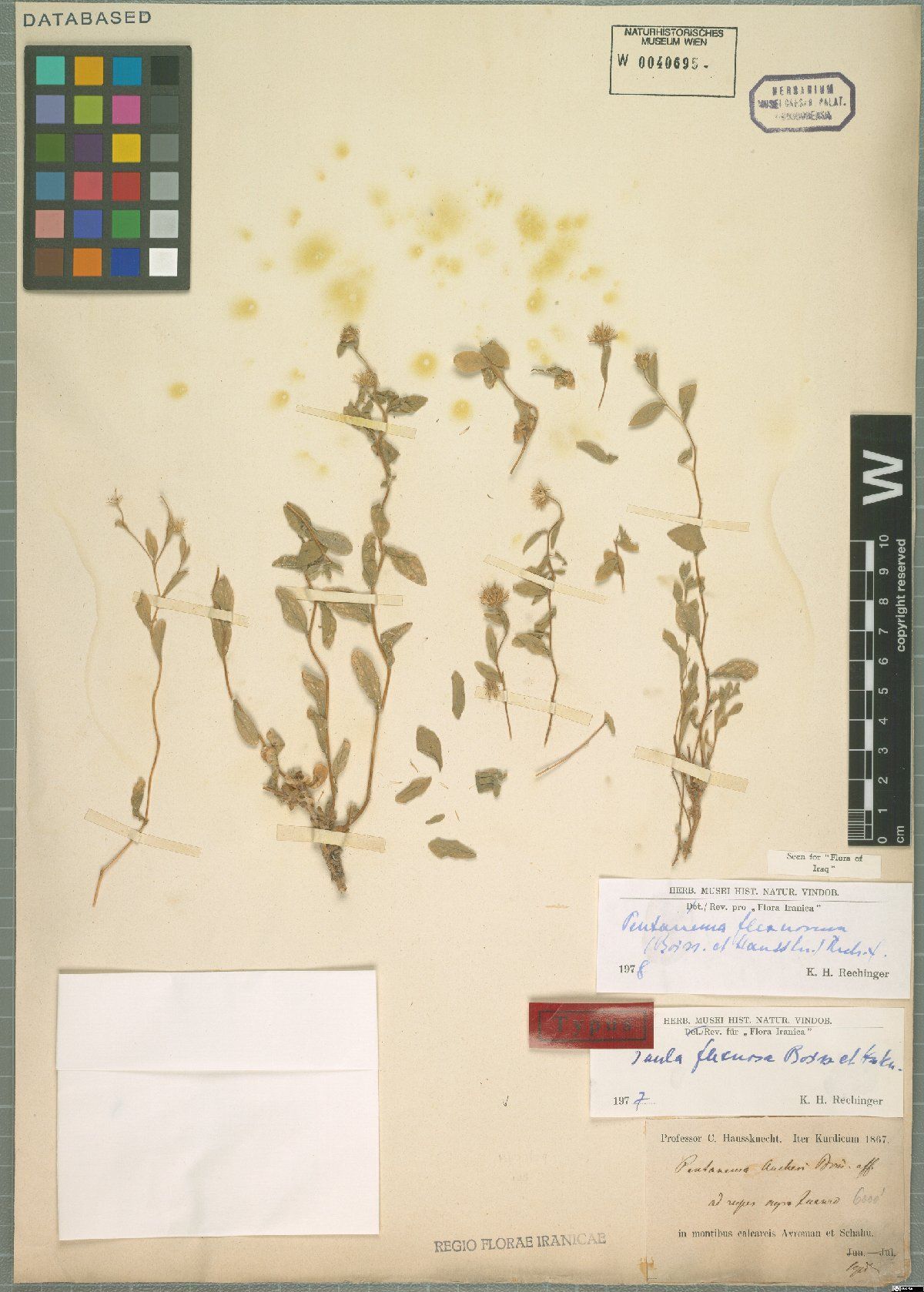
Boissier published it in 1875 as Inula flexuosa, from "the limestone rocks of western Persia above Juanro, 6,000 feet", flowering in August and September[4]. A century later the botanist Karl Heinz Rechinger revised the Vienna sheet for Flora Iranica, where it now carries a red "Typus" label, and in 1980 he moved the species into Pentanema, the genus Haussknecht's label had first suggested, as Pentanema flexuosum[6][2].
The two cousins are easy to confuse. Maroofi and Ghaderi separate P. kurdistanicum by its stems densely covered with white hairs mainly towards the top, its conspicuous hairy resting buds, its smaller leaves, its slightly longer flower heads (5–7 mm against 4–5 mm), outer bracts about as long as the inner ones, and just 5 pappus bristles in the disc florets, against 5–7 in P. flexuosum[1].
Where it grows
Kew's checklist gives its range simply as "Iran"[7]. In Kurdish terms that is two neighbouring mountain ranges of Rojhilat, Şaho and Hewraman, and its authors call it a local endemic found nowhere else[1].
Its home is subalpine cliff. In the authors' words, it "grows in deep grooves on bare rocks, under the situation of the shortage of water and mineral nutrients, at altitudes of 2500 m to 2700 m"[1]. Summers on these high slopes are dry, fairly hot and sunny, and the temperature can swing widely, over the year and between day and night, especially at the surface of the ground[1]. The authors place it in the Irano-Turanian floristic region[1].
Maroofi and Ghaderi call Şaho "one of the completely unknown areas", hardly studied because of its complex terrain and a lack of in-depth research, and they name Haussknecht as the first and best known of the few botanists who collected there[1]. The mountain keeps proving them right. After the bellflower of 2015 and this plant of 2016, Mahfouz Advay described a fritillary, Fritillaria shahuensis, in 2024, from the north-west slope of Şaho near the village of Novin[2].
How rare is it?
Very, as far as anyone knows. Maroofi and Ghaderi found only small populations, each of fewer than 15 to 20 plants, and proposed that it should count as Endangered under the criteria of the IUCN, the international body behind the Red List of threatened species[1]. That is the authors' own assessment: the species has not been formally evaluated for the IUCN Red List[8].
Since its description it has hardly been seen in public. The Global Biodiversity Information Facility (GBIF) holds no record of it, and nobody has posted it on iNaturalist[8][9]. The only photographs of it we found are those in the original paper, taken by Ghaderi[1]. Anyone climbing Şaho or Hewraman in June or July may find a tuft of small yellow flower heads in a crack in the rock: a photograph would be a real addition to what is known of it. Please leave the plant where it grows.
Its name in Kurdish
No Kurdish name has been recorded for this species. Its authors give none[1], and none of the name sources we checked lists it or its genus.
Sources
- 1.Maroofi, H. & Ghaderi, H. (2016). Pentanema kurdistanicum (Inuleae, Asteraceae), a new species from subalpine cliffs of Kurdistan, Iran. Phytotaxa 253(3): 223-226. doi:10.11646/phytotaxa.253.3.7https://doi.org/10.11646/phytotaxa.253.3.7
- 2.International Plant Names Index. Royal Botanic Gardens, Kew, Harvard University Herbaria and Australian National Herbarium.
- abPentanema kurdistanicum Maroofi & Ghaderi. urn:lsid:ipni.org:names:77154209-1.
- cCampanula kurdistanica Advay & Maroofi. urn:lsid:ipni.org:names:77150070-1.
- dauthor record for Heinrich Carl Haussknecht.
- ePentanema flexuosum (Boiss. & Hausskn.) Rech.f., Flora Iranica 145: 102 (1980); Inula flexuosa Boiss. & Hausskn.
- fFritillaria shahuensis Advay, Phytotaxa 662(3): 280 (2024).
- urn:lsid:ipni.org:names:77154209-1. ipni.orghttps://www.ipni.org/n/77154209-1accessed 14 November 2026
- 3.↩Cassini, H. (1818). Aperçu des genres nouveaux formés par M. Henri Cassini dans la famille des Synanthérées, huitième fascicule. Bulletin des Sciences par la Société Philomatique de Paris 1818: 73–75, p. 74.
- 4.Boissier, E. (1875). Flora Orientalis, vol. 3. Geneva & Basel. archive.orghttps://archive.org/details/floraorientaliss03bois
- 5.↩Gutiérrez-Larruscain, D., Santos-Vicente, M., Anderberg, A. A., Rico, E. & Martínez-Ortega, M. M. (2018). Phylogeny of the Inula group (Asteraceae: Inuleae): evidence from nuclear and plastid genomes and a recircumscription of Pentanema. Taxon 67(1): 149–164. doi:10.12705/671.9https://doi.org/10.12705/671.9
- 6.abcNatural History Museum Vienna (W) – Herbarium. via GBIF, herbarium specimen W 0040695 (via GBIF).
- 7.Plants of the World Online. Royal Botanic Gardens, Kew.
- ↩Pentanema kurdistanicum.
- plant_name_id 3114604. powo.science.kew.orghttps://powo.science.kew.org/taxon/urn:lsid:ipni.org:names:77154209-1accessed 14 November 2026
- 8.abGlobal Biodiversity Information Facility (GBIF): Pentanema kurdistanicum, species 9460018 (accessed 15 November 2026).
- 9.↩iNaturalist. Pentanema kurdistanicum, taxon 1262462 (accessed 15 November 2026). inaturalist.orghttps://www.inaturalist.org/
Last updated 20 November 2026