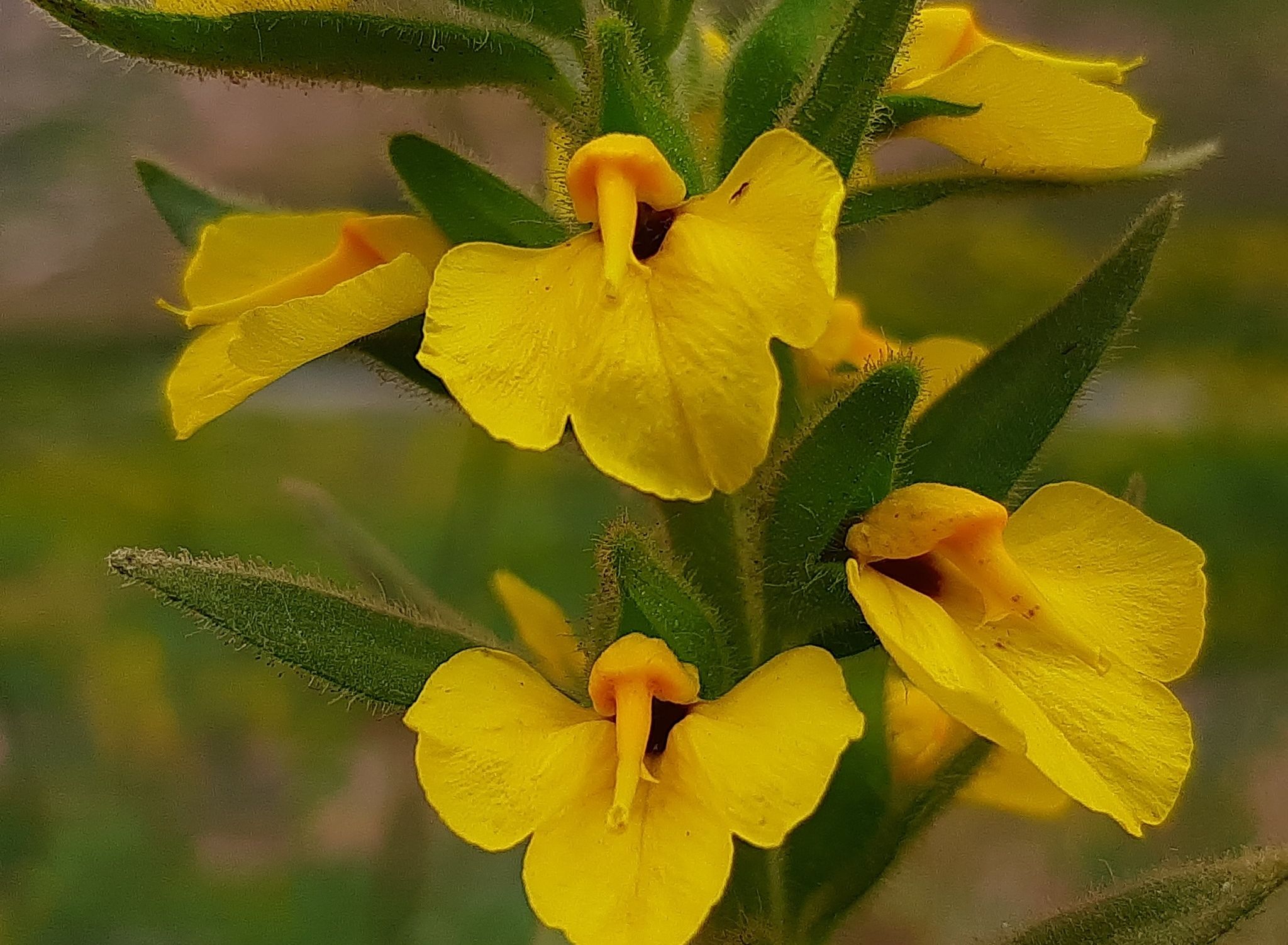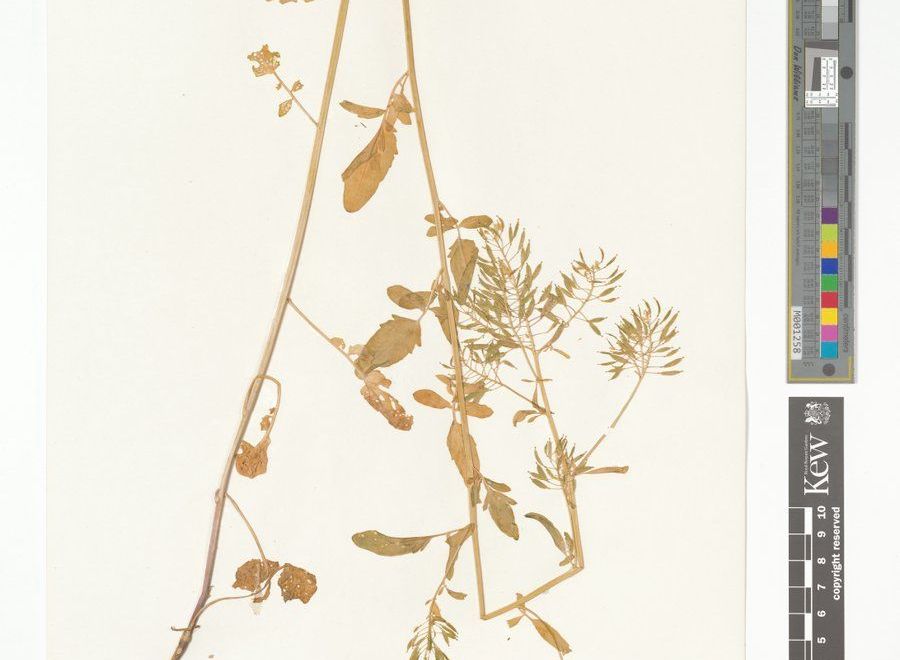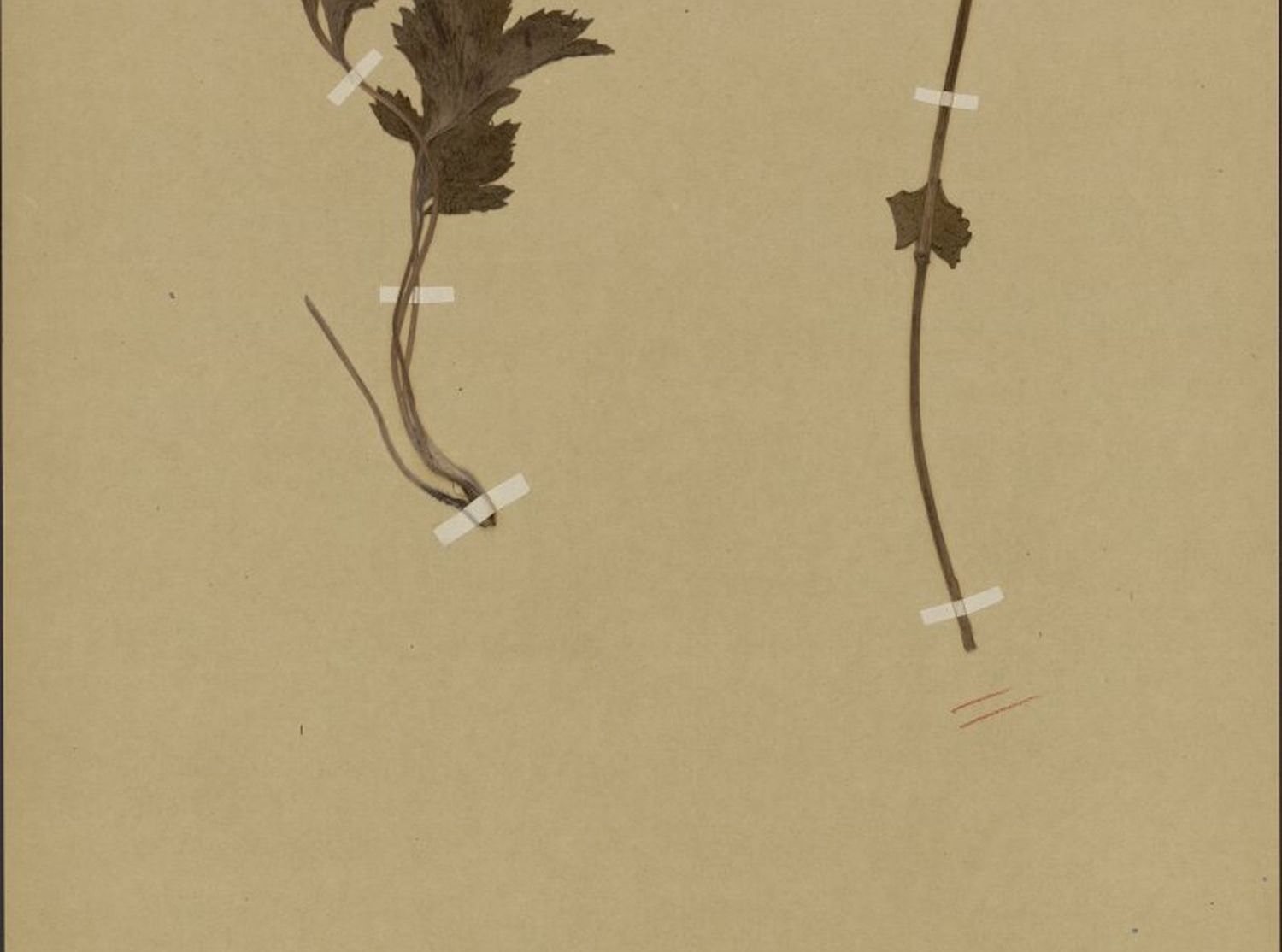
Ranunculus kurdicus is a buttercup of the high mountains of Kurdistan. It grows in wet ground near late snow, by streams and on rock ledges, mostly between about 2,300 and 3,100 metres, in Bakur and Başûr[1][2][3]. It was found in 1859 by a botanist who wrote that he had never thought he could get "so deep into Kurdistan"[4], and it only received the name kurdicus 130 years later, when its first name turned out to belong to a water plant from Bavaria[5][6].
How it got its name
- Named by
- Greuter & Burdet, 1989Published in Willdenowia 19: 46
"So deep into Kurdistan", 1859
In August 1859 the botanist Theodor Kotschy (1813–1866)[5] rode south from Erzîrom (Erzurum) with a painter, crossed the Bingöl mountains and botanised for fifteen days around Gimgim (Varto)[4]. From Mûş he went on to Bidlîs (Bitlis), and from there twice into what he called a terra incognita, an unknown land, once for fifteen days and once for eight[4]. On 31 October, back in Erzurum, he wrote:
Von Musch aus ging ich nach Bitlis, von wo ich in die terra incognita einmal für 15 Tage und zum zweiten Mal für 8 Tage eingedrungen bin. Das nordwestliche Drittel des weissen Fleckes auf den Karten wird jetzt ausgefüllt werden.
From Musch I went to Bitlis, from where I pushed into the terra incognita, once for 15 days and a second time for 8 days. The north-western third of the white patch on the maps will now be filled in.[4] (our translation)
Among the plants he called "very valuable" were "even some from Van and the Müküs"[4] (our translation), and he added: "I never thought I could get so deep into Kurdistan and bring back such a rich haul"[4] (our translation).
One of those plants from Müküs, today Miks (Bahçesaray) in the province of Wan, south of Lake Van, was a buttercup. Kotschy pressed it on 23 September 1859 in damp ground at a place his label calls Chana Putkie, at 8,000 feet[7]. The printed label still sits on a sheet in Paris:
In humidis ad Chana Putkie prov. Müküs Karduchorum alt. 8000'. Die 23. Sept.
In damp places at Chana Putkie, in the province of Müküs of the Karduchians, at 8,000 feet. On 23 September.[7] (our translation)
Karduchorum, "of the Karduchians", is a name out of classical history. The Karduchians are the mountain people whom the Greek soldier and writer Xenophon met on his army's long march home, and whom prisoners, in his Anabasis, describe as "dwelling up on the hills, addicted to war, and not subject to the king"[8]. Nineteenth-century scholars, among them the geographer Heinrich Kiepert, took them to be the Kurds[8], and Kotschy's label uses the name in the same way.
A name that was already taken
The printed labels of Kotschy's 1859 collection already announce the buttercup as a new species, "Ranunculus diversifolius Boiss. et Kotschy sp. nov.", with the botanist Edmond Boissier as co-author[7]. Boissier published the description in 1867 in the first volume of his Flora Orientalis. His Latin places it "in humidis alpinis Armeniæ Kurdicæ", in damp alpine places of what he called Kurdish Armenia, at Chana Putkie near Mükûs, flowering in summer[1].
Diversifolius means "with different leaves" (our translation), and the plant earns it: its root leaves are split into three broad segments, while the leaves up the stem are cut into narrow strips[1].
But the name was not free. In 1789 the botanist Franz von Paula Schrank had already called a buttercup Ranunculus diversifolius: a water plant from around Ingolstadt with a floating stem, hair-like leaves under water and kidney-shaped, hand-shaped leaves above it[6]. Under the rules of botanical naming, a later name spelled exactly like an earlier one for a different plant is illegitimate[9], and so Boissier's name was[5]. Botanists went on using it for more than a century all the same[2].
In 1989 the botanists Werner Greuter and Hervé Burdet (1939–2024) gave the mountain buttercup a new name in the Berlin journal Willdenowia: Ranunculus kurdicus, "Kurdish"[5]. A replacement name is tied to the type of the name it replaces[9], so the plant Kotschy pressed at Miks in 1859 still defines the species[1][5]. The old name lingers: in GBIF, a few herbarium sheets from ponds, a lake and a river in Germany and France, labelled R. diversifolius, are still filed under R. kurdicus[2].
What to look for
Boissier's description, from Kotschy's specimens[1]:
- a perennial with an oblique, short rootstock, fibrous and woolly at the neck;
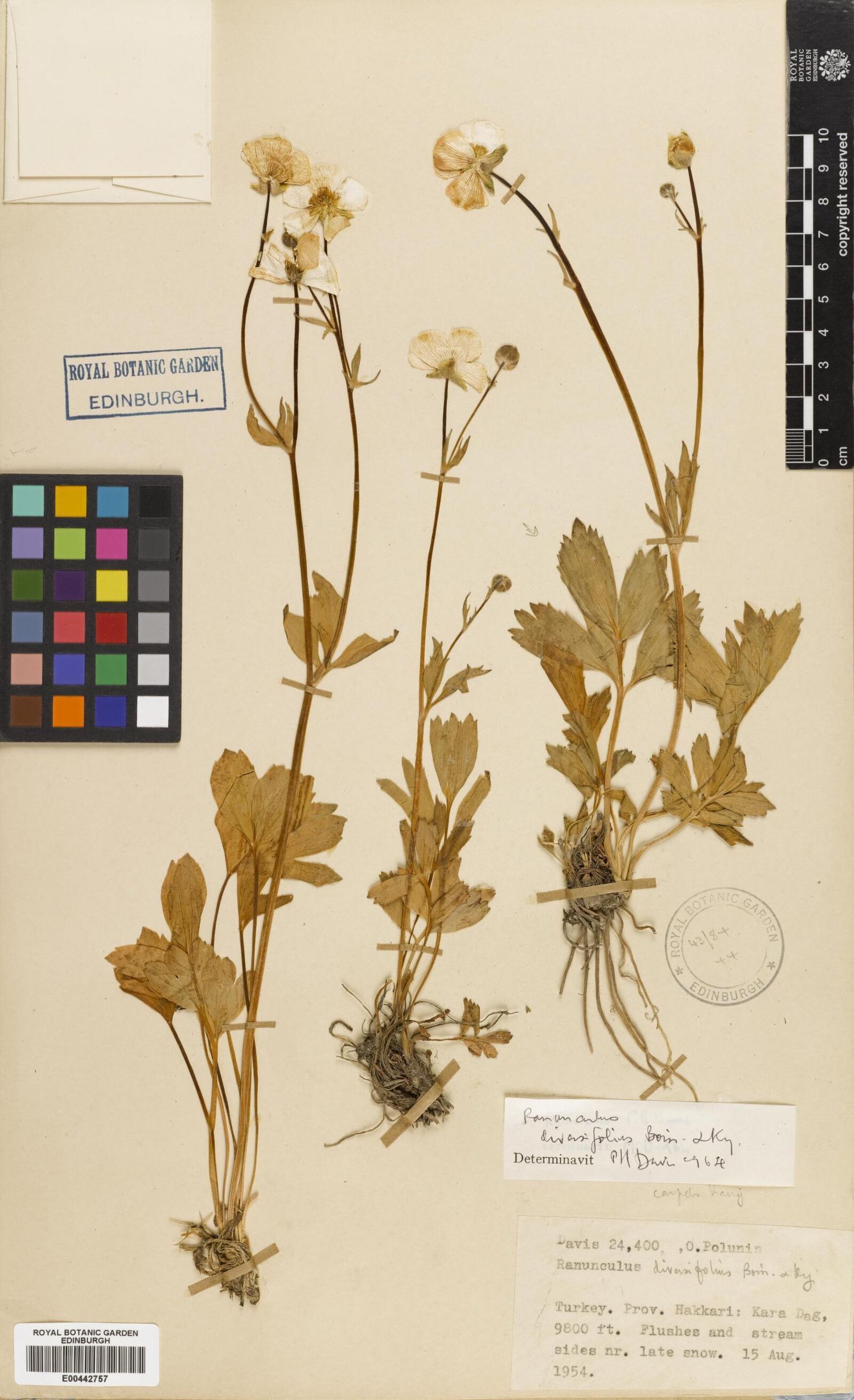
- root leaves on long stalks, 3–4 inches (about 8–10 cm), the stalks with spreading soft hairs at the base; the blade covered in very close-lying hairs and divided into three obovate segments, each 1 to 1½ inches long (about 2.5–4 cm), narrowed to the base and cut or sharply lobed;
- stem leaves cut in a feather pattern into narrow, toothed lobes, the topmost into very narrow, linear strips;
- stems about a foot tall (some 30 cm), forked, with four or five flowers;
- flowers the size of those of the common meadow buttercup (R. acris), with softly hairy sepals that spread rather than fold back;
- fruitlets almost round and smooth, with a short, hooked beak.
Its hairy-fruited twin
On the same journey Kotschy collected a second, very similar buttercup near Mûş, at 8,000 feet on alpine ground just left by the snow[1]. Boissier named it Ranunculus trichocarpus, "hairy-fruited" (our translation). He kept the two apart by two features: in R. trichocarpus the sepals fold back and the fruitlets are hairy, while in R. kurdicus the sepals spread and the fruitlets are smooth[1].
Later botanists have not always agreed. In the Flora of Iran of 1986, Ahmad Parsa treated R. kurdicus as no more than a variety of R. trichocarpus[5]. Kew's checklist today keeps them as two species[10]. In the field the line can blur: a plant collected on Artos above Westan (Gevaş) in 1956 was noted as having yellow flowers with folded-back sepals, but someone has pencilled "glabrous!" on the sheet, and the handwritten identification places it between the two[2].
Where it grows
Kew's checklist gives its range as eastern Turkey to north-western Iran, with records from Turkey, Iraq and Iran[10]. In Kurdish terms it is a plant of the high mountains of Bakur and Başûr, around Lake Van and south to Helgurd; for Iran we found no locality. Most of the records come from the botanists Peter Davis and Oleg Polunin, who collected around Lake Van and in Colemêrg in 1954[2]. The records we found:
- Bakur, Miks (Müküs) in Wan: damp ground at about 8,000 feet, the type locality, 23 September 1859[1][7].
- Bakur, around Lake Van: on Artos above Westan (Gevaş), on rock ledges above a snow patch at 2,750 m (1956) and at about 3,050 m (1954); on Kavuşşahap Dağ in the Satak district, on a rocky slope at 3,100 m (1954)[2].
- Bakur, Bidlîs: on Kars Dağ and Pelli Dağ, at about 2,300 to 3,050 m (1954)[2].
- Bakur, Colemêrg (Hakkâri): by a stream below the Cîlo summer pastures at 9,000 feet (about 2,750 m) and in wet flushes near late snow on Kara Dağ at 9,800 feet (about 3,000 m), August 1954; in the Sat mountains at 1,450 and 2,600 m, June 1966[2].
- Başûr: at 2,400 m on the southern slope of a 2,450 m peak above Sarcal, at the southern foot of Helgurd, 5 June 1960; and at the village of Sakri Sakran in the district of Rewandiz (Rawanduz), 6 June 1961[3]. Emil Hadač collected both, the second with Faisal abd'el Kader; in 2002 he and Jindřich Chrtek noted that the account in Flora of Iraq (1980) listed only five localities[3]. On the same peak, just below the summit, Hadač found another buttercup, R. myosuroides, by melting snow that same day[3].
Most of these places are wet: snow-melt flushes, stream banks, damp alpine ground, with a few rock ledges and rocky slopes[1][7][2]. The specimens were collected between June and September[7][2][3]; Boissier simply wrote "summer"[1].
Kurdish names for buttercups
We found no Kurdish name recorded for Ranunculus kurdicus itself. Sources do give names for buttercups in general, at the level of the genus:
- çûng and pêmirîşk, for the genus Ranunculus, in Edîb Polat's plant list of 2006[11];
- tolatirş, for buttercups (Ranunculus spp.), in Dirihî's plant list of 2007[12];
- kolirka panir and javrashk, the names used by Yezidis and Kurds in Armenia for several buttercups, in a 2016 study of their food plants[13]. The authors translate kolirka panir as "yellow flower"[13].
- In Rojhilat, a 2009 survey recorded چنارکله for another buttercup, R. sericeus, at Merîwan (Marivan)[14].
That 2016 study also records a use. Yezidis and Kurds in Armenia gather the yellow petals of several buttercups and put them in cheese, for flavour, for colour and simply for decoration; the authors had not seen this among other groups in Armenia, and their informants said it was more common in the past[13].
These are records of traditional use, not advice.
Sources
- 1.Boissier, E. (1867). Flora Orientalis, vol. 1. Basel & Geneva: H. Georg.
- adhi1: 22, 45, 47. Geneva & Basel.
- bcj1: 22, 45, 47. Geneva & Basel; p. 45.
- e1: 22, 45, 47. Geneva & Basel; pp. 22, 45.
- f1: 22, 45, 47. Geneva & Basel; p. 47.
- g1: 22, 45, 47. Geneva & Basel; pp. 22, 45, 47.
- p. 45. archive.orghttps://archive.org/details/floraorientaliss01bois/page/n88/mode/1upaccessed 14 November 2026
- 2.abcdefghijRoyal Botanic Garden Edinburgh Herbarium (E), specimen catalogue (via data.rbge.org.uk and GBIF). herbarium specimens E00442757, E00442760, E00442765–E00442767 and others, and further records, via GBIF. data.rbge.org.ukhttps://data.rbge.org.uk/herb/
- 3.Hadač, E. & Chrtek, J. (2002). A contribution to the Ranunculaceae of Iraq. Časopis Národního muzea, Řada přírodovědná 171.
- 4.[Kotschy, T.] (1860). Personalnotizen. Oesterreichische Botanische Zeitschrift 10: 14–15.
- 5.International Plant Names Index. Royal Botanic Gardens, Kew, Harvard University Herbaria and Australian National Herbarium.
- 6.Schrank, F. von P. (1789). Baiersche Flora. 2: 103. Munich.
- 7.abcdefMuséum national d'Histoire naturelle, Paris, herbarium specimen P00186329 (Kotschy, Suppl. 739, 1859), via GBIF.
- 8.abXenophon, Anabasis, Book III, ch. 5, translated by H. G. Dakyns (Project Gutenberg).
- 9.International Code of Nomenclature for algae, fungi, and plants (Shenzhen Code, 2018), Art. 7.4 and 53.1.
- 10.Plants of the World Online. Royal Botanic Gardens, Kew.
- abRanunculus kurdicus, R. trichocarpus.
- plant_name_id 2523844. powo.science.kew.orghttps://powo.science.kew.org/taxon/urn:lsid:ipni.org:names:941185-1accessed 14 November 2026
- 11.↩Edîb Polat (2006). Flora Kurdistanê (I). institutkurde.orghttps://www.institutkurde.org/publications/kurmanci/
- 12.↩Ehmedê Dirihî (2007). Flora Kurdistanê (II). institutkurde.orghttps://www.institutkurde.org/publications/kurmanci/
- 13.Roman Hovsepyan, Nina Stepanyan-Gandilyan, Hamlet Melkumyan, Lili Harutyunyan (2016). Food as a marker for economy and part of identity: traditional vegetal food of Yezidis and Kurds in Armenia. doi:10.1016/j.jef.2016.01.003https://doi.org/10.1016/j.jef.2016.01.003
- 14.↩F. Hooshidari (2009). Medicinal plants of Kurdistan province (گیاهان دارویی استان کردستان). ijmapr.areeo.ac.irhttps://ijmapr.areeo.ac.ir/article_7319.html
- 15.Ahmet Kasımoğlu (Ehmedê Dirihî) (2013). Ferhenga Navên Nebatan a Kurdî (Dictionary of Kurdish Plant Names). Mardin Artuklu University, Institute of Living Languages in Turkey (ISBN 978-605-4202-12-6).
Last updated 20 November 2026