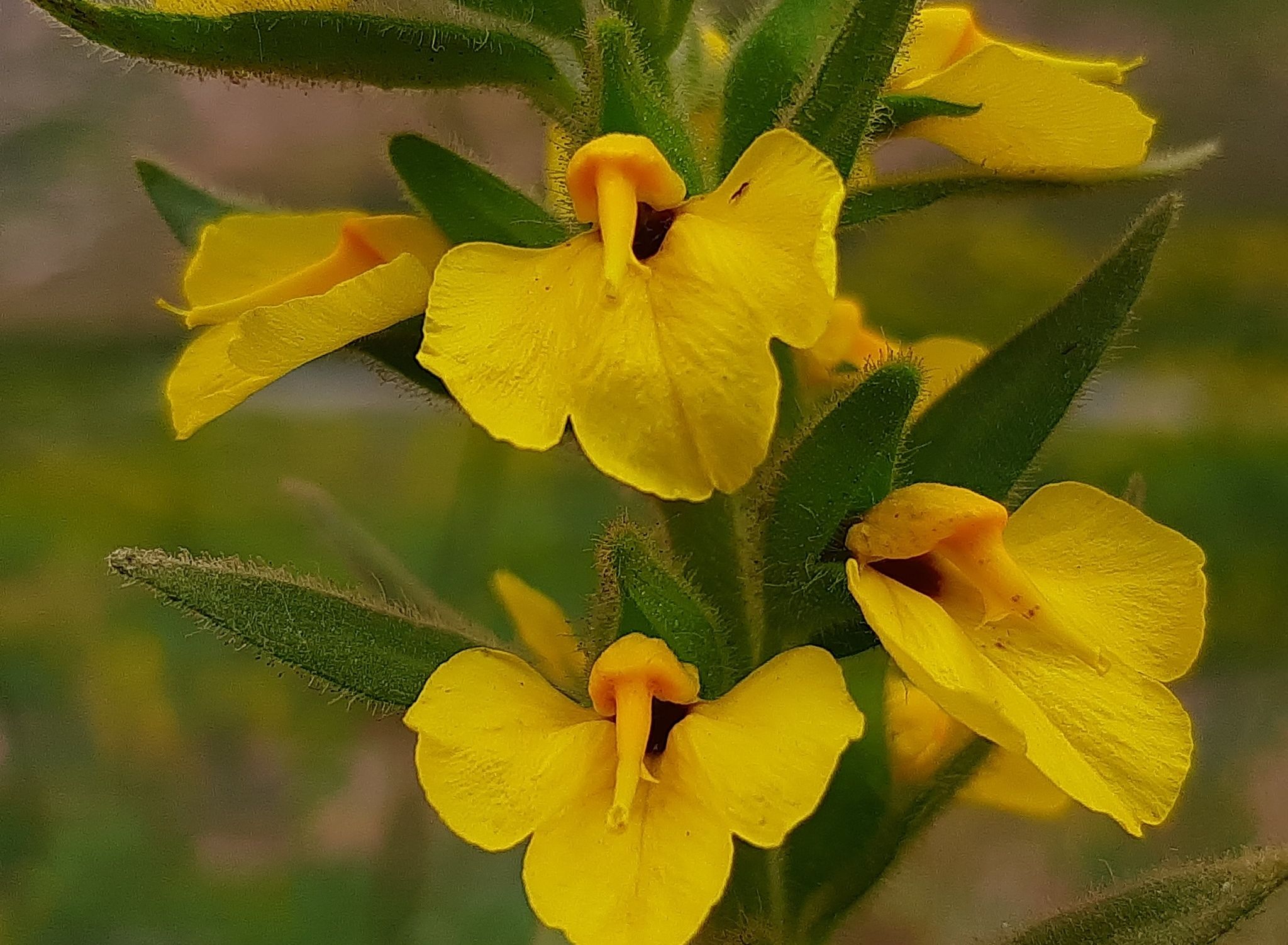
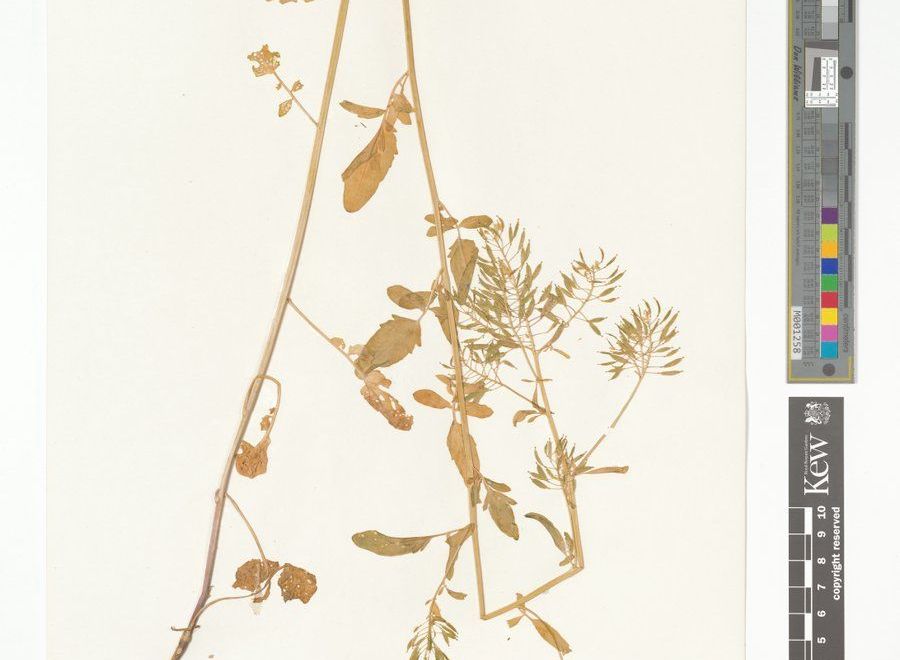
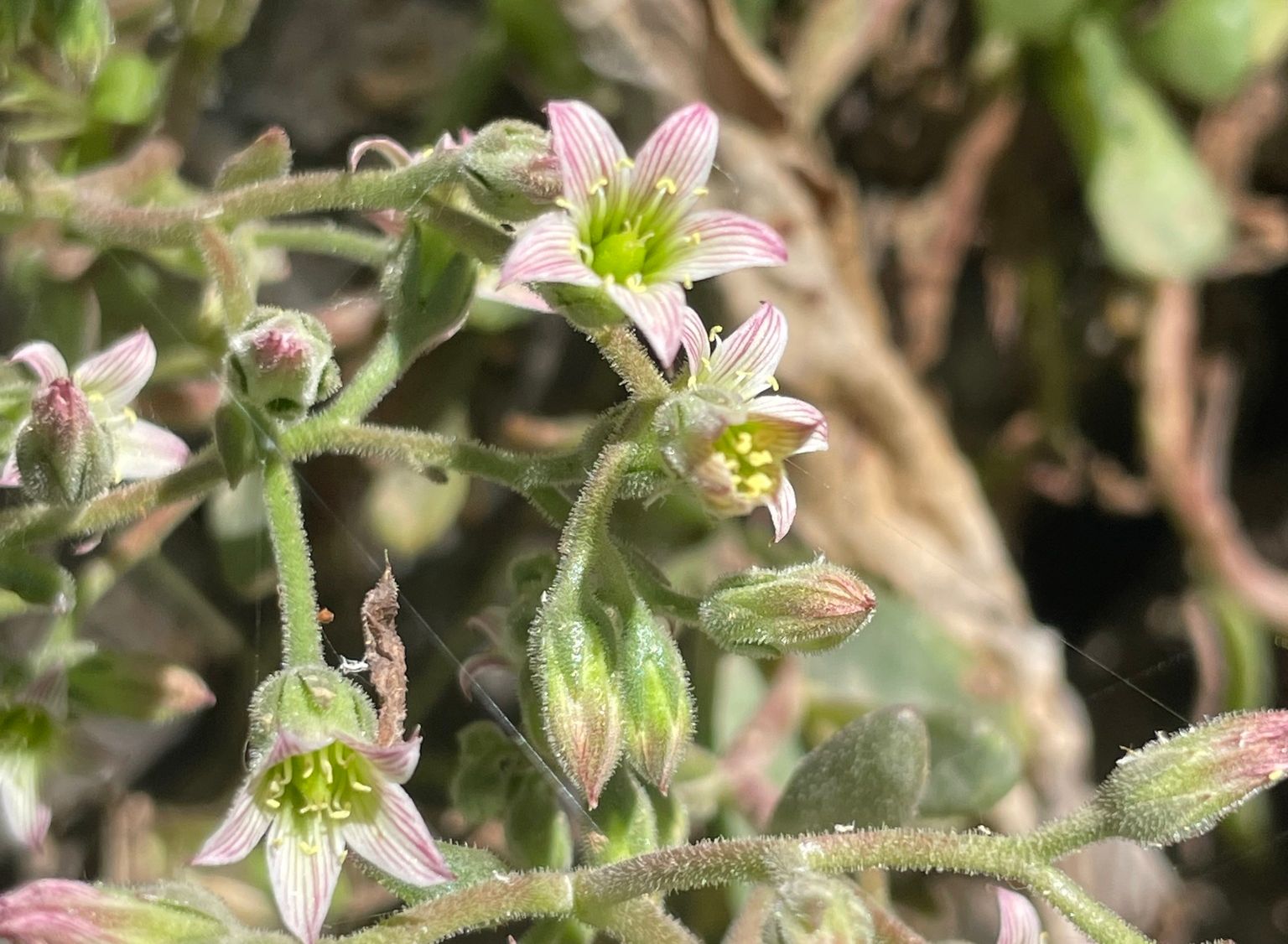
Reseda kurdica is a small, hairless plant of the family Resedaceae, about 15 cm tall, with short, dense racemes of flowers[1]. It is known from a single place: the uplands near Mendelî (Mandali), on the old frontier between the Ottoman and Persian lands, where the pharmacist and botanist Friedrich Wilhelm Noë collected in May 1850 or 1851 (the records differ)[1][2][3][4]. Edmond Boissier described it, named it after Kurdistan, and then, as far as the digitised records go, no one found it again[5][6]. A 1978 monograph of its family treats it not as a species at all, but as a stunted desert form of a widespread white Reseda[4].
How it got its name
- Named by
- Boiss. & Noë, 1867Published in Fl. Orient. 1: 426
A botanist on the frontier commission
Friedrich Wilhelm Noë (1798–1858)[7] was a pharmacist who had worked in Fiume (Rijeka) and later ran the botanical garden of Galata-Serai in Constantinople[8]. In 1849 he joined, as physician and naturalist, the commission led by Derwisch Pasha that travelled the long frontier between the Ottoman Empire and Persia[9]. Edmond Boissier (1810–1885)[7], the Geneva botanist to whom Noë sent his plants, put it this way in the preface to his Flora Orientalis[1]:
Noë, pharmacien de Trieste, attaché à la Commission qui devait fixer les frontières de la Turquie et de la Perse, a fait, en 1851, un assez long séjour à Bagdad et à Mohammera en Babylonie, et m'a envoyé une collection intéressante de cette contrée peu connue.
Noë, a pharmacist from Trieste attached to the Commission that was to fix the borders of Turkey and Persia, made a fairly long stay in Baghdad and Mohammera in Babylonia in 1851, and sent me an interesting collection from this little-known country.[1] (our translation)
Noë returned in 1852 and had to hand his collections from the journey over to the medical school; in early 1854 he planned to go back with his son to collect the region's plants again[9].
A label from Mendelî
The dated specimens Noë collected at Mendelî, in Dresden and Geneva, carry the date May 1851[2][3][10]. For the Reseda itself, his number 1166, the botanists who saw a sheet of it in Dresden give May 1850[4]; we could not see that label to check which year is right. His handwritten labels place the town carefully. One, on a sage, reads "Mendeli (zw. Bagdad u. Kermanschah a. d. pers. Grenze)": between Baghdad and Kirmaşan (Kermanshah), on the Persian border[3]. Another, on an orchid he numbered 1187, adds a regional name[2]:
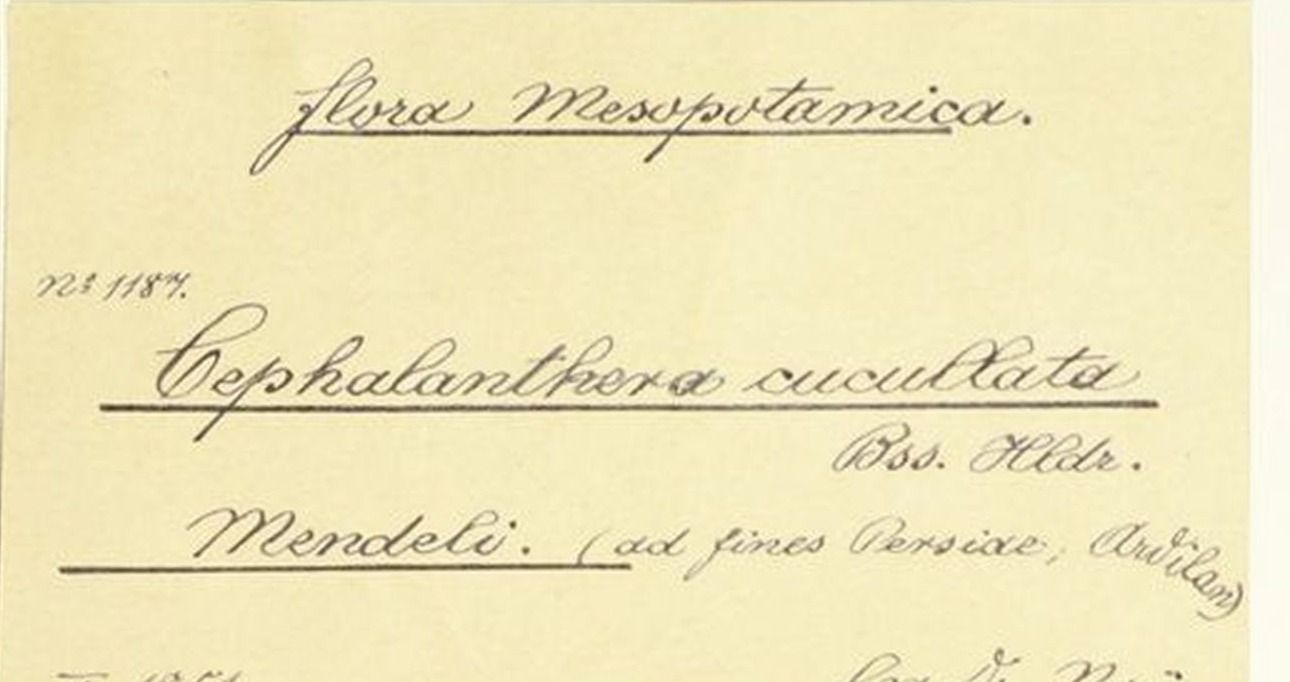
"Ad fines Persiae" means "on the borders of Persia". Ardilan is most likely Ardalan, the name of a Kurdish principality on the Persian side of the frontier. Yet the same labels file his Mendelî plants under "flora Mesopotamica"[2][3], while Boissier, as we will see, placed the same spot in Kurdistan[1]: a town on the edge of both.
Named on a label, published after Noë's death
Among the plants from Mendelî was a small white Reseda. Its name first appeared on the labels of the sets of dried plants Noë sent out ("in Noë pl. exs."), as Reseda kurdica "Boiss. et Noë", a name Boissier and Noë gave it together[1][7]. It was first published with a description in the first volume of Boissier's Flora Orientalis in 1867[1][7], nine years after Noë had died[7].
Boissier's note on where it grew is a single line:
Hab. in subalpinis Kurdistaniæ Persicæ prope Mendeli (Noë!).
It grows in subalpine places of Persian Kurdistan near Mendeli (Noë's specimen, seen by Boissier).[1] (our translation)
The Geneva herbarium's record of another of Noë's plants from the same place, a scorzonera, gives almost the same words: "In subalpinis Persiae in Kurdistania prope Mendeli"[10]. So kurdica, "Kurdish", records Boissier's view of where Mendelî lay: in Kurdistan, on the Persian side of the frontier[1]. Noë himself wrote "Ardilan", the name of a Kurdish principality, on one of his labels[2].
What Boissier saw
Boissier's description is short, and he left one part of it blank[1]:
- a low, hairless plant with several stems from the base, about half a foot (some 15 cm) tall;
- leaves cut into narrow, rather blunt segments;
- flowers fairly large, with their parts in fives, almost without stalks (the stalk shorter than the calyx), in short, dense, narrow racemes;
- petals twice as long as the calyx, the upper ones cut into five lobes;
- marked with a circled 2: a biennial;
- the fruit: "capsulâ....", a row of dots where the description of the capsule should be.
Presumably Noë's plants carried no ripe fruit[1]. Boissier's key to the genus leans heavily on the capsules and seeds[1], so the species was incomplete from the start.
A white-flowered Reseda
Boissier placed it in the first section of the genus Reseda, Leucoreseda, "white reseda": plants with white petals, the upper ones usually three-lobed, flower parts in fives or sixes, upright four-toothed capsules and leaves once or twice cut like a feather[1]. Boissier does not give the petal colour of R. kurdica itself, but placing it here makes it a white-flowered Reseda[1]. In his flora the section had just three species in the whole Orient: R. alba, R. propinqua and R. kurdica[1].
He told the Kurdish plant from its two relatives like this[1]:
- from R. alba, whose flowers are barely larger, by its almost stalkless flowers and its five-cleft upper petals;
- from R. propinqua, which it resembles in habit and in its thin leaf segments, by its petals, twice as long as the calyx rather than about as long, and five-cleft rather than three-cleft. R. propinqua has much smaller flowers and grew, in Boissier's flora, in the deserts of Egypt, on the border of Sinai and Palestine, and in the Syrian desert[1].
A desert form of the white Reseda?
In 1978 Moustafa S. Abdallah and H. C. D. de Wit published the last part of their revision of the whole family Resedaceae, at the agricultural university of Wageningen[4]. They studied a sheet of Noë's number 1166, "Kurdistania, pr. Mendeli", in the Dresden herbarium, and set beside it similar plants from Khuzestan (east of Andimeshk), from the Jazira desert of Iraq, from Jordan and from Syria. All of them, they wrote, "represent poorly developed desert forms of R. alba subsp. decursiva var. propinqua"[4].
So in their arrangement R. kurdica is no longer a species. It is a synonym of a variety of R. alba, the same variety that also takes in Boissier's R. propinqua[4]. That variety has short-stalked flowers, petals about twice as long as the sepals and capsules on stalks 3–5 mm long, and it grows across the range of its subspecies, from North Africa and the eastern Mediterranean as far as Persia[4]. Petals twice as long as the calyx were one of the two features by which Boissier had kept R. kurdica apart from R. propinqua[1]. The authors also list the floras that had used the name R. kurdica before them, among them accounts of the flora of Iraq from 1950 and 1964[4].
Two sheets from Palestine
Only two herbarium sheets in GBIF, the global database of digitised collections, are filed under Reseda kurdica, and neither comes from Kurdistan[5]. Both are in Edinburgh. One was collected by John Ball on stony hills near Mar Saba in Palestine in April 1877, the other by J. E. Dinsmore on hillsides east of Jerusalem; both collectors had named their plants R. propinqua[11][11]. In September 1991 R. Aránega revised both sheets, on slips of the Complutense University herbarium in Madrid (MACB), and gave them a new name: Reseda kurdica[11][11]. Both places lie inside the range Boissier gave for R. propinqua, which includes the desert between Sinai and Palestine[1].
So thirteen years after the monograph had merged the two names, Aránega went the other way and filed plants named R. propinqua under R. kurdica[11][11][4]. Aránega's reasons we could not find out: no published account of this revision turned up in our search. Kew's checklist, for its part, still accepts R. kurdica as a species, and gives it only for eastern Iraq[12]. The line between R. kurdica and R. propinqua has clearly not looked the same to everyone who has studied these plants.
Where it grows
Kew's checklist gives its native range as eastern Iraq[12], which fits Mendelî, today the town of Mandali on the Iraqi side of the border. The only record with a place is still Noë's: "subalpine places … near Mendeli"[1]. Boissier gives no height above sea level and no flowering time[1]; the other plants Noë labelled at Mendelî were collected in May[2][3].
A plant to look for again
There is no photograph of Reseda kurdica on iNaturalist[6], no digitised specimen from Kurdistan[5], and no assessment of its conservation status[5]. Its fruit, as far as we could find, has never been described[1]. It may grow unnoticed in the hills along the border, or it may be, as Abdallah and de Wit thought, a stunted desert form of Reseda alba[4]. Whoever finds a small, hairless white Reseda with five-cleft upper petals near Mendelî in spring could settle a question that has stayed open since 1851.
Kurdish names
No Kurdish name has been recorded for Reseda kurdica itself. Ehmedê Dirihî's dictionary of Kurdish plant names gives two names for the genus Reseda as a whole, from the source he codes AA: kuncî deymî and xakşîr deymî[13]. These are names for the group, not for this species.
Sources
- 1.Boissier, E. (1867). Flora Orientalis, vol. 1. Basel & Geneva: H. Georg.
- abefghijkprtuvp. 426. archive.orghttps://archive.org/details/floraorientaliss01bois/page/n469/mode/1up
- cdp. XXIV. archive.orghttps://archive.org/details/floraorientaliss01bois/page/n469/mode/1up
- lpp. 423–424. archive.orghttps://archive.org/details/floraorientaliss01bois/page/n469/mode/1up
- mop. 423. archive.orghttps://archive.org/details/floraorientaliss01bois/page/n469/mode/1up
- npp. 423, 426. archive.orghttps://archive.org/details/floraorientaliss01bois/page/n469/mode/1up
- qsp. 425. archive.orghttps://archive.org/details/floraorientaliss01bois/page/n469/mode/1up
- p. 426. archive.orghttps://archive.org/details/floraorientaliss01bois/page/n469/mode/1upaccessed 14 November 2026
- 2.abcdefHerbarium Dresdense, TU Dresden, specimen DR 083018 (Noë 1187, Mendeli, May 1851), via GBIF. api.gbif.orghttps://api.gbif.org/v1/occurrence/4100271656
- 3.abcdeHerbarium Dresdense, TU Dresden, specimen DR 049472 (Noë, Mendeli, May 1851), via GBIF. api.gbif.orghttps://api.gbif.org/v1/occurrence/3855119242
- 4.Abdallah, M. S. & de Wit, H. C. D. (1978). The Resedaceae: a taxonomical revision of the family (final instalment). Mededelingen Landbouwhogeschool Wageningen 78-14. edepot.wur.nlhttps://edepot.wur.nl/287583
- 5.abcdGBIF.org GBIF Backbone Taxonomy and occurrence records. org, occurrences of Reseda kurdica (taxon 3916439), accessed 15 November 2026.. api.gbif.orghttps://api.gbif.org/v1/occurrence/search?taxonKey=3916439
- 6.abiNaturalist. Reseda kurdica (taxon 1110489), accessed 15 November 2026. inaturalist.orghttps://www.inaturalist.org/
- 7.International Plant Names Index. Royal Botanic Gardens, Kew, Harvard University Herbaria and Australian National Herbarium.
- abcdeReseda kurdica Boiss. & Noë, urn:lsid:ipni.org:names:715518-1; author records for Noë and Boissier.. ipni.orghttps://www.ipni.org/n/715518-1
- urn:lsid:ipni.org:names:715518-1. ipni.orghttps://www.ipni.org/n/715518-1accessed 14 November 2026
- 8.↩Göttingen University Herbarium (GOET), Index Collectorum: Noë, Friedrich Wilhelm. uni-goettingen.dehttps://www.uni-goettingen.de/en/187065.html
- 9.ab[Anon.] (1853). Personalnotizen. Oesterreichisches Botanisches Wochenblatt 3: 368. zobodat.athttps://www.zobodat.at/pdf/OeBoZ_003_0368.pdf
- 10.abConservatoire et Jardin botaniques de Genève (G) – Herbarium. via GBIF, specimens G00780348 and G00780182 (Noë, Mendeli), via GBIF.. api.gbif.orghttps://api.gbif.org/v1/occurrence/5295107630
- 11.Royal Botanic Garden Edinburgh Herbarium (E), specimen catalogue (via data.rbge.org.uk and GBIF).
- acespecimen E00151029 (Ball 827, 1877), via GBIF.. api.gbif.orghttps://api.gbif.org/v1/occurrence/575010880
- bdfspecimen E00151020 (Dinsmore 3512), via GBIF.. api.gbif.orghttps://api.gbif.org/v1/occurrence/574972428
- 12.Plants of the World Online. Royal Botanic Gardens, Kew.
- abReseda kurdica Boiss. & Noë.. powo.science.kew.orghttps://powo.science.kew.org/taxon/urn:lsid:ipni.org:names:715518-1
- plant_name_id 2525907. powo.science.kew.orghttps://powo.science.kew.org/taxon/urn:lsid:ipni.org:names:715518-1accessed 14 November 2026
- 13.↩Ahmet Kasımoğlu (Ehmedê Dirihî) (2013). Ferhenga Navên Nebatan a Kurdî (Dictionary of Kurdish Plant Names). Mardin Artuklu University, Institute of Living Languages in Turkey (ISBN 978-605-4202-12-6), pp. 495, 854.
Last updated 20 November 2026