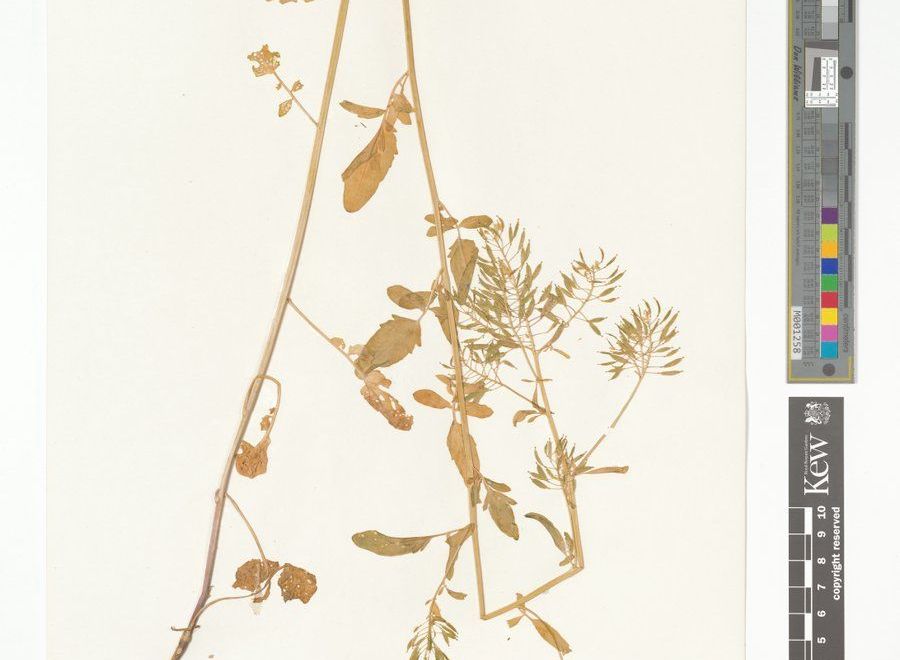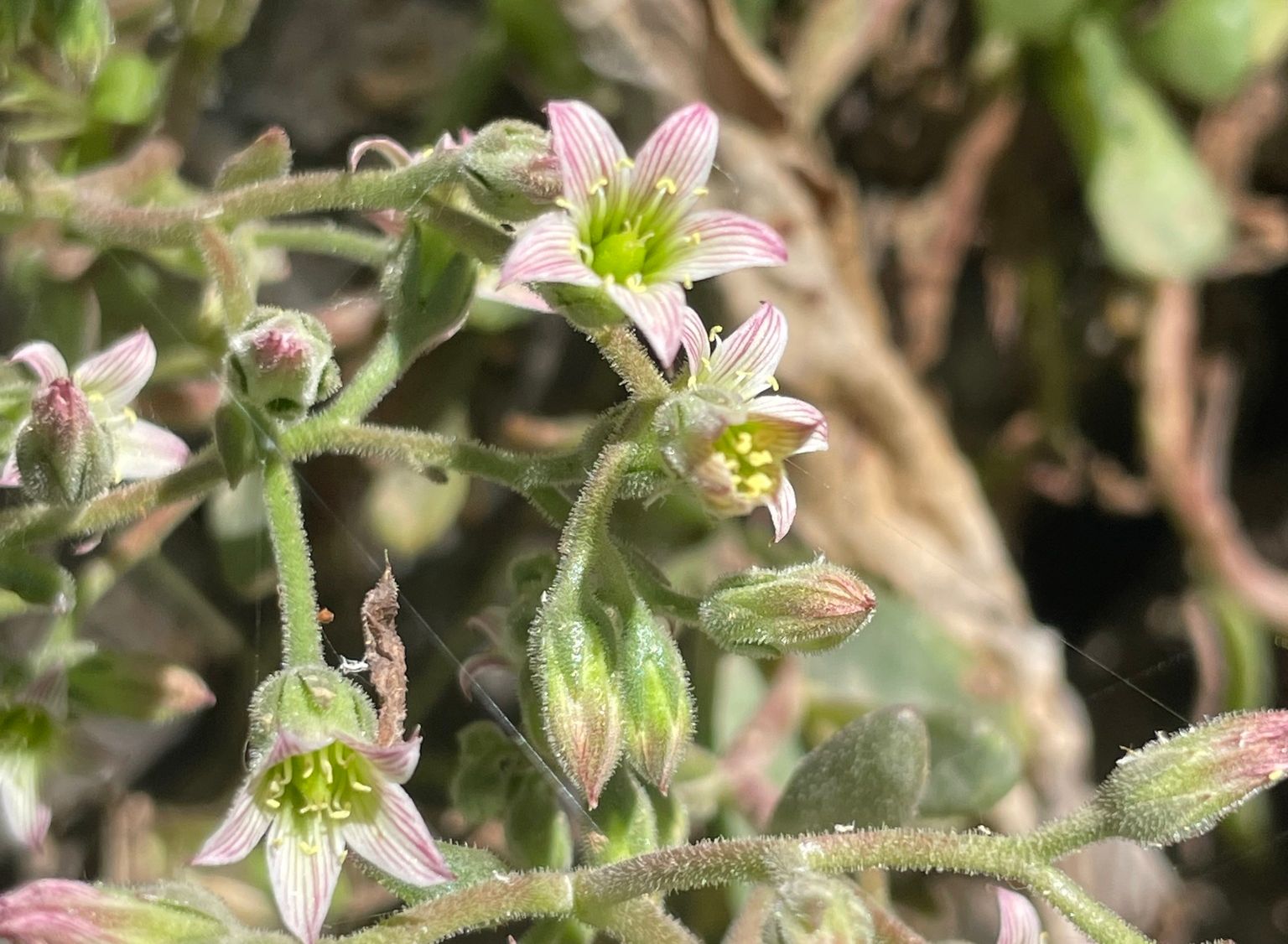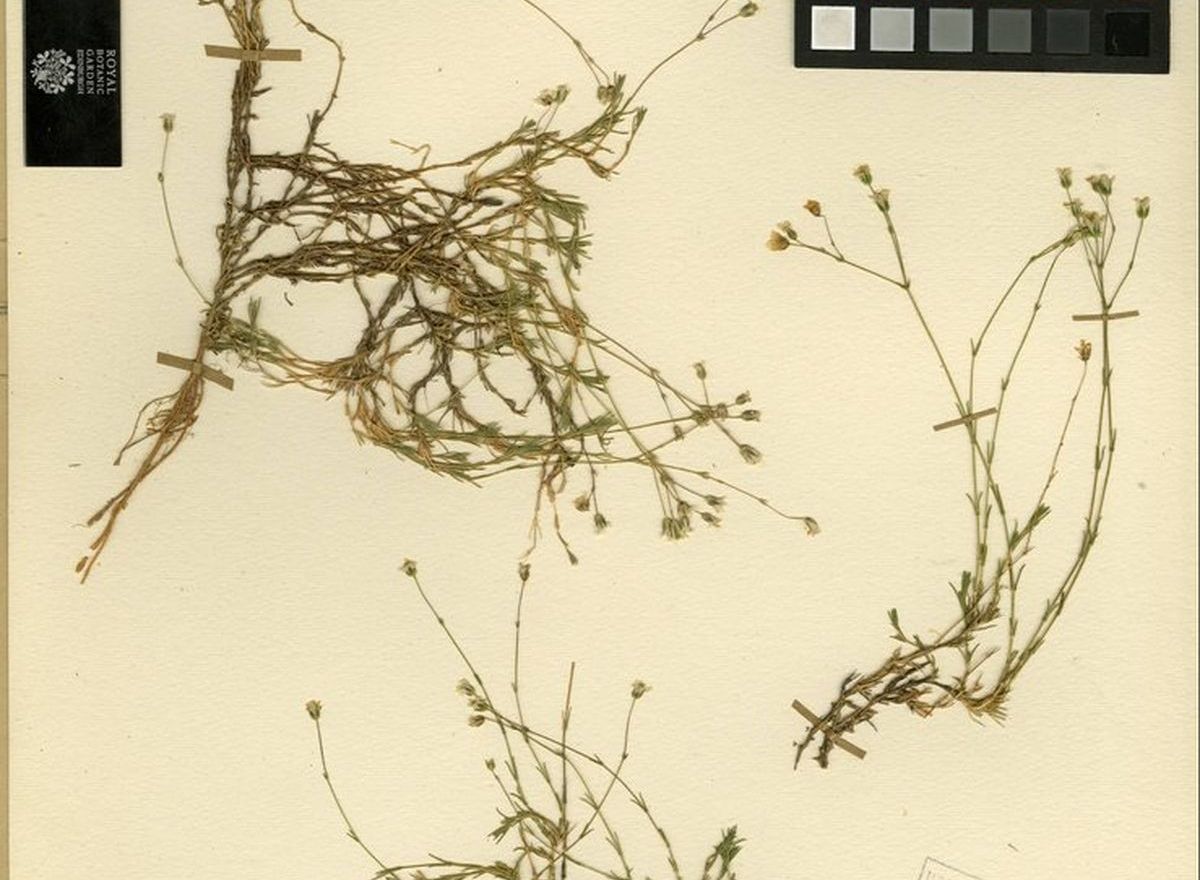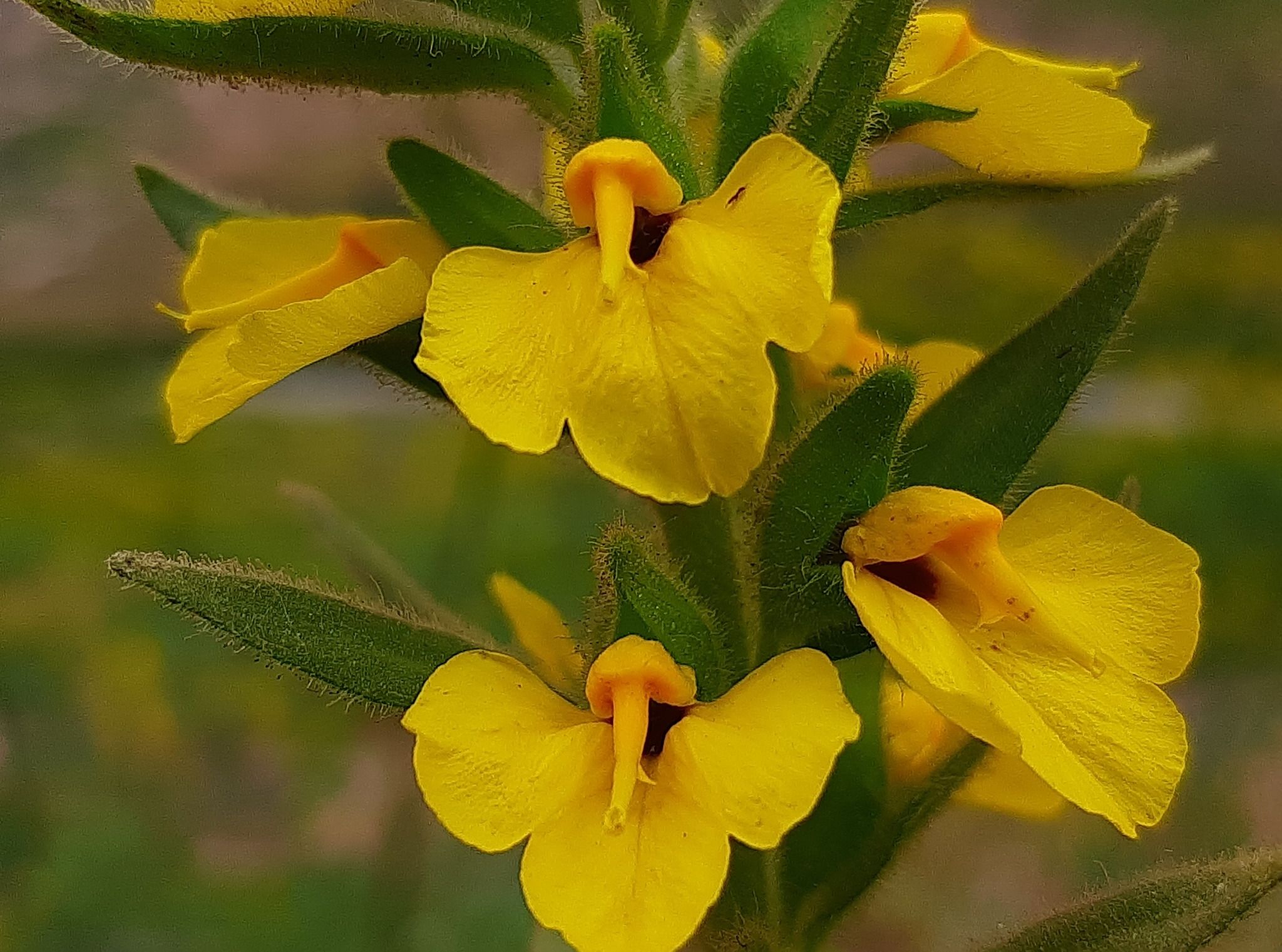
Rhynchocorys kurdica is a tall, golden-flowered mountain plant of the high pastures and rocky slopes of Kurdistan, mostly between about 2,100 and 3,400 metres[1]. Its flowers are shaped like a helmet drawn out into a slender, straight beak, with dark spots at the base of the lower lip[1][2]. It belongs to the broomrape family (Orobanchaceae), in the group of half-parasites that includes the yellow rattles (Rhinanthus)[1][3]. Almost every specimen we found comes from the mountains of North Kurdistan (Bakur) and South Kurdistan (Başûr)[4][1][5][2][2][2][2]; one old sheet comes from further down the Zagros[6].
How it got its name
- Named by
- Nábělek, 1926Published in Spisy Přír. Fak. Masarykovy Univ. 70: 36
A name changed at the last minute
The plant was found on 26 July 1910 by the botanist František Nábělek (1884–1965)[7][8], on a journey of 1909–1910 through Palestine, Syria, Mesopotamia, Kurdistan and western Iran[9][7]. That July he was ill again with malaria, but on 14 July he set out from Sêrt (Siirt) for Wan (Van), through the mountains of the Zozan, Ramoran and Hakkari districts, crossing deep gorges like that of the Botan river[9]. On 26 July he climbed a mountain he called Halakur-Dar, about 2,700 m high, one of the highest summits he climbed on the way to Wan[9]. On humus-rich stony ground at about 2,300 m he collected a tall yellow-flowered plant under his number 1459[4][10].
He was home in Moravia by the end of 1910[9], but for years he lived in the small town of Lipník, where he could not compare his plants with herbarium specimens, and during the First World War he could not go on with the work. Only after moving to Brno in 1921 could he give it all his free time[9]. His handwritten description of the new species, dated 20 December 1925, is still kept with the specimen[10]. It shows that the plant almost had a different name. Nábělek first wrote Rhynchocorys warakensis, after Warak-Dar, a mountain near Wan that he climbed in August 1910[9], and gave its locality as that mountain. Then he crossed both out. Above the struck-out name he wrote Kurdicus, and above the struck-out locality "Kurdistaniae Turcicae distr. Ramorân, in monte Halakur-Dar", the mountain where he had really collected it. The date he had written, 26 July 1910, was never struck out: it was the day he spent on Halakur-Dar[9][10] (our reading of the manuscript).
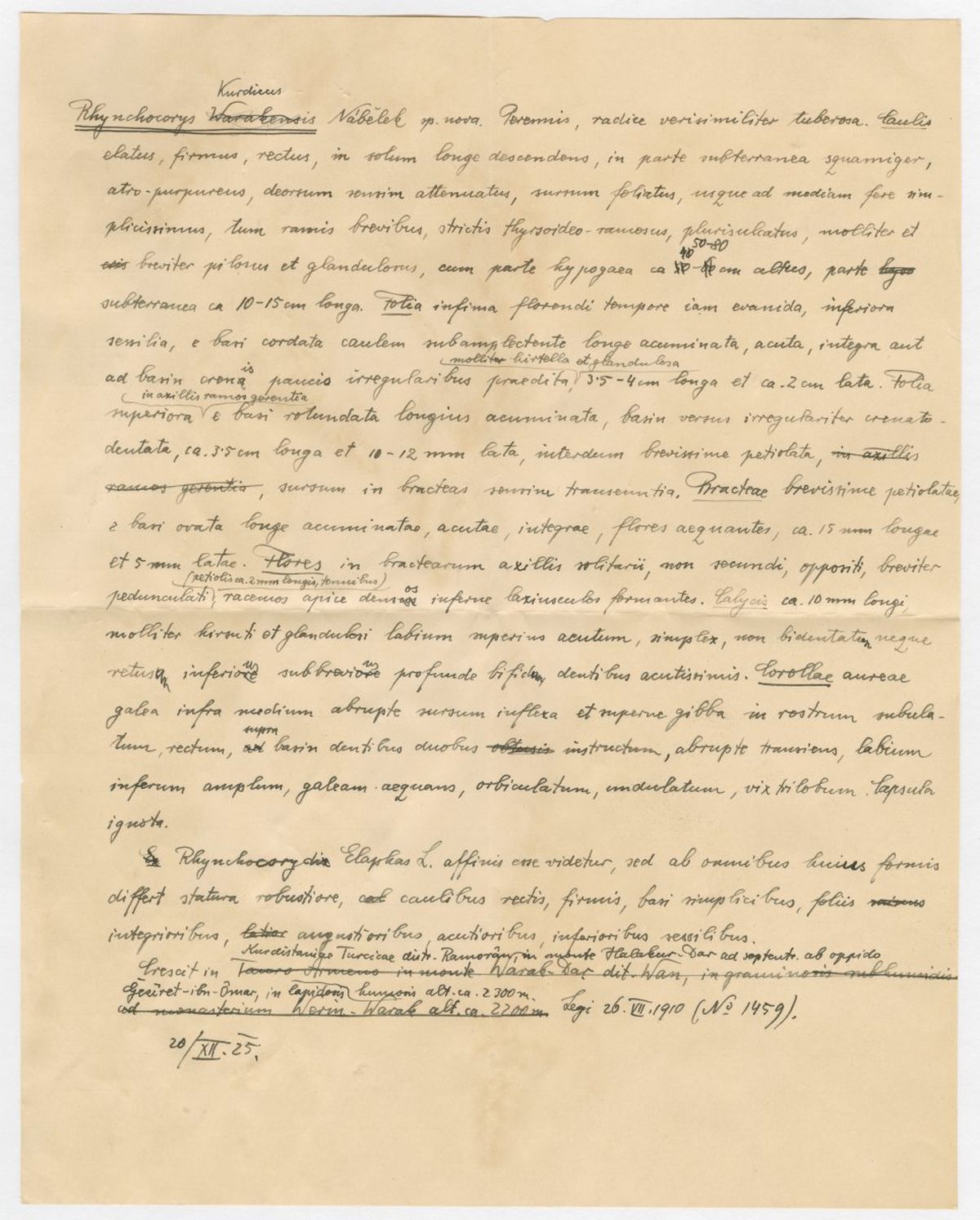
He published it in 1926, in the third part of his Iter Turcico-Persicum, the account of his journey's plants issued by the science faculty of Masaryk University in Brno, with his own drawing of the flower and a photograph of the pressed plant[4]. He spelled it Rhynchocorys Kurdicus; the name is written Rhynchocorys kurdica today[11][8]. The epithet means "Kurdish", after the land where it was found: in the same work Nábělek arranged his localities as Kurdistania Turcica and Kurdistania Persica, Ottoman and Persian Kurdistan[4]. The genus name, from the Greek for "snout" and "helmet", describes the flower: the upper lip forms a helmet, and the helmet ends in a beak [our explanation].
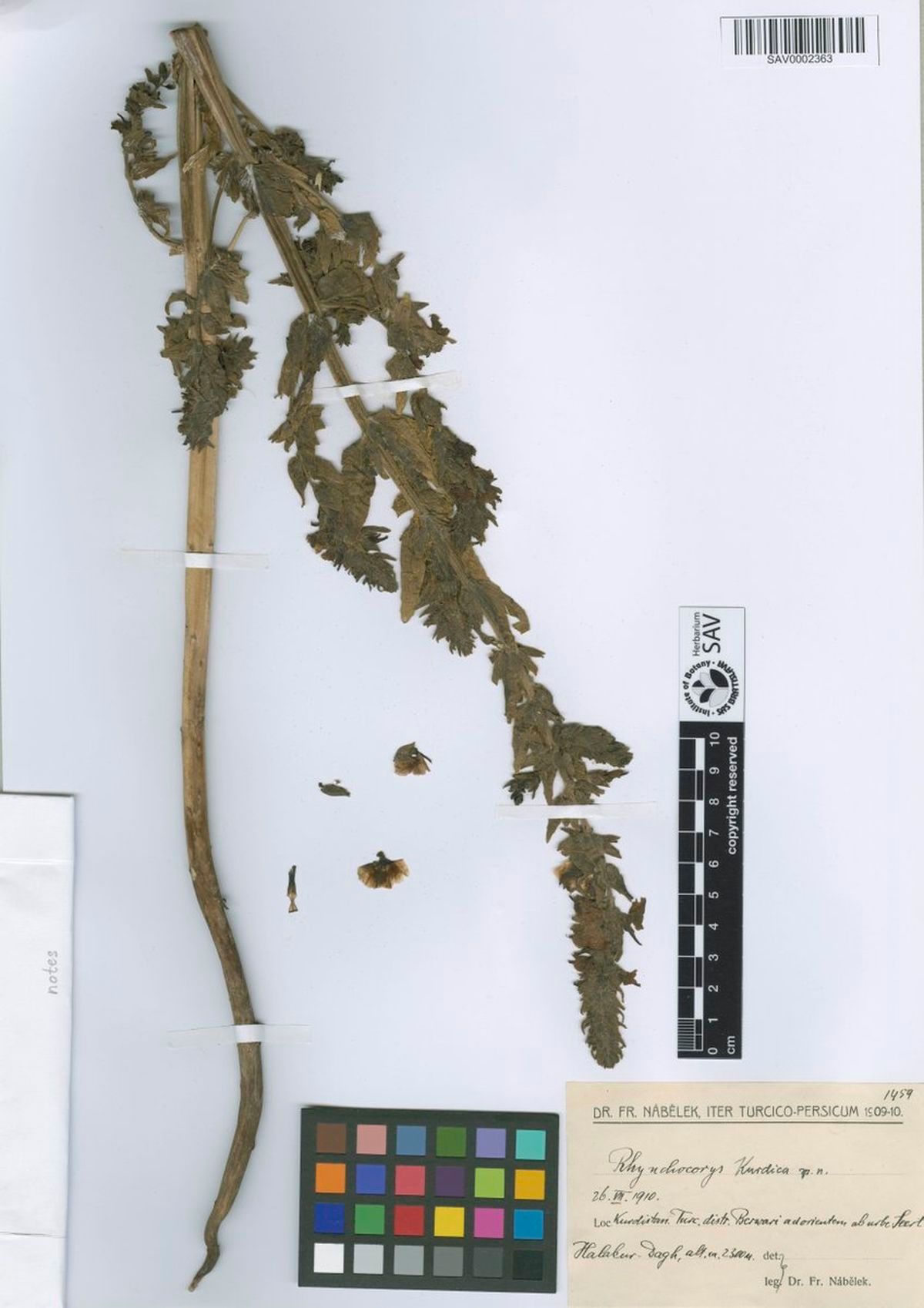
Nábělek's five sheets of number 1459 are kept today in the herbarium of the Slovak Academy of Sciences in Bratislava, where his whole collection of about 6,500 specimens ended up after passing through several herbaria[10][7]. Where exactly Halakur-Dar lies is less certain than it looks. His printed paper puts it in the Ramoran district, north of Cizîr (Cizre)[4], his own label on the sheet in the Berwari district east of Sêrt, and his travel account in the Hakkari district[9][10]. The 1970 revision of the genus, whose authors saw only a photograph of the type, even listed it under Iraq[1].
Close to the elephant's trunk
Nábělek thought his plant was closest to Rhynchocorys elephas, a species whose name compares the beaked flower to an elephant's trunk [our explanation]. He separated it by its much more robust build, stiff, straight stems that are unbranched at the base, and narrower, more pointed, more entire leaves, the lower ones without a stalk[4].
In 1970 R. B. Burbidge and I. B. K. Richardson, writing from the Flora Europaea secretariat at Reading University, revised the whole genus Rhynchocorys, which had been neglected since George Bentham's account of 1846[1]. It was Peter Davis, who had collected the plant himself, who brought the genus to their attention and supervised the work, part of which was done in Edinburgh in 1967–68[1]. They accepted six species, with the greatest concentration in the Caucasus, eastern and northern Turkey, the north of Iraq and northwest Iran[1]. R. kurdica kept its place. In their key and description it stands out by its alternate leaves on the lower stem, its entire leaves, its hairy style and a lower lip more than 1 cm wide[1]. In their overview of the genus, R. kurdica and R. odontophylla stand out as the tall ones, with stout stems up to a metre, while the other species are "much smaller, between 15 and 40 cm in height"[1]. They had no direct proof, but thought it "very likely" that, like the yellow rattles, all Rhynchocorys are half-parasites, green plants that take part of their water and food from the roots of their neighbours[1]. Later DNA studies placed the genus with the yellow rattles in the half-parasitic branch of the broomrape family[3]. How the flowers are pollinated was not known either. Because they are built much like those of a lousewort, Pedicularis groenlandica, the two botanists suggested that bumblebees gathering pollen may be involved[1]. Its closest look-alike in Başûr is R. odontophylla, a species Burbidge and Richardson described in the same paper from a single gathering Davis made in July 1966 east of the Tahir pass, between Eleşkirt and Horasan[1], and first recorded from the Qendîl mountains in 2017; it differs in its toothed leaves and smaller lower lip[12], and its hairs are so dense that the plant looks almost felted and bluish-grey[1].
The same revision named a new subspecies of the elephant's-trunk species from Başûr: R. elephas subsp. carduchorum, from a gathering made in July 1932 on "Arl Gird Dagh", probably Helgurd, in the Rewandiz district[1][5]. Its name means "of the Carduchi", the mountain people that the Greek soldier Xenophon and his army fought their way through around 400 BC [our explanation; the paper does not explain the name]. So two plants of this small genus carry a reference to the Kurdish mountains in their names.
What to look for
- A stiff, upright perennial with a rigid, woody stem, 50 to 100 cm tall, softly hairy and sticky with glands, often branched in its upper half[4][1]. Nábělek dug up a stem that ran 10–15 cm underground, scaly and dark purple there[4].
- Leaves lance-shaped, long-pointed and mostly entire, the lower ones without a stalk and clasping the stem with a heart-shaped base, alternate or scattered low down and opposite above[4][1].
- Flowers single in the axils of the leafy bracts, forming a spike that is dense at the top and looser below[4].
- The corolla is golden yellow. Its upper lip bends sharply upwards into a helmet that ends in a straight, awl-like beak with two small teeth; the lower lip is broad, round and wavy, more than 1 cm wide[4][1]. Burbidge and Richardson describe the flowers of the genus as yellow with two brown or red spots on the lower lip[1]; Davis noted a "dark purple-maroon base to lip"[2]. Their measurements: corolla tube 8–11 mm, beak 5–8 mm, lower lip 12–20 mm across, on flower stalks 5–8 mm long[1].
- The capsule holds 50 to 70 seeds, each about 0.8 mm long, striate and wrinkled: more seeds than any other Rhynchocorys, whose capsules hold from 4 to about 40[1].
Where it grows
Kew's checklist gives its range as southeast Turkey to western Iran, recorded from Turkey, Iraq and Iran[11]. In Kurdish terms that means the high mountains of Bakur and Başûr, where almost every specimen we could check was gathered:
- Bakur: Nábělek's Halakur-Dar, at about 2,300 m[4][10]. In July and August 1954 the botanists P. H. Davis and O. Polunin found it on Artos Dağ above Westan (Gevaş) at 9,500 ft, on Kavuşşahap Dağ in the Şax (Çatak) district at 8,000 ft "through spiny Astragalus", and in a meadow by a stream below the summer pasture of Cîlo (Mount Cilo) at 9,000 ft[2]. Tong found it on Artos Dağ too, at 2,800–3,300 m, and Duncan and Tait on Sat Dağ above Gever (Yüksekova), in a valley north of the lake, at 2,600 m[1]. In June 1966 Davis collected it again on rocky limestone slopes at 2,300–2,400 m, near the pass between Marunis and Elkî (Beytüşşebap), in Colemêrg (Hakkâri) province[2]. In July 2024 it was photographed in flower in the Gever district[13].
- Başûr: the first record came from the Rustam Herbarium's collectors, at a place they wrote "Chia-i-Mandali", at 2,400 m in July 1932; R. A. Blakelock of Kew named it from Nábělek's description[5][2]. In 1957 A. Rawi and I. Serhang gathered it in the Qendîl (Qandil) range northeast of Ranye (Rania), at Lake Kermasu at 2,100–2,600 m and at Malakh on the southern slopes at 2,400–2,600 m, both times in the Astragalus zone[2], and K. H. Rechinger found it above Pushtashan in the Qendîl range at 1,800 m[2].
- A small, almost hairless plant gathered by J. B. Gillett at Ser Kurawa in the Hewlêr (Erbil) district, at 2,900 m among stony slopes on metamorphic rock in August 1947, was left with a question mark: Burbidge and Richardson thought it "may belong to this species" because of its hairy style[1][2].
- Further south in the Zagros, a plant gathered by Theodor Strauss in August 1899 on the mountain he wrote "Schuturunkuh", in Luristan (Lorestan), was first named as a variety of R. elephas and is now filed under R. kurdica in the Jena herbarium[6].
It flowers from June to August[1]; the dated specimens run from 21 June to 11 August[10][2][2][2][2].
Kurdish names
Ehmedê Dirihî's dictionary of Kurdish plant names gives two names for Rhynchocorys kurdica in its Latin index: masîcark and nuklo[14]. Neither name has its own entry in the Kurdish part of the dictionary, so the book does not say where they were recorded. If you know this plant, or another Kurdish name for it, we would like to hear from you.
Sources
- 1.Burbidge, R. B. & Richardson, I. B. K. (1970). A revision of the genus Rhynchocorys. Notes from the Royal Botanic Garden Edinburgh 30(1): 97–107.
- 2.Royal Botanic Gardens, Kew – Herbarium Specimens. via GBIF. gbif.orghttps://www.gbif.org/dataset/cd6e21c8-9e8a-493a-8a76-fbf7862069e5
- aefghpherbarium specimens K005607228, K005607230, K005607231 and K005607232 (Davis and Polunin, via GBIF).
- bjmherbarium specimens K005607160 and K005607163 (Rawi & Serhang 18293 and 18244, via GBIF).
- clnherbarium specimen K005607162 (Gillett 9785, via GBIF).
- dkoherbarium specimen K005607164 (Rechinger 11069, via GBIF).
- iherbarium specimen K005607161 (Rustam Herbarium 2853, via GBIF).
- 3.abTěšitel, J., Říha, P., Svobodová, Š., Malinová, T. & Štech, M. (2010). Phylogeny, life history evolution and biogeography of the rhinanthoid Orobanchaceae. Folia Geobotanica 45: 347–367. doi:10.1007/s12224-010-9089-yhttps://doi.org/10.1007/s12224-010-9089-y
- 4.Nábělek, F. (1926). Iter Turcico-Persicum. Pars III. Plantarum collectarum enumeratio. Spisy vydávané přírodovědeckou fakultou Masarykovy university 70: 36–37.
- 5.Blakelock, R. A. (1949). The Rustam Herbarium, 'Iraq. Systematic List. Part III. Kew Bulletin 4(4): 528.
- 6.abHerbarium Haussknecht, Jena (JE), specimen records (JACQ) via GBIF. Jena, specimen JE 00019791 (Strauss, 1899, via GBIF). api.gbif.orghttps://api.gbif.org/v1/occurrence/3028980654
- 7.abcKempa, M., Edmondson, J., Lack, H. W., Smatanová, J. & Marhold, K. (2016). František Nábělek's Iter Turcico-Persicum 1909–1910 – database and digitized herbarium collection. PhytoKeys 75: 69–79. doi:10.3897/phytokeys.75.9780https://doi.org/10.3897/phytokeys.75.9780
- 8.International Plant Names Index. Royal Botanic Gardens, Kew, Harvard University Herbaria and Australian National Herbarium.
- aauthor record for František Nábělek.
- bRhynchocorys kurdica Nábělek; Rhynchocorys elephas subsp. carduchorum R.B.Burb. & I.Richardson.
- urn:lsid:ipni.org:names:808882-1. ipni.orghttps://www.ipni.org/n/808882-1accessed 14 November 2026
- 9.Nábělek, F. (1923). Iter Turcico-Persicum. Pars I. Plantarum collectarum enumeratio. Spisy vydávané přírodovědeckou fakultou Masarykovy university 35: 5–11.
- 10.abcdefgSlovak Academy of Sciences herbarium (SAV), specimens SAV0002363–SAV0002367, Nábělek 1459 (via GBIF).
- 11.Plants of the World Online. Royal Botanic Gardens, Kew.
- abRhynchocorys kurdica.
- plant_name_id 2527964. powo.science.kew.orghttps://powo.science.kew.org/taxon/urn:lsid:ipni.org:names:808882-1accessed 14 November 2026
- 12.↩Sardar, A. Sh. (2017). A new record of Rhynchocorys odontophylla Burbidge & Richardson (Scrophulariaceae) for Flora of Iraq. Diyala Journal for Pure Science 13(2): 270–281. doi:10.24237/djps.1302.286Ahttps://doi.org/10.24237/djps.1302.286A
- 13.↩iNaturalist. observation 234074211 (Serdar Ölez, 2024). inaturalist.orghttps://www.inaturalist.org/
- 14.↩Ahmet Kasımoğlu (Ehmedê Dirihî) (2013). Ferhenga Navên Nebatan a Kurdî (Dictionary of Kurdish Plant Names). Mardin Artuklu University, Institute of Living Languages in Turkey (ISBN 978-605-4202-12-6), p. 1145.
- Herbarium SAV (Bratislava), sheet SAV0002363 (Rhynchocorys kurdica; Nábělek), via GBIF. SAV0002363. api.gbif.orghttps://api.gbif.org/v1/occurrence/1831341278accessed 14 November 2026
Last updated 20 November 2026