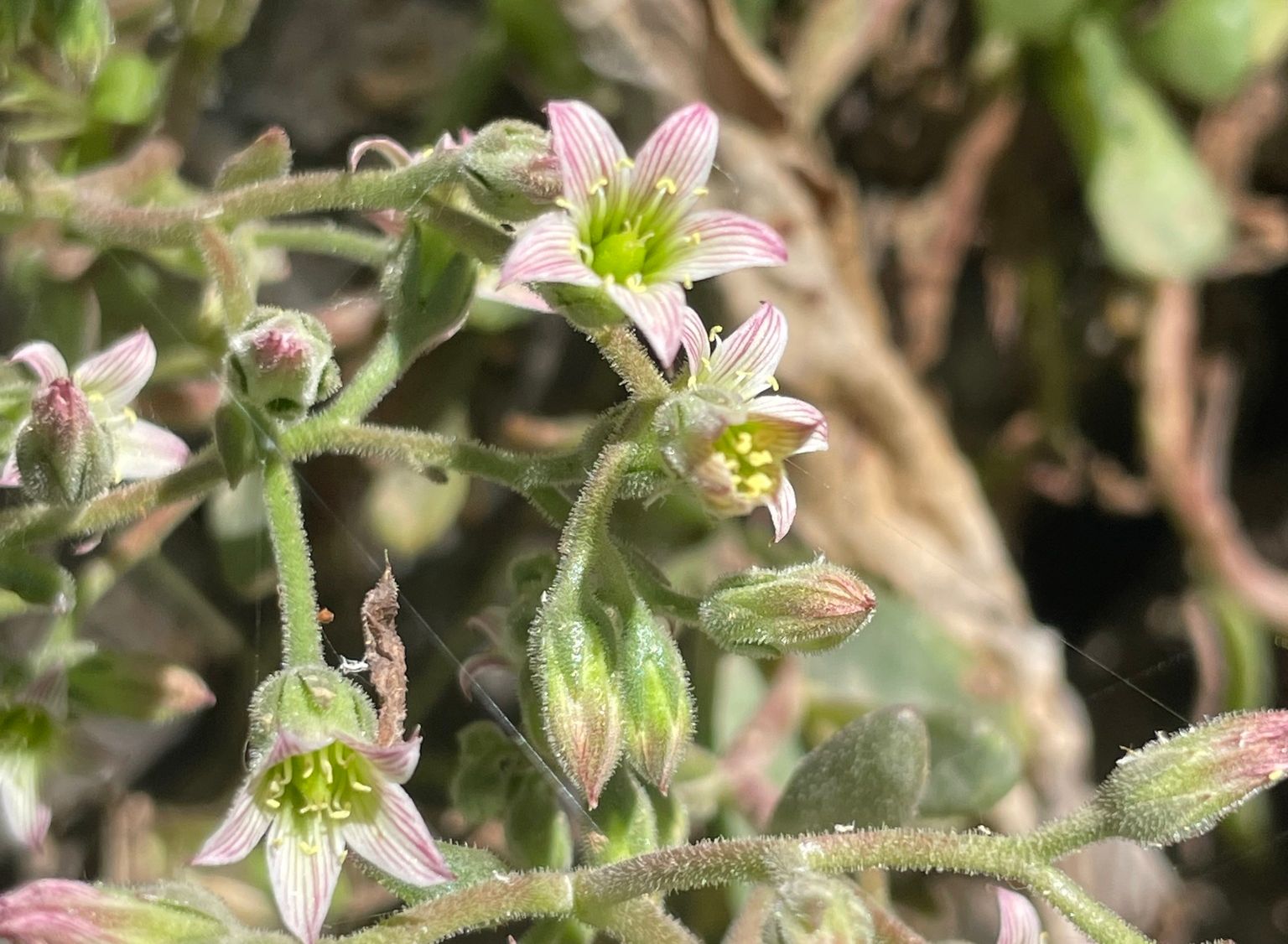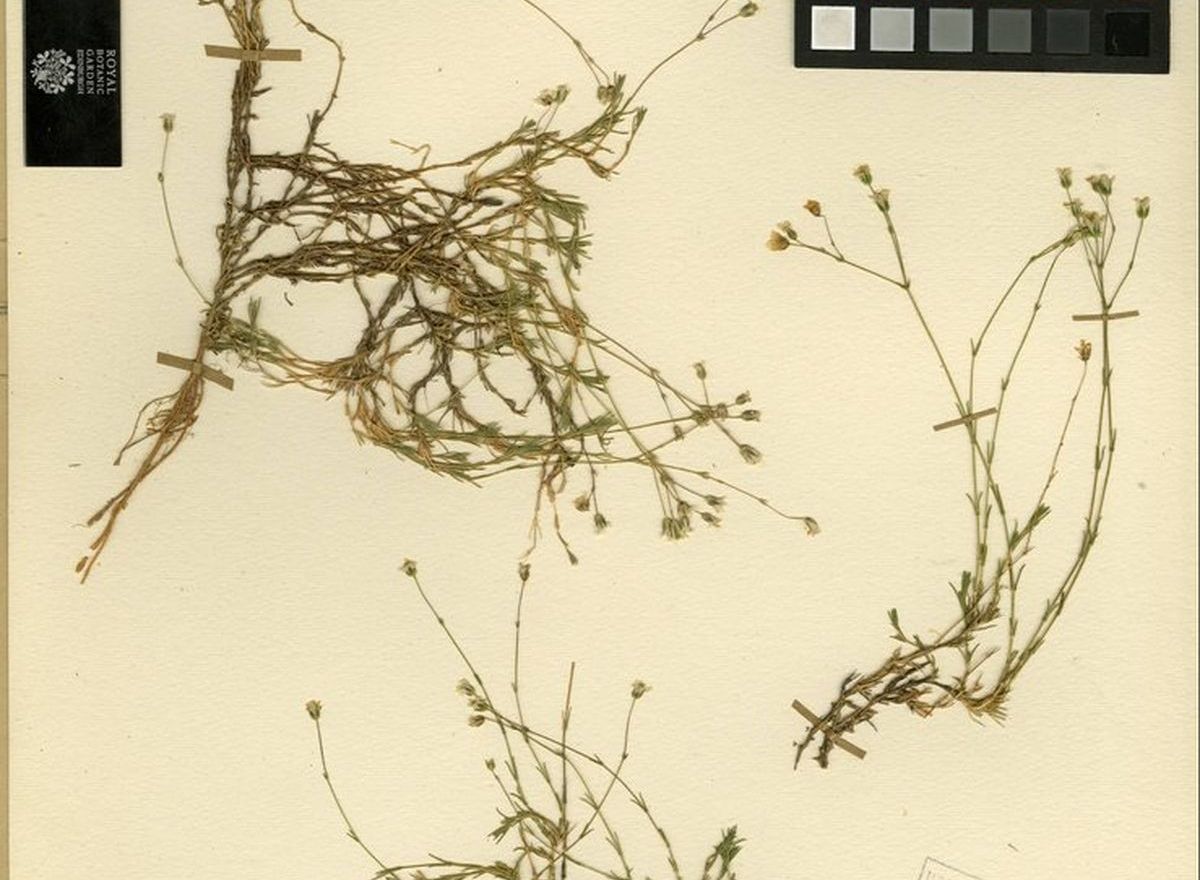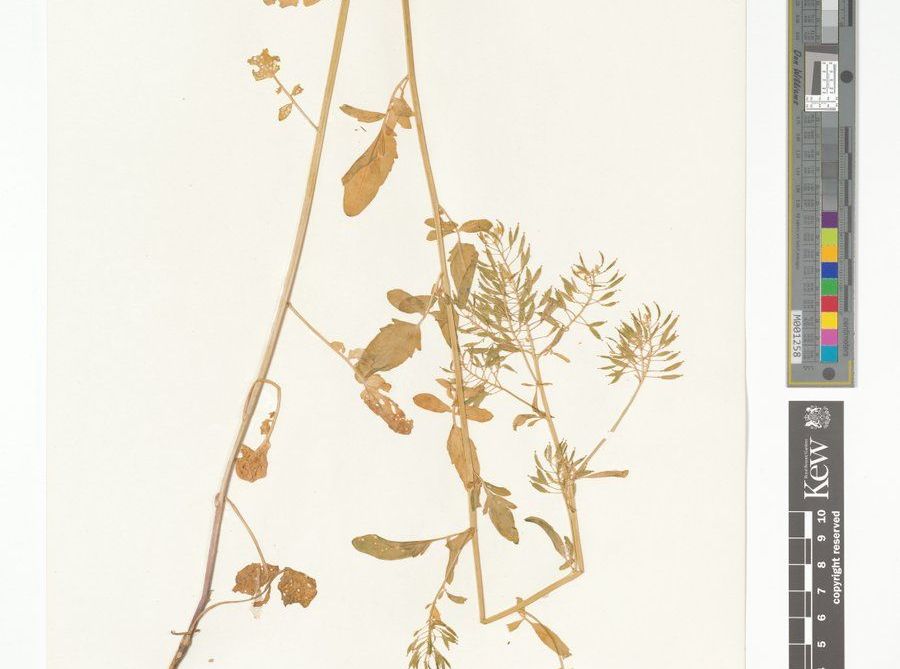
Rorippa kurdica is a yellow-flowered cress of mountain streams in East Kurdistan (Rojhilat)[1][2]. It is a stout perennial, often knee-high or more, with ascending, much-branched stems, leaves cut into a few large lobes and loose sprays of small yellow flowers that turn into short, thick pods[1]. It belongs to the cabbage and mustard family (Brassicaceae), in the genus of the yellowcresses, Rorippa[2][3]. Every specimen we could find was gathered in the mountains around Sine (Sanandaj), or on the way from there towards the border with South Kurdistan (Başûr), and no photograph of a living plant seems to exist[4][5][6][5][7][8].
How it got its name
- Named by
- (Boiss. & Hausskn.) Hedge, 1968Published in Fl. Iranica 57: 217
Found in 1867, published after Boissier's death
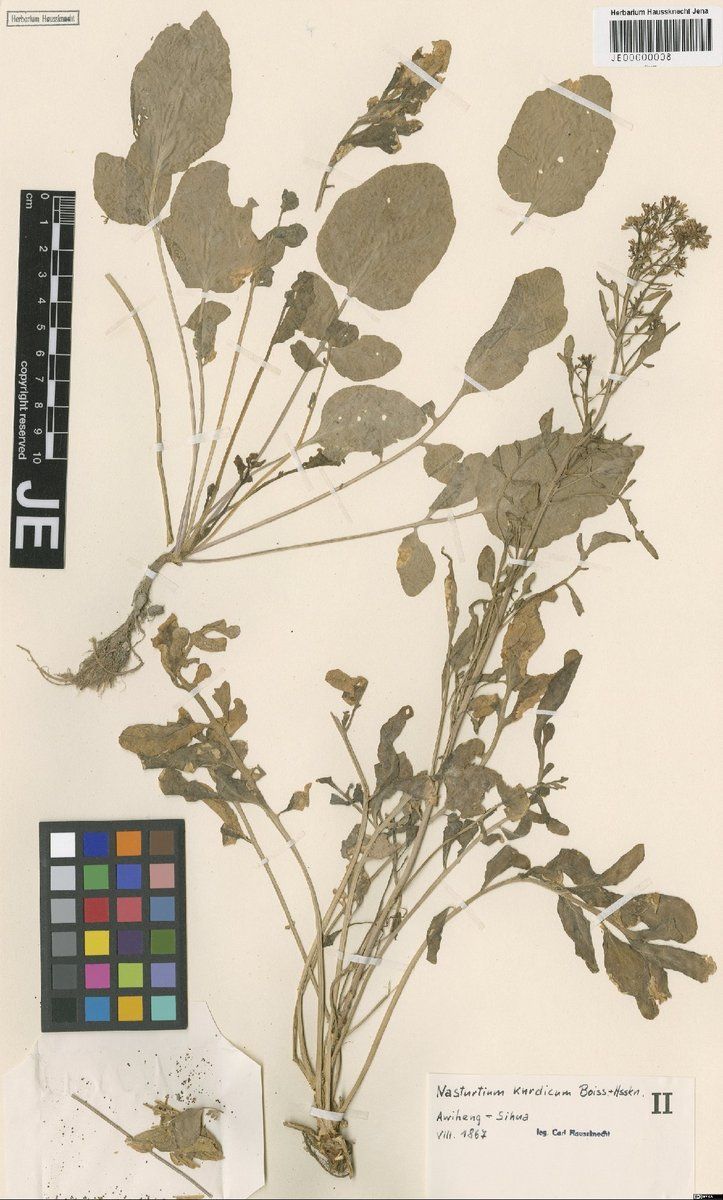
In the summer of 1867 the botanist Heinrich Carl Haussknecht (1838–1903)[9] was in the mountains of Rojhilat, then called Persian Kurdistan, on his journey through Persia (1867–1869)[1][10]. Beside the streams between a large village he wrote Awiheng and the town he wrote Sihna, at 5,000 to 7,000 feet (about 1,500 to 2,100 m), he gathered a tall yellow-flowered cress[1][11]. His diary, published in 2024, shows when he was on that road: he reached Awiheng on 17 August 1867 and rode on through the night to Sihna, where he arrived on 18 August[10]. On one of his labels he noted its yellow flowers and added, with an exclamation mark, Spec. nov.!: "new species!"[4] (our reading of the handwriting).
His specimens went to Geneva, to Edmond Boissier (1810–1885)[9], who was writing Flora Orientalis, the great flora of the Near East, and to herbaria across Europe: duplicates are kept today in London (at the Natural History Museum and at Kew), Jena, Paris and Vienna[11]. One of Kew's sheets carries the note "Recd 6/70", probably received in June 1870[5].
Boissier did not live to publish the plant. He died in 1885, and his notes were brought out in 1888 by R. Buser, the curator of the de Candolle herbarium, as a supplement to the Flora[1]. There, on page 35, the plant appears as Nasturtium kurdicum Boiss. & Hausskn., to be inserted before Nasturtium silvestre[1], the creeping yellowcress now called Rorippa sylvestris[12]. The epithet kurdicum means "Kurdish": Boissier's locality reads, in Latin, "by the streams of the mountains of Persian Kurdistan near Awiheng and Sihua"[1].
Hab. ad rivulos montium Kurdistaniae Persicae prope Awiheng et Sihua 5-7000' (Haussk.!).
By the streams of the mountains of Persian Kurdistan near Awiheng and Sihua, 5,000–7,000 feet (Haussknecht's specimen, seen by Boissier).[1] (our translation)
In 2019 Ihsan Al-Shehbaz and Gabrielle Barriera, going through every cress name in Boissier's Flora, found that the sheet Boissier himself had used, kept in his herbarium in Geneva, is a folder of two sheets, one of them with Haussknecht's handwritten label. They identified it as the holotype, the single specimen the name hangs on[11].
Sihua or Sihna?
The printed Flora says "Sihua"[1], and so does a later label in Jena[4]. The handwritten labels at Kew and in Vienna are catalogued as "Sihna"[5], and that is the spelling Boissier uses elsewhere in Flora Orientalis for Haussknecht's other plants from the same mountains: "between Awiheng and Sihna", and "between Sihna and Kermanchah"[6] (our translation). Haussknecht's own diary settles the question. He writes the town Sihna throughout, and describes it as the seat of Aman Allah Khan, who had been, in his words, "Wali of Kurdistan" for seventeen years [our translation]; the editors of the 2024 edition identify it as today's Sanandaj[10]. Sihna is Sine, the Kurdish name of Sanandaj, and "Sihua" in the printed Flora is a misreading of it[1][5][6][10] (our conclusion). Every later specimen of the plant was also collected around Sine[5][8].
The diary also shows what Awiheng was. Haussknecht set out from Pêncwên (Penjwen) on 13 August[10] and on 17 August came to Awiheng, a village of about a thousand flat-roofed houses, built in terraces on a foothill below a mountain that looks like a pyramid from afar, which he wrote "Perkirmes Awiheng". Springs above the village feed the brook that runs down past it to a river he wrote Dere Huyae[10]. As Haussknecht saw it in 1867, its people spoke only Kurdish, and the Hawrami language was confined to the Hewraman (Hawraman) and Shaho mountains[10]. From there he left at nine in the evening for Sihna, said to be five hours away, riding much of the way along a brook, up a cold, treeless alpine valley and over the highest pass of the range, which he wrote Aschkann[10]. Boissier's "Mount Awiheng in western Persia, above Pendjavin" for another of Haussknecht's plants[6] is therefore loose: by Haussknecht's own route, Awiheng lay several days' ride east of Pêncwên and a night's ride west of Sine[10] (our reading).
Why it is a Rorippa and not a Nasturtium
In Boissier's day Nasturtium was a large genus that held both the watercress and the yellowcresses[1]. In 1968 Ian Hedge (1928–2022)[9], writing the cabbage family for Flora Iranica, kept Nasturtium for the watercresses alone[3] and moved the Kurdish plant into Rorippa, as Rorippa kurdica (Boiss. & Hausskn.) Hedge[9][2]. The "(Boiss. & Hausskn.)" in brackets records who named it first.
DNA studies later backed the split: Nasturtium, the watercress of the market, turned out to be closer to the bittercresses (Cardamine) than to Rorippa[3]. The two are also easy to tell apart in the field. Watercress is an almost always aquatic plant with hollow stems that root at the nodes and white flowers; the yellowcresses grow in wet or damp places, almost always from a taproot, and have yellow or occasionally white flowers[3]. Boissier's description of the Kurdish plant, with its yellow petals and its runner-forming root[1], fits the yellowcresses.
What to look for
Boissier's description is still the fullest there is[1]:
- a perennial with a root that sends out runners, and thick stems that rise from a bent base and branch heavily from low down; the plant is often two feet tall (around 60 cm);
- the lowest leaves long-stalked, undivided and oval; the others cut into one or two pairs of oval or oblong, sparsely toothed lobes with a larger end lobe; the upper leaves with narrower lobes;
- flowers in loose sprays (racemes) that lengthen as they fruit, to 4–6 inches (about 11–16 cm), with yellow petals longer than the sepals;
- pods on stalks that stand out at an angle, slightly longer than their stalks, narrowly oval, tipped by the style, about four times as long as wide: 4–5 lines long and almost 1½ lines wide (roughly 9–11 mm long and 3 mm wide);
- seeds that look warty under a hand lens.
Boissier separated it from the creeping yellowcress by its fewer, larger leaf lobes and above all by its pods, which are shorter but much thicker[1].
Where it grows
Kew's checklist gives its native range simply as western Iran[2]. In Kurdish terms it is a plant of Rojhilat, and so far of a small part of it: every record after 1867 comes from the hills around Sine, north and east of the town, and the first one from the mountains between Sine and Awiheng.
- The type gathering: by mountain streams between Awiheng and Sihna (Sine), 5,000–7,000 feet, in August 1867[1][11][4][5]. The Geneva sheet is recorded as July[11], but the diary has Haussknecht on this road only on 17 and 18 August, after he had come over from Başûr[10] (our inference).
- 31 km north of Sine, at 2,000 m, gathered by the botanist M. L. Grant on 8 July 1964[8].
- At the foot of Mount Hamzeh Arab, southeast of Bîcar (Bijar), at 2,000 m, on 1 July 1971[5].
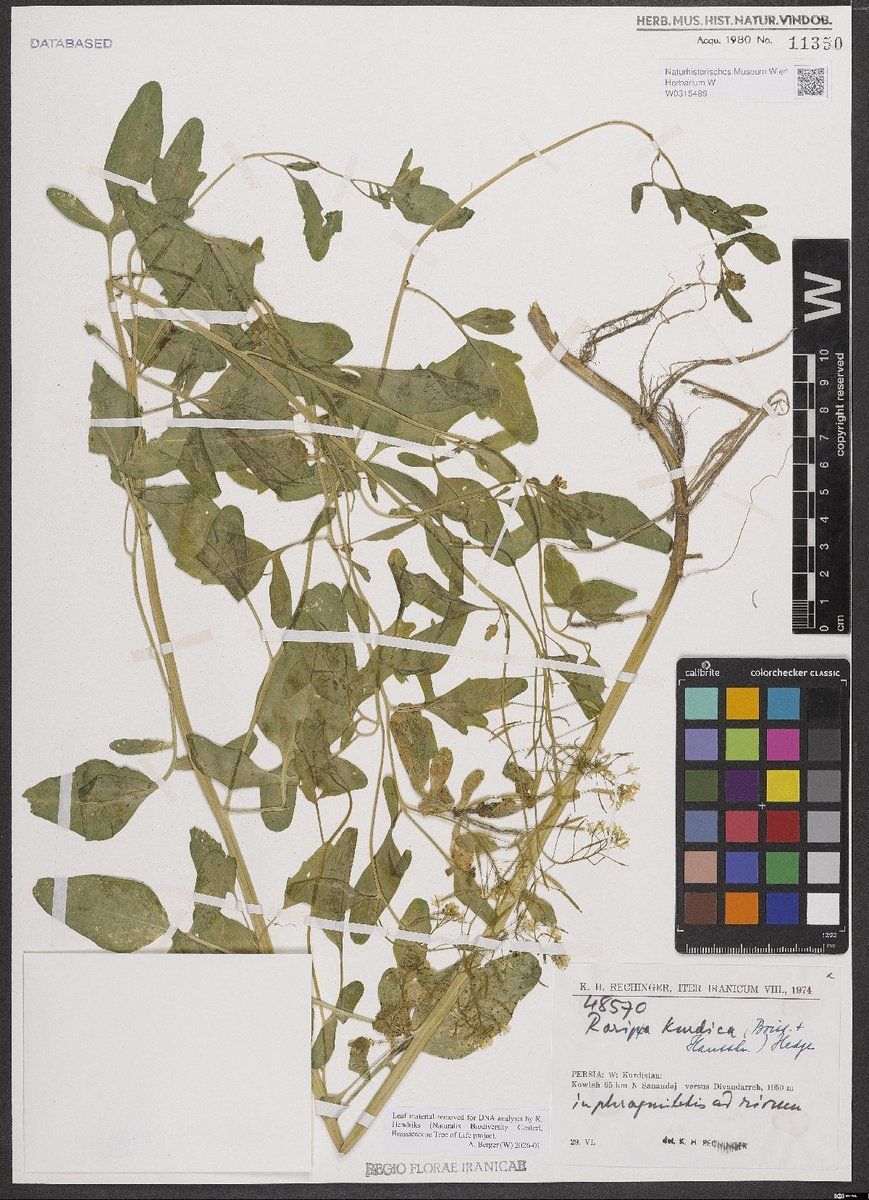
- At Kowleh, 65 km north of Sine on the way to Dîwandere (Divandarreh), at 1,950 m, on 29 June 1974, "in phragmitetis ad rivum": in a reed bed by a stream[5].
The last two were collected by Karl Heinz Rechinger (1906–1998)[9], the editor of Flora Iranica[9], on the seventh and eighth of his collecting journeys he numbered Iter Iranicum[5]. Between them, the old and new labels describe the same place: running water in the mountains, at about 1,500 to 2,100 m[1][5].
The dated specimens were gathered between late June and August[4][5][5][8]; no source we found gives its flowering time.
A leaf for the tree of life
The Kurdish cress has never been photographed alive, as far as we know, but it has not been forgotten. In January 2026 a small piece of leaf was removed from Rechinger's 1974 sheet in Vienna for K. Hendriks of the Naturalis Biodiversity Center in Leiden, for the Brassicaceae Tree of Life project, which is working out how all the members of the cabbage family are related[7]. A plant last gathered more than fifty years ago in a reed bed north of Sine may yet find its place on that tree.
Kurdish names
We found no Kurdish name for Rorippa kurdica. Ehmedê Dirihî's dictionary of Kurdish plant names lists names for other yellowcresses, but not for this one[13], and none of the other sources in our names database mentions it.
Its relative the watercress, Nasturtium officinale, is a well-known wild food in the same part of Kurdistan: Hawrami and Mukriyani Kurds in Rojhilat call it Kuzala or Kashala and eat it raw and in soups[14]. Those names belong to the watercress, not to this plant.
If you know this plant from the streams around Sine, or have a Kurdish name for it, we would like to hear from you. It has not been assessed for the IUCN Red List[12].
Sources
- 1.Boissier, E. (1888). Flora Orientalis, Supplementum (ed. R. Buser). Geneva & Basel.
- abcdefgijklnop
- hmp. 35.
- Suppl. p. 35 (as Nasturtium Kurdicum). archive.orghttps://archive.org/details/PierreEdmondBoissierFloraOrientalisSiveEnumeratioPlantarumInOrienteAGraeciaEtAeg/page/n73/mode/1upaccessed 14 November 2026
- Suppl. p. 35. archive.orghttps://archive.org/details/PierreEdmondBoissierFloraOrientalisSiveEnumeratioPlantarumInOrienteAGraeciaEtAeg/page/n73/mode/1upaccessed 14 November 2026
- 2.Plants of the World Online. Royal Botanic Gardens, Kew.
- abcdRorippa kurdica.
- plant_name_id 2417281. powo.science.kew.orghttps://powo.science.kew.org/taxon/urn:lsid:ipni.org:names:288760-1accessed 14 November 2026
- 3.Al-Shehbaz, I. A. & Price, R. A. (1998). Delimitation of the genus Nasturtium (Brassicaceae). Novon 8: 124–126.
- 4.abcdeHerbarium Haussknecht, Jena (JE), specimen records (JACQ) via GBIF. Jena, specimens JE 00000008 and JE 00000009 (via GBIF). api.gbif.orghttps://api.gbif.org/v1/occurrence/3028980654
- 5.Royal Botanic Gardens, Kew – Herbarium Specimens. via GBIF. gbif.orghttps://www.gbif.org/dataset/cd6e21c8-9e8a-493a-8a76-fbf7862069e5
- 6.Boissier, E. (1872). Flora Orientalis 2. Genève & Basel. archive.orghttps://archive.org/details/floraorientaliss02bois
- 7.abNatural History Museum Vienna (W) – Herbarium. via GBIF, specimen W 0315489 (K. H. Rechinger 48570, via GBIF).
- 8.abcdMissouri Botanical Garden, specimen 105458736 (M. L. Grant 16066, via GBIF).
- 9.International Plant Names Index. Royal Botanic Gardens, Kew, Harvard University Herbaria and Australian National Herbarium.
- 10.Kämpfer, C., Knost, S., Victor, K., Hellwig, F. H., Schönig, H. & Werner, C. U. (eds) (2024). Die Reisetagebücher des Botanikers Carl Haussknecht. Band 2: Persien, 1867–1869. Bamberger Orientstudien 18. Bamberg: University of Bamberg Press. fis.uni-bamberg.dehttps://fis.uni-bamberg.de/handle/uniba/95176
- 11.abcdeAl-Shehbaz, I. A. & Barriera, G. (2019). Typification of Edmond Boissier's Cruciferae (Brassicaceae) names enumerated in Flora Orientalis. Boissiera 72: 1–193 (p. 36).
- 12.abGBIF.org GBIF Backbone Taxonomy and occurrence records. IUCN Red List category of Rorippa kurdica; GBIF Backbone Taxonomy, Nasturtium sylvestre. gbif.orghttps://www.gbif.org/
- 13.↩Ahmet Kasımoğlu (Ehmedê Dirihî) (2013). Ferhenga Navên Nebatan a Kurdî (Dictionary of Kurdish Plant Names). Mardin Artuklu University, Institute of Living Languages in Turkey (ISBN 978-605-4202-12-6).
- 14.↩Naji Sulaiman, Fereshteh Salehi, Renata Sõukand, Andrea Pieroni, et al. (2024). Cultural vs. State Borders: Plant Foraging by Hawraman and Mukriyan Kurds in Western Iran. doi:10.3390/plants13071048https://doi.org/10.3390/plants13071048
Last updated 20 November 2026