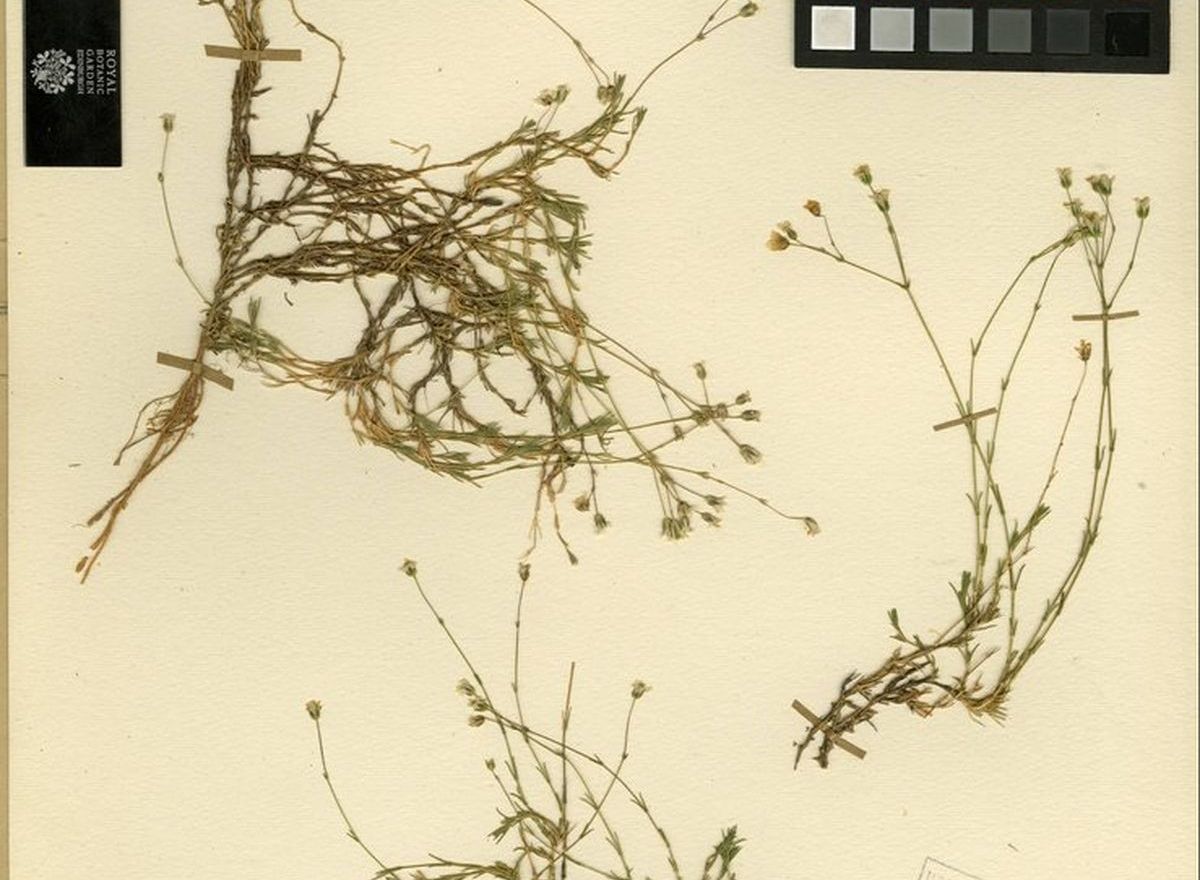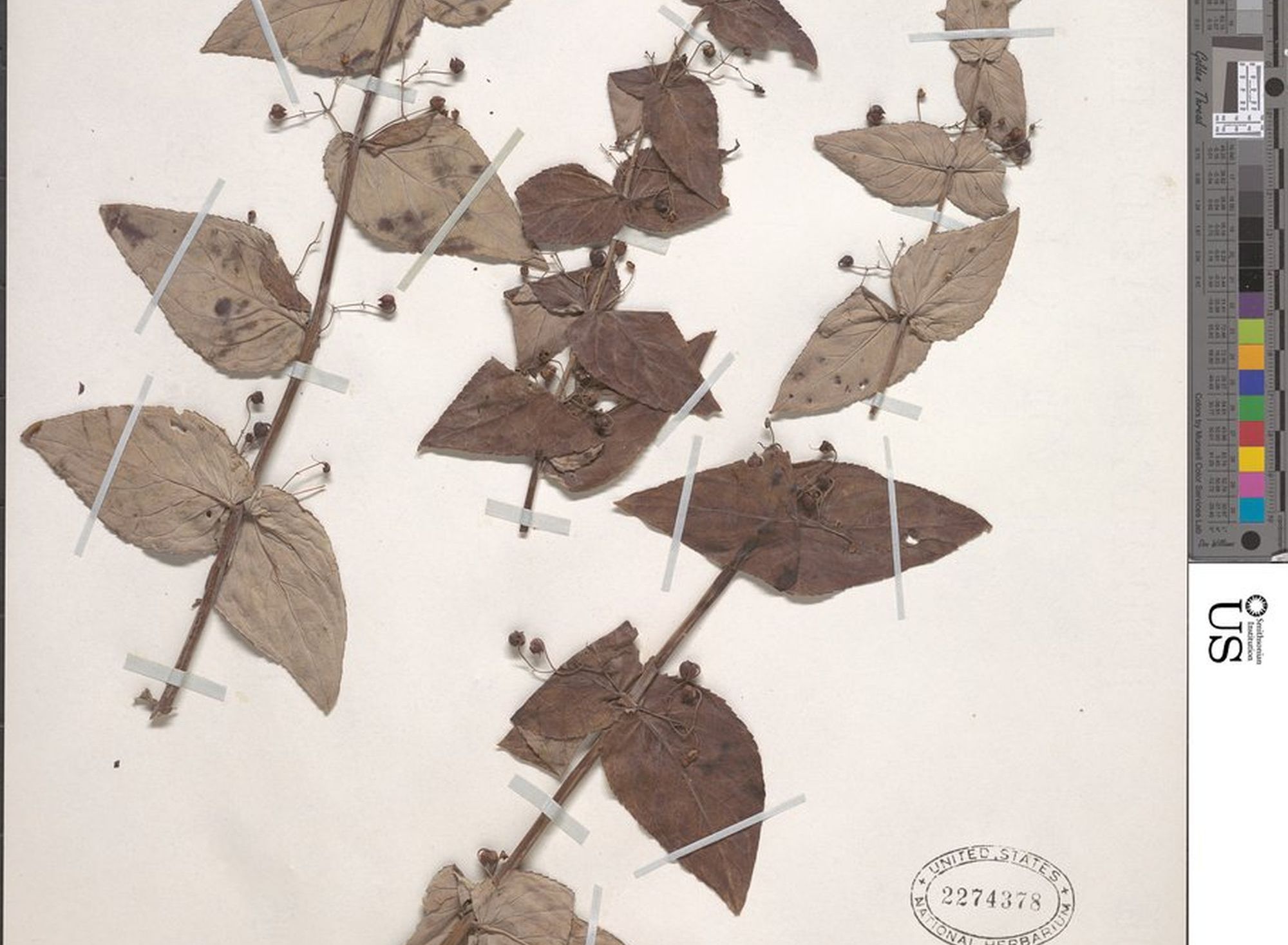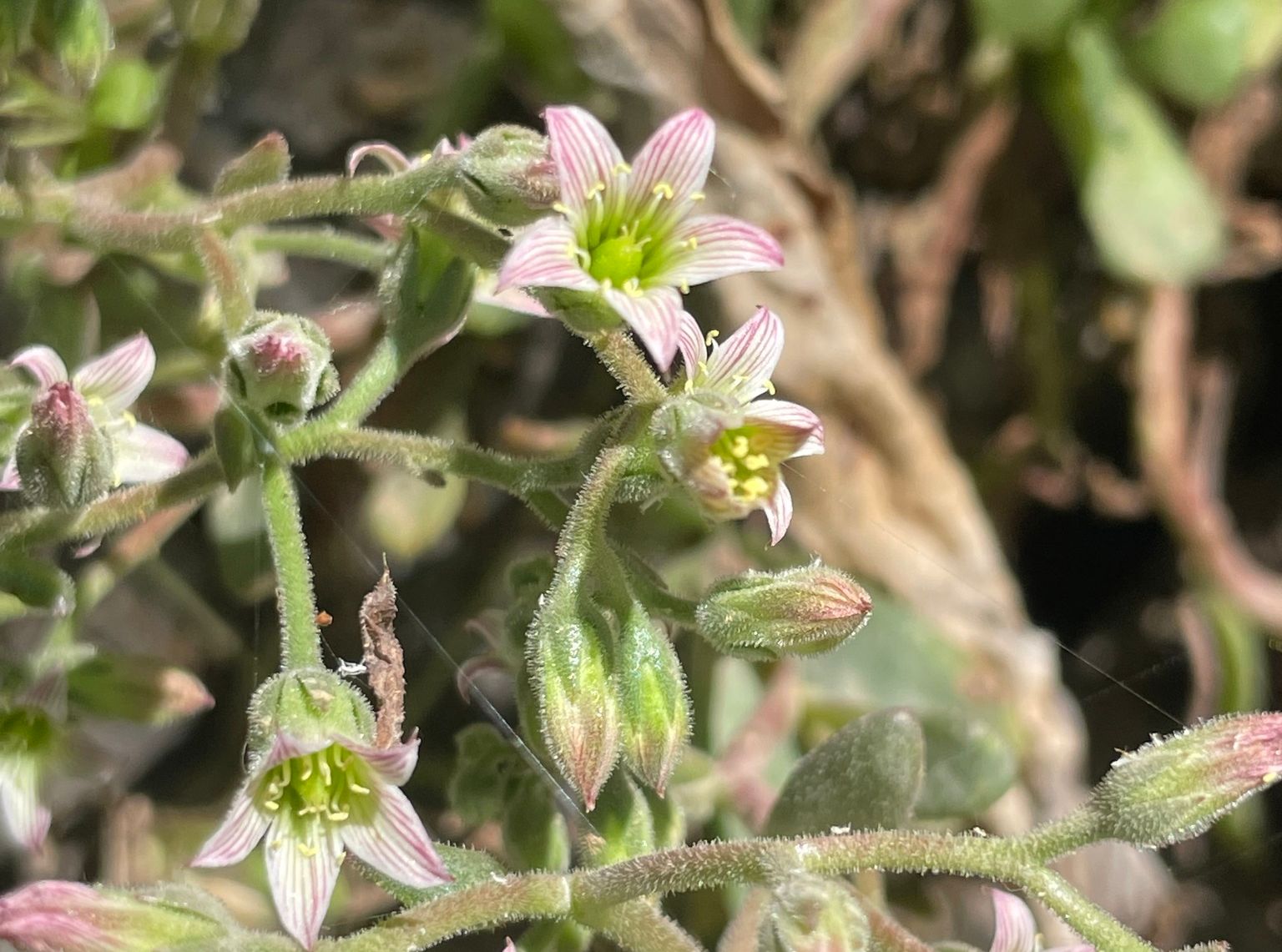
Rosularia sempervivum is a small succulent of rock crevices. It grows as tight rosettes of fleshy, fringed leaves, and in late spring sends up leafy, sticky-haired stems hung with bell-shaped flowers[1][2]. Of the three subspecies in Başûr, the one that carries the Kurds in its name, subsp. kurdica, has the largest leaves and flowers, mostly white[2]. It grows on the limestone mountains of Başûr (South Kurdistan), where it was first gathered near Şeqlawe in May 1893[2][3], and herbarium sheets from Bakur (North Kurdistan) and Rojhilat (East Kurdistan) are filed under it too[4].
How it got its name
- Named by
- (M.Bieb.) A.Berger, 1930Published in Nat. Pflanzenfam., ed. 2. 18a: 466
Leaves of a houseleek, flowers of a Cotyledon
The species was named from the eastern Caucasus, not from Kurdistan. In 1798 the naturalist Friedrich August Marschall von Bieberstein published a description of the provinces between the rivers Terek and Kura on the Caspian Sea, and in it he listed some thirty plants "unknown until now to botanists". One of them was "a species of Cotyledon (Cotyledon sempervivi)"[5][6].
Two years later, in the botanical appendix to the German edition of the book, he described it properly[1]. The roots, he wrote, send out "globular rosettes of leaves, in the manner of Sempervivum", the houseleeks; the leaves are wedge-shaped, short and broad, densely overlapping, fleshy, and fringed all round with tiny bristles; the flowering stems are about a hand-span tall, and the flowers a little larger than those of orpine (Sedum telephium), and of the same colour, with small purple anthers[1]. It grew "rather rarely, on rocks of the higher mountains", and flowered in June[1]. He summed the plant up in four words:
Folia Sempervivi; flores Cotyledonis.
The leaves of a Sempervivum; the flowers of a Cotyledon.[1] (our translation)
That is where the epithet sempervivum comes from: a plant that looks, until it flowers, like a houseleek. The genus name it carries today says something similar. Rosularia, from the Latin rosa with the diminutive -ula, refers to the leaves arranged in a little rose, a rosette[2]. The species was moved into that genus in 1930[6].
Number 1217, from the foot of Mount Sefîn
On 20 May 1893 the botanist Joseph Bornmüller was travelling through Kurdistan on the journey he called his Iter Persico-turcicum[3]. Low on Mount Sefîn, by the village of Şeqlawe, at about 1,000 m, he gathered rosette plants growing on the rocks and gave them two numbers, 1217 and 1218[3][7]. His printed label puts the place first and in bold: Kurdistania[3].
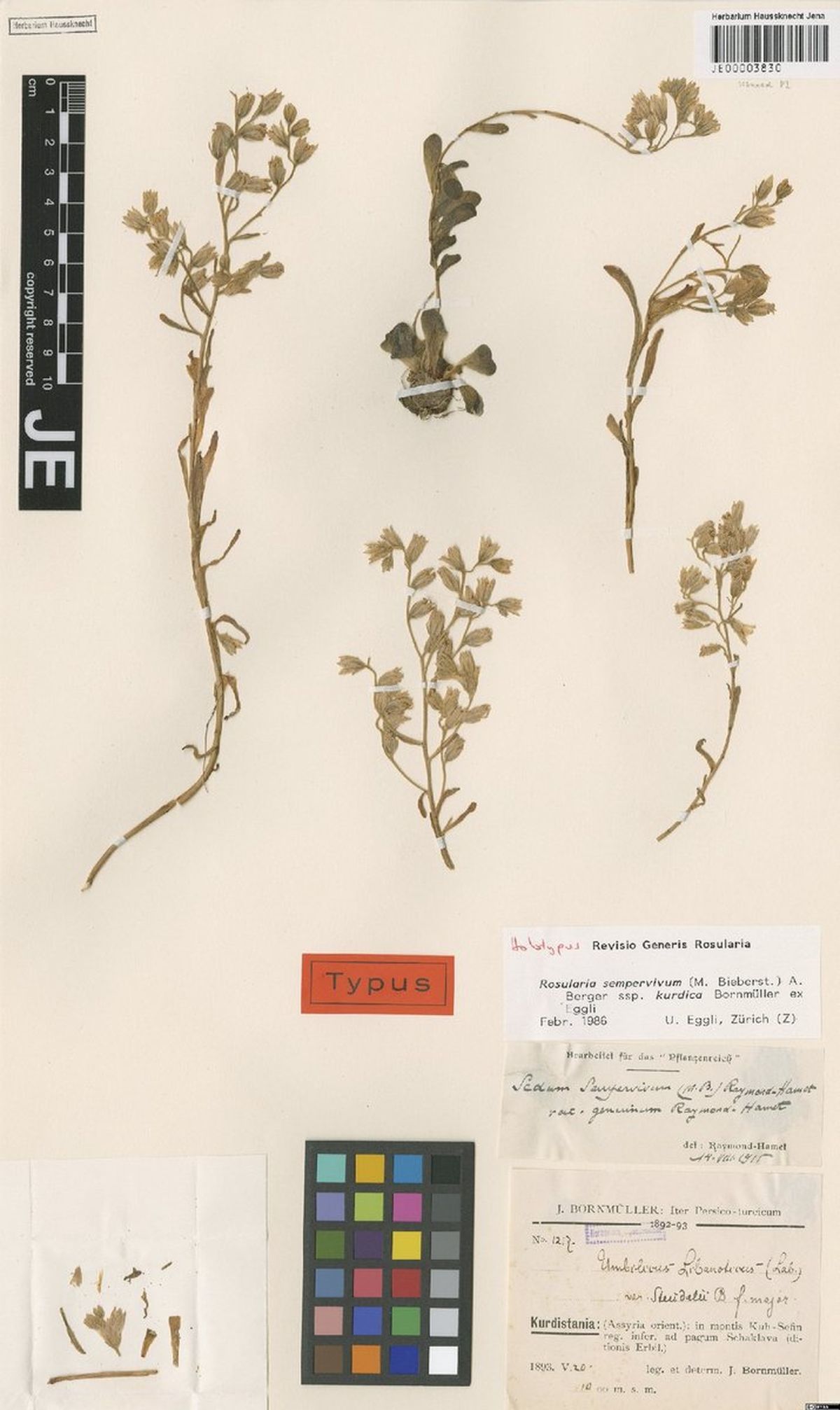
The sheet that is now the type, in Jena, carries much of the plant's history in its labels[3]:
- Bornmüller's own, with his identification in his handwriting: Umbilicus libanoticus var. steudelii, forma major, "the larger form";
- a label headed "worked up for Das Pflanzenreich", the German series of plant monographs, on which Raymond-Hamet wrote Sedum sempervivum var. genuinum, apparently in 1915;
- and, in February 1986, a printed label from Urs Eggli of Zürich, then revising the whole genus: Rosularia sempervivum subsp. kurdica "Bornmüller ex Eggli", with Holotypus added in red ink.
In between, in 1938, Bornmüller had published a variety kurdica of Cotyledon libanotica, which the Flora of Iraq treats as the same plant[6][2]. In 1972 the Flora of Turkey moved it to Rosularia radiciflora subsp. kurdica[6][2]. Eggli's monograph of 1988 placed it under Rosularia sempervivum, as subsp. kurdica[6][2]. The words "Bornmüller ex Eggli" on his label are botanists' shorthand: the epithet kurdica was Bornmüller's idea, and Eggli was the one who published it in the form now accepted[6][3]. So in less than a century the Kurdish subspecies has been filed under Umbilicus, Sedum, Cotyledon and Rosularia in turn, and the epithet that stuck is the one pointing to Kurdistan.
The Flora of Iraq follows Eggli: of the several species, subspecies and varieties once named from the region, it keeps a single species, with three subspecies[2].
What to look for
The Flora of Iraq describes the species as an upright perennial, usually 12–20 cm tall, with tuberous roots and a short woody base (caudex)[2]:
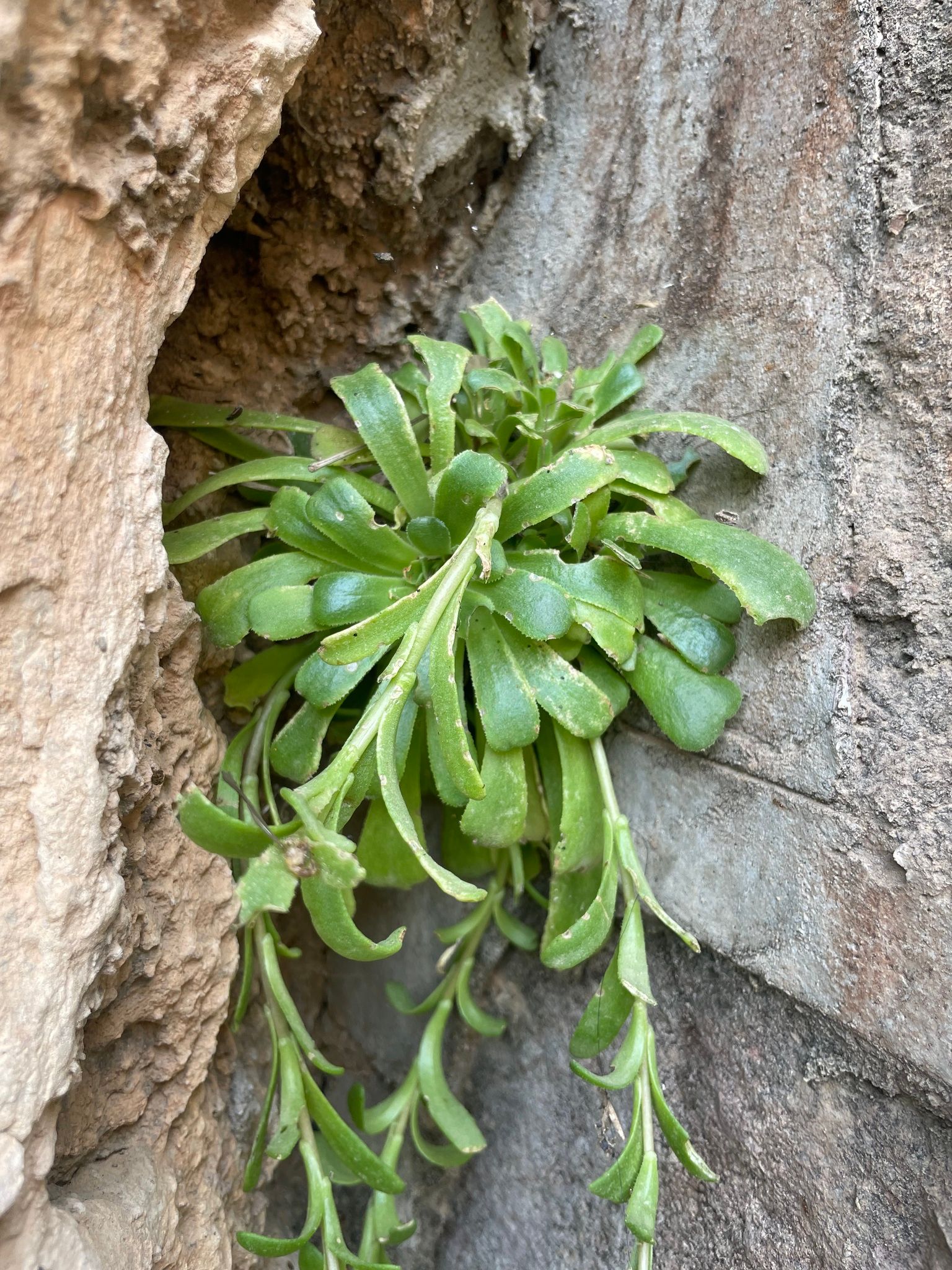
- rosettes open and rounded, usually 4–6 cm across, with no obvious resting phase, spreading by runners 1–10 cm long;
- leaves succulent, oblong to spoon-shaped, fringed with fine hairs;
- flowering stems branched, glandular-hairy, with bracts that have a small spur at the base;
- flowers with five parts, 7–10 mm long, pink or white with pink veins, bell- to urn-shaped, with ten stamens and purple anthers.
Three subspecies grow in Başûr, and the Kurdish one stands out[2]:
- subsp. kurdica: leaves broadest towards the tip (obovate), mostly 16–50 mm long and 7–11 mm wide, sometimes up to 88 mm long; flowering stems glandular-hairy, with usually 11–43 flowers; flowers open bells, "predominantly white with spreading lobes", sometimes with pink or purple veins, and larger than in the other two;
- subsp. sempervivum: narrower, oblong leaves, 10–25 mm long; glandular-hairy stems; flowers mostly pink, or white veined with pink;
- subsp. persica: flowering stems almost hairless; flowers pink.
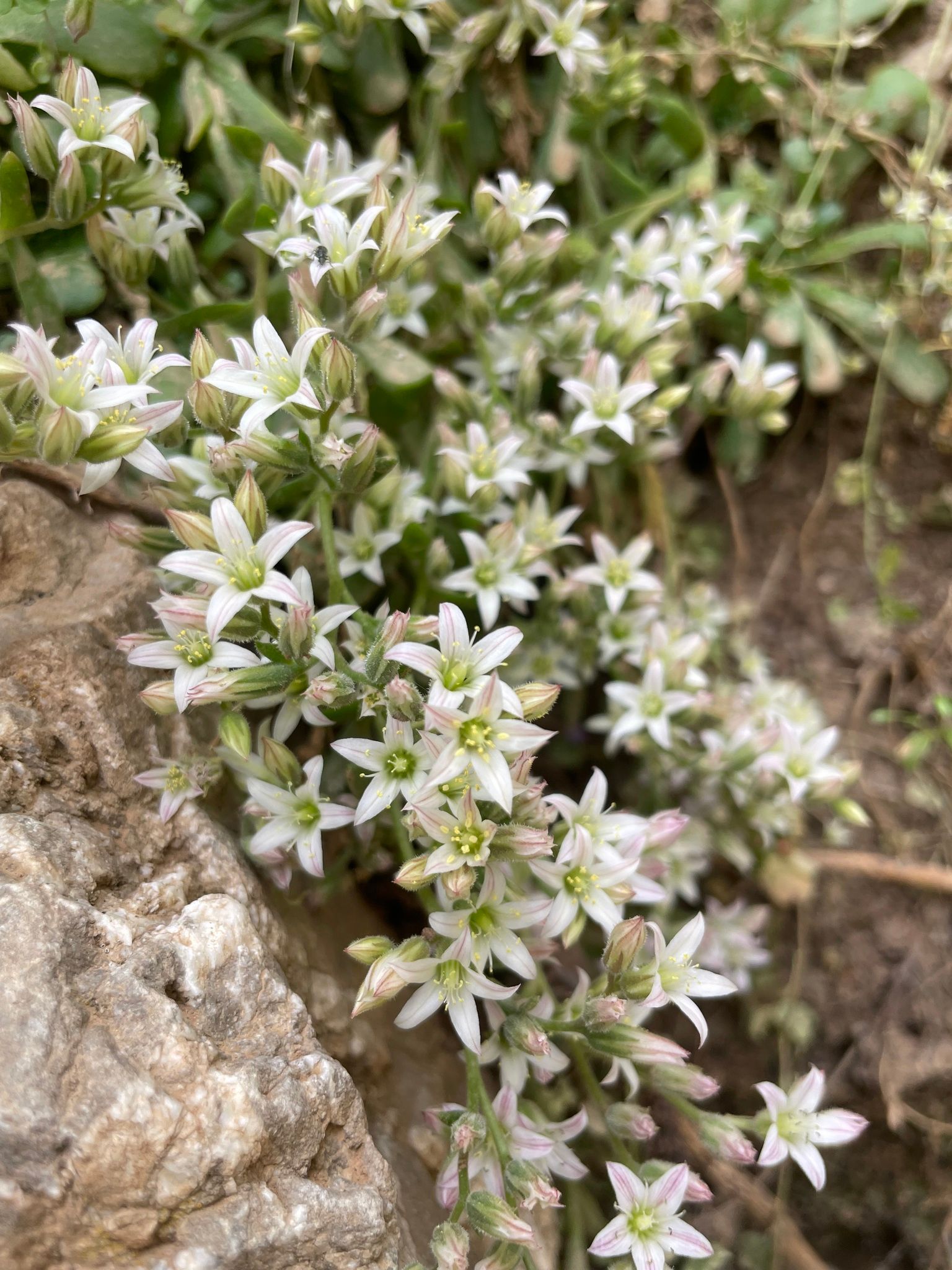
A lookalike on the high ridges. A smaller crevice plant of the summits, Prometheum rechingeri, used to be placed in Rosularia too, and some of its collections look much like the Kurdish subspecies[2][8]. In Başûr it is very rare, in the thorn-cushion zone above 2,400 m on Helgurd (Halgurd) and nearby peaks, and it flowers in August[2]. It has no woody base and glandular leaf edges; subsp. kurdica usually has a well-developed caudex running into a thick taproot, toothed leaf edges and free carpels[8].
Where it grows
Kew's checklist gives the species' native range as eastern Turkey to Iran, with records from Transcaucasia, Iran, Iraq, Lebanon and Syria, Palestine and Turkey[9]. Subsp. kurdica is the Kurdistan member of the group: the Flora of Iraq calls it "widespread in the mountain region" of Başûr[2], and herbarium sheets filed under it reach into Bakur and Rojhilat[4].
- Başûr: the gorge at Duhok; Gali Mazurka near Amêdî (Amadiya); Khantur mountain north-east of Zaxo (Zakho); the slopes of Mount Gara above Sersing (Sarsang); Şeqlawe and Mount Sefîn, the type locality; Karoukh mountain and the gorges around Rewandiz (Rowanduz); north-west of Ranye (Rania) and north-east of Hacî Omeran (Haji Omaran); Kajan mountain near Penjwên (Penjwin), Silêmanî (Sulaymaniyah) and Pîremegrûn (Pira Magrun); between Helebce (Halabja) and Tewêle (Tawila); and the valley of Laliş (Lalish), the holy place of the Ezidis, where it was collected in June 1934[2][4].
- Bakur: Nábělek's sheets from limestone crevices at about 2,550 m on Halakur-Dar, north of Cizîr (Cizre), labelled "Kurdistaniae Turcicae"[4]; a sheet from the Wan (Van) area at 2,850 m[4]; and, at the western edge of its range, Sintenis' gathering of June 1890 from rocks at Egîn (Kemaliye) on the upper Euphrates, which the Jena herbarium lists as a paratype, one of the specimens cited with the type[4].
- Rojhilat: Haussknecht's sheet of July 1867 from the limestone rocks of the Hewraman and Şaho mountains[4]; a 1966 gathering from Nawa Kuh north-west of Kerend (Karind), labelled simply "Kurdistan"[4]; and one from 1971 on the road from Xoy (Khoy) to Qotur[4]. A 2017 paper counts subsp. kurdica among the plants of Iran[8], although the Flora of Iraq still marked its presence there with a question mark[2].
Its home is rock: "crevices of rocks and cliffs, on slopes of limestone mountains", between about 700 and 2,000 m in Başûr[2]. Botanists who collected it at Pîremegrûn in 2010 found it in a steep canyon of dolomitic limestone with a few coppiced oaks, at 1,316 m, in the shade of a deep crevice[10]. Nábělek's labels say the same in Latin: in crevices of limestone rocks north of Cizîr, and in "damp and shady" crevices on the pass between Hewlêr (Erbil) and Rewandiz[4].
It flowers from May to July[2]. Bornmüller's type was in flower on 20 May[3], and in the Caucasus Bieberstein saw the species flower in June[1].
Kurdish names
Ehmedê Dirihî's dictionary of Kurdish plant names, Ferhenga Navên Nebatan a Kurdî (2013), lists two names under the old genus name Cotyledon[11]:
- belgê pizî, in the Latin index, for Cotyledon libanotica, the plant now treated as another subspecies of the same species[11][6];
- belgê pizîyê kurdan, for Cotyledon libanotica var. kurdica, Bornmüller's name for the Kurdish subspecies[11].
Neither entry gives a region or an informant. The second name follows the Latin epithet word for word (kurdan, "of the Kurds"), so it is best read as a dictionary name for the subspecies rather than one recorded in the field. No field record of a Kurdish name for this plant turned up in the floras and ethnobotanical studies we read.
Sources
- 1.Marschall von Bieberstein, F. A. (1800). Beschreibung der Länder zwischen den Flüssen Terek und Kur am Caspischen Meere, mit einem botanischen Anhange. Frankfurt am Main: 176–177.
- 2.Ghazanfar, S.A. & Edmondson, J.R. (eds) (2013). Flora of Iraq, Volume 5, part 2: Lythraceae to Campanulaceae. Royal Botanic Gardens, Kew. ISBN 978-1-84246-493-9.
- 3.Herbarium Haussknecht, Jena (JE), specimen records (JACQ) via GBIF.
- 4.abcdefghijHerbarium specimens of Rosularia sempervivum subsp. kurdica at JE, SAV, ZSS, K and MO (via GBIF).
- 5.↩Marschall von Bieberstein, F. A. (1798). Tableau des provinces situées sur la côte occidentale de la mer Caspienne, entre les fleuves Terek et Kour. St Petersburg.
- 6.International Plant Names Index. Royal Botanic Gardens, Kew, Harvard University Herbaria and Australian National Herbarium.
- abcdefgCotyledon sempervivum M.Bieb.; Rosularia sempervivum (M.Bieb.) A.Berger; Cotyledon libanotica var. kurdica Bornm.; Rosularia radiciflora subsp. kurdica (Bornm.) Chamb. & Muirhead; Rosularia sempervivum subsp. kurdica Eggli and the other subspecies.
- urn:lsid:ipni.org:names:274966-1. ipni.orghttps://www.ipni.org/n/274966-1accessed 14 November 2026
- 7.↩Duplicates and paratype of Bornmüller 1217/1218: JE 00003842, W 1895-0001666, B 10 0241945, B 10 0241946 (via GBIF).
- 8.abcAmini Rad, M., Eggli, U. & Gholipour, A. (2017). Prometheum rechingeri. a new report from Iran. Rostaniha 18(2): 142–149.
- 9.Plants of the World Online. Royal Botanic Gardens, Kew.
- ↩Rosularia sempervivum.
- plant_name_id 2416867. powo.science.kew.orghttps://powo.science.kew.org/taxon/urn:lsid:ipni.org:names:274966-1accessed 14 November 2026
- 10.↩Flora of the World: specimen A. G. Miller et al. 121.A20, Pîremegrûn, 9 June 2010.
- 11.Ahmet Kasımoğlu (Ehmedê Dirihî) (2013). Ferhenga Navên Nebatan a Kurdî (Dictionary of Kurdish Plant Names). Mardin Artuklu University, Institute of Living Languages in Turkey (ISBN 978-605-4202-12-6).
Last updated 20 November 2026