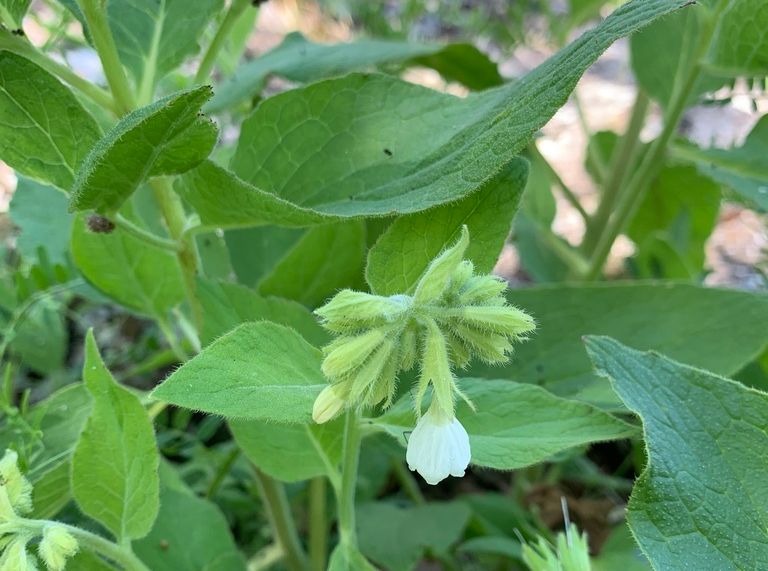
Symphytum kurdicum is a tall, branching comfrey with drooping clusters of white, bell-shaped flowers. It grows on shady rocks and cliffs and along streams in the mountains of North, South and East Kurdistan (Bakur, Başûr and Rojhilat), mostly between about 950 and 1,800 m, and flowers in April and May[1]. It was named in 1875 from one dried stem in fruit, collected somewhere between Silêmanî and Sine[2][3], and its first description has a gap where the lower leaves should be.
How it got its name
- Named by
- Boiss. & Hausskn., 1875Published in Pl. Orient. Nov. 2: 5
A plant with a gap in its description
The stem was gathered by the botanist Carl Haussknecht (1838–1903)[4] on his travels in Kurdistan. Edmond Boissier (1810–1885)[4] published it under both their names in Geneva on 20 February 1875, in a slim booklet of new plants from the East, Plantarum orientalium novarum decas secunda. Its title page calls it an excerpt from the third volume of his great Flora Orientalis, "soon to appear"[2]. In the end the comfreys only came out in the fourth volume, in 1879[3].
His habitat line is a single sentence:
Hab. in Kurdistaniâ Persiæ conterminâ inter Sulimanieh et Sihna (Haussk!).
It grows in Kurdistan on the border with Persia, between Sulaimaniyah and Sihna (Haussknecht!).[2] (our translation)
Sulimanieh is Silêmanî (Sulaymaniyah) in Başûr. Sihna is how Boissier's books spell Haussknecht's Sine (Sanandaj) in Rojhilat[1] (our interpretation). The epithet kurdicum, "Kurdish", records where it was found.
The description itself has a hole in it. Boissier lists the leaves, and where the lower ones should be he simply printed three dots: "inferioribus…", "the lower ones…"[2]. Four years later, in Flora Orientalis, he explained why: the species was "described from a single fruiting specimen without its basal leaves", but it was "very distinct" all the same, with a tall stem, upper leaves still three inches long and a large fruiting calyx[3] (our translation).
The Flora also changed one letter. There the place is printed "Sikna"[3], while the 1875 booklet reads "Sihna"[2] and the 1969 revision of the genus "Sehna"[1]. The Flora's "Sikna" looks like a printing slip: elsewhere in the same volume the town is spelled "Sihna"[3].
Later collectors
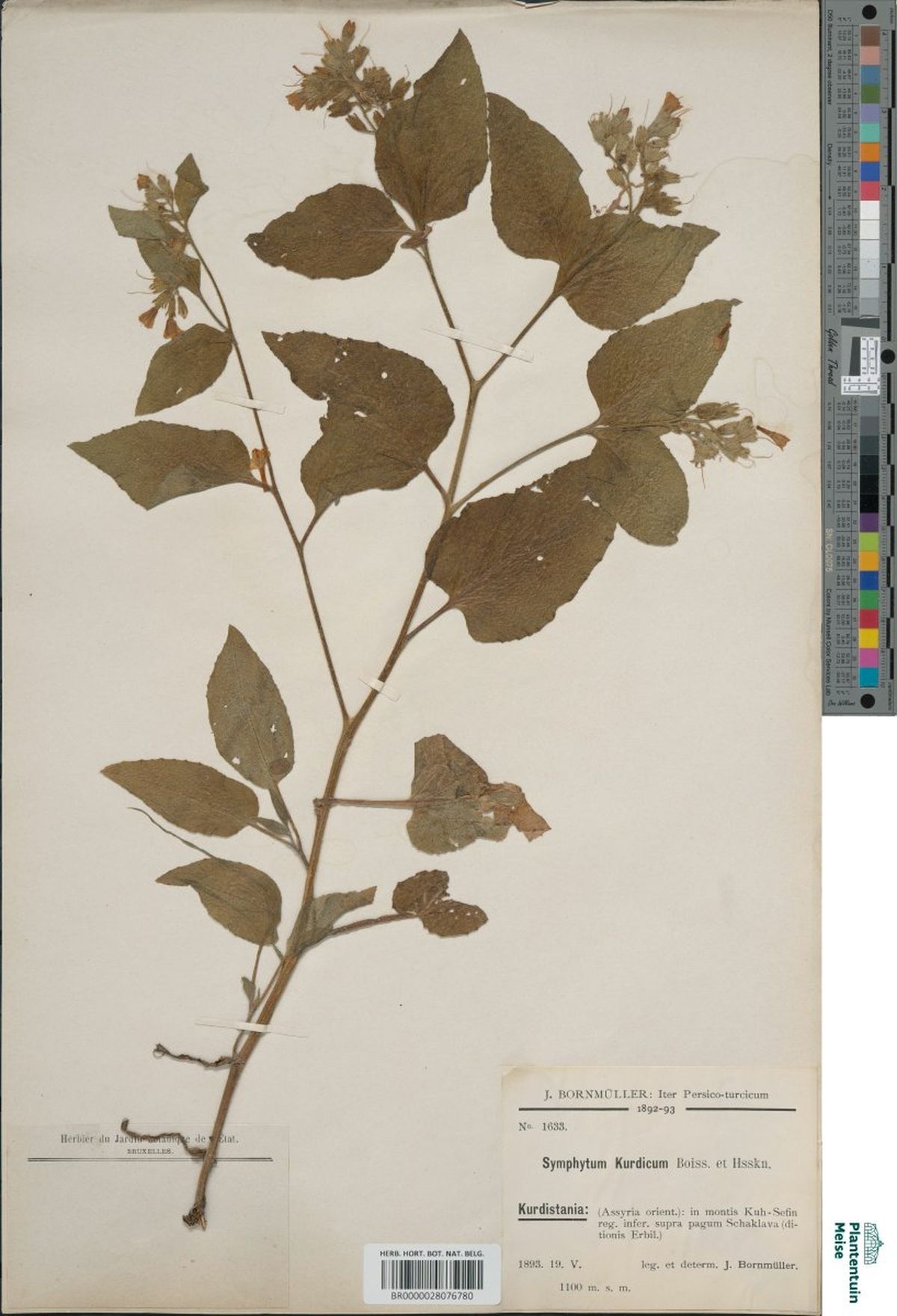
Later travellers filled in the picture. On 19 May 1893 Joseph Bornmüller (1862–1948)[4] collected it in flower on the lower slopes of Sefîn, the mountain above the village of Şeqlawe (Shaqlawa), at 1,100 m. His printed label names the land plainly: "Kurdistania"[5]. Seventeen years later, on 23 May 1910, the botanist František Nábělek (1884–1965)[4] found it among oak shrubs on a mountain he wrote "Handrian-Dagh", near Rewandiz (Rawandiz), at about 1,200 m. Other sheets of his, from "Kurruk-Dar" near Rewandiz, record it by a spring in damp, humus-rich ground and on stony ground, at 1,600–1,900 m[6].
In Bakur the botanist Peter Hadland Davis (1918–1992)[4] met it several times, between 1954 and 1966[1][7]. With Ian Hedge, on 25 May 1957, he collected it 5 km east of Mêrdîn (Mardin) at 1,200 m, and his label is a small description in itself: "Under shady cliffs. Perennial. Flower white."[7].
How to recognise it
In 1969 Gerald Wickens (1927–2019)[4] of Kew revised all the comfreys of Turkey and the neighbouring lands. He kept S. kurdicum in section Orientalia, where Bucknall had put it in 1913, together with S. orientale and three other species, and described it like this[1]:
- a tall, branched perennial, pale green, with stiff, prickle-like, backward-bent bristles scattered on the stem, the branches and the leaf veins[2][1];
- thin, rough leaves, ovate to oblong, with wavy, finely toothed edges; even the upper leaves have a stalk[2][1];
- short, forked, fairly dense clusters of about ten flowers[2][1];
- a calyx 7–9 mm long, cut a quarter to nearly half of the way into lance-shaped teeth, which grows to about 12 mm in fruit[1] (on his fruiting specimen Boissier saw the teeth as broad, blunt triangles[2]);
- a white corolla 16–19 mm long, a narrow tube only 1.5–2.5 mm wide widening like a funnel, with short, rounded lobes[2][1];
- nutlets about 4 × 2.5 mm, narrowed at the base and then bent sharply sideways, with a fine net of wrinkles and small bumps[2][3][1].
From S. orientale it differs in its rougher, thinner leaves, its stalked upper leaves and its more compact clusters of flowers[1]. Wickens also thought Bucknall's sections hid real kinships: by giving so much weight to the calyx and the colour of the flowers, he wrote, they disguised the affinity of S. orientale and S. kurdicum with a variety of another comfrey, S. palaestinum var. majus, from the Cilician Plain, the Anti-Taurus and the Amanus[1].
A puzzle in the style
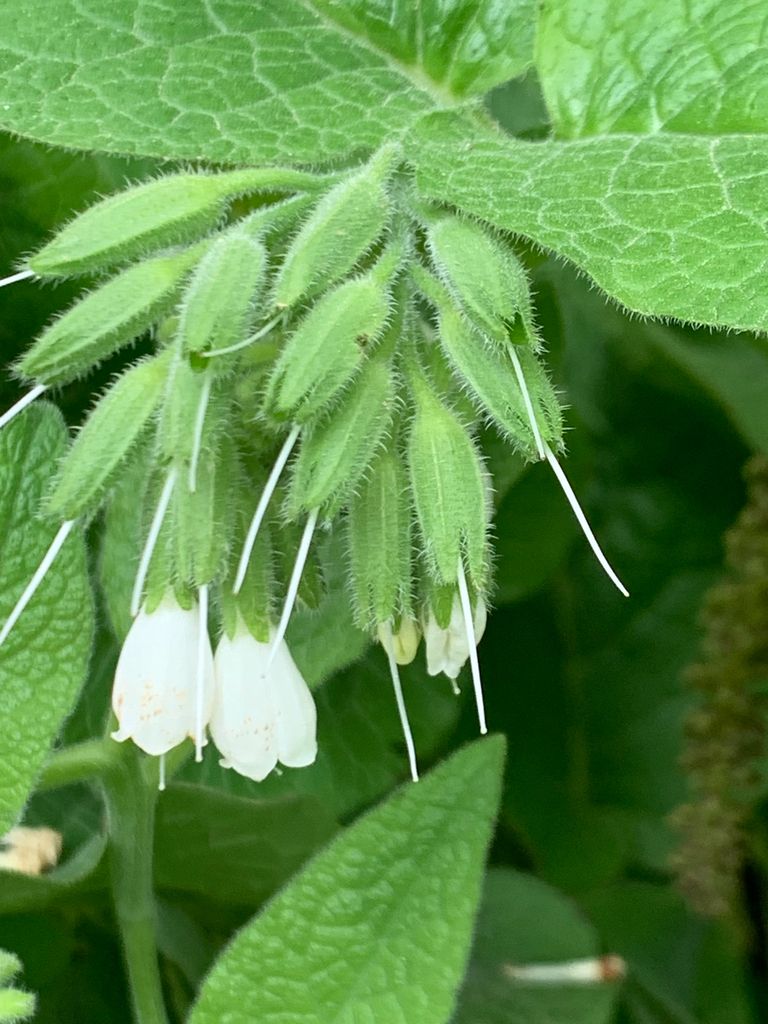
One detail in Wickens's description may not match the living plant. He wrote "Style not exserted": the style, the thread that carries the stigma, should stay inside the flower[1]. But he raised the question himself. An earlier botanist, Bucknall, had written that the slender style sticks out a little in mature flowers, and Wickens noted that while this is certain for one group of comfreys, "from the available herbarium material it was not possible to confirm this for all the species. Bucknall had the advantage of being able to observe living material"[1]. For S. orientale, the species he compared it with, he gave the style as sticking out 1–2 mm[1]. Photographs of S. kurdicum taken near Duhok in April 2025, confirmed by a second observer, show long white threads hanging well below the mouths of the flowers and even out of buds that have not opened yet[8]. They look very much like styles. A botanist with a fresh flower in hand could settle the question.
Where it grows
Kew's checklist gives its range as eastern Turkey to western Iran, recorded from Iran, Iraq and Turkey[9]. In Kurdish terms it is a plant of the mountains of Bakur, Başûr and Rojhilat. The specimens Wickens saw come from[1]:
- Bakur: Karz Dağ above Kotum and the town of Bidlîs (Bitlis), 1,550–1,800 m; Mêrdîn, 1,200 m; and the road from Şemzînan (Şemdinli) to Gever (Yüksekova), 1,600 m.
- Başûr: some sixteen gatherings around Rewandiz, Sefîn and Şeqlawe, Pêncwên (Penjwin), Jabal Khantur, Jabal Bakhair, Qarachitan and the Zawita gorge, Pushtashan north-east of Ranye (Ranya), Kopi Gara Dagh and Karokh Dag, between 950 and 1,800 m; and Sheikh Adi near Ain Sifni, the valley of Laliş.
- Rojhilat: Merîwan (Marivan), 1,300–1,600 m.
In recent years naturalists have photographed it in flower again and again in Başûr: near Duhok and Hiror, around Amêdî (Amadiya), near Soran and Çoman (Choman), and near Silêmanî, from March to May[8][8].
Wickens wrote that the comfreys of Turkey are plants of moist sites and, on Davis's word, that in the drier areas it is unusual to find more than a small population in any one place[1]. S. kurdicum, too, likes shade and water: shady rocks, cliffs and stream banks[1], humus-rich damp ground by a spring and stony slopes[6], and the undergrowth of oak scrub[6]. In Iran it has also been collected in the Ghasemlou valleys of West Azerbaijan province, for a laboratory study[10].
It has not been assessed for the IUCN Red List[11].
Knitbone
Symphytum is the genus of the comfreys, called "knitbone" in English. The name comes from Greek, from a word for "growing together", meaning bones knitting after a fracture, and comfreys were used for fractures, sprains and bruises from antiquity on[12]. The same plants contain pyrrolizidine alkaloids, which can damage the liver; health agencies advise against taking comfrey internally[12].
Of S. kurdicum itself, no traditional use appears in the sources we read. A 2022 laboratory study from Tabriz found that extracts of its aerial parts had strong antioxidant activity and were active against some bacteria and a yeast[10].
These are records of research and traditional use, not medical advice.
Its names
Ehmedê Dirihî's dictionary of Kurdish plant names lists three Kurdish names for Symphytum kurdicum in its Latin index: mijmijok, baperikok and ezmangag[13]. They are not formed from the Latin, like the many "… of the Kurds" names in the same book, but the index gives no region or informant for them, so it is not clear where they were heard. In the main part of the dictionary mijmijok is a name for several other plants too, among them alkanets (Anchusa), relatives of the comfreys, and bugle (Ajuga)[13]. One mijmijok entry, from a source Dirihî codes CB, gives no botanical name at all, only a note: children pull the plant up in spring and suck its root, and it may be an Anchusa[13] (our translation).
The same dictionary has a second, odder line for the plant. Its Turkish index gives, under kürt kafesotu, not a name but the words Mêrdînê şîn tê[13], "it grows in Mêrdîn" [our translation], and another index line has just Mêrdîn[13]. That is exactly where Davis and Hedge found it in 1957[7].
Kürt kafesotu, "Kurdish comfrey", is its Turkish name. In his introduction Dirihî notes that the Turkish plant checklist of 2012 named it so, along with three other plants called kurdica[13].
Sources
- 1.Wickens, G. E. (1969). A revision of Symphytum L. in Turkey and adjacent areas. Notes from the Royal Botanic Garden Edinburgh 29(2): 157–180.
- 2.abcdefghijkBoissier, E. (1875). Plantarum orientalium novarum decas secunda. Geneva: H. Georg, p. 5.
- 3.Edmond Boissier (1879). Flora Orientalis, vol. 4. H. Georg, Geneva and Basel (Internet Archive).
- 4.International Plant Names Index. Royal Botanic Gardens, Kew, Harvard University Herbaria and Australian National Herbarium.
- 5.↩Meise Botanic Garden, herbarium specimen BR0000028076780 (J. Bornmüller 1633, Sefîn, 1893), via GBIF.
- 6.abcHerbarium of the Slovak Academy of Sciences (SAV), specimens SAV0006327–SAV0006330 (F. Nábělek, near Rewandiz, 1910), via GBIF.
- 7.abcRoyal Botanic Gardens, Kew – Herbarium Specimens. via GBIF, herbarium specimens K004575438–K004575442 (P. H. Davis's gatherings, 1954–1966), via GBIF. gbif.orghttps://www.gbif.org/dataset/cd6e21c8-9e8a-493a-8a76-fbf7862069e5
- 8.iNaturalist. inaturalist.orghttps://www.inaturalist.org/
- 9.Plants of the World Online. Royal Botanic Gardens, Kew.
- ↩Symphytum kurdicum.
- plant_name_id 2475625. powo.science.kew.orghttps://powo.science.kew.org/taxon/urn:lsid:ipni.org:names:120797-1accessed 14 November 2026
- 10.abMahmoudzadeh, E. et al. (2022). Nanoencapsulation of n-butanol extract of Symphytum kurdicum and Symphytum asperrimum. Iranian Journal of Basic Medical Sciences 25(3): 364–371.
- 11.↩GBIF.org GBIF Backbone Taxonomy and occurrence records. IUCN Red List category for Symphytum kurdicum (accessed 15 November 2026). gbif.orghttps://www.gbif.org/
- 12.abSalehi, B. et al. (2019). Symphytum species: a comprehensive review on chemical composition, food applications and phytopharmacology. Molecules 24(12): 2272.
- 13.Ahmet Kasımoğlu (Ehmedê Dirihî) (2013). Ferhenga Navên Nebatan a Kurdî (Dictionary of Kurdish Plant Names). Mardin Artuklu University, Institute of Living Languages in Turkey (ISBN 978-605-4202-12-6).
Last updated 20 November 2026