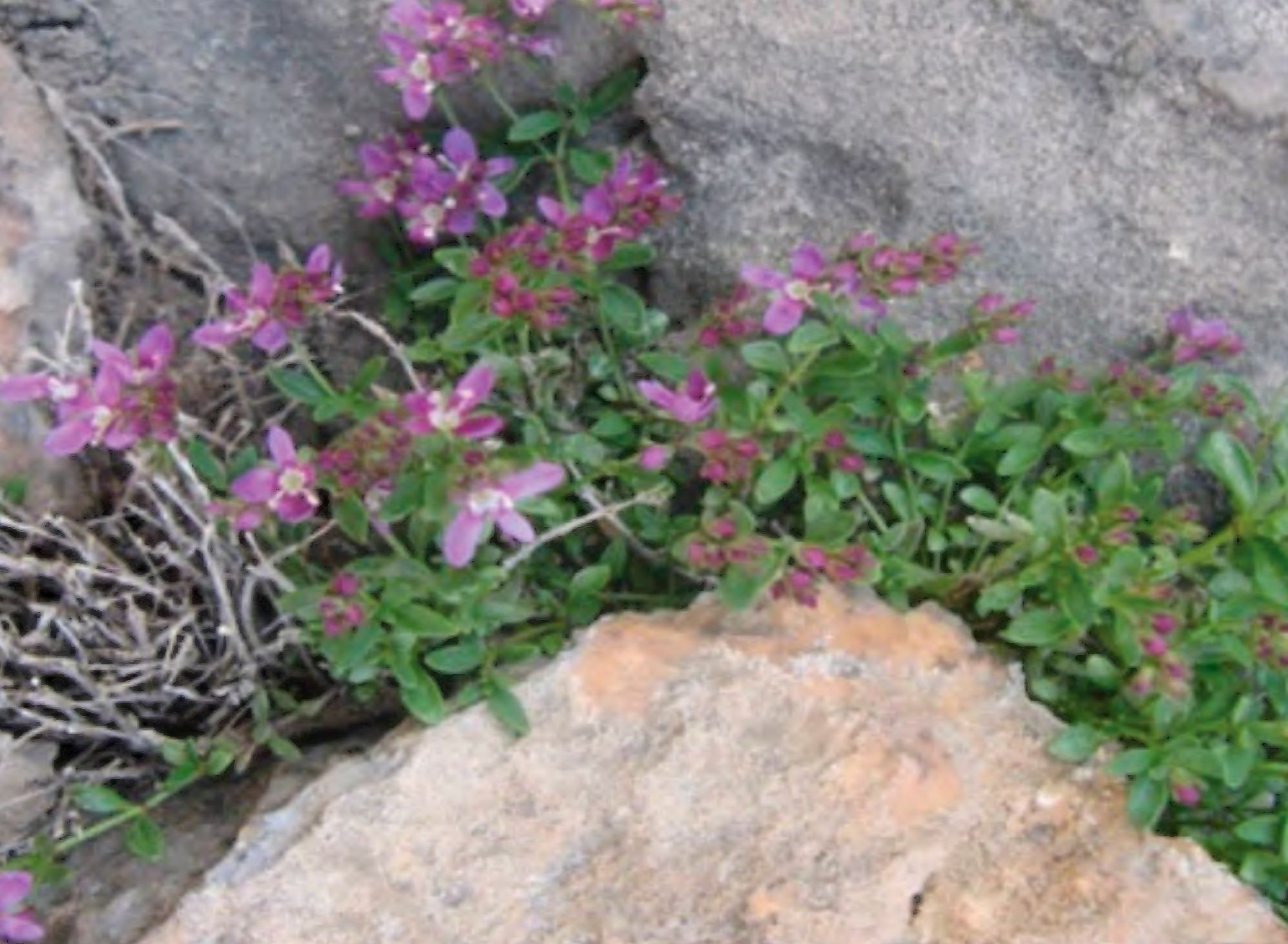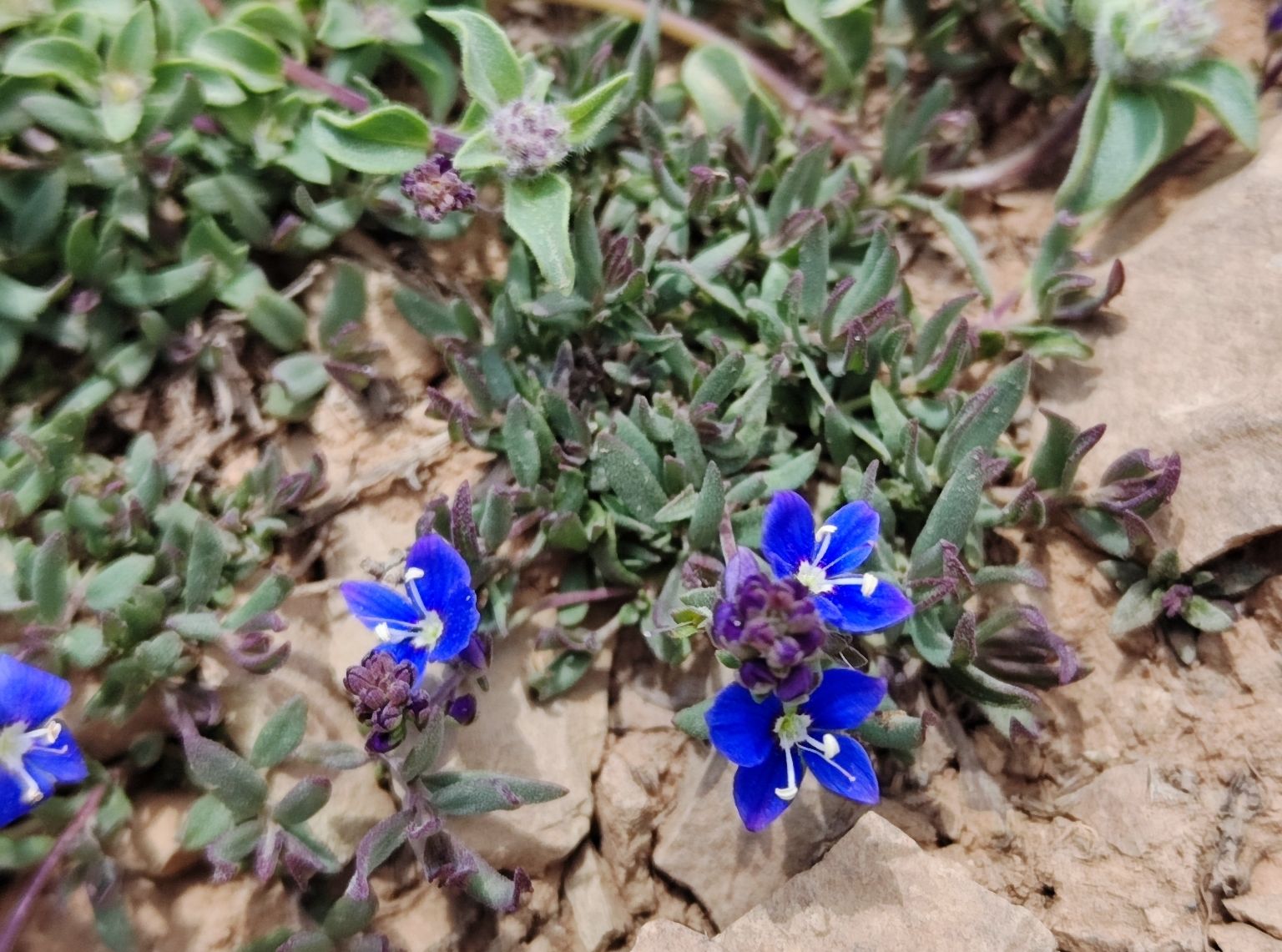
Veronica kurdica is a small speedwell of high mountain rock and scree: a low mat of thin, branching stems, narrow grey-green leaves and loose sprays of deep blue flowers[1][2][3]. Its name says "Kurdish", and one of the two plants it was first described from came from "the mountains of Kurdistan"[1]. But that plant has been lost, and for more than 150 years botanists have argued over whether the species was real at all[1][2][4][5]. Today the speedwell that carries the name is known with certainty from the Alborz, with pink-flowered plants in the southern Zagros and the highlands of Kerman, and its place in Kurdistan is still an open question[5][3][6][7].
How it got its name
- Named by
- Benth., 1846Published in Prodr. 10: 473
A species with a question mark
In 1846 the botanist George Bentham (1800–1884)[8] wrote the account of the figwort family for the great Prodromus, the many-volume survey of the world's flowering plants then edited by Alphonse de Candolle[1][8]. Among dozens of speedwells he described a new one, Veronica kurdica, from two dried plants: one collected by a "J. Brandt" "in the mountains of Kurdistan", the other by the traveller Rémi Aucher-Éloy "in the alps of Elamont", his number 5089[1].
Bentham was not fully convinced by his own species. He put a question mark beside its number, "68 ?", and ended his description with a sentence that has followed the plant ever since[1]:
Species evidenter distincta, sed in specim. melioribus recognoscenda.
Clearly a distinct species, but one to be confirmed on better specimens.[1] (our translation)
The plants he had seen were tiny: twisted stems about 5 to 8 cm long, pale leaves only 4 to 7 mm long with their edges often rolled under, and flowering shoots that began short and grew to about 8 cm in fruit. The flower stalks were as fine as hairs and much longer than the small calyx, and the corolla was large[1] (our conversions of his inches and lines).
Where is Elamont?
The "alps of Elamont" are not in Kurdistan. A slip on Aucher-Éloy's sheet in the Natural History Museum in Vienna reads "Elamout = mons Alamut"[9], and in 2025 the Veronica specialist Dirk Albach agreed: Elamont is Mount Alamut, in the Alborz mountains near Tehran[5]. Aucher-Éloy probably collected it there on 30 August 1837[5].
And Brandt's Kurdish plant? No one has found it. Albach writes that "the herbarium of Brandt is unknown", with Brandt's later material probably in St Petersburg, where Bentham is unlikely to have seen it[5]. When the botanist M. A. Fischer had to choose a single specimen to fix the name, in 1981, he could only pick Aucher-Éloy's Alamut plant[5][9]. In 2025, after going through the roughly 16,000 speedwell specimens of the newly digitised Paris herbarium, Albach revisited that choice[5]. Bentham, he argues, is unlikely to have seen the sheet in Vienna either: his description most probably rests on the duplicates at Kew and Geneva, and of these the Kew sheet is "the more complete specimen". Albach therefore made the Kew sheet the type in place of Fischer's[5]. It is still the same gathering from the same mountain, and more duplicates of it survive in London, Geneva, Paris and Vienna[5]. So the plant that defines Veronica kurdica today, its type, comes from the Alborz. The Kurdish half of Bentham's original material survives only in the name.
"Is it a real species?"
In 1879 the botanist Edmond Boissier gathered every record he could for his Flora Orientalis[2]. He wrote the first collector's name as "Brant" and his locality, in his own Latin, as in montibus Armeniae Kurdicae, "in the mountains of Kurdish Armenia", and added plants from around Ardahan, from the southern slopes of the Bingöl mountains at 6,000 feet, and from the high mountains of northern and southern Iran[2]. His description gives the colour that Bentham's dried plants could not: a blue corolla, four times as long as the calyx[2].
Then he voiced the doubt again. The plant, he wrote, is "very close" to a narrow-leaved variety of the eastern speedwell Veronica orientalis, and differs from it "almost only" in its longer, spreading flower stalks. An species legitima?, he asked: "Is it a real species?"[2] (our translation). One of the plants on his list, from the Bingöl mountains, had in fact been handed out under the name V. orientalis[2].
The name also gathered offshoots. On his second journey to Iran, in 1902, the botanist Joseph Bornmüller collected speedwells he took for variants of this one, and in 1907 he published three forms of V. kurdica, major, inciso-crenata and nivalis; the chosen sheet of major comes from the alpine zone of Damavand, at 3,000–3,500 m[5]. Fischer later kept major and nivalis in V. kurdica but moved inciso-crenata to V. orientalis. Like Brandt's plant, Bornmüller's forms have proved hard to find: Albach could trace only one sheet of major anywhere, in Paris, and none of the five gatherings Bornmüller listed for nivalis[5].
In 1949 the doubt became a verdict. R. A. Blakelock of Kew, working through the plants of the Rustam Herbarium from Başûr (South Kurdistan) and the rest of Iraq, filed all of them under V. orientalis: from Marmarut mountain near Rewandiz (Rawandiz) in April 1932, from wet places at 2,700–3,000 m on the mountain the collectors wrote "Arl Gird Dagh", probably Helgurd, in July 1932, with "pale blue" flowers, and from Zawita in July 1933[4]. He listed V. kurdica as a mere synonym. The characters said to separate these plants "break down", he wrote, "when a sufficient range of material is examined", and he preferred "to regard V. orientalis as one polymorphic species rather than as several species"[4].
Not a cousin after all
The answer came from DNA. In 2022 M. Doostmohammadi and colleagues, Dirk Albach among them, sequenced the speedwells of the group Veronica subgenus Pentasepalae[3]. Their samples of V. kurdica from the Alborz and the Zagros formed one well-supported branch, together with two other Iranian mountain species, V. daranica and V. khorassanica. V. orientalis was elsewhere in the tree. "V. kurdica is not related to V. orientalis", they concluded: the likeness that had misled botanists since Boissier, above all in plants from high altitudes, is the result of convergent evolution[3]: two unrelated lines that came to look alike.
They also counted its chromosomes for the first time: 16, in both of its subspecies[3]. And they gave the clearest way to tell the two speedwells apart in the field. V. orientalis grows as a compact tuft from a central woody base. V. kurdica has no such centre: it sends out long, thin, low-lying, much-branched stems that sometimes root as they go[3]. Albach calls it "a prostrate, suffruticose plant", a creeping plant that is woody at the base[5].
Its closest relatives are all mountain speedwells of Iran, and one of them was found in Kurdistan. In 2015 the botanist Mahfouz Advay found a tiny, purple-flowered speedwell in the limestone cracks of Şaho above Kamyaran, in Rojhilat (East Kurdistan); in 2024 he, Albach and Doostmohammadi described it as Veronica kurdistanica, a member of "the species group of V. kurdica"[7].
In a way, Bentham's "better specimens" turned out to be DNA. The species is real, and his 1846 name stands: Veronica kurdica Benth.[5][3][6].
What to look for
- A low, mat-forming perennial, woody at the base, with long, thin, much-branched stems lying on the ground, without a central tuft[1][5][3]. Bentham's dried plants were only 5 to 8 cm long[1]; plants of the Alborz are mostly 10 to 20 cm, rarely up to 30 cm[7].
- Small, narrow leaves, 5 to 10 mm long, linear near the top of the stem and broader, elliptic to ovate, lower down[7]; mostly entire, the middle ones sometimes with a few small teeth, the edges often rolled under[1][2]. The plant is hairless or grey with very short, crisped hairs, never sticky with glands[1][2][7].
- Loose sprays of 5 to 20 flowers rising from the leaf axils[1][7]; flower stalks hair-thin, spreading, longer than the calyx, 4 to 8 mm long in fruit[1][2][7]. The calyx has four narrow, unequal lobes[2].
- A large blue corolla, dark blue to violet-blue and 8 to 10 mm across[1][2][7]. The plants of the Alborz have dark blue flowers; those of the Zagros and the mountains of Kerman, often treated as a separate subspecies, filicaulis, have pink flowers, shorter flower stalks and a shorter style[3].
- A small heart-shaped, two-lobed capsule, broader than long (about 2.5–4 by 4–5 mm) and longer than the calyx[1][2][7].
Where it grows
Kew's checklist gives its native range as northern Iran only, and calls it a perennial of the subalpine zone[6]. Kew treats the pink-flowered southern plants as a separate species, V. filicaulis[6]; Doostmohammadi and colleagues keep them in V. kurdica, as Fischer did in 1981[3][8]. In their view the species runs along the Alborz and down the Zagros to the highlands of Kerman[3]. The type locality, Mount Alamut, is in the Alborz[5]. Every photograph of the species on iNaturalist so far comes from the Alborz[10].
That leaves Kurdistan, the land in the name. Older collections from Kurdistan do exist, but no modern study we read has confirmed any of them:
- Brandt's plant from "the mountains of Kurdistan", the one that gave the species its name, is lost[1][5].
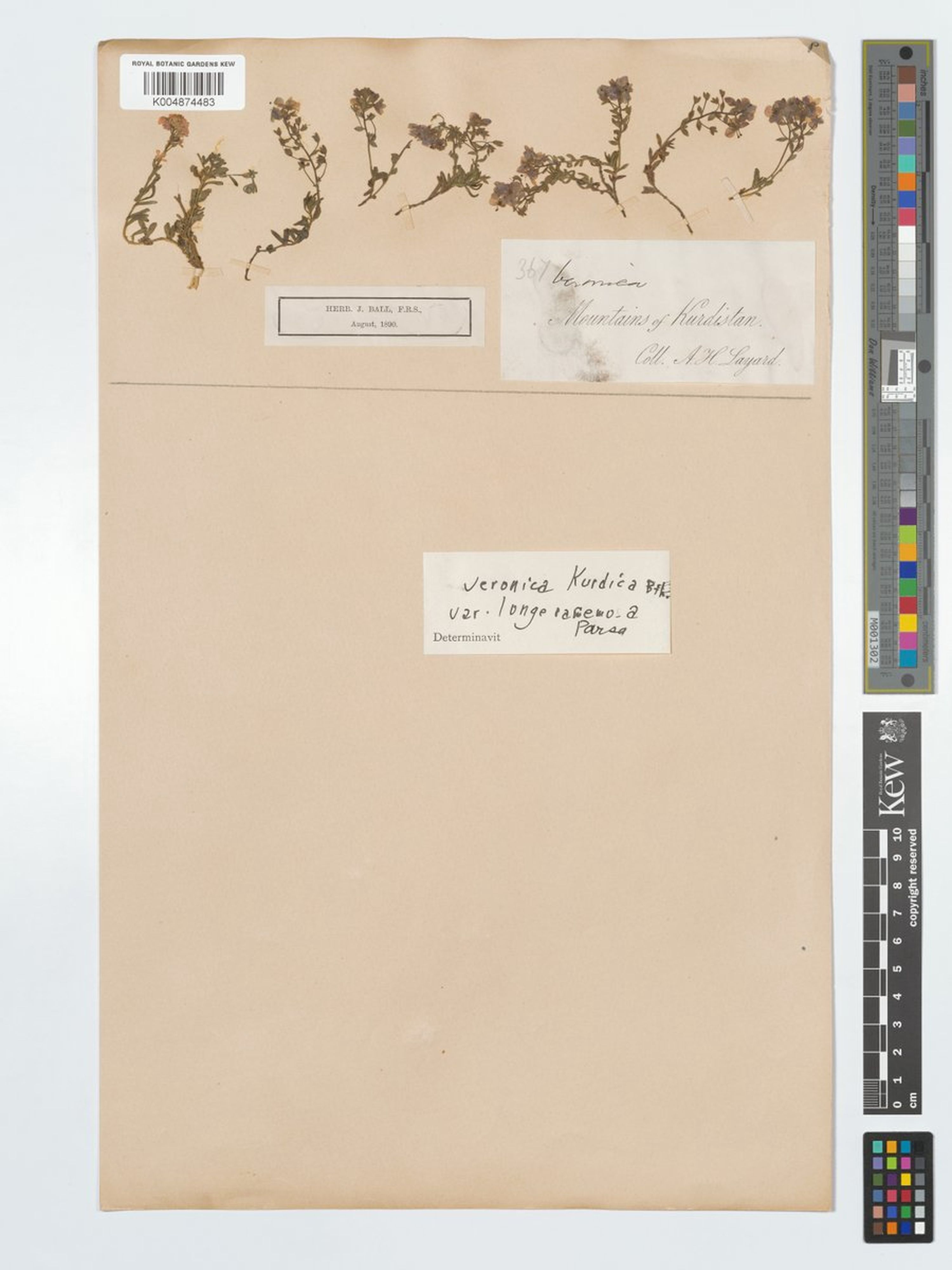
- Austen Henry Layard, the archaeologist of Nineveh, also gathered a speedwell in the "Mountains of Kurdistan". His undated sheet carries the label of the herbarium of the alpinist and botanist John Ball and is now at Kew, identified as V. kurdica var. longiracemosa, the "long-racemed" variety named by the botanist Ahmad Parsa[11]. Parsa described that variety from a plant he collected on Tochal in the Alborz[12].
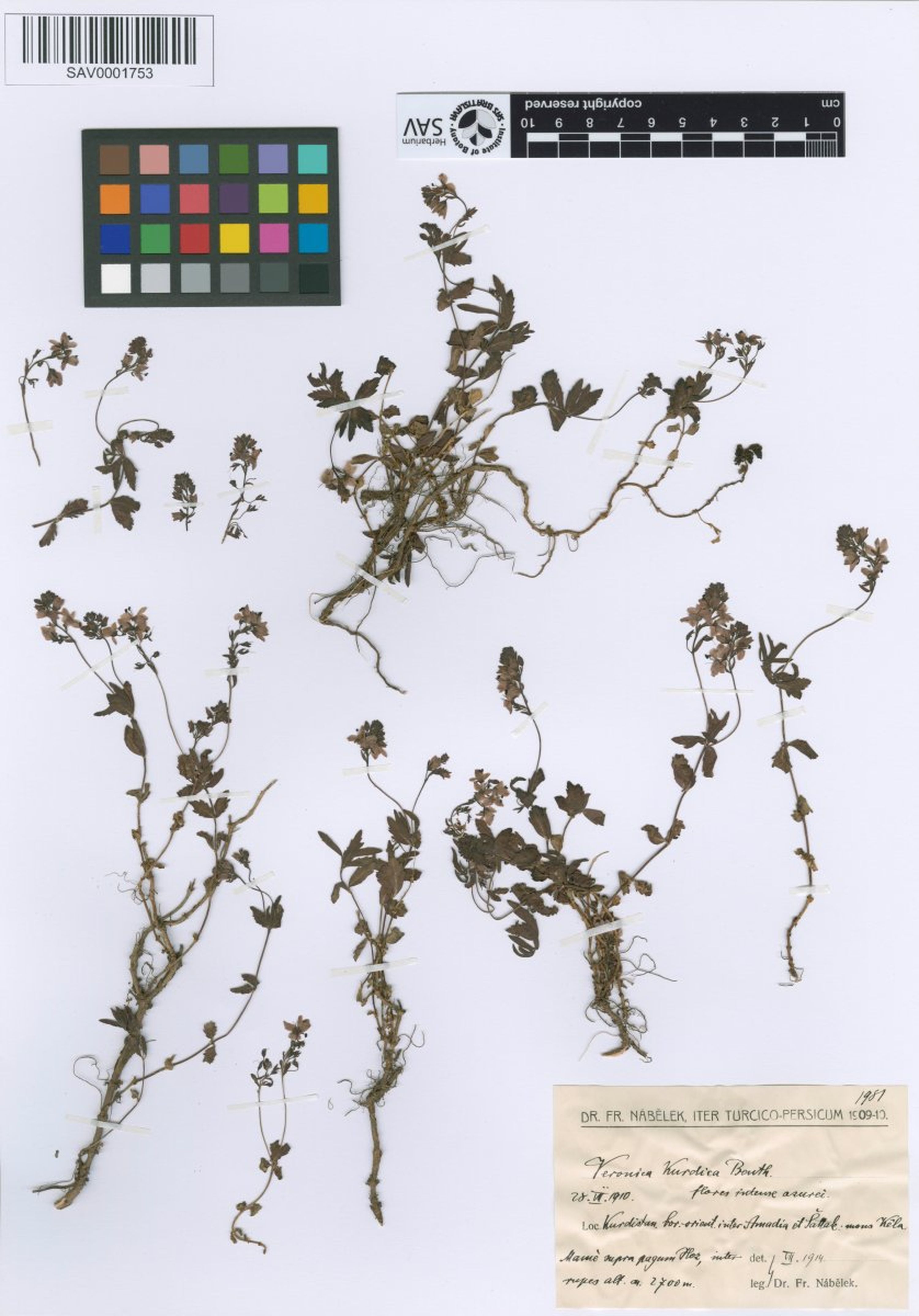
- František Nábělek collected plants he labelled Veronica kurdica among rocks on two mountains in June 1910. His labels place the first, Dwile above the village of Hašitha (about 2,300 m), between Amêdî (Amadiya) and Colemêrg (Hakkâri), and the second, Kela Mamé above the village of Hoz (about 2,700 m), between Amêdî and a place he wrote as Šattak. On both labels he noted flores intense azurei, "flowers an intense azure"[13] (our translation). Whether these plants are V. kurdica in today's sense or one of its look-alikes, no modern study we read says.
- Boissier's records from the mountains he called Armeniae Kurdicae ("of Kurdish Armenia") and the Bingöl mountains[2], and the Rustam Herbarium's plants from Helgurd and Rewandiz that Blakelock filed under V. orientalis[4], have not been looked at again in the light of the 2022 study as far as we know.
So for now the "Kurdish speedwell" is best documented outside Kurdistan, in the Alborz, and its Kurdish story is a missing specimen and a few old sheets waiting for a second look. If you photograph a low, creeping, blue-flowered speedwell on the high scree of Helgurd, Colemêrg or the Zagros, it is worth a closer look.
Kurdish names
We found no Kurdish name for Veronica kurdica itself. For speedwells in general, Kurdish plant lists give:
- giyayê belalûkê, for Veronica species, in Edîb Polat's list in the Kurmanji journal Kurmancî (2006)[14] and in Ehmedê Dirihî's dictionary of Kurdish plant names (2013), without a place of record[15];
- Giyayê bilalûkê, for Veronica species, in Dirihî's list in Kurmancî (2007)[16];
- çimêpisîngan, for the genus Veronica, in Dirihî's dictionary with the place code Pîran[15].
These are names for the genus, not for this species. If you know a Kurdish name for a speedwell of the high mountains, we would like to hear from you.
Sources
- 1.Bentham, G. (1846). Scrophulariaceae. In: De Candolle, A. (ed.), Prodromus Systematis Naturalis Regni Vegetabilis 10: 186-586. Paris.
- 2.Edmond Boissier (1879). Flora Orientalis, vol. 4. H. Georg, Geneva and Basel (Internet Archive). archive.orghttps://archive.org/details/floraorientaliss04bois
- 3.abcdefghijkDoostmohammadi, M., Bordbar, F., Albach, D. C. & Mirtadzadini, M. (2022). Phylogeny and historical biogeography of Veronica subgenus Pentasepalae (Plantaginaceae): evidence for its origin and subsequent dispersal. Biology 11(5): 639. doi:10.3390/biology11050639https://doi.org/10.3390/biology11050639
- 4.abcdBlakelock, R. A. (1949). The Rustam Herbarium, 'Iraq. Systematic List. Part III. Kew Bulletin 4(4): 528.
- 5.Albach, D. C. (2025). From just a few to the most type-rich herbarium for Veronica L. (Plantaginaceae): the effect of digitization of the Muséum national d'Histoire naturelle herbarium in Paris. Adansonia, sér. 3, 47(7): 47–130. doi:10.5252/adansonia2025v47a7https://doi.org/10.5252/adansonia2025v47a7
- 6.Plants of the World Online. Royal Botanic Gardens, Kew.
- abcdVeronica kurdica and Veronica filicaulis.
- plant_name_id 2462669. powo.science.kew.orghttps://powo.science.kew.org/taxon/urn:lsid:ipni.org:names:812182-1accessed 14 November 2026
- 7.Advay, M., Albach, D.C. & Doostmohammadi, M. (2024). A new species of Veronica (Plantaginaceae) from Western Iran. PhytoKeys 237: 219-230. doi:10.3897/phytokeys.237.115003https://doi.org/10.3897/phytokeys.237.115003
- 8.International Plant Names Index. Royal Botanic Gardens, Kew, Harvard University Herbaria and Australian National Herbarium.
- abcVeronica kurdica Benth. and its infraspecific names; author record for G. Bentham; Prodromus publication record.
- urn:lsid:ipni.org:names:812182-1. ipni.orghttps://www.ipni.org/n/812182-1accessed 14 November 2026
- 9.abNatural History Museum Vienna (W) – Herbarium. via GBIF, herbarium specimen W 0053058 (via GBIF).
- 10.↩iNaturalist. observations of Veronica kurdica (taxon 899891), incl. observation 389023925. inaturalist.orghttps://www.inaturalist.org/
- 11.↩Royal Botanic Gardens, Kew – Herbarium Specimens. via GBIF, herbarium specimen K004874483 (via GBIF). gbif.orghttps://www.gbif.org/dataset/cd6e21c8-9e8a-493a-8a76-fbf7862069e5
- 12.↩Parsa, A. (1948). New species and varieties of the Persian flora: II. Kew Bulletin 3(2): 222.
- 13.↩Slovak Academy of Sciences, herbarium specimens SAV0001753 and SAV0001754 (via GBIF).
- 14.↩Edîb Polat (2006). Flora Kurdistanê (I). institutkurde.orghttps://www.institutkurde.org/publications/kurmanci/
- 15.Ahmet Kasımoğlu (Ehmedê Dirihî) (2013). Ferhenga Navên Nebatan a Kurdî (Dictionary of Kurdish Plant Names). Mardin Artuklu University, Institute of Living Languages in Turkey (ISBN 978-605-4202-12-6).
- 16.↩Ehmedê Dirihî (2007). Flora Kurdistanê (II). institutkurde.orghttps://www.institutkurde.org/publications/kurmanci/
Last updated 20 November 2026