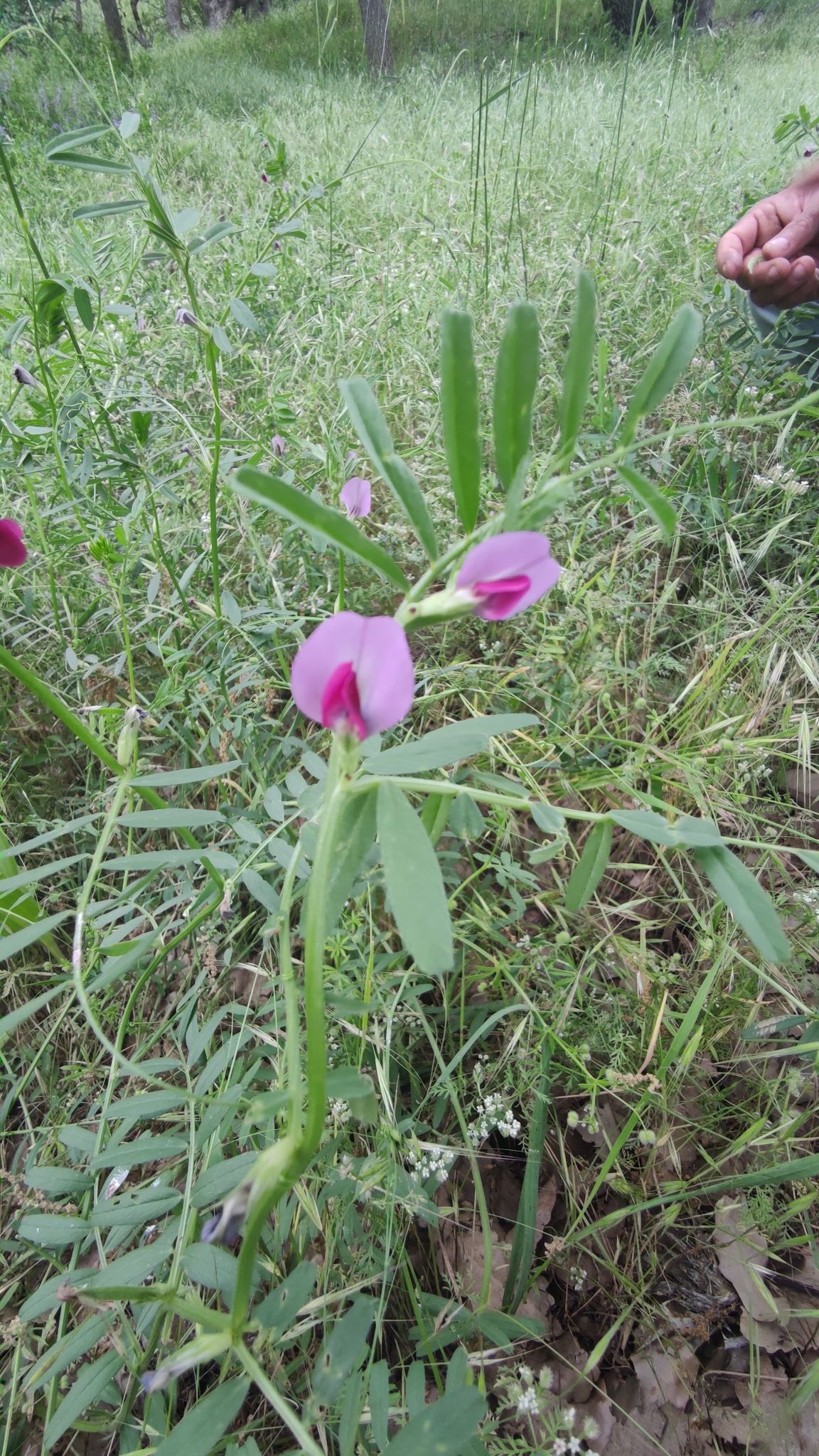
Vicia kurdica is a small purple-flowered vetch, a wild member of the pea family, described in 2010 from the hills of Sine (Sanandaj) in East Kurdistan (Rojhilat)[1][2]. It is a close relative of the common vetch of Kurdish fields[1][3], and as far as we could find it is still known from a single gathering, made on a May day in 2006 at 1,550 m[2][4][5].
How it got its name
- Named by
- Jalilian, 2010Published in Feddes Repert. 121: 81
- Type collected by
- Maroofi6 May 2006
A May day above Sine
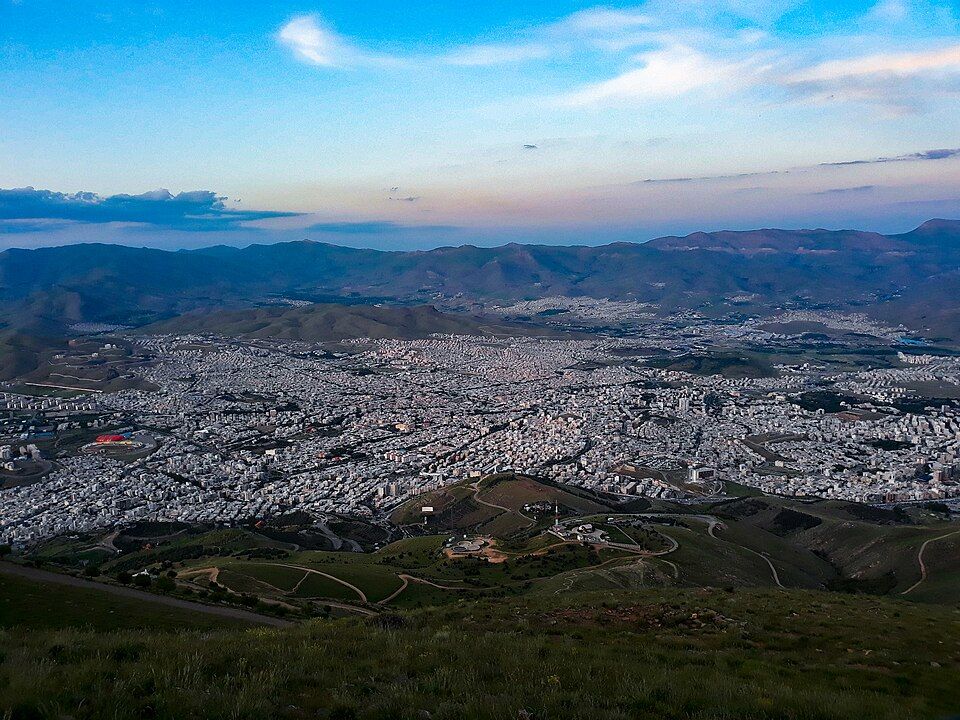
On 6 May 2006 the botanist H. Maroofi gathered a vetch near Sine, at 1,550 m, in the province of Kurdistan[2]. Maroofi worked at the province's own Research Center of Agriculture and Natural Resources[4], and the specimen, number 7801, stayed at home: it became the holotype, the one sheet to which the name is tied for good, and it is kept in that research centre's herbarium in Kurdistan. A duplicate, an isotype, went to TARI, the herbarium of the Research Institute of Forests and Rangelands in Tehran[2][4].
So a plant named after Kurdistan has its reference specimen in Kurdistan, collected by a botanist working there.
Named in 2010
Four years later the plant had a name. Nastaran Jalilian[2] described it as a species new to science in the botanical journal Feddes Repertorium in May 2010, with four co-authors: M. R. Rahiminejad of the University of Isfahan, H. Saeidi, A. A. Maassoumi of the Research Institute of Forests and Rangelands in Tehran, and Maroofi[1][2][4]. The name is Jalilian's alone, Vicia kurdica Jalilian. The paper, four pages long, presents the plant "in line drawing" and compares it with three relatives it closely resembles: V. lathyroides, V. cuspidata and the common vetch, V. sativa[1][2].
Kurdica means "Kurdish". The paper's abstract does not explain the choice[1]; the plant came from the province of Kurdistan[2].
Jalilian and colleagues went on to revise the whole genus in Iran. Their 2014 revision, built on some 500 specimens, counts 40 species of Vicia in Iran, arranged in 15 sections, and notes that two of them had only just been described: V. kurdica, and V. gariensis from Hamadan province (2011)[4]. Worldwide, the genus has somewhere between 150 and 210 species, most richly in the Mediterranean and the Caucasus[4].
How to know it
In the 2014 revision V. kurdica sits in section Vicia, the group of the common vetch, with four other species found in Iran: V. grandiflora, V. lathyroides, V. cuspidata and V. sativa[4]. The revision's identification key separates it from them step by step[4]:
- Its seeds are smooth, and the tendrils at the leaf tips may be simple or branched. V. lathyroides and V. cuspidata have simple tendrils and sculptured seeds.
- The standard, the large upright petal at the back of the flower, is purple. In V. grandiflora it is pale yellow to cream.
- Against the common vetch, it is a plant built small. Each leaf has mostly three pairs of leaflets (two to four), where V. sativa has four to eight. Its flowers are only 6–8 mm long, against (10–)14–27 mm. The stipules, the small leafy flaps where the leaf joins the stem, are up to 4 mm long with one to three teeth (2–8 mm with two to five teeth in V. sativa). And its pods are short, 19–25 mm long and 5–6.5 mm wide, where the common vetch has pods 40–60 mm long, sometimes 70.
The protologue's full description and its drawing are in the 2010 paper, which we could not read; this account rests on the revision's key.
One gathering, one string of DNA
Kew's checklist gives its native range simply as Iran[6]. In Kurdish terms that is one place in Rojhilat, near Sine[2]. The 2014 revision lists no specimens of it at all[4], and in the Global Biodiversity Information Facility (GBIF) the species has exactly one record. That record is not a pressed plant but a piece of DNA: a sequence of the ribosomal ITS region, filed in the public sequence databases as Vicia kurdica "isolate 7801", the number of Maroofi's type gathering, from the "Research Center of Agriculture and …"[5]. iNaturalist has no record of it at all, so no photograph of the living plant is known to us[5][6].
The same marker was put to the test in a 2025 study of nine wild vetches from the mountains of South Kurdistan (Başûr) which found it good for confirming which species a plant belongs to, but not always able to separate close relatives[7]. V. kurdica was not among them.
So for now V. kurdica is known to us from one May gathering near Sine, its type sheet in a Kurdish herbarium and one sequence in a database. Spring in the hills around Sine is the time and place to look for it again.
Vetches in Kurdish fields
Its relatives have long been plants people know. When R. A. Blakelock of Kew listed the Rustam Herbarium's plants from Başûr and the rest of Iraq in 1948, the field notes for vetches read like a farmer's[3]:
- The common vetch grew on daim, unirrigated cultivated land, "throughout the province" of Silêmanî (Sulaimaniya), a "spring plant eaten by all animals". The narbonne vetch, V. narbonensis, was a "spring plant of great value to all animals" there.
- Near Akrê (Acra), at about 450–900 m, the common vetch was a fodder plant. The specimen, collected in mid-April 1932 by the Qaimaqam (district governor) of Acra, came with its Kurdish name: lantkai qili[3].
Some vetches are food for people too. In the spring of 2019 a field study in twelve villages of southern Başûr, along the lower Great Zab, Little Zab and Sîrwan (Sirwan) rivers, recorded the young pods of bitter vetch, V. ervilia, eaten as a snack; the authors describe their taste as herbaceous, like peas. It was named Gadana, a name noted only in the villages of the Kakai, the Kurdish Yarsani community[8]. Ehmedê Dirihî's dictionary of Kurdish plant names lists gadene among its names for the same species[9].
These are records of traditional use, not advice to eat wild plants.
Its name in Kurdish
No Kurdish name has been recorded for Vicia kurdica itself. Kurdish sources record many names for vetches as a group. Dirihî's dictionary gives baqil, boyboy, col, gêndel, koşne, maşik, paqley, polke and şolik for the genus Vicia[9]: names for the group, not for this particular plant. For the common vetch, the Kurdish Institute of Paris's Kurmanji plant list of 2006 gives şoqil, şolgenîk, baqilfisek, colgenî, kelîk, and gasos in Bahdinan, and on another page also baqilê gamêşan and kuşne[10].
Sources
- 1.abcdeJalilian, N., Rahiminejad, M. R., Saeidi, H., Maassoumi, A. A. & Maroofi, H. (2010). Vicia kurdica (Papilionaceae), a new species from Iran. Feddes Repertorium 121(1–2): 81–84. doi:10.1002/fedr.201011131https://doi.org/10.1002/fedr.201011131
- 2.International Plant Names Index. Royal Botanic Gardens, Kew, Harvard University Herbaria and Australian National Herbarium.
- 3.Blakelock, R. A. (1948). The Rustam Herbarium, 'Iraq. Systematic List. Part I. Kew Bulletin 3(3): 404–405.
- 4.Jalilian, N., Rahiminejad, M. R., Maassoumi, A. A. & Maroofi, H. (2014). Taxonomic revision of the genus Vicia L. (Fabaceae) in Iran. Iranian Journal of Botany 20(2): 155–164.
- 5.abcGenBank/ENA sequence KJ787169 (Vicia kurdica isolate 7801, ITS), via GBIF occurrence 3987175466.
- 6.Plants of the World Online. Royal Botanic Gardens, Kew.
- abVicia kurdica.
- plant_name_id 2899149. powo.science.kew.orghttps://powo.science.kew.org/taxon/urn:lsid:ipni.org:names:77105315-1accessed 14 November 2026
- 7.↩Al-Taie, A. T., Golparvar, A. R., Hasan, M. A. & Naderi Darbaghshahi, M. R. (2025). Molecular taxonomy of Vicia L. species (Fabaceae) from the mountainous regions of Iraqi Kurdistan based on ITS barcoding. Phytotaxa 726(4): 259–271. doi:10.11646/phytotaxa.726.4.3https://doi.org/10.11646/phytotaxa.726.4.3
- 8.↩Andrea Pieroni, Hawre Zahir, Hiwa M. Ahmed, Renata Sõukand (2019). Where tulips and crocuses are popular food snacks: Kurdish traditional foraging reveals traces of mobile pastoralism in Southern Iraqi Kurdistan. Table 1. doi:10.1186/s13002-019-0341-0https://doi.org/10.1186/s13002-019-0341-0
- 9.abAhmet Kasımoğlu (Ehmedê Dirihî) (2013). Ferhenga Navên Nebatan a Kurdî (Dictionary of Kurdish Plant Names). Mardin Artuklu University, Institute of Living Languages in Turkey (ISBN 978-605-4202-12-6), p. 1165.
- 10.↩Edîb Polat (2006). Flora Kurdistanê (I). pp. 1, 3. institutkurde.orghttps://www.institutkurde.org/publications/kurmanci/
Last updated 20 November 2026