How it got its name
- Named by
- Advay, 2024Published in PhytoKeys 237: 220
- Type collected by
- Advay7 May 2015
Where it grows in Kurdistan
At 2500–2950 m above sea level.
A speedwell in the cracks of Şaho
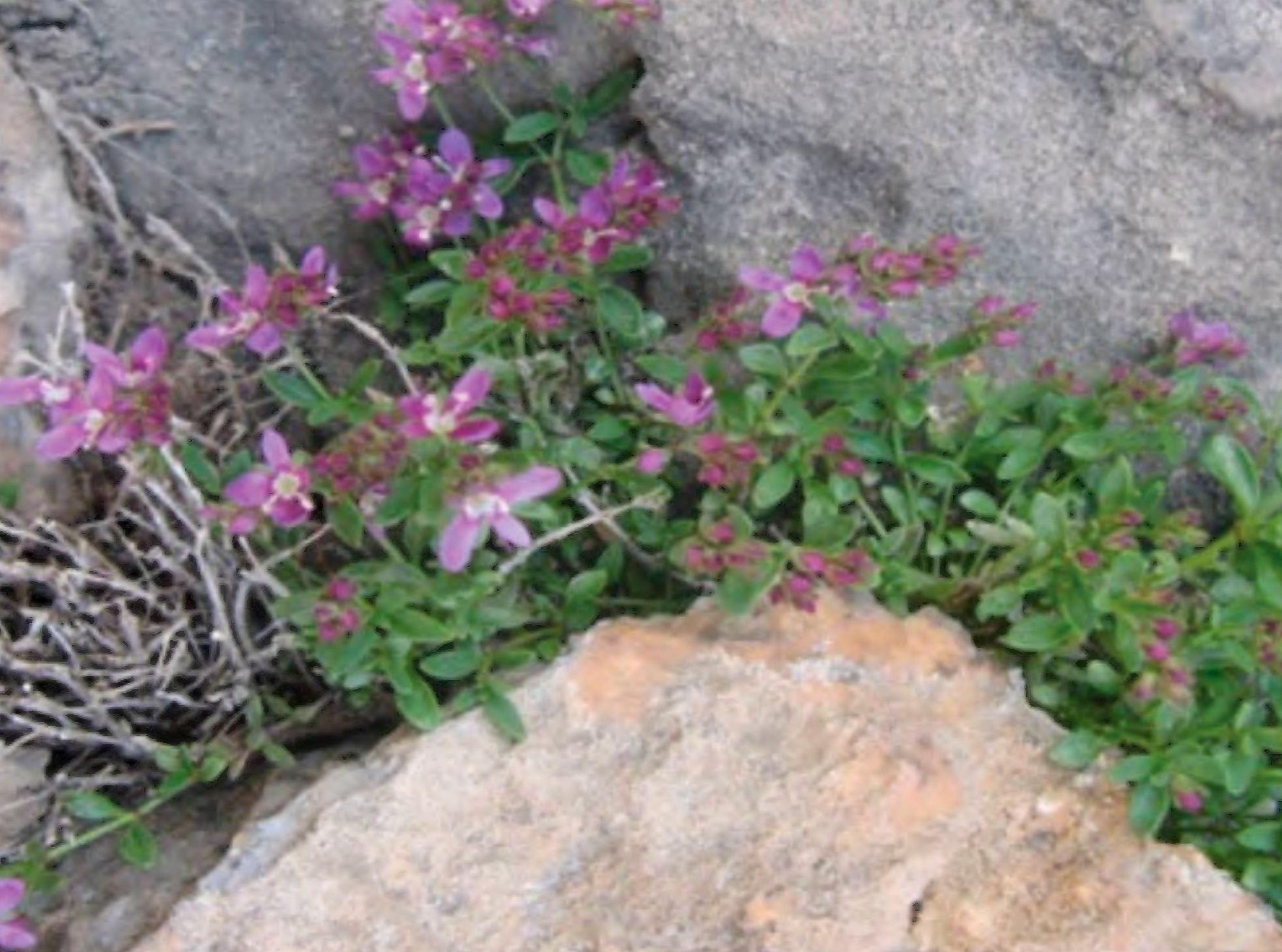
In May 2015 the botanist Mahfouz Advay was on a field survey on the western slopes of the Zagros, on Şaho (Shahu) above Kamyaran, in the Hewraman (Hawraman) region of Rojhilat, East Kurdistan[1]. High up, at about 2,700 m, he found a tiny speedwell growing out of the cracks in the limestone: a plant of the kind botanists call a chasmophyte, from the Greek for "chasm", one that lives in rock crevices[1].
It was only 4 to 8 cm tall, with woody little stems, fleshy leaves and short spikes of purple flowers[1]. On 7 May he pressed specimens of it under his number 12808, and on 10 May more from 2,500 m on the same mountain[1].
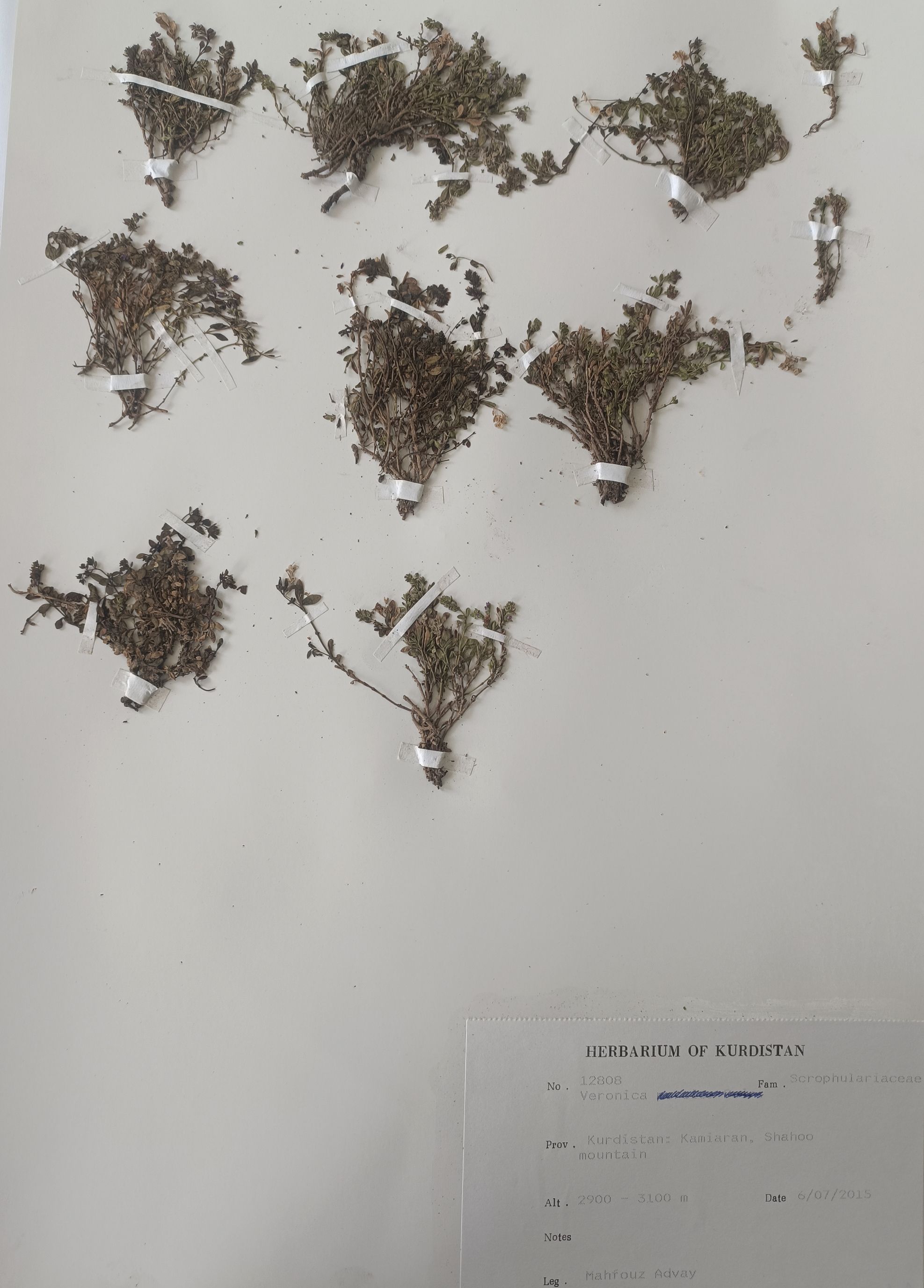
The label on the sheet he made still says where it came from: "Herbarium of Kurdistan" at the top, and below, "Kurdistan: Kamiaran, Shahoo mountain"[1].
Almost nine years to a name
At first sight the plant looked like Veronica daranica, a cliff speedwell of the central Zagros[1]. Advay checked it against the keys of Flora Iranica and the Flora of Iran, against photographs of type specimens in London, Kew, Montpellier and Paris, and against the collections of four Iranian herbaria, among them the Herbarium of Kurdistan[1]. In May 2023 he went back to Şaho and collected it again, at 2,920 m[1].
With the botanist Dirk C. Albach of the University of Oldenburg and Moslem Doostmohammadi of Shahid Bahonar University of Kerman, he also read a stretch of its DNA, taken from the 2015 specimen itself, and placed it in the family tree of its relatives[1]. The evidence agreed: this was a species no one had described.
They published it on 29 January 2024 in the open-access journal PhytoKeys as Veronica kurdistanica[1][2]. The name, they wrote, refers to Kurdistan Province, where the new species was discovered[1]. The holotype, the specimen that fixes the name, is Advay's sheet 12808 in the Herbarium of Kurdistan (HKS); a duplicate is in Tehran (TUH)[1]. Kew's checklist accepts the name[3].
A small detail on that label tells a story of its own. It files the plant under the family Scrophulariaceae, where speedwells were long placed (Iranian papers of 2001 to 2005 still describe new speedwells under that family), and the name index IPNI files this very name there too. The paper itself puts Veronica in Plantaginaceae, the plantain family, "in its current circumscription"[1][2].
A family of Kurdish speedwells
Speedwells) are a big genus, about 450 species, at home from the sea shore to the high mountains and from deserts to water. Their centres of diversity are the eastern Mediterranean, New Zealand and the Irano-Turanian region, the dry heart of western Asia to which the paper also assigns the plant from Şaho[1].
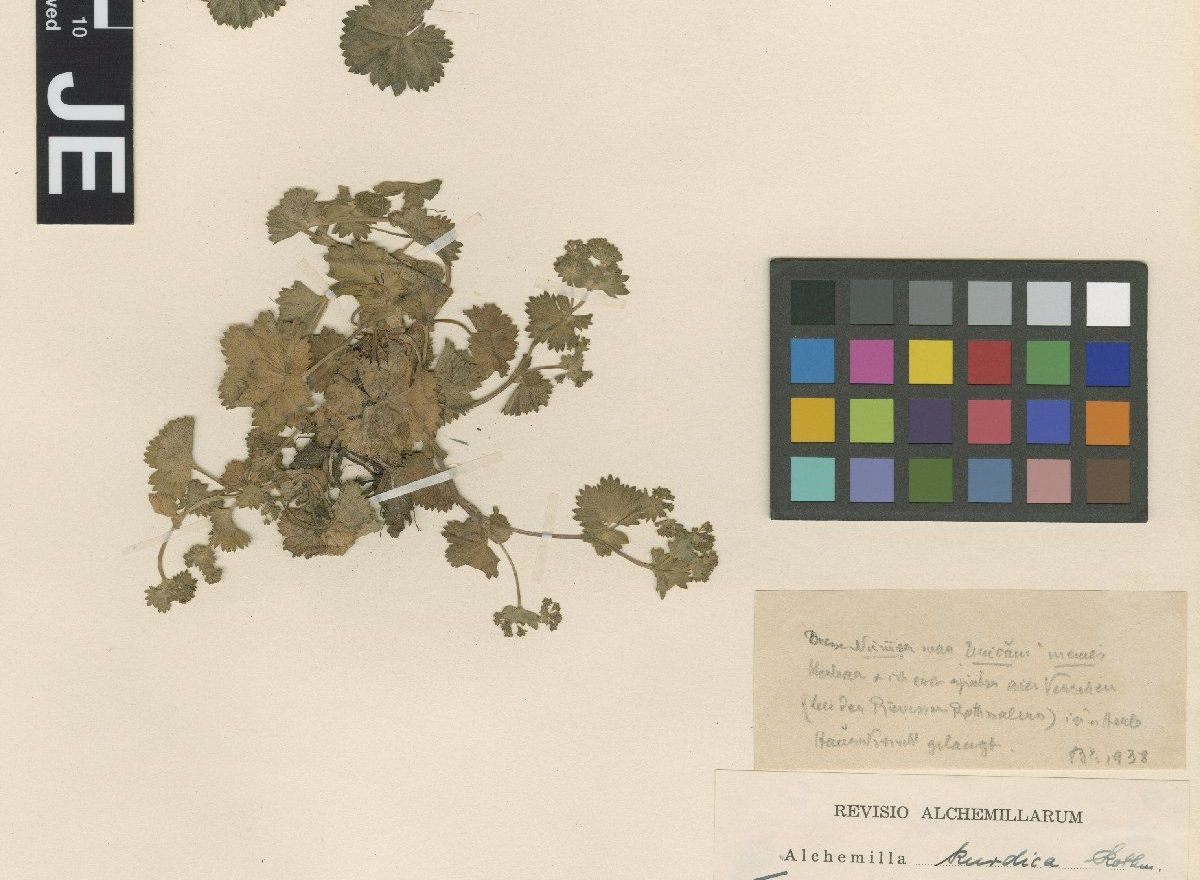
V. kurdistanica belongs to the group of Veronica kurdica, the speedwell named after the Kurds by George Bentham in 1846[1][2]. Its other close relatives are V. daranica and V. khorassanica. In the DNA tree all of them sit together, unresolved, in one branch[1]. They are all perennials adapted to dry conditions and, in the authors' words, "important constituents of the alpine flora of Iran"[1]. The larger group they belong to, the subgenus Pentasepalae, probably arose on the Iranian plateau, leaving old, isolated species scattered along the Zagros and Alborz[1].
The plant from Şaho looks most like V. daranica, yet the two grow more than 500 km apart[1]. And it has one thing none of its relatives has: it is densely glandular. The others are either hairless or have plain, non-glandular hairs[1].
What to look for
The description in the paper[1]:
- A tiny perennial, 4 to 8 cm tall, from a stout rootstock, with woody stems that rise from a curved base. The whole plant is more or less densely covered in glandular hairs.
- Leaves. Eight to ten pairs, fleshy and untoothed, oblong-obovate to elliptic or spoon-shaped; the lower ones narrow into a stalk, the upper ones sit directly on the stem, 4 to 6 mm long.
- Flowers. One or two short spikes, usually at the tips of the stems, each with 4 to 14 flowers, on stalks of only 1 to 1.5 mm. The corolla is purple, 4 to 5 mm across, with a white tube that is densely hairy inside; the stamens have white filaments.
- Fruit. A small heart-shaped capsule, 1.2 to 2.2 mm long and about 2 mm wide, as long as the calyx or slightly longer, with flat, yellowish-brown seeds.
Next to V. kurdica, which can grow up to 30 cm tall and has dark to violet-blue flowers 8 to 10 mm across, it is a miniature: shorter, with smaller purple flowers, its spikes at the stem tips rather than in the leaf axils[1].
Where it grows
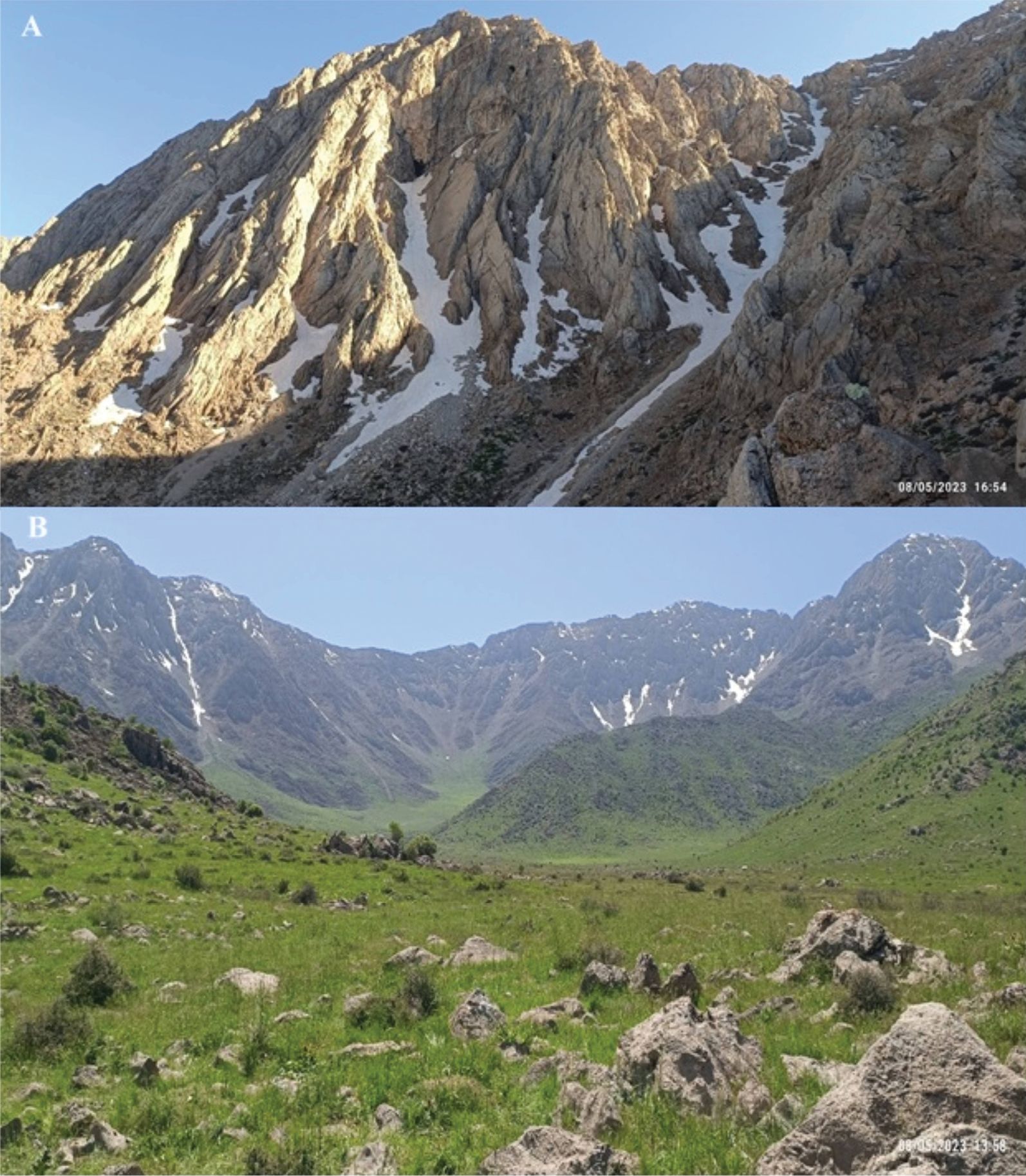
V. kurdistanica is known only from Şaho, from a few populations on limestone cliffs of its mountain slopes between 2,500 and 2,950 m[1]. Kew's checklist gives its native range simply as north-west Iran[3]; in Kurdish terms, it is a plant of Hewraman in Rojhilat. It flowers in April and May and fruits in June[1].
Rare, and barely known
The authors estimate that the species occupies less than 50 km² and propose that it be classed as Critically Endangered, the highest category of threat for a plant still in the wild[1]. That is a proposal in a scientific paper, not yet an assessment on the IUCN Red List.
Outside the paper, no photograph of a wild plant seems to have been shared: iNaturalist has no observation of it, and GBIF no occurrence record[4]. Advay's photographs and the pressed sheets in the Herbarium of Kurdistan and in Tehran are what we have.
The authors end with a sentence that could stand as a motto for this site: the discovery, they write, "emphasizes that the Kurdistan region is an important center of diversity, despite being under-investigated", and future field work may well find more[1].
Kurdish names
No Kurdish name has been recorded for Veronica kurdistanica itself; a plant first described in 2024 has not had the time. The Kurdish names in the sources are names for speedwells as a group, genus names:
- giyayê belalûkê, in Edîb Polat's list of Kurdish plant names for "Veronica spp"[5] and in Ehmedê Dirihî's dictionary for a Veronica species[6];
- Giyayê bilalûkê, in Dirihî's list of 2007, for "Veronica spp"[7];
- çimêpisîngan, in Dirihî's dictionary for the genus Veronica, with the source code Pîran[6].
Dirihî also lists veronika for the genus[6], a dictionary name that mirrors the Latin.
Sources
- 1.Advay, M., Albach, D.C. & Doostmohammadi, M. (2024). A new species of Veronica (Plantaginaceae) from Western Iran. PhytoKeys 237: 219-230. doi:10.3897/phytokeys.237.115003https://doi.org/10.3897/phytokeys.237.115003
- agjlp. 220.
- bipp. 219–220.
- cupp. 224–225.
- dpp. 220, 228.
- ep. 223, Fig. 2.
- fp. 219.
- hzp. 228.
- kwxp. 225.
- mpp. 219, 223, 229–230.
- npp. 219, 225.
- oqrstyp. 226.
- ppp. 226–227.
- vp. 222.
- treatment, PhytoKeys 237: 219-230 (name p. 220); text via Plazi treatment in GBIF. api.gbif.orghttps://api.gbif.org/v1/species/220927465/descriptionsaccessed 14 November 2026
- 2.International Plant Names Index. Royal Botanic Gardens, Kew, Harvard University Herbaria and Australian National Herbarium.
- abVeronica kurdistanica Advay.
- cVeronica kurdica Benth., Prodromus 10: 473 (1846).
- urn:lsid:ipni.org:names:77335343-1. ipni.orghttps://www.ipni.org/n/77335343-1accessed 14 November 2026
- 3.Plants of the World Online. Royal Botanic Gardens, Kew.
- abVeronica kurdistanica.
- plant_name_id 3319974. powo.science.kew.orghttps://powo.science.kew.org/taxon/urn:lsid:ipni.org:names:77335343-1accessed 14 November 2026
- 4.↩iNaturalist. taxon 1570111, and GBIF occurrence search, consulted 15 November 2026. inaturalist.orghttps://www.inaturalist.org/
- 5.↩Edîb Polat (2006). Flora Kurdistanê (I). p. 2. institutkurde.orghttps://www.institutkurde.org/publications/kurmanci/
- 6.Ahmet Kasımoğlu (Ehmedê Dirihî) (2013). Ferhenga Navên Nebatan a Kurdî (Dictionary of Kurdish Plant Names). Mardin Artuklu University, Institute of Living Languages in Turkey (ISBN 978-605-4202-12-6).
- 7.↩Ehmedê Dirihî (2007). Flora Kurdistanê (II). p. 6. institutkurde.orghttps://www.institutkurde.org/publications/kurmanci/
Last updated 20 November 2026